


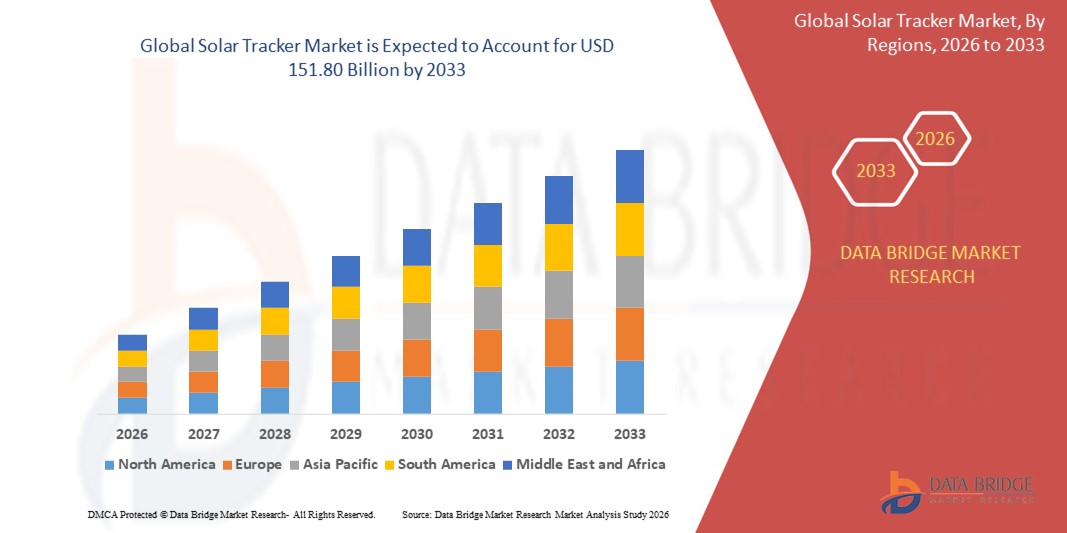
What is the Global Solar Tracker Market Size and Growth Rate?
- The global solar tracker market size was valued at USD 15.41 billion in 2025 and is expected to reach USD 151.80 billion by 2033, at a CAGR of 33.10% during the forecast period
- The rising numbers of government incentives to support the value and use of solar panels has highly influenced growth of the solar tracker market. In line with this, the increasing focus on utility scale projects along with stringent clean energy targets and growing off grid electricity demand are also acting as a key determinant favoring the growth of the solar tracker market
- Also, growing demand for energy, increasing environmental concerns and growing awareness associated with the depleting fossil fuel around the world are also positively impacting the growth of the solar tracker market. The major factor accountable for the growth of the market is the decreasing wind and solar component cost
What are the Major Takeaways of Solar Tracker Market?
- The growing concern over energy conservation and transition from non-renewable energy to renewable energy is also flourishing the growth of the solar tracker market. However, the lack of required infrastructure and lack of awareness may act as key restraint towards solar tracker market growth rate, whereas the high initial and installation cost have the potential to challenge the growth of the solar tracker market
- North America dominated the Solar Tracker market with the largest revenue share of 42.8% in 2025, driven by the increasing deployment of utility-scale solar projects, favorable government incentives, and a strong presence of leading solar tracker manufacturers
- Asia-Pacific is projected to witness the fastest CAGR of 10.4% from 2026 to 2033, driven by rising energy demand, rapid industrialization, and strong government initiatives promoting solar adoption
- The Solar Photovoltaic (PV) segment dominated the market with the largest revenue share of 65.4% in 2025, driven by its widespread adoption in utility-scale and commercial solar installations due to cost-effectiveness and ease of integration
Report Scope and Solar Tracker Market Segmentation
|
Attributes |
Solar Tracker Key Market Insights |
|
Segments Covered |
|
|
Countries Covered |
North America
Europe
Asia-Pacific
Middle East and Africa
South America
|
|
Key Market Players |
|
|
Market Opportunities |
|
|
Value Added Data Infosets |
In addition to the insights on market scenarios such as market value, growth rate, segmentation, geographical coverage, and major players, the market reports curated by the Data Bridge Market Research also include in-depth expert analysis, pricing analysis, brand share analysis, consumer survey, demography analysis, supply chain analysis, value chain analysis, raw material/consumables overview, vendor selection criteria, PESTLE Analysis, Porter Analysis, and regulatory framework. |
What is the Key Trend in the Solar Tracker Market?
Growing Adoption of Dual-Axis and AI-Integrated Tracking Systems
- The solar tracker market is witnessing a major technological transformation with rising adoption of dual-axis trackers and AI-based control systems that optimize solar panel orientation for maximum energy capture and efficiency
- Manufacturers are integrating IoT sensors, predictive analytics, and real-time monitoring to enhance system reliability and minimize operational losses caused by weather fluctuations.
- For instance, Nextracker Inc. introduced its TrueCapture™ Smart Control System, which uses advanced machine learning algorithms to improve energy yield by 2–6% compared to traditional trackers
- The demand for automated and adaptive solar tracking solutions is increasing as large-scale utility projects seek higher performance and lower levelized cost of electricity (LCOE)
- Growing emphasis on energy optimization, grid stability, and reduced carbon emissions is further encouraging investment in intelligent tracking technologies
- As digitalization accelerates across the renewable sector, AI-integrated dual-axis trackers are expected to dominate future installations, driving global efficiency and sustainability in solar power generation
What are the Key Drivers of Solar Tracker Market?
- Increasing demand for renewable energy across industrial and utility sectors is driving large-scale solar tracker installations to enhance energy output and reduce dependency on fossil fuels
- For instance, in 2024, Array Technologies, Inc. deployed over 4 GW of solar trackers globally, emphasizing modular designs that improve efficiency and lower maintenance costs
- Government incentives, tax credits, and renewable energy targets across the U.S., Europe, and Asia-Pacific are accelerating tracker adoption in new solar projects
- Declining costs of photovoltaic (PV) components and improved tracker durability have made solar energy systems more affordable and viable for commercial and residential sectors
- Technological advancements such as wireless communication, remote control systems, and real-time performance analytics are enhancing energy yield and reducing operational downtime
- As the global push for net-zero emissions strengthens, the Solar Tracker market is poised for robust growth, particularly in utility-scale solar farms
Which Factor is Challenging the Growth of the Solar Tracker Market?
- High installation and maintenance costs, especially for dual-axis systems, remain a significant barrier for small and medium-scale solar projects
- For instance, fluctuations in steel and actuator prices during 2024–2025 led to increased project expenses, impacting return on investment for several solar developers
- Complex installation requirements and the need for precise alignment in uneven terrains increase operational challenges and setup time
- Exposure to extreme weather conditions, such as strong winds or heavy snow, can reduce tracker lifespan and performance, necessitating robust design upgrades
- Competition from fixed-tilt solar systems, which offer lower upfront costs, continues to challenge tracker adoption in cost-sensitive markets
- To address these issues, manufacturers are focusing on cost reduction, modular designs, and weather-resistant materials, ensuring sustainable market expansion and long-term project reliability
How is the Solar Tracker Market Segmented?
The market is segmented on the basis of technology, product type, application and end users.
- By Technology
On the basis of technology, the solar tracker market is segmented into Solar Photovoltaic (PV), Concentrated Photovoltaic (CPV), and Concentrated Solar Power (CSP). The Solar Photovoltaic (PV) segment dominated the market with the largest revenue share of 65.4% in 2025, driven by its widespread adoption in utility-scale and commercial solar installations due to cost-effectiveness and ease of integration. The increasing availability of high-efficiency PV modules, combined with government subsidies for renewable energy expansion, has further strengthened this segment.
Meanwhile, the Concentrated Photovoltaic (CPV) segment is anticipated to register the fastest CAGR from 2026 to 2033, fueled by technological advancements in optical concentrators and higher power conversion efficiencies. The growing focus on maximizing land use and output per square meter is expected to accelerate CPV adoption in high-irradiance regions across Asia-Pacific and the Middle East.
- By Product Type
On the basis of product type, the solar tracker market is segmented into Single Axis and Dual Axis trackers. The Single Axis segment dominated the market with the largest revenue share of 74.3% in 2025, owing to its lower installation cost, simpler design, and compatibility with large-scale utility projects. It allows panels to follow the sun’s movement on one axis, improving energy yield by 20–30% compared to fixed systems.
However, the Dual Axis segment is projected to record the fastest CAGR from 2026 to 2033, supported by rising demand for high-precision solar tracking in concentrated solar power (CSP) and distributed generation systems. The ability of dual-axis trackers to optimize performance throughout the year, regardless of seasonal changes, makes them increasingly attractive for projects in regions with variable solar radiation.
- By Application
On the basis of application, the solar tracker market is segmented into Utility, Non-Utility, and Others. The Utility segment dominated the market with the largest revenue share of 81.6% in 2025, primarily driven by large-scale solar farm installations and growing investments in grid-connected renewable projects worldwide. Rising government incentives for solar infrastructure development and the integration of advanced tracking systems for optimal energy generation further fuel this dominance.
The Non-Utility segment is expected to grow at the fastest CAGR from 2026 to 2033, attributed to expanding adoption across commercial and industrial sectors seeking to reduce operational costs and carbon footprints. The increasing deployment of trackers in corporate sustainability programs and microgrid systems is set to support segment growth over the forecast period.
- By End User
On the basis of end user, the solar tracker market is segmented into Residential, Commercial, and Utility. The Utility segment dominated the market with the largest revenue share of 68.9% in 2025, driven by extensive government-backed solar projects and large-scale investments by energy developers in regions such as North America, Europe, and Asia-Pacific. Utility-scale solar farms widely deploy both single and dual-axis trackers to maximize power output and efficiency.
The Commercial segment, however, is projected to exhibit the fastest CAGR from 2026 to 2033, fueled by increasing adoption of solar tracking systems by manufacturing facilities, educational institutions, and corporate campuses. The rising focus on sustainability targets and cost-effective renewable power generation is further propelling commercial-sector adoption globally.
Which Region Holds the Largest Share of the Solar Tracker Market?
- North America dominated the Solar Tracker market with the largest revenue share of 42.8% in 2025, driven by the increasing deployment of utility-scale solar projects, favorable government incentives, and a strong presence of leading solar tracker manufacturers. The region’s focus on renewable energy transition, coupled with rising investments in solar infrastructure across the U.S. and Canada, has significantly accelerated market growth
- The availability of advanced technologies such as dual-axis and AI-integrated trackers, alongside robust policies such as the U.S. Inflation Reduction Act (IRA), continues to strengthen North America’s leadership in the global solar tracker landscape
- Furthermore, the growing emphasis on sustainability, decarbonization targets, and solar project expansion by private energy developers is fueling consistent regional dominance in the coming years
U.S. Solar Tracker Market Insight
The U.S. represents the largest share of the North American Solar Tracker market, supported by large-scale utility solar installations and government initiatives promoting renewable energy adoption. The market benefits from strong R&D capabilities, domestic manufacturing support, and tax incentives that encourage solar deployment. The integration of smart tracking technologies and AI-based monitoring systems is driving improved performance and reliability. With major players such as Nextracker Inc., Array Technologies, Inc., and First Solar, Inc. leading technological innovation, the U.S. remains at the forefront of global solar tracker advancements.
Canada Solar Tracker Market Insight
Canada is contributing steadily to North America’s solar tracker market growth through ongoing investments in renewable infrastructure and supportive policies at the provincial level. The country’s focus on achieving net-zero emissions by 2050 has led to the adoption of high-efficiency solar systems integrated with single and dual-axis trackers. Expanding collaborations between local developers and global tracker suppliers are enhancing project scalability, particularly in Alberta, Saskatchewan, and Ontario. As large-scale solar projects increase, Canada is emerging as a key player in North America’s renewable energy transition.
Asia-Pacific Solar Tracker Market Insight
Asia-Pacific is projected to witness the fastest CAGR of 10.4% from 2026 to 2033, driven by rising energy demand, rapid industrialization, and strong government initiatives promoting solar adoption. Countries such as China, India, Japan, and Australia are investing heavily in solar infrastructure to diversify energy sources and reduce dependence on fossil fuels. The growing focus on cost-efficient renewable solutions, combined with declining component prices and local manufacturing initiatives, is accelerating solar tracker installations across the region.
China Solar Tracker Market Insight
China remains the largest contributor to the Asia-Pacific solar tracker market, supported by large-scale solar park development and government-backed renewable energy targets. The nation’s growing emphasis on energy independence and carbon neutrality by 2060 is fostering the rapid deployment of solar trackers in both utility and commercial applications. Major domestic manufacturers and international collaborations are improving technology adoption and reducing overall installation costs.
India Solar Tracker Market Insight
India is witnessing strong growth in the solar tracker market, driven by ambitious renewable capacity goals under the National Solar Mission. Government tenders and private sector investments in solar parks across Rajasthan, Gujarat, and Karnataka are promoting large-scale tracker integration. The growing presence of international tracker providers and innovations in locally manufactured tracking systems are enhancing cost efficiency, making India one of the fastest-growing markets in the region.
Europe Solar Tracker Market Insight
Europe continues to show stable growth, driven by strict environmental regulations, decarbonization goals, and increasing solar power capacity additions. Countries such as Spain, Germany, and France are prioritizing tracker deployment in large solar farms to maximize energy yield. The European Union’s focus on renewable energy self-sufficiency and sustainable technology integration is boosting market penetration.
Germany Solar Tracker Market Insight
Germany leads the European solar tracker market due to its advanced renewable energy policies and continuous expansion of solar farms. The adoption of single and dual-axis trackers to enhance efficiency aligns with the nation’s commitment to achieving 80% renewable electricity by 2030. Supportive grid infrastructure and technological innovation continue to strengthen Germany’s position in the regional market.
U.K. Solar Tracker Market Insight
The U.K. market is expanding steadily, supported by increasing solar installations in both commercial and residential sectors. Rising awareness of renewable benefits and the push for energy independence are fueling tracker adoption. Investments in solar farms and government-backed green initiatives, such as Contracts for Difference (CfD) schemes, are promoting consistent market growth, positioning the U.K. as a key contributor to Europe’s solar tracker expansion.
Which are the Top Companies in Solar Tracker Market?
The solar tracker industry is primarily led by well-established companies, including:
- Nextracker Inc. (U.S.)
- Array Technologies, Inc. (U.S.)
- Abengoa (Spain)
- Trina Solar (China)
- First Solar (U.S.)
- Powerway Renewable Energy Co., Ltd. (China)
- Haosolar Co. Ltd. (China)
- Soltec (Spain)
- Scorpius Trackers (India)
- AllEarth Renewables (U.S.)
- DEGERENERGIE GMBH & CO. KG (Germany)
- Arctech (China)
- Convert Italia (Italy)
- PVHardware (Spain)
- SunPower Corporation (U.S.)
- MECASOLAR (Spain)
- STI Norland (Spain)
- GameChange Solar (U.S.)
- Gonvarri Industries (Spain)
- ArcelorMittal (Luxembourg)
- Ideematec (Germany)
What are the Recent Developments in Global Solar Tracker Market?
- In April 2023, Nextracker Inc. announced plans to double India’s solar tracker manufacturing capacity to 10 gigawatts in the coming years. The company will produce semiconductors under the Production-Linked Incentive (PLI) scheme and aims to indigenously manufacture 100% of its products. With India targeting 500 GW of renewable capacity by 2030, Nextracker expects 7–8 GW of projects annually to include tracker systems. This strategic expansion strengthens Nextracker’s footprint in India’s growing solar energy ecosystem
- In February 2023, PVHardware revealed plans to build the world’s largest solar tracker factory in Spain, spanning 65,000 square meters. The facility is expected to boost the company’s total production capacity to 25 GW, positioning PVHardware as the global leader in solar tracker manufacturing. This initiative highlights Spain’s emerging role as a global hub for solar technology innovation
- In February 2023, Solar Steel, in collaboration with Electrum, signed an agreement to supply TracSmarT+ solar trackers for the 21 MW Osów project in Poland. This project will become the largest solar tracking installation in the country, providing enough clean energy for 7,000 homes and reducing over 4,200 tons of CO₂ emissions annually. The collaboration reflects Europe’s growing commitment to renewable energy transition
- In April 2022, Array Technologies, Inc. entered into an agreement to supply 1 GW of DuraTrack HZ v3 single-axis solar trackers for the Gemini Solar Project in the U.S.. Expected to be one of the largest solar-plus-storage facilities in the country, the project will significantly enhance solar energy reliability and efficiency. This deal reinforces Array Technologies’ leadership in the U.S. solar tracking sector.
- In February 2022, Solar Steel began developing its Digital Twins project for photovoltaic plants, designed to simulate system behavior during design, engineering, and O&M phases. The digital twin model enables predictive maintenance by identifying potential failures and allowing proactive interventions. This technological advancement marks a major step toward smarter and more efficient solar power management

- Interactive Data Analysis Dashboard
- Company Analysis Dashboard for high growth potential opportunities
- Research Analyst Access for customization & queries
- Competitor Analysis with Interactive dashboard
- Latest News, Updates & Trend analysis
- Harness the Power of Benchmark Analysis for Comprehensive Competitor Tracking
Global Solar Tracker Market, Supply Chain Analysis and Ecosystem Framework
To support market growth and help clients navigate the impact of geopolitical shifts, DBMR has integrated in-depth supply chain analysis into its Global Solar Tracker Market research reports. This addition empowers clients to respond effectively to global changes affecting their industries. The supply chain analysis section includes detailed insights such as Global Solar Tracker Market consumption and production by country, price trend analysis, the impact of tariffs and geopolitical developments, and import and export trends by country and HSN code. It also highlights major suppliers with data on production capacity and company profiles, as well as key importers and exporters. In addition to research, DBMR offers specialized supply chain consulting services backed by over a decade of experience, providing solutions like supplier discovery, supplier risk assessment, price trend analysis, impact evaluation of inflation and trade route changes, and comprehensive market trend analysis.
Data collection and base year analysis are done using data collection modules with large sample sizes. The stage includes obtaining market information or related data through various sources and strategies. It includes examining and planning all the data acquired from the past in advance. It likewise envelops the examination of information inconsistencies seen across different information sources. The market data is analysed and estimated using market statistical and coherent models. Also, market share analysis and key trend analysis are the major success factors in the market report. To know more, please request an analyst call or drop down your inquiry.
The key research methodology used by DBMR research team is data triangulation which involves data mining, analysis of the impact of data variables on the market and primary (industry expert) validation. Data models include Vendor Positioning Grid, Market Time Line Analysis, Market Overview and Guide, Company Positioning Grid, Patent Analysis, Pricing Analysis, Company Market Share Analysis, Standards of Measurement, Global versus Regional and Vendor Share Analysis. To know more about the research methodology, drop in an inquiry to speak to our industry experts.
Data Bridge Market Research is a leader in advanced formative research. We take pride in servicing our existing and new customers with data and analysis that match and suits their goal. The report can be customized to include price trend analysis of target brands understanding the market for additional countries (ask for the list of countries), clinical trial results data, literature review, refurbished market and product base analysis. Market analysis of target competitors can be analyzed from technology-based analysis to market portfolio strategies. We can add as many competitors that you require data about in the format and data style you are looking for. Our team of analysts can also provide you data in crude raw excel files pivot tables (Fact book) or can assist you in creating presentations from the data sets available in the report.













