


What is the Solid State Chip Battery Market Size and Growth Rate?
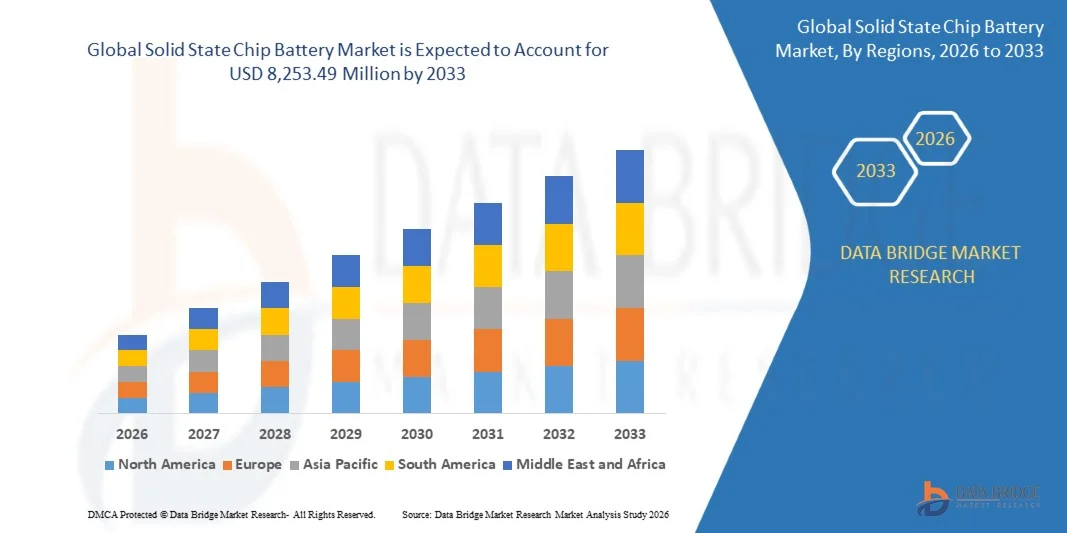
- As per Data Bridge Market Research analysis, the solid state chip battery market was valued at USD 957.46 million in 2025 and is projected to reach USD 8,253.49 Million by 2033, growing at a CAGR of 30.90% from 2026 to 2033.
- The market is experiencing rapid growth driven by product innovations and R&D activities, increasing demand for batteries with higher energy density, greater stability and safety, and expanding applications across wearable devices, medical devices, smart cards, and wireless sensor nodes.
- The increasing adoption of compact batteries in medical devices, IoT devices, and smart wearables, combined with the advantages of solid-state batteries over traditional lithium-ion batteries, is supporting market expansion. Solid-state chip batteries offer higher energy density, longer shelf life, greater stability, and reduced risk of thermal runaway, while ongoing development of composite solid electrolytes is helping address limitations such as low ionic conductivity and poor mechanical properties.
Market Size & Forecast
- Global Market Value (2025): USD 957.46 Million
- Expected Market Value (2033): USD 8,253.49 Million
- Forecast CAGR (2026–2033): 30.90%
- Leading Region in 2025: North America
- Fastest Growing Region: Asia Pacific
What are the Major Takeaways of the Solid State Chip Battery Market?
- North America dominated the solid state chip battery market with the largest revenue share of 34.2% in 2025, supported by early adoption of advanced battery technologies and substantial research and development investments.
- Asia-Pacific is expected to be the fastest-growing region at a CAGR of 25.7% from 2026 to 2033, fueled by extensive consumer electronics manufacturing, aggressive electric vehicle deployment strategies, and substantial government support for battery technology development.
- The primary battery segment led the market with a 55.60% share in 2025, driven by demand for compact power sources with long shelf life.
- Secondary battery are the fastest-growing recharge ability type, projected to register a CAGR of 22%, reflecting the surge in demand for rechargeable power sources in wearable electronics, medical devices, IoT systems, and wireless sensor nodes
- The below 10mAh segment dominated the capacity type category with a 40.45% revenue share in 2025, led by the strong demand for ultra-compact batteries in low-power electronics.
- Composite electrolyte accounted for 35.40% of the market share in 2025, preferred by its ability to combine polymer flexibility with the electrochemical and mechanical advantages of inorganic materials.
- The pouch cell segment is the fastest-growing form factor category, with a CAGR of 29%, driven by demand for lightweight and flexible battery configurations with greater active-material capacity
Report Scope and Solid State Chip Battery Market Segmentation
|
Attributes |
Solid State Chip Battery Key Market Insights |
|
Segments Covered |
|
|
Countries Covered |
North America
Europe
Asia-Pacific
Middle East and Africa
South America
|
|
Key Market Players |
|
|
Market Opportunities |
|
|
Value Added Data Infosets |
In addition to the market insights such as market value, growth rate, market segments, geographical coverage, market players, and market scenario, the market report curated by the Data Bridge Market Research team includes in-depth expert analysis, import/export analysis, pricing analysis, production consumption analysis, and pestle analysis. |
What is the Key Trend in the Solid State Chip Battery Market?
- The increasing miniaturization of electronic systems is driving demand for thin-film solid-state microbatteries that offer compact design, intrinsic safety, and compatibility with on-chip integration for IoT, wearable, and medical devices.
- For instance, in April 2025, a study published in Proceedings of the National Academy of Sciences demonstrated a collective microfabrication approach for series-connected microbattery packs, supporting the development of integrated solid-state power sources for microscale electronics.
- Advanced vapor-deposition and microfabrication techniques are enabling three-dimensional integration, conformal interfaces, and increasingly compact solid-state battery architectures for next-generation microsystems.
- Research is increasingly focusing on flexible and customizable solid-state microbatteries to meet the power requirements of wearable electronics, smart cards, sensors, and implantable devices.
- For instance, in July 2025, a research article published in Nano-Micro Letters reviewed vapor-deposition engineering for thin-film microbatteries, highlighting spatial atomic layer deposition and scalable vapor-phase strategies for three-dimensional integration and monolithic interfacing with Internet of Things device platforms.
- As microelectronics, IoT, wearable devices, and implantable technologies continue to require compact, reliable, and safe energy storage, solid-state chip batteries are expected to become increasingly important for integrated microscale power applications.
What are the Key Drivers of the Solid State Chip Battery Market?
- The rapid expansion of IoT, wearable electronics, smart cards, sensors, and implantable devices is increasing demand for compact on-chip batteries that provide high energy density, long-term reliability, and compatibility with microfabrication processes.
- For instance, in August 2022, an article published in Advanced Materials identified the rapid growth of Internet of Things devices and the need for autonomous micropower sources as a major driver for all-solid-state thin-film microbatteries designed for on-chip applications.
- The superior safety characteristics of solid-state electrolytes, combined with compact form factors and reduced leakage risks, are increasing their suitability for applications where conventional liquid-electrolyte batteries face integration and safety limitations.
- For instance, in March 2025, a research article published in Energy Storage Materials demonstrated monolithically integrated solid-state microbatteries with 1,431 μAh cm⁻² areal capacity and stable performance after 8,000 cycles, with an integrated five-cell module powering a wristwatch.
- With increasing demand for miniaturized, reliable, and integrated power sources across connected electronics and medical technologies, solid-state chip batteries are expected to gain greater adoption in next-generation microelectronic systems.
Which Factors are Challenging the Growth of the Solid State Chip Battery Market?
- Solid-state chip batteries face high manufacturing costs and low-throughput production challenges because fabrication requires specialized thin-film deposition, interface engineering, and precise control of materials and processing conditions.
- For instance, in November 2025, a research article published in Electrochimica Acta highlighted the fabrication challenges associated with thin-film solid-state microbatteries, requiring multiple battery layers to be deposited through RF magnetron sputtering for full-cell construction.
- Volume changes in active materials and chemomechanical damage create additional challenges because repeated expansion and contraction can compromise solid–solid interfaces and battery durability.
- Achieving scalable manufacturing with consistent quality and throughput remains challenging because solid-state batteries require specialized processing and precise control of materials and interfaces.
- These manufacturing complexities can restrict commercialization and large-scale deployment, particularly where solid-state batteries must compete with established lithium-ion technologies on cost and production efficiency.
- For instance, in January 2025, an article published in Journal of Energy Storage reported that solid-state batteries have an estimated cost exceeding USD 100/kWh because of high material-processing costs and low-throughput manufacturing methods, highlighting the cost challenge for commercialization.
- The high production costs, interface-related degradation, and limited manufacturing throughput associated with solid-state battery technologies continue to restrict broader commercialization, making scalable fabrication and cost reduction essential for expanding solid-state chip battery adoption.
How is the Solid State Chip Battery Market Segmented?
The solid state chip battery market is segmented on the basis of recharge ability, capacity, material type, form factor, and application
- By Recharge Ability
On the basis of recharge ability, the market is segmented into primary battery and secondary battery. The primary battery segment dominated the market with an estimated 55.60% share in 2025, supported by demand for compact power sources with long shelf life. Primary solid-state batteries are suitable for smart cards, medical devices, sensors, and other low-power electronic applications. Their solid-state construction eliminates liquid electrolyte leakage and supports stable operation in compact devices. These batteries are particularly suitable where frequent recharging is unnecessary or impractical. Increasing deployment of miniaturized electronic products is supporting demand for primary chip batteries. Their established use in single-use and long-life applications continues to support their leading position.
The secondary battery segment is projected to register the fastest growth at a CAGR of 22% during forecast period, driven by increasing demand for rechargeable power sources in wearable electronics, medical devices, IoT systems, and wireless sensor nodes. Rechargeable solid-state batteries enable repeated charging cycles and reduce the requirement for battery replacement. Advances in solid electrolytes and thin-film manufacturing are improving the performance of rechargeable microbatteries. Increasing research is focused on improving cycle life, energy density, and charging performance. Their ability to provide rechargeable power within compact dimensions makes them attractive for next-generation electronic products. Growing demand for reusable and reliable energy-storage technologies is expected to accelerate this segment.
- By Capacity
On the basis of capacity, the market is segmented into below 10mAh, between 10mAh & 100mAh, and above 100mAh. The below 10mAh segment dominated the market with an estimated 40.45% share in 2025, reflecting strong demand for ultra-compact batteries in low-power electronics. These batteries are suitable for smart cards, sensors, wearable devices, and miniature medical electronics. Their small capacity allows manufacturers to maintain compact device dimensions. The expansion of IoT devices is increasing demand for small batteries capable of powering sensors and connected components. Thin-film technologies further support development of batteries within this capacity range. The segment is closely aligned with continuing miniaturization across electronic systems.
The between 10mAh & 100mAh segment is expected to witness the fastest growth at a CAGR of 23% during forecast period, as electronic products increasingly require higher energy capacity without significant increases in size. This range is suitable for wearable devices, medical electronics, wireless sensors, and portable consumer electronics. Growing connectivity and functionality of miniature devices are increasing their energy requirements. Rechargeable configurations can further improve the attractiveness of this capacity category. Advances in electrode and electrolyte materials are supporting higher energy density within compact structures. Increasing adoption of sophisticated wearable and IoT devices is expected to create further demand for intermediate-capacity batteries.
- By Material Type
On the basis of material type, the market is segmented into polymer electrolyte, ceramic electrolyte, and composite electrolyte. The composite electrolyte segment dominated the market with an estimated 35.40% share in 2025, supported by its ability to combine polymer flexibility with the electrochemical and mechanical advantages of inorganic materials. Composite electrolytes can help address limitations associated with ionic conductivity and mechanical strength. Their characteristics make them suitable for different solid-state battery architectures. Research and development activities are increasingly focused on composite electrolyte formulations. Improved interfaces can support better battery performance and reliability. The technology is particularly relevant to next-generation solid-state batteries for compact electronic applications.
The ceramic electrolyte segment is expected to register the fastest growth at a CAGR of 20% during forecast period, owing to high thermal stability, non-flammability, and favorable electrochemical characteristics. Ceramic electrolytes can improve battery safety by replacing flammable liquid electrolytes. Their ionic-conductivity potential makes them attractive for high-performance solid-state systems. Advances in ceramic materials are improving compatibility with electrodes and thin-film manufacturing. These developments are particularly important for compact batteries used in electronics and medical devices. Increasing emphasis on safer and higher-performance energy storage is supporting adoption. Continued improvements in processing and interface engineering are expected to accelerate segment development.
- By Form Factor
On the basis of form factor, the market is segmented into thin film, coin cell, pouch cell, and prismatic. The thin-film segment dominated the market with a 45% share in 2025, driven by superior manufacturing precision, excellent form-factor flexibility, and performance characteristics suited to miniaturized applications. Thin-film batteries can be integrated into extremely small electronic systems where conventional batteries are unsuitable. Their architecture is particularly relevant to wearable devices, medical electronics, sensors, and smart cards. Thin-film manufacturing also enables precise control over electrode and electrolyte layers. Increasing demand for miniaturized and lightweight electronics is strengthening adoption. Their combination of compact dimensions, flexibility, and integration capability makes thin film the leading form factor.
The pouch cell segment is expected to witness the fastest growth at a CAGR of 29% during forecast period, supported by demand for lightweight and flexible battery configurations with greater active-material capacity. Pouch cells provide efficient utilization of available space and can be manufactured in different dimensions. They are suitable for applications requiring greater energy capacity than conventional chip-scale architectures. Advances in solid electrolyte materials are improving the feasibility of pouch-based solid-state batteries. Flexible packaging can also support integration into portable and next-generation electronic products. Increasing commercialization of solid-state battery technologies is expected to create further opportunities for pouch-cell designs.
- By Application
On the basis of application, the market is segmented into consumer electronics, medical devices, smart packaging, smart cards, wearable devices, wireless sensor nodes, and others. The consumer electronics segment dominated the market with a 52% share in 2025, supported by increasing demand for wearable devices, smartphone miniaturization, and enhanced safety requirements for portable electronics. Solid-state chip batteries provide compact power sources for space-constrained electronic products. Their solid electrolytes can also reduce safety risks associated with liquid electrolytes. Increasing miniaturization of consumer electronics is creating additional demand for small batteries. Growing adoption of connected and portable devices further strengthens the segment. Consumer electronics therefore remains the largest application category in the cited market research.
The wearable devices segment is expected to witness the fastest growth at a CAGR of 28% during forecast period, driven by increasing adoption of smartwatches, fitness trackers, smart glasses, and other wearable electronics. These devices require lightweight and compact batteries that can operate reliably within limited spaces. Solid-state chip batteries are suitable because of their small form factor and improved safety characteristics. Thin-film and flexible architectures can support innovative wearable designs. Increasing integration of health-monitoring, connectivity, and sensing functions is raising the power requirements of wearable products. Continued development of flexible and miniaturized solid-state batteries is expected to accelerate adoption in this application.
Which Region Holds the Largest Share of the Solid State Chip Battery Market?
- North America dominated the solid state chip battery market with the largest revenue share of 34.2% in 2025, supported by early adoption of advanced battery technologies and substantial research and development investments.
- The region also benefits from significant investments in battery research, increasing demand for miniaturized energy-storage technologies, and growing applications across consumer electronics, medical devices, wearable technologies, and IoT systems. Strong technological capabilities and continued development of solid-state battery materials and manufacturing processes further strengthen North America's leading position in the global market.
U.S. Solid State Chip Battery Market Insight
The U.S. solid state chip battery market is witnessing strong growth due to substantial investments in advanced battery technologies, semiconductor manufacturing, and miniaturized energy-storage systems. The country benefits from a strong technology ecosystem and extensive research and development capabilities in next-generation batteries. In September 2024, the U.S. Department of Energy announced USD 3 billion for 25 battery-manufacturing projects across 14 states, supporting advanced battery production and domestic supply chains. In addition, increasing demand for compact batteries in consumer electronics, medical devices, and IoT applications is supporting market development. These factors are strengthening the U.S. position in the solid state chip battery industry.
Asia-Pacific Solid State Chip Battery Market Insight
The Asia-Pacific solid state chip battery market is expected to witness rapid growth, driven by extensive consumer electronics manufacturing, electric vehicle deployment, and substantial government support for battery technology development..China accounts for approximately 60% of global battery manufacturing capacity, creating a strong manufacturing base for next-generation battery technologies. Japan, China, and South Korea are also investing heavily in solid-state battery research and commercialization. Increasing demand for miniaturized electronics, wearable devices, and connected technologies is further supporting regional expansion. These developments are positioning Asia-Pacific as the fastest-growing regional market.
Japan Solid State Chip Battery Market Insight
The Japan solid state chip battery market is witnessing consistent growth due to strong investments in battery research, automotive innovation, and next-generation energy-storage technologies. Japanese automotive manufacturers are actively developing all-solid-state batteries for future electric vehicles. In September 2024, Toyota's all-solid-state battery development and production plan was certified by Japan's Ministry of Economy, Trade and Industry (METI), with production planned as part of its next-generation battery program. Japan's established electronics industry also creates demand for compact and high-performance batteries. Increasing development of solid electrolytes and advanced manufacturing processes is further supporting technological progress. These investments are strengthening Japan's position as an important market for solid-state battery technologies.
China Solid State Chip Battery Market Insight
The China solid state chip battery market is growing rapidly, supported by its extensive battery manufacturing ecosystem, expanding electric vehicle industry, and increasing investment in next-generation battery technologies. China accounts for approximately 60% of global battery manufacturing capacity. The country's large consumer electronics manufacturing base also provides significant opportunities for miniature solid-state batteries used in connected and portable devices. Government support for advanced battery technologies is encouraging research and commercialization. Increasing demand for higher-energy-density and safer batteries is further strengthening development activities. The combination of manufacturing scale, electronics production, and battery technology investment is supporting China's growing role in the global solid-state battery market.
U.K. Solid State Chip Battery Market Insight
The U.K. solid state chip battery market is experiencing steady growth, supported by strong battery research programs, advanced materials science capabilities, and government-backed technology development. The Faraday Institution's SOLBAT project, focuses on overcoming fundamental challenges associated with lithium-metal anode solid-state batteries. Research has examined lithium–solid-electrolyte interactions, dendrite formation, crack propagation, and electrode–electrolyte degradation. Solid-state batteries are being investigated for applications spanning electric vehicles, consumer electronics, and aerospace. Increasing research into solid electrolytes and scalable manufacturing is supporting technological development. These capabilities are strengthening the U.K.'s position in next-generation battery research and commercialization.
Germany Solid State Chip Battery Market Insight
The Germany solid state chip battery market is expanding steadily due to strong automotive research capabilities, advanced materials expertise, and increasing investment in next-generation battery technologies. In March 2025, Fraunhofer ISC announced the FUNCY-SSB project, a collaboration involving partners from Germany, Slovenia, and Norway to develop stable solid-state battery cells over a three-year period. The project specifically addresses challenges associated with combining different solid-state battery materials into stable cells. Germany's strong automotive manufacturing base provides an important application environment for advanced battery technologies. Increasing research into solid electrolytes, energy density, safety, and manufacturing processes is supporting market development. These activities are strengthening Germany's role in European solid-state battery innovation.
Which are the Top Companies in Solid State Chip Battery Market?
The solid state chip battery industry is primarily led by well-established companies, including:
- TDK Corporation (Japan)
- I-TEN (France)
- Ilika plc (U.K.)
- FDK CORPORATION (Japan)
- Murata Manufacturing Co., Ltd. (Japan)
- VARTA AG (Germany)
- Panasonic Energy Co., Ltd. (Japan)
- Ensurge Micropower ASA (U.S.)
- QuantumScape Battery, Inc. (U.S.)
- Factorial Inc. (U.S.)
- ProLogium Technology Co., Ltd. (Taiwan)
- Solid Power, Inc. (U.S.)
- Excellatron Solid State, LLC (U.S.)
- BrightVolt, Inc. (U.S.)
- Cymbet Corporation (U.S.)
- NGK INSULATORS, LTD. (Japan)
- TAIYO YUDEN CO., LTD. (Japan)
- STMicroelectronics (Switzerland)
What are Latest Developments in Solid State Chip Battery Market?
- In April 2025, ITEN announced a major advancement in its solid-state lithium-ion battery technology, achieving a 200C discharge rate and beginning production scale-up for its Powency product family. The company stated that its surface-mount-device solid-state batteries were being manufactured at scale for electronic applications, including IoT and connected devices. The development strengthens the commercialization of miniature SMD solid-state batteries by combining high-power performance with compact energy-storage technology.
- In July 2024, TDK showcased its CeraCharge ceramic solid-state SMD battery at electronica China 2024, highlighting its 1.5 V nominal voltage and 100 μAh capacity. The rechargeable battery uses a solid ceramic electrolyte that eliminates the risk of electrolyte leakage and fire and is designed for mass production using TDK's multilayer ceramic technology. Its compact SMD configuration supports applications in IoT devices, wearables, and other space-constrained electronic products.
- In June 2024, TDK's next-generation CeraCharge material development demonstrated the company's continued move toward higher-energy-density chip batteries, with the company targeting applications such as wireless earphones, hearing aids, and smartwatches. The new material combines an oxide-based solid electrolyte with lithium-alloy anodes to achieve approximately 1,000 Wh/L. This development is particularly relevant to the solid-state chip battery market because it targets replacement of conventional coin-cell batteries while retaining a compact form factor and improved safety characteristics.
- In June 2024, TDK announced the development of a new material for its CeraCharge next-generation solid-state battery, achieving an energy density of 1,000 Wh/L, approximately 100 times higher than its conventional solid-state battery. The new technology uses an oxide-based solid electrolyte and lithium-alloy anodes and is intended for compact applications including wireless earphones, hearing aids, and smartwatches. The development represents a significant advancement in chip-sized solid-state batteries designed to replace conventional coin-cell batteries.
- In April 2024, Ensurge Micropower announced the first shipment of its fully functional multi-layer solid-state lithium microbatteries to a leading consumer electronics company. The 10-micron microbatteries were developed for space-constrained applications including wearables, hearables, and IoT sensors, marking a move from development toward customer evaluation and commercialization. The shipment demonstrates progress in bringing rechargeable solid-state microbattery technology into real-world electronic applications.

- Interactive Data Analysis Dashboard
- Company Analysis Dashboard for high growth potential opportunities
- Research Analyst Access for customization & queries
- Competitor Analysis with Interactive dashboard
- Latest News, Updates & Trend analysis
- Harness the Power of Benchmark Analysis for Comprehensive Competitor Tracking
Data collection and base year analysis are done using data collection modules with large sample sizes. The stage includes obtaining market information or related data through various sources and strategies. It includes examining and planning all the data acquired from the past in advance. It likewise envelops the examination of information inconsistencies seen across different information sources. The market data is analysed and estimated using market statistical and coherent models. Also, market share analysis and key trend analysis are the major success factors in the market report. To know more, please request an analyst call or drop down your inquiry.
The key research methodology used by DBMR research team is data triangulation which involves data mining, analysis of the impact of data variables on the market and primary (industry expert) validation. Data models include Vendor Positioning Grid, Market Time Line Analysis, Market Overview and Guide, Company Positioning Grid, Patent Analysis, Pricing Analysis, Company Market Share Analysis, Standards of Measurement, Global versus Regional and Vendor Share Analysis. To know more about the research methodology, drop in an inquiry to speak to our industry experts.
Data Bridge Market Research is a leader in advanced formative research. We take pride in servicing our existing and new customers with data and analysis that match and suits their goal. The report can be customized to include price trend analysis of target brands understanding the market for additional countries (ask for the list of countries), clinical trial results data, literature review, refurbished market and product base analysis. Market analysis of target competitors can be analyzed from technology-based analysis to market portfolio strategies. We can add as many competitors that you require data about in the format and data style you are looking for. Our team of analysts can also provide you data in crude raw excel files pivot tables (Fact book) or can assist you in creating presentations from the data sets available in the report.













