


What is the Solketal Size and Growth Rate?
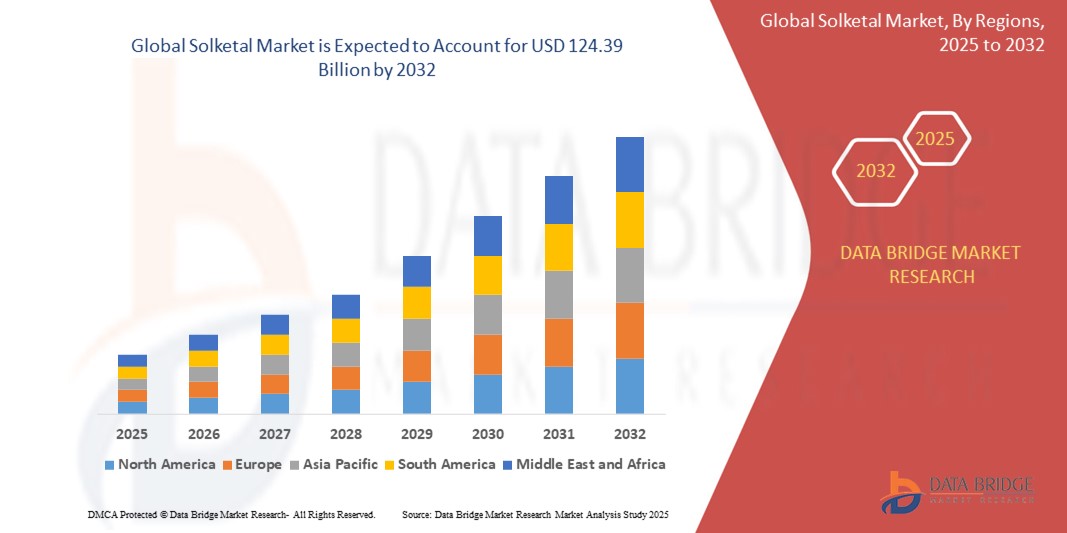
- As per Data Bridge Market Research Analysis the global solketal market was valued at USD 94.46 billion in 2024 and is expected to reach USD 124.39 billion by 2032
- During the forecast period of 2025 to 2032 the market is likely to grow at a CAGR of 3.50%, primarily driven by the increasing demand for biofuels and renewable energy sources
- This growth is driven by factors such as the rising adoption of sustainable chemicals in the automotive and industrial sectors
Market Size & Forecast
- Global Market Value (2024): USD 94.46 billion
- Expected Market Value (2032): USD 124.39 billion
- Forecast CAGR (2024–2032):3.50%
What are the Major Takeaways of Solketal?
- The global solketal market has shown steady growth in recent years, with an increasing demand for bio-based chemicals, particularly in applications such as biofuels and pharmaceuticals. The market is expected to continue growing at a consistent rate through 2032
- Solketal, a chemical compound derived from glycerol, has gained popularity due to its versatility and sustainable nature. It is primarily used as an oxygenated additive in fuels, which enhances fuel quality and reduces emissions
- The growing shift towards environmentally friendly solutions has led to an increase in the use of solketal in various industries, including automotive, pharmaceutical, and chemical. As industries strive for cleaner alternatives, solketal’s role in improving sustainability becomes more significant
- The solketal market is increasingly characterized by innovations in production methods and applications. Companies are focusing on refining manufacturing processes to enhance efficiency and meet the rising global demand for renewable and bio-based chemicals
- The competitive landscape of the solketal market features key players who are making significant strides in expanding their product portfolios and improving production techniques to meet consumer needs
- For instance, companies are exploring new ways to integrate solketal into eco-friendly fuel formulations to align with global environmental goals
- In conclusion, the global solketal market is poised for continued growth as industries increasingly adopt sustainable and eco-friendly solutions
Report Scope and Solketal Market Segmentation
|
Attributes |
Solketal Key Market Insights |
|
Segments Covered |
|
|
Countries Covered |
North America
Europe
Asia-Pacific
Middle East and Africa
South America
|
|
Key Market Players |
|
|
Market Opportunities |
|
|
Value Added Data Infosets |
|
What is the Key Trend in the Solketal?
“Growing Use of Solketal in Sustainable Industries”
- Solketal is gaining momentum as industries shift toward eco-conscious manufacturing and chemical processing for cleaner alternatives
- Its bio-based origin from glycerol makes solketal a preferred choice in applications where sustainability and safety are essential
- Many manufacturers in sectors like cosmetics and pharmaceuticals are integrating solketal into their formulations due to its low toxicity and high biodegradability
- The push for green chemistry is influencing companies to invest in better and cleaner solketal production methods using renewable resources
- For instance companies are developing advanced catalytic techniques and using waste-derived glycerol to create solketal in more environmentally friendly ways
- In conclusion, Solketal is becoming increasingly important in sustainable product development and is shaping the future of green chemical applications across multiple industries.
Solketal Market Dynamics
Driver
“Increasing Demand for Sustainable Chemicals”
- Growing demand for sustainable and bio-based chemicals across industries is driving the solketal market. The shift towards eco-friendly solutions aims to reduce dependence on fossil fuels and minimize carbon footprints
- Solketal, derived from glycerol, is a renewable chemical that plays a significant role in creating cleaner fuel alternatives. It enhances combustion efficiency and reduces emissions, making it valuable in the biofuel industry
- The automotive and energy sectors are increasingly adopting solketal as an additive in biofuels to help meet environmental regulations and reduce harmful emissions
- Solketal is also being explored in pharmaceutical and chemical industries, where it is used in drug synthesis and as a solvent. This expanding application further boosts its demand
- Governments and regulatory bodies are encouraging the use of bio-based chemicals through environmental regulations and incentives for renewable energy sources, creating a favorable environment for solketal production
- In conclusion, the solketal market is growing due to the rising demand for sustainable chemicals, with key industries adopting it for cleaner fuel solutions and other applications. This trend is expected to drive continued market expansion and innovation
Opportunity
“Expanding Applications in Biofuels and Pharmaceuticals”
- The expanding applications of solketal in both biofuels and pharmaceuticals present significant growth opportunities for the market. With the global shift toward cleaner energy, biofuels are becoming increasingly essential in the energy mix
- Solketal, as an oxygenated additive in biofuels, helps enhance fuel properties, improving combustion efficiency and reducing emissions. This makes it a critical component in meeting global energy demands while aligning with environmental goals
- The growing demand for sustainable biofuels driven by stricter environmental regulations provides solketal producers with an opportunity to scale up production and explore new formulations to meet the needs of the energy sector
- In the pharmaceutical industry, solketal is being recognized for its role as a solvent in drug formulation. Its renewable nature and low toxicity make it a favorable alternative to conventional solvents, contributing to the rise of green chemistry
- With ongoing advancements in production technologies, manufacturers have an opportunity to meet the increasing demand for sustainable, bio-based chemicals, expanding solketal’s presence in both the energy and pharmaceutical sectors
- In conclusion, the expanding applications of solketal in biofuels and pharmaceuticals offer strong market opportunities, particularly with the growing emphasis on sustainability and green chemistry. As production technologies advance, solketal’s market reach is set to grow across multiple industries
Restraint/Challenge
“High Production Costs Associated with Its Manufacturing Process”
- One of the main challenges facing the solketal market is the high production cost associated with its manufacturing. Despite its environmental and performance benefits, the process of producing solketal remains costly due to the advanced technologies required
- The production process involves multiple stages, including esterification and catalytic reactions, which are energy-intensive and require specialized equipment. These factors contribute to higher operational costs, making solketal more expensive compared to petroleum-derived additives
- Glycerol, the primary raw material for solketal, is a by-product of biodiesel production. The fluctuating prices of glycerol, as well as its availability, can further impact the overall cost of solketal production, adding uncertainty for manufacturers
- The high production costs of solketal present a challenge, especially in cost-sensitive industries such as automotive and fuel production, where companies may prioritize lower-cost additives over sustainable alternatives
- In order to compete with conventional additives, manufacturers need to optimize production methods, reduce energy consumption, and improve the scalability of solketal production. Without these advancements, solketal’s market penetration may be limited, especially in cost-driven industries
- In conclusion, the high production costs of solketal remain a significant barrier to its widespread adoption, particularly in industries where price sensitivity is key. Overcoming these challenges is essential for solketal to compete with traditional chemical additives
How is the Solketal Segmented?
The market is segmented on the basis of purity, application, end user, packaging format, and sales channel.
|
Segmentation |
Sub-Segmentation |
|
By Purity |
|
|
By Application |
|
|
By End User |
|
|
By Packaging Format |
|
|
By Sales channel |
|
Which Region Holds the Largest Share of the How is Solketal Segmented?
“North America is the Dominant Region in the Solketal Market”
- The North American region holds the largest share in the global solketal market due to its advanced technological infrastructure and strong focus on sustainable energy solutions
- In North America, the U.S. is leading the market with its significant investments in renewable energy sources, such as biofuels, which are a primary application for solketal
- Government initiatives, policies, and incentives to reduce carbon emissions and promote green chemistry are further fueling the demand for solketal in this region
- The automotive and energy industries in North America are adopting biofuels more rapidly, driving the need for solketal as a fuel additive to enhance fuel efficiency and reduce emissions
- In addition, the pharmaceutical sector in North America is growing, and the demand for bio-based solvents like solketal is increasing as companies shift toward green chemistry practices
- The region’s advanced research and development capabilities in bio-based chemicals and fuel technologies continue to position it as a dominant player in the global solketal market
- In conclusion, North America dominates the solketal market due to its advanced infrastructure and strong adoption of sustainable energy solutions
“Asia-Pacific is Projected to Register the Highest Growth Rate”
- The Asia-Pacific region is expected to witness the fastest growth in the solketal market during the forecast period
- Countries like China and India are focusing on reducing fossil fuel dependency and increasing biofuel production, which presents a major growth opportunity for solketal
- The automotive sector in the region is increasingly adopting biofuels, driving demand for solketal as an effective additive for cleaner combustion
- Growing environmental awareness and government support for renewable energy projects are accelerating the adoption of biofuels and, in turn, boosting the solketal market in this region
- The pharmaceutical and chemical industries in Asia-Pacific are also exploring bio-based chemicals like solketal for their green chemistry applications
- Rapid industrialization and increasing investments in sustainable energy technologies further contribute to the region’s market growth
- In conclusion Asia-Pacific region is expected to experience the fastest growth driven by increasing biofuel production and government support for renewable energy
Which are the Top Companies in Solketal?
The market competitive landscape provides details by competitor. Details included are company overview, company financials, revenue generated, market potential, investment in research and development, new market initiatives, global presence, production sites and facilities, production capacities, company strengths and weaknesses, product launch, product width and breadth, application dominance. The above data points provided are only related to the companies' focus related to market.
The Major Market Leaders Operating in the Market Are:
- GLACONCHEMIE GmbH (Germany)
- Merck KGaA (Germany)
- Solvay (Belgium)
- Thermo Fisher Scientific (U.S.)
- Suzhou ChonTech BioPharma Co., Ltd. (China)
- TCI Chemicals (India) Pvt. Ltd. (India)
- Avera Chemicals Inc. (U.S.)
- CHEMOS GmbH & Co. KG (Germany)
- HANGZHOU ICH BIOFARM CO. LTD. (China)
- CM Fine Chemical (China)
- LOBA Feinchemie GmbH (Germany)
- TOCOPHARM CO., LTD. (Taiwan)
- abcr GmbH (Germany)
- Lanxess AG (Germany)
- BASF SE (Germany)
- Eastman Chemical Company (U.S.)
- Royal DSM (Netherlands)
- LyondellBasell Industries (Netherlands/U.S.)
- Arkema (France)
- Wacker Chemie AG (Germany)
What are Latest Developments in Solketal?
- In March 2025, the solketal market is gaining momentum due to increasing demand for eco-friendly pharmaceutical solutions. The shift towards sustainable, bio-based chemicals is driving growth, with solketal being increasingly used in drug formulation as a green alternative to conventional solvents. This trend is supported by a growing focus on reducing environmental impact and adopting sustainable manufacturing practices across various industries
- In March 2025, the solketal market is experiencing significant growth, driven by the increasing demand for sustainable and bio-based chemicals across various industries. Solketal, derived from glycerol, is gaining attention for its applications in biofuels, pharmaceuticals, and as a solvent in chemical processes. The shift towards cleaner energy solutions and environmentally friendly manufacturing practices is propelling the adoption of solketal, positioning it as a key component in the transition to greener industrial practices
- In December 2024, a study published in RSC Advances introduced an efficient method for synthesizing solketal—a fuel additive—from biowaste glycerol using transition metal-based solid acid catalysts. This approach addresses the surplus glycerol produced in biodiesel manufacturing, converting it into valuable chemicals like solketal. The process demonstrated high glycerol conversion rates and solketal yields, highlighting its potential for sustainable chemical production
- In July 2024, a study published in ChemistrySelect provided a comprehensive review of recent advancements in solketal synthesis from glycerol and acetone. The authors systematically examined four different reaction mechanisms for the ketonation reaction of glycerol and acetone. They categorized catalysts into two main types: homogeneous and non-homogeneous, with further subcategories within non-homogeneous catalysts
- In March 2025, the solketal market is experiencing significant growth, driven by the increasing demand for sustainable and bio-based chemicals across various industries. Solketal, derived from glycerol, is gaining attention for its applications in biofuels, pharmaceuticals, and as a solvent in chemical processes. The shift towards cleaner energy solutions and environmentally friendly manufacturing practices is propelling the adoption of solketal, positioning it as a key component in the transition to greener industrial practices

- Interactive Data Analysis Dashboard
- Company Analysis Dashboard for high growth potential opportunities
- Research Analyst Access for customization & queries
- Competitor Analysis with Interactive dashboard
- Latest News, Updates & Trend analysis
- Harness the Power of Benchmark Analysis for Comprehensive Competitor Tracking
Table of Content
1 INTRODUCTION
1.1 OBJECTIVES OF THE STUDY
1.2 MARKET DEFINITION
1.3 OVERVIEW OF GLOBAL SOLKETAL MARKET
1.4 CURRENCY AND PRICING
1.5 LIMITATION
1.6 MARKETS COVERED
2 MARKET SEGMENTATION
2.1 KEY TAKEAWAYS
2.2 ARRIVING AT THE GLOBAL SOLKETAL MARKET SIZE
2.3 VENDOR POSITIONING GRID
2.4 MARKETS COVERED
2.5 GEOGRAPHIC SCOPE
2.6 YEARS CONSIDERED FOR THE STUDY
2.7 RESEARCH METHODOLOGY
2.8 TECHNOLOGY LIFE LINE CURVE
2.9 MULTIVARIATE MODELLING
2.1 PRIMARY INTERVIEWS WITH KEY OPINION LEADERS
2.11 DBMR MARKET POSITION GRID
2.12 MARKET APPLICATION COVERAGE GRID
2.13 DBMR MARKET CHALLENGE MATRIX
2.14 IMPORT AND EXPORT DATA
2.15 SECONDARY SOURCES
2.16 GLOBAL SOLKETAL MARKET: RESEARCH SNAPSHOT
2.17 ASSUMPTIONS
3 MARKET OVERVIEW
3.1 DRIVERS
3.2 RESTRAINTS
3.3 OPPORTUNITIES
3.4 CHALLENGES
4 EXECUTIVE SUMMARY
5 PREMIUM INSIGHTS
5.1 PRODUCTION CONSUMPTION ANALYSIS
5.2 IMPORT EXPORT SCENARIO
5.3 LIST OF KEY BUYERS, BY REGION
5.3.1 NORTH AMERICA
5.3.2 EUROPE
5.3.3 ASIA PACIFIC
5.3.4 SOUTH AMERICA
5.3.5 MIDDLE EAST & AFRICA
5.4 PRICE TREND ANALYSIS
5.5 RAW MATERIAL PRODUCTION COVERAGE
5.6 TECHNOLOGICAL ADVANCEMENT BY MANUFACTURERS
5.7 PORTER’S FIVE FORCES
5.8 REGULATION COVERAGE
5.8.1 PRODUCT CODES
5.8.2 CERTIFIED STANDARDS
5.8.3 SAFETY STANDARDS
6 SUPPLY CHAIN ANALYSIS
6.1 OVERVIEW
6.2 LOGISTIC COST SCENARIO
6.3 IMPORTANCE OF LOGISTICS SERVICE PROVIDERS
7 GLOBAL SOLKETAL MARKET, BY PURITY, (2020-2029) (USD MILLION)
7.1 OVERVIEW
7.2 96-98%
7.3 0.98
7.4 >98%
8 GLOBAL SOLKETAL MARKET, BY APPPLICATION, (2020-2029) (USD MILLION)
8.1 OVERVIEW
8.2 SOLVENT
8.3 BIOFUEL
8.4 PHARMACEUTICAL INTERMEDIATE
8.5 OTHERS
9 GLOBAL SOLKETAL MARKET, BY END USER, (2020-2029) (USD MILLION)
9.1 OVERVIEW
9.2 COSMETICS AND PERSONAL CARE
9.2.1 COSMETICS AND PERSONAL CARE, BY PURITY
9.2.1.1. 96-98%
9.2.1.2. 0.98
9.2.1.3. >98%
9.3 FOOD AND BEVERAGE INDUSTRY
9.3.1 FOOD AND BEVERAGE INDUSTRY, BY PURITY
9.3.1.1. 96-98%
9.3.1.2. 0.98
9.3.1.3. >98%
9.4 PHARMACEUTICAL INDUSTRY
9.4.1 PHARMACEUTICAL INDUSTRY, BY PURITY
9.4.1.1. 96-98%
9.4.1.2. 0.98
9.4.1.3. >98%
9.5 CHEMICAL MANUFACTURING
9.5.1 CHEMICAL MANUFACTURING, BY PURITY
9.5.1.1. 96-98%
9.5.1.2. 0.98
9.5.1.3. >98%
9.6 PAINTS AND COATINGS
9.6.1 PAINTS AND COATINGS, BY PURITY
9.6.1.1. 96-98%
9.6.1.2. 0.98
9.6.1.3. >98%
9.7 OTHERS
10 GLOBAL SOLKETAL MARKET, BY GEOGRAPHY, (2020-2029) (USD MILLION)
10.1 GLOBAL BUSINESS TRAVEL MARKET, (ALL SEGMENTATION PROVIDED ABOVE IS REPRESENTED IN THIS CHAPTER BY COUNTRY)
10.2 NORTH AMERICA
10.2.1 U.S.
10.2.2 CANADA
10.2.3 MEXICO
10.3 EUROPE
10.3.1 GERMANY
10.3.2 U.K.
10.3.3 ITALY
10.3.4 FRANCE
10.3.5 SPAIN
10.3.6 RUSSIA
10.3.7 SWITZERLAND
10.3.8 TURKEY
10.3.9 BELGIUM
10.3.10 NETHERLANDS
10.3.11 LUXEMBURG
10.3.12 REST OF EUROPE
10.4 ASIA-PACIFIC
10.4.1 JAPAN
10.4.2 CHINA
10.4.3 SOUTH KOREA
10.4.4 INDIA
10.4.5 SINGAPORE
10.4.6 THAILAND
10.4.7 INDONESIA
10.4.8 MALAYSIA
10.4.9 PHILIPPINES
10.4.10 AUSTRALIA & NEW ZEALAND
10.4.11 REST OF ASIA-PACIFIC
10.5 SOUTH AMERICA
10.5.1 BRAZIL
10.5.2 ARGENTINA
10.5.3 REST OF SOUTH AMERICA
10.6 MIDDLE EAST AND AFRICA
10.6.1 SOUTH AFRICA
10.6.2 EGYPT
10.6.3 SAUDI ARABIA
10.6.4 UNITED ARAB EMIRATES
10.6.5 ISRAEL
10.6.6 REST OF MIDDLE EAST AND AFRICA
11 GLOBAL SOLKETAL MARKET, COMPANY LANDSCAPE
11.1 COMPANY SHARE ANALYSIS: GLOBAL
11.2 COMPANY SHARE ANALYSIS: NORTH AMERICA
11.3 COMPANY SHARE ANALYSIS: EUROPE
11.4 COMPANY SHARE ANALYSIS: ASIA-PACIFIC
11.5 MERGERS AND ACQUISITIONS
11.6 NEW PRODUCT DEVELOPMENT AND APPROVALS
11.7 EXPANSIONS
11.8 PARTNERSHIP AND OTHER STRATEGIC DEVELOPMENTS
12 SWOT AND DATA BRIDGE MARKET RESEARCH ANALYSIS
13 GLOBAL SOLKETAL MARKET- COMPANY PROFILE
13.1 GLACONCHEMIE GMBH
13.1.1 COMPANY SNAPSHOT
13.1.2 REVENUE ANALYSIS
13.1.3 COMPANY SHARE ANALYSIS
13.1.4 PRODUCT PORTFOLIO
13.1.5 RECENT UPDATE
13.2 SOLVAY
13.2.1 COMPANY SNAPSHOT
13.2.2 REVENUE ANALYSIS
13.2.3 COMPANY SHARE ANALYSIS
13.2.4 PRODUCT PORTFOLIO
13.2.5 RECENT UPDATE
13.3 FISHER SCIENTIFIC UK LTD
13.3.1 COMPANY SNAPSHOT
13.3.2 REVENUE ANALYSIS
13.3.3 COMPANY SHARE ANALYSIS
13.3.4 PRODUCT PORTFOLIO
13.3.5 RECENT UPDATE
13.4 SUZHOU CHONTECH BIOPHARMA CO., LTD.
13.4.1 COMPANY SNAPSHOT
13.4.2 REVENUE ANALYSIS
13.4.3 COMPANY SHARE ANALYSIS
13.4.4 PRODUCT PORTFOLIO
13.4.5 RECENT UPDATE
13.5 TCI CHEMICALS (INDIA) PVT. LTD.
13.5.1 COMPANY SNAPSHOT
13.5.2 REVENUE ANALYSIS
13.5.3 COMPANY SHARE ANALYSIS
13.5.4 PRODUCT PORTFOLIO
13.5.5 RECENT UPDATE
13.6 CHEMOS GMBH & CO. KG
13.6.1 COMPANY SNAPSHOT
13.6.2 REVENUE ANALYSIS
13.6.3 COMPANY SHARE ANALYSIS
13.6.4 PRODUCT PORTFOLIO
13.6.5 RECENT UPDATE
13.7 HANGZHOU ICH BIOFARM CO
13.7.1 COMPANY SNAPSHOT
13.7.2 REVENUE ANALYSIS
13.7.3 COMPANY SHARE ANALYSIS
13.7.4 PRODUCT PORTFOLIO
13.7.5 RECENT UPDATE
13.8 CM FINE CHEMICALS GMBH
13.8.1 COMPANY SNAPSHOT
13.8.2 REVENUE ANALYSIS
13.8.3 COMPANY SHARE ANALYSIS
13.8.4 PRODUCT PORTFOLIO
13.8.5 RECENT UPDATE
13.9 LOBA FEINCHEMIE GMBH
13.9.1 COMPANY SNAPSHOT
13.9.2 REVENUE ANALYSIS
13.9.3 COMPANY SHARE ANALYSIS
13.9.4 PRODUCT PORTFOLIO
13.9.5 RECENT UPDATE
13.1 TOCOPHARM CO, LTD.
13.10.1 COMPANY SNAPSHOT
13.10.2 REVENUE ANALYSIS
13.10.3 COMPANY SHARE ANALYSIS
13.10.4 PRODUCT PORTFOLIO
13.10.5 RECENT UPDATE
*NOTE: THE COMPANIES PROFILED IS NOT EXHAUSTIVE LIST AND IS AS PER OUR PREVIOUS CLIENT REQUIREMENT. WE PROFILE MORE THAN 100 COMPANIES IN OUR STUDY AND HENCE THE LIST OF COMPANIES CAN BE MODIFIED OR REPLACED ON REQUEST
14 RELATED REPORTS
15 QUESTIONNAIRE
16 CONCLUSION
17 ABOUT DATA BRIDGE MARKET RESEARCH

Global Solketal Market, Supply Chain Analysis and Ecosystem Framework
To support market growth and help clients navigate the impact of geopolitical shifts, DBMR has integrated in-depth supply chain analysis into its Global Solketal Market research reports. This addition empowers clients to respond effectively to global changes affecting their industries. The supply chain analysis section includes detailed insights such as Global Solketal Market consumption and production by country, price trend analysis, the impact of tariffs and geopolitical developments, and import and export trends by country and HSN code. It also highlights major suppliers with data on production capacity and company profiles, as well as key importers and exporters. In addition to research, DBMR offers specialized supply chain consulting services backed by over a decade of experience, providing solutions like supplier discovery, supplier risk assessment, price trend analysis, impact evaluation of inflation and trade route changes, and comprehensive market trend analysis.
Data collection and base year analysis are done using data collection modules with large sample sizes. The stage includes obtaining market information or related data through various sources and strategies. It includes examining and planning all the data acquired from the past in advance. It likewise envelops the examination of information inconsistencies seen across different information sources. The market data is analysed and estimated using market statistical and coherent models. Also, market share analysis and key trend analysis are the major success factors in the market report. To know more, please request an analyst call or drop down your inquiry.
The key research methodology used by DBMR research team is data triangulation which involves data mining, analysis of the impact of data variables on the market and primary (industry expert) validation. Data models include Vendor Positioning Grid, Market Time Line Analysis, Market Overview and Guide, Company Positioning Grid, Patent Analysis, Pricing Analysis, Company Market Share Analysis, Standards of Measurement, Global versus Regional and Vendor Share Analysis. To know more about the research methodology, drop in an inquiry to speak to our industry experts.
Data Bridge Market Research is a leader in advanced formative research. We take pride in servicing our existing and new customers with data and analysis that match and suits their goal. The report can be customized to include price trend analysis of target brands understanding the market for additional countries (ask for the list of countries), clinical trial results data, literature review, refurbished market and product base analysis. Market analysis of target competitors can be analyzed from technology-based analysis to market portfolio strategies. We can add as many competitors that you require data about in the format and data style you are looking for. Our team of analysts can also provide you data in crude raw excel files pivot tables (Fact book) or can assist you in creating presentations from the data sets available in the report.













