


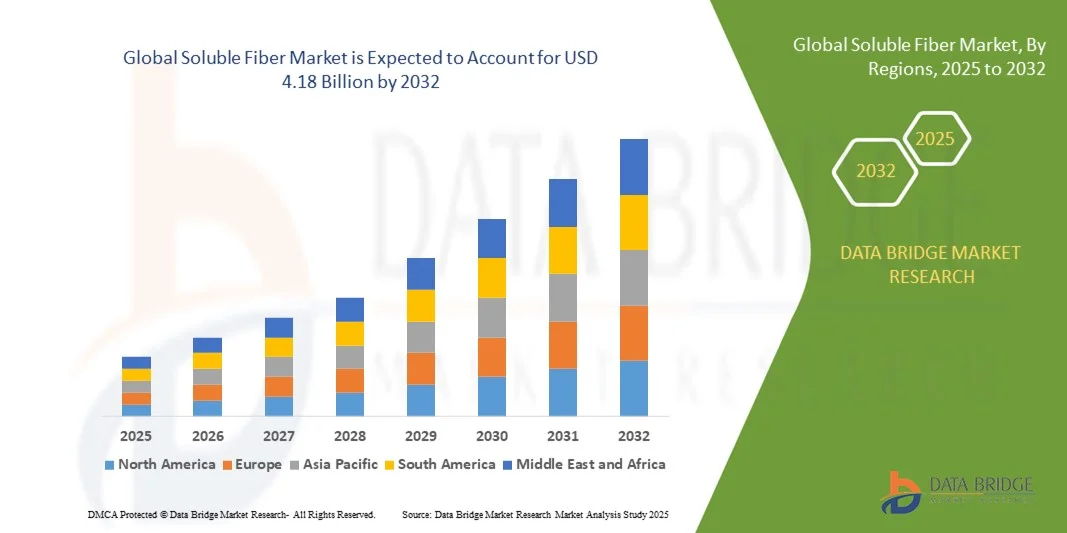
Global Soluble Fiber Market Size
- The global soluble fiber market size was valued at USD 2.35 billion in 2024 and is expected to reach USD 4.18 billion by 2032, growing at a CAGR of 7.49% during the forecast period
- Market growth is primarily driven by increasing awareness of gut health, rising demand for functional foods, and growing consumer preference for natural and plant-based ingredients across food and beverage applications
- Additionally, the expanding use of soluble fiber in dietary supplements, pharmaceuticals, and animal nutrition is reinforcing its market potential, further accelerating demand and contributing to the sector’s substantial expansion
Global Soluble Fiber Market Analysis
- Soluble fiber, a type of dietary fiber that dissolves in water to form a gel-like substance, is becoming increasingly essential in food, pharmaceutical, and nutraceutical industries due to its proven benefits in digestive health, cholesterol reduction, and blood sugar regulation
- The growing demand for soluble fiber is primarily driven by rising health consciousness among consumers, increased prevalence of lifestyle-related diseases, and a surge in demand for functional and fortified food products
- North America dominated the global soluble fiber market with the largest revenue share of 35.5% in 2024, driven by growing consumer awareness of health benefits, high demand for functional foods, and strong presence of key manufacturers. The U.S. led market growth with increasing incorporation of soluble fiber in dietary supplements, food, and beverage products, supported by ongoing research and innovation in fiber-based formulations and clean-label trends.
- Asia-Pacific is expected to be the fastest growing region in the global soluble fiber market during the forecast period, fueled by rapid urbanization, rising disposable incomes, and increasing health consciousness among consumers. Markets such as China and India are witnessing significant growth due to expanding processed food industries and greater adoption of dietary supplements containing soluble fiber.
- The Food and Beverages segment dominated the market with the largest revenue share of 38.5% in 2024, driven by the rising demand for clean-label and functional food products
Report Scope and Global Soluble Fiber Market Segmentation
|
Attributes |
Soluble Fiber Key Market Insights |
|
Segments Covered |
|
|
Countries Covered |
North America
Europe
Asia-Pacific
Middle East and Africa
South America
|
|
Key Market Players |
|
|
Market Opportunities |
|
|
Value Added Data Infosets |
In addition to the insights on market scenarios such as market value, growth rate, segmentation, geographical coverage, and major players, the market reports curated by the Data Bridge Market Research also include in-depth expert analysis, pricing analysis, brand share analysis, consumer survey, demography analysis, supply chain analysis, value chain analysis, raw material/consumables overview, vendor selection criteria, PESTLE Analysis, Porter Analysis, and regulatory framework. |
Global Soluble Fiber Market Trends
Rising Innovation in Functional Fiber Formulations and Delivery Formats
- A significant and accelerating trend in the global Soluble Fiber Market is the growing innovation in fiber formulations and delivery formats, driven by advancements in food science and increasing consumer demand for convenient, health-focused products. These innovations are enhancing the versatility and appeal of soluble fibers across diverse applications in food, beverage, and nutraceutical sectors.
- For Instance, companies are developing microencapsulated and powdered forms of inulin, beta-glucan, and polydextrose that can be easily incorporated into functional beverages, dairy alternatives, and meal replacement products without altering taste or texture. These new delivery systems enable seamless fiber fortification, particularly in ready-to-drink formats and on-the-go snacks.
- Furthermore, the integration of soluble fibers into plant-based and clean-label products is expanding rapidly. Brands are formulating high-fiber plant-based yogurts, protein bars, and vegan baked goods using chicory root fiber, resistant dextrin, and other prebiotic ingredients to support gut health and satiety.
- Innovations in fiber technology also include the development of multi-functional blends that combine soluble fiber with protein or probiotics, enhancing both nutritional profile and digestive benefits. For instance, synbiotic supplements now offer combined fiber and probiotic delivery to support microbiome health in a single, easy-to-consume product.
- This trend is reshaping product development strategies across food and health industries, as manufacturers aim to meet rising consumer expectations for functional nutrition without compromising sensory experience. Leading companies such as BENEO, ADM, and DuPont are investing in R&D to launch next-generation soluble fiber solutions tailored to specific health outcomes such as blood sugar control, weight management, and immune support.
- As health-conscious consumers seek more integrated and effective nutritional solutions, the demand for innovative and user-friendly fiber formulations continues to grow across global markets, making functional versatility a key driver of future expansion in the soluble fiber industry.
Global Soluble Fiber Market Dynamics
Driver
Growing Demand Driven by Health Awareness and Functional Food Adoption
-
The rising global prevalence of lifestyle-related health conditions such as obesity, diabetes, and cardiovascular diseases is a major driver of demand for soluble fiber, as consumers increasingly seek dietary solutions to support better health and prevent illness.
- For instance, food and beverage manufacturers are incorporating prebiotic fibers like inulin, beta-glucan, and polydextrose into a wide range of products—from dairy alternatives and fortified beverages to functional snacks—to appeal to health-conscious consumers seeking natural and clean-label solutions.
- Soluble fiber’s proven benefits in supporting digestive health, improving glycemic control, and lowering cholesterol make it an attractive ingredient for consumers pursuing wellness-focused lifestyles.
- Moreover, the rising popularity of plant-based and gut-health-centric diets is boosting the demand for fiber-enriched foods. Functional nutrition trends, supported by increased consumer education on the role of the gut microbiome, are leading to a surge in fiber-forward product innovations.
- The convenience of incorporating soluble fiber into everyday foods and beverages, combined with its versatility across applications, is accelerating its adoption in both developed and emerging markets. Industry leaders such as ADM, BENEO, and Ingredion are responding with new product developments and marketing strategies aimed at mainstreaming fiber-enhanced nutrition across all age groups and demographics.
Restraint/Challenge
Taste, Texture Limitations, and Cost Pressures in Product Formulation
-
Despite its health benefits, incorporating soluble fiber into food and beverage products presents certain formulation challenges, particularly in maintaining taste, texture, and mouthfeel—factors that significantly influence consumer acceptance.
- For instance, some soluble fibers like guar gum and psyllium may impart a gummy or gritty texture, or alter the sweetness profile of the final product, leading manufacturers to limit inclusion levels or seek specialized processing techniques to mask these effects.
- Additionally, high-quality soluble fibers, especially those derived from chicory root or oats, can be expensive to produce and source consistently, which places cost pressures on manufacturers and may limit their use in price-sensitive product segments.
- This is particularly challenging for producers in developing markets or for smaller food brands seeking to balance nutritional value with affordability. The lack of standardized regulations for fiber claims in some regions further complicates labeling and marketing strategies.
- To overcome these barriers, companies are investing in R&D to develop more cost-effective, neutral-tasting fiber solutions with improved solubility and compatibility across diverse product formats. Collaborative efforts between ingredient suppliers and food brands will be essential to expand soluble fiber usage while maintaining consumer satisfaction and cost-efficiency.
Global Soluble Fiber Market Scope
The market is segmented on the basis of application, source, function, and form.
- By Application
On the basis of application, the market is segmented into food and beverages, dietary supplements, pharmaceuticals, animal feed, and cosmetics. The food and beverages segment dominated the market with the largest revenue share of 38.5% in 2024, driven by the rising demand for clean-label and functional food products. Increasing consumer awareness regarding gut health and digestion has led to greater incorporation of dietary fibers and prebiotics into everyday food items like baked goods, dairy products, and beverages.
The Dietary Supplements segment is projected to witness the fastest CAGR of 18.9% from 2025 to 2032, fueled by growing health consciousness and the shift toward preventive healthcare. The use of prebiotics in supplements is on the rise due to their role in supporting digestive health, immunity, and nutrient absorption. Capsules, tablets, and gummies with prebiotic ingredients are gaining traction among fitness-focused consumers and aging populations.
- By Source
On the basis of source, the market is segmented into psyllium, inulin, oligofructose, pectins, and guar gum. The Inulin segment held the largest market revenue share of 34.7% in 2024, attributed to its natural origin, strong scientific backing, and wide applicability in food, beverage, and pharmaceutical formulations. Inulin's dual role as a prebiotic and fat replacer makes it an ideal ingredient in health-oriented product innovations.
The psyllium segment is expected to register the fastest CAGR of 17.4% from 2025 to 2032, owing to its high soluble fiber content and growing recognition in dietary and therapeutic applications. Psyllium is particularly gaining popularity in gluten-free formulations and heart health supplements due to its cholesterol-lowering and digestive benefits.
- By Function
On the basis of function, the market is categorized into thickening agent, stabilizer, emulsifier, fat replacer, and texturizer. The thickening agent segment dominated the market with the largest revenue share of 30.1% in 2024, driven by its extensive use in soups, sauces, dairy, and bakery applications to improve consistency and mouthfeel. Natural and plant-based thickeners are increasingly preferred over synthetic additives, aligning with clean-label trends.
The fat replacer segment is projected to grow at the fastest CAGR of 19.6% from 2025 to 2032, fueled by rising health concerns related to obesity and cardiovascular diseases. Consumers are actively seeking low-fat food alternatives, and prebiotic-based fat replacers allow manufacturers to offer products that retain flavor and texture while improving nutritional profiles.
- By Form
On the basis of form, the market is segmented into powder, liquid, and granule. The powder segment accounted for the largest market revenue share of 57.8% in 2024, owing to its ease of formulation, longer shelf life, and compatibility with a wide range of applications including supplements, food, and beverages. The powdered form offers convenience in transportation, storage, and precise dosing, which is essential for industrial applications.
The liquid segment is anticipated to witness the fastest CAGR of 16.3% from 2025 to 2032, driven by its rising use in ready-to-drink functional beverages and infant nutrition. Liquid prebiotics are favored in applications requiring fast absorption and ease of mixing, especially in health and wellness drinks, boosting their market appeal.
Global Soluble Fiber Market Regional Analysis
- North America dominated the Global Soluble Fiber Market with the largest revenue share of 35.5% in 2024, driven by rising health awareness, strong demand for functional foods, and a mature nutraceutical industry.
- Consumers in the region increasingly seek natural and science-backed dietary ingredients, including soluble fibers such as inulin, beta-glucan, and polydextrose, which are widely used in fortified beverages, meal replacements, and dietary supplements.
- The region’s market growth is further supported by high disposable incomes, growing incidence of lifestyle-related diseases such as diabetes and obesity, and a well-established presence of leading functional ingredient manufacturers. Additionally, regulatory support for health claims and clean-label trends continue to encourage the adoption of soluble fiber in both food and pharmaceutical applications, solidifying North America’s position as a key contributor to global market expansion.
U.S. Soluble Fiber Market Insight
The U.S. soluble fiber market captured the largest revenue share of 78.3% in 2024 within North America, driven by increasing consumer awareness of gut health, heart health, and the role of fiber in preventive wellness. The widespread availability of fiber-enriched functional foods, beverages, and dietary supplements is fueling growth. U.S. consumers are highly receptive to ingredients like inulin, beta-glucan, and resistant dextrin, which are now common in cereals, nutrition bars, plant-based yogurts, and meal replacements. Additionally, the strong presence of major players such as ADM, Cargill, and DuPont enhances market penetration through ongoing product innovation and strategic partnerships across food and pharma sectors.
Europe Soluble Fiber Market Insight
The Europe soluble fiber market is projected to grow at a strong CAGR during the forecast period, primarily driven by stringent health and nutrition regulations, rising demand for clean-label products, and growing consumer focus on digestive and metabolic health. The region shows high adoption of fiber-enriched foods and beverages, with chicory root fiber, oat beta-glucan, and pectin commonly used in daily nutrition. Regulatory support for health claims and rising interest in sustainable, plant-based diets are contributing to the market's expansion across both Western and Eastern Europe. Growth is strong in both retail and clinical nutrition segments.
U.K. Soluble Fiber Market Insight
The U.K. soluble fiber market is expected to grow at a notable CAGR during the forecast period, supported by increasing consumer focus on dietary wellness and government-led public health initiatives encouraging higher fiber intake. The popularity of prebiotic and gut-health-promoting products, particularly among millennials and older adults, is driving demand for fiber ingredients like inulin and polydextrose. U.K. manufacturers are also responding to clean-label trends by replacing synthetic additives with natural fibers for texture, taste, and nutrition enhancement. The rise of plant-based diets and functional beverages is further fueling market expansion.
Germany Soluble Fiber Market Insight
The Germany soluble fiber market is anticipated to grow at a considerable CAGR throughout the forecast period, driven by a strong focus on health, innovation, and sustainability. German consumers increasingly prefer food products that offer both nutritional value and environmental responsibility, boosting demand for plant-derived fibers such as chicory root inulin and oat beta-glucan. The country’s robust regulatory framework for food safety and wellness claims supports product innovation in the functional foods and nutraceutical sectors. Additionally, rising interest in gut health and preventive nutrition among aging consumers is creating opportunities for targeted fiber-enriched solutions.
Asia-Pacific Soluble Fiber Market Insight
The Asia-Pacific soluble fiber market is poised to grow at the fastest CAGR of 24.6% during the forecast period from 2025 to 2032, driven by rapid urbanization, increasing health awareness, and growing disposable incomes in emerging economies like China, India, and Southeast Asia. Government initiatives promoting dietary wellness and chronic disease prevention are encouraging food manufacturers to incorporate more functional ingredients such as soluble fiber. Additionally, the region benefits from a strong agricultural base and increasing investments in food processing technologies, making fiber-rich ingredients more accessible and affordable to a wide consumer base.
Japan Soluble Fiber Market Insight
The Japan soluble fiber market is witnessing steady growth, fueled by a health-conscious population and strong demand for functional and convenience-based foods. With an aging demographic and increasing focus on gut health, Japanese consumers are driving demand for soluble fibers in ready-to-drink beverages, yogurts, and supplements. Inulin and resistant starch are among the most commonly used ingredients in the market. The country's innovation-driven food industry and regulatory support for health claims are fostering growth, especially in products targeting digestive wellness, blood sugar control, and immune health.
China Soluble Fiber Market Insight
The China soluble fiber market held the largest revenue share in the Asia-Pacific region in 2024, supported by rapid industrialization, a growing middle class, and increased consumer interest in functional and health-boosting foods. The government’s focus on public health nutrition and the widespread promotion of dietary fiber in national dietary guidelines have accelerated the market. Functional beverages, traditional medicine-based supplements, and fortified bakery products are key segments where soluble fibers such as polydextrose and beta-glucan are gaining traction. Domestic manufacturers are scaling production to meet demand, driving both affordability and innovation in the space.
Global Soluble Fiber Market Share
The Soluble Fiber industry is primarily led by well-established companies, including:
- BENEO (Germany)
- Lonza (Switzerland)
- DuPont de Nemours, Inc. (U.S.)
- Archer Daniels Midland Company (ADM) (U.S.)
- Batory Foods (U.S.)
- Ingredion Incorporated (U.S.)
- Roquette Freres (France)
- PURIS (U.S.)
- Tate & Lyle (U.K.)
- Emsland Group (Germany)
- Cargill, Incorporated (U.S.)
- Kerry Inc. (Ireland)
- The Green Labs LLC (U.S.)
- Nexira (France)
- Farbest Brands (U.S.)
- J. RETTENMAIER & SÖHNE GmbH + Co KG (Germany)
- Taiyo International (Japan)
- AGT Food and Ingredients (Canada)
What are the Recent Developments in Global Soluble Fiber Market?
- In May 2024, BENEO, a leading functional ingredient manufacturer based in Germany, announced the expansion of its chicory root fiber production capacity at its facility in Pemuco, Chile. This strategic investment aims to meet the rising global demand for prebiotic fibers like inulin and oligofructose, which support digestive health and immune function. The expansion underscores BENEO’s commitment to sustainable sourcing and innovation in the soluble fiber market while strengthening its global supply chain to serve key markets across North America, Europe, and Asia-Pacific.
- In April 2024, Ingredion Incorporated, a U.S.-based global ingredients solutions provider, launched a new range of soluble dietary fiber ingredients under the VERSAFIBE™ brand. These clean-label, plant-based fibers are designed to enhance the nutritional profile of foods and beverages without affecting taste or texture. The launch supports growing consumer demand for high-fiber, low-sugar products and highlights Ingredion’s strategic focus on health and wellness-driven product innovation in the food and beverage sector.
- In March 2024, Cargill, Incorporated introduced a new portfolio of fiber-enriched sweetener solutions targeting reduced-sugar product formulations across confectionery, dairy, and bakery applications. Developed using soluble fibers such as chicory root and soluble corn fiber, the line aims to support manufacturers in delivering better-for-you products that align with clean-label and regulatory requirements. The move reflects Cargill’s continued investment in functional ingredients and its response to evolving consumer preferences for healthier indulgences.
- In February 2024, Nexira, a French company specializing in natural plant-based ingredients, launched Inavea™ Baobab Acacia, a new synergistic blend of soluble fibers sourced from acacia gum and baobab fruit. Positioned as a 100% organic prebiotic solution, this product delivers both digestive health benefits and environmental sustainability. The launch highlights Nexira’s leadership in eco-conscious innovation and its commitment to providing multifunctional fiber solutions that cater to health-focused consumers and environmentally aware brands.
- In January 2024, Roquette Frères, a key player in plant-based ingredients from France, unveiled plans to invest in a new research and development facility focused on dietary fibers and plant-based nutrition. The center, located in Lestrem, France, is aimed at accelerating the development of next-generation soluble fibers that improve health outcomes, including satiety, glycemic response, and gut microbiota modulation. This initiative reaffirms Roquette’s strategic vision to be at the forefront of global food innovation and support the growing demand for personalized nutrition solutions.

- Interactive Data Analysis Dashboard
- Company Analysis Dashboard for high growth potential opportunities
- Research Analyst Access for customization & queries
- Competitor Analysis with Interactive dashboard
- Latest News, Updates & Trend analysis
- Harness the Power of Benchmark Analysis for Comprehensive Competitor Tracking
Global Soluble Fiber Market, Supply Chain Analysis and Ecosystem Framework
To support market growth and help clients navigate the impact of geopolitical shifts, DBMR has integrated in-depth supply chain analysis into its Global Soluble Fiber Market research reports. This addition empowers clients to respond effectively to global changes affecting their industries. The supply chain analysis section includes detailed insights such as Global Soluble Fiber Market consumption and production by country, price trend analysis, the impact of tariffs and geopolitical developments, and import and export trends by country and HSN code. It also highlights major suppliers with data on production capacity and company profiles, as well as key importers and exporters. In addition to research, DBMR offers specialized supply chain consulting services backed by over a decade of experience, providing solutions like supplier discovery, supplier risk assessment, price trend analysis, impact evaluation of inflation and trade route changes, and comprehensive market trend analysis.
Data collection and base year analysis are done using data collection modules with large sample sizes. The stage includes obtaining market information or related data through various sources and strategies. It includes examining and planning all the data acquired from the past in advance. It likewise envelops the examination of information inconsistencies seen across different information sources. The market data is analysed and estimated using market statistical and coherent models. Also, market share analysis and key trend analysis are the major success factors in the market report. To know more, please request an analyst call or drop down your inquiry.
The key research methodology used by DBMR research team is data triangulation which involves data mining, analysis of the impact of data variables on the market and primary (industry expert) validation. Data models include Vendor Positioning Grid, Market Time Line Analysis, Market Overview and Guide, Company Positioning Grid, Patent Analysis, Pricing Analysis, Company Market Share Analysis, Standards of Measurement, Global versus Regional and Vendor Share Analysis. To know more about the research methodology, drop in an inquiry to speak to our industry experts.
Data Bridge Market Research is a leader in advanced formative research. We take pride in servicing our existing and new customers with data and analysis that match and suits their goal. The report can be customized to include price trend analysis of target brands understanding the market for additional countries (ask for the list of countries), clinical trial results data, literature review, refurbished market and product base analysis. Market analysis of target competitors can be analyzed from technology-based analysis to market portfolio strategies. We can add as many competitors that you require data about in the format and data style you are looking for. Our team of analysts can also provide you data in crude raw excel files pivot tables (Fact book) or can assist you in creating presentations from the data sets available in the report.













