What is the Soundbar Market Size and Growth Rate?
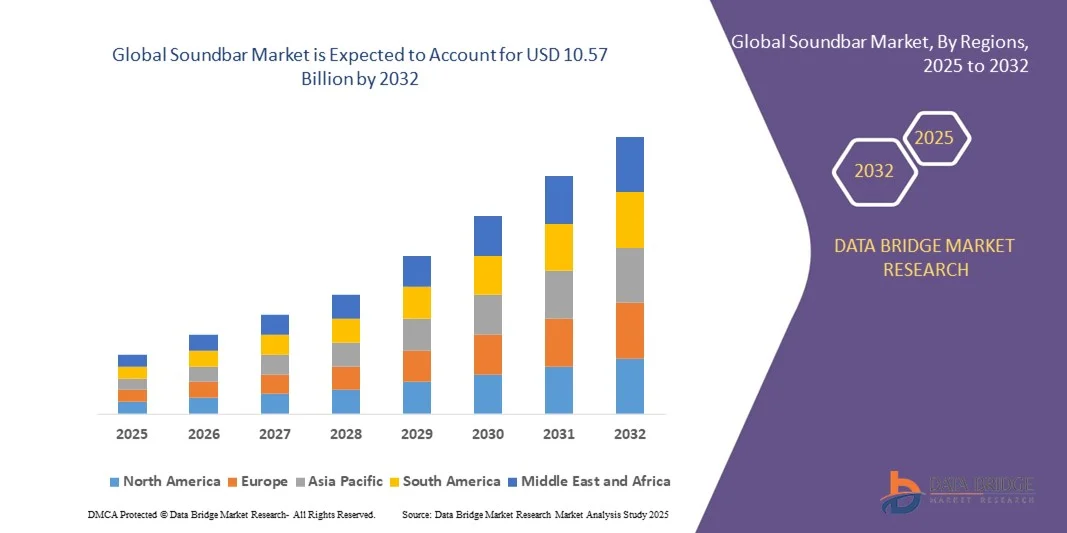
- As per Data Bridge Market Research Analysis the global Soundbar Market size was valued at USD 8.03 billion in 2024 and is expected to reach USD 10.57 billion by 2032, at a CAGR of 3.50% during the forecast period.
- The market growth is primarily driven by the increasing adoption of advanced audio technologies and rising consumer preference for immersive home entertainment experiences, coupled with the growing trend of home theater setups.
- Additionally, the demand for compact, high-quality, and wireless audio solutions that seamlessly integrate with smart TVs and connected devices is further fueling the market expansion, making soundbars a preferred choice for enhanced audio experiences across residential and commercial spaces.
Market Size & Forecast
Global Market Value (2024): USD 8.03 billion
Expected Market Value (2032): USD 10.57 billion
Forecast CAGR (2025–2032): 3.50%
What are the Major Takeaways of Soundbar Market?
- Soundbars, providing enhanced audio output for televisions and entertainment systems, are becoming essential components of modern home and commercial entertainment setups due to their compact design, superior sound quality, and seamless integration with smart TVs and connected devices.
- The growing demand for soundbars is primarily driven by increasing consumer preference for immersive audio experiences, the rising adoption of home theater systems, and the convenience of space-saving, wireless audio solutions.
- North America dominated the Global Soundbar Market with the largest revenue share of 31.5% in 2024, attributed to early adoption of smart home entertainment technologies, high disposable incomes, and a strong presence of major electronics manufacturers, with the U.S. seeing substantial growth in premium and wireless soundbar installations, fueled by innovations in Dolby Atmos, AI-enhanced sound, and multi-device connectivity.
- Asia-Pacific is expected to be the fastest-growing region in the Global Soundbar Market during the forecast period due to rapid urbanization, increasing disposable incomes, and a growing preference for home entertainment solutions in countries like China and India.
- The wall-mounted segment dominated the market with the largest revenue share of 46.5% in 2024, driven by its space-saving design and compatibility with modern home entertainment setups.
Report Scope and Global Soundbar Market Segmentation
|
Attributes |
Soundbar Key Market Insights |
|
Segments Covered |
|
|
Countries Covered |
North America
Europe
Asia-Pacific
Middle East and Africa
South America
|
|
Key Market Players |
|
|
Market Opportunities |
|
|
Value Added Data Infosets |
In addition to the insights on market scenarios such as market value, growth rate, segmentation, geographical coverage, and major players, the market reports curated by the Data Bridge Market Research also include in-depth expert analysis, pricing analysis, brand share analysis, consumer survey, demography analysis, supply chain analysis, value chain analysis, raw material/consumables overview, vendor selection criteria, PESTLE Analysis, Porter Analysis, and regulatory framework. |
What is the Key Trend in the Soundbar Market?
Enhanced Convenience Through AI and Voice Integration
- A significant and accelerating trend in the global Soundbar Market is the deepening integration with artificial intelligence (AI) and popular voice‑controlled ecosystems such as Amazon Alexa, Google Assistant and Apple Siri / Apple HomeKit. This fusion of technologies is significantly enhancing user convenience and control over their home‑audio and entertainment systems.
- For instance, premium models such as the Samsung Q Series Soundbar and the Sonos Beam Gen 2 Soundbar incorporate built‑in voice assistant support and AI‑driven audio calibration, allowing users to adjust sound levels, switch sources, or control other smart devices simply by speaking.
- AI integration in soundbars enables features such as automatic room‑based audio tuning, adaptive sound modes based on content type (movies, sports, music) and voice‑command playback or home‑ecosystem control. Many new soundbars adjust equalisation dynamically using built‑in AI algorithms that analyse room acoustics and user preferences.
- The seamless integration of soundbars with digital assistants and broader smart‑home platforms facilitates centralised control over entertainment and connected‑home devices. Through a single interface, users can manage their soundbar alongside their smart TV, lighting systems, thermostats and voice‑enabled assistants, creating a unified and automated living environment.
- This trend towards more intelligent, intuitive and interconnected audio systems is fundamentally reshaping user expectations for home entertainment. Consequently, manufacturers such as LG and Bose are developing AI‑enabled soundbars with features such as voice‑control compatibility across multiple ecosystems and auto‑tuning of speaker output.
- The demand for soundbars that offer seamless AI and voice‑control integration is growing rapidly across both residential and commercial sectors, as consumers increasingly prioritise convenience, immersive sound and comprehensive smart‑home functionality.
Global Soundbar Market Dynamics
Driver
Growing Need Due to Rising Home Entertainment Expectations and Smart‑Home Adoption
- The increasing demand for high-quality home entertainment experiences, coupled with the accelerating adoption of smart-home ecosystems, is a significant driver for the heightened demand for soundbars.
- For instance, in 2024, LG and Samsung launched AI-enabled soundbars with seamless integration into smart TVs and home automation systems, allowing for automated audio calibration and voice-controlled operation. Such strategies by key companies are expected to drive soundbar market growth in the forecast period.
- As consumers seek more immersive audio experiences to complement smart TVs, gaming consoles, and streaming services, soundbars offer enhanced sound quality, surround-sound simulation, and wireless connectivity, providing a compelling upgrade over built-in TV speakers.
- Furthermore, the growing popularity of smart home devices and the desire for interconnected living spaces are making soundbars an integral component of these systems, offering seamless integration with other smart devices, digital assistants, and streaming platforms.
- The convenience of wireless connectivity, voice control, multi-room audio, and app-based management are key factors propelling the adoption of soundbars in both residential and commercial settings. The trend towards DIY smart home installations and the increasing availability of user-friendly soundbar models further contribute to market growth.
Restraint/Challenge
High Costs, Compatibility Issues, and Market Saturation
- Concerns regarding high initial costs, compatibility issues with different TVs or smart-home platforms, and market saturation pose significant challenges to broader market penetration. Premium soundbars with advanced features such as Dolby Atmos, AI audio calibration, and multi-device integration are priced higher than standard models, limiting adoption among price-sensitive consumers.
- For instance, reports of compatibility issues between certain soundbars and smart TV brands have caused some consumers to hesitate before upgrading their home audio systems.
- Addressing these challenges through standardization, improved compatibility, and tiered product offerings is crucial for building consumer confidence. Companies like Sonos and Bose emphasize ease of setup, cross-device compatibility, and bundled features in their marketing to reassure potential buyers.
- While mid-range and budget-friendly soundbars have become more accessible, high-end models with advanced audio technologies still carry a premium, which can slow widespread adoption, especially in emerging markets or for cost-conscious households.
- Overcoming these challenges through competitive pricing, consumer education, enhanced compatibility, and innovative feature offerings will be vital for sustained growth in the global soundbar market.
How is the Soundbar Market Segmented?
Soundbar market is segmented on the basis of type, installation method, product and technology.
- By Type
On the basis of type, the Global Soundbar Market is segmented into wall-mounted, table-top, and others. The wall-mounted segment dominated the market with the largest revenue share of 46.5% in 2024, driven by its space-saving design and compatibility with modern home entertainment setups. Wall-mounted soundbars are particularly popular among homeowners looking to integrate premium audio without cluttering living spaces. Their aesthetic appeal, coupled with advanced features such as Dolby Atmos support and AI audio calibration, further enhances adoption.
The table-top segment is expected to witness the fastest CAGR of 19.8% from 2025 to 2032, fueled by its portability, ease of installation, and suitability for smaller living areas or temporary setups. Table-top soundbars are increasingly integrated with smart TV systems, gaming consoles, and streaming devices, making them a convenient and flexible option for both residential and commercial users seeking high-quality audio experiences.
- By Installation Method
On the basis of installation method, the Global Soundbar Market is segmented into active soundbars, passive soundbars, and others. The active soundbar segment held the largest market revenue share of 52.3% in 2024, owing to its built-in amplifiers, connectivity options, and user-friendly plug-and-play design. Active soundbars deliver superior sound performance without requiring additional external amplifiers, making them the preferred choice for home theaters, gaming setups, and smart homes.
The passive soundbar segment is anticipated to witness the fastest CAGR of 18.5% from 2025 to 2032, driven by growing interest in custom audio installations and professional-grade home entertainment systems. Passive soundbars, often preferred by audiophiles, allow for flexible configuration with separate amplifiers, enabling users to tailor audio performance to room acoustics and personal preferences, particularly in high-end residential and commercial spaces.
- By Application
On the basis of application, the Global Soundbar Market is segmented into home audio, commercial, and others. The home audio segment dominated the market with the largest revenue share of 57.8% in 2024, driven by increasing adoption of smart TVs, streaming platforms, and home theater setups. Consumers are prioritizing immersive sound experiences to complement high-definition visual content, making soundbars an essential component of modern living rooms.
The commercial segment is expected to witness the fastest CAGR of 21.2% from 2025 to 2032, fueled by demand in offices, restaurants, retail outlets, and hospitality venues seeking compact, high-quality audio solutions. Commercial installations benefit from soundbars’ space efficiency, wireless connectivity, and integration with public announcement systems or background music solutions, allowing businesses to deliver superior audio experiences for customers and employees while minimizing installation complexity.
- By Product
On the basis of product, the Global Soundbar Market is segmented into 2-channel, 2.1-channel, 5.1-channel, and others. The 2.1-channel segment held the largest market revenue share of 49.1% in 2024, owing to its balanced combination of stereo channels and subwoofer support, which provides a rich audio experience without occupying excessive space. 2.1-channel soundbars are widely used in living rooms, home theaters, and small commercial spaces for high-quality music and movie playback.
The 5.1-channel segment is expected to witness the fastest CAGR of 20.5% from 2025 to 2032, driven by growing consumer demand for immersive surround sound, Dolby Atmos, and cinema-like audio experiences at home. These advanced soundbars are increasingly paired with smart TVs, streaming services, and gaming consoles to deliver high-fidelity, multi-directional sound in both residential and premium commercial setups.
- By Technology
On the basis of technology, the Global Soundbar Market is segmented into Bluetooth, Wi-Fi, and AirPlay. The Bluetooth segment dominated the market with the largest revenue share of 45.7% in 2024, due to its wide compatibility, low power consumption, and simple pairing process for wireless audio streaming from smartphones, tablets, and laptops. Bluetooth-enabled soundbars are popular for their plug-and-play convenience and portability, making them suitable for casual and everyday audio use.
The Wi-Fi segment is anticipated to witness the fastest CAGR of 22.1% from 2025 to 2032, fueled by the rise of multi-room audio, smart-home integration, and cloud-based music streaming services. Wi-Fi soundbars enable higher-quality audio transmission, integration with voice assistants, and centralized control of multiple devices, making them an attractive choice for connected homes and premium entertainment setups.
Which Region Holds the Largest Share of the Soundbar Market?
- North America dominated the Global Soundbar Market with the largest revenue share of 31.5% in 2024, driven by the increasing adoption of home entertainment systems, smart TVs, and connected home audio devices.
- Consumers in the region highly value immersive sound experiences, convenience, and seamless integration of soundbars with smart TVs, streaming platforms, and voice-controlled assistants such as Amazon Alexa and Google Assistant.
- This widespread adoption is further supported by high disposable incomes, a tech-savvy population, and the growing preference for premium home audio setups that deliver cinematic-quality sound. The region’s strong retail and e-commerce channels, coupled with frequent product launches by key players, further bolster market growth. Consequently, soundbars have become a preferred audio solution for both residential and commercial spaces, offering enhanced entertainment experiences, compact form factors, and easy integration into modern smart home ecosystems.
U.S. Soundbar Market Insight
The U.S. soundbar market captured the largest revenue share of 81% in 2024 within North America, fueled by the rapid adoption of smart TVs, home theaters, and connected audio devices. Consumers are increasingly prioritizing immersive audio experiences, convenience, and integration with voice-controlled assistants such as Amazon Alexa, Google Assistant, and Apple HomeKit. The growing preference for home entertainment upgrades, coupled with robust demand for wireless connectivity and mobile app integration, further propels the soundbar industry. Moreover, frequent product launches, technological innovations, and a strong e-commerce ecosystem contribute to sustained market expansion, making soundbars a favored audio solution for both residential and commercial spaces.
Europe Soundbar Market Insight
The Europe soundbar market is projected to expand at a substantial CAGR throughout the forecast period, primarily driven by rising demand for premium home entertainment systems and smart home integration. Increasing urbanization, high disposable incomes, and growing awareness of advanced audio technologies are fostering the adoption of soundbars. European consumers are particularly drawn to features such as Dolby Atmos, multi-room connectivity, and voice assistant compatibility. The region is experiencing notable growth across residential, commercial, and hospitality applications, with soundbars being integrated into both new homes and modernized entertainment setups.
U.K. Soundbar Market Insight
The U.K. soundbar market is anticipated to grow at a noteworthy CAGR during the forecast period, driven by increasing interest in home entertainment, smart TV adoption, and demand for superior audio quality. Additionally, the desire for sleek, space-saving audio solutions encourages both homeowners and commercial establishments to invest in soundbars. The U.K.’s mature e-commerce and retail infrastructure, combined with growing adoption of voice-assisted devices and smart home systems, is expected to continue stimulating market growth.
Germany Soundbar Market Insight
The Germany soundbar market is expected to expand at a considerable CAGR during the forecast period, fueled by growing consumer preference for high-fidelity audio and technologically advanced home entertainment systems. Germany’s strong emphasis on innovation, quality engineering, and sustainable electronics supports the adoption of smart and energy-efficient soundbars. Integration with multi-room setups and home automation systems is becoming increasingly popular, particularly in residential and commercial spaces, where consumers value premium audio experiences combined with convenience and reliability.
Asia-Pacific Soundbar Market Insight
The Asia-Pacific soundbar market is poised to grow at the fastest CAGR of 24% during the forecast period of 2025 to 2032, driven by rising urbanization, increasing disposable incomes, and rapid technological adoption in countries such as China, Japan, and India. The growing popularity of home entertainment systems, government initiatives promoting digital lifestyles, and expanding awareness of immersive audio technologies are fueling adoption. Furthermore, APAC’s emergence as a manufacturing hub for audio electronics is improving affordability and accessibility, enabling a broader consumer base to invest in high-quality soundbars.
Japan Soundbar Market Insight
The Japan soundbar market is gaining momentum due to the country’s tech-savvy population, high urban density, and preference for compact, high-quality home entertainment solutions. Japanese consumers prioritize immersive audio experiences and seamless integration with smart TVs, IoT devices, and voice assistants. Additionally, the aging population is increasing demand for easy-to-use, accessible audio solutions suitable for both residential and commercial settings. Multi-room and wireless connectivity features further drive market growth in Japan.
China Soundbar Market Insight
The China soundbar market accounted for the largest revenue share in Asia-Pacific in 2024, attributed to rapid urbanization, a growing middle class, and strong technological adoption. The country is a major hub for smart home devices, and soundbars are increasingly popular in residential, commercial, and hospitality settings. Government initiatives supporting smart homes and cities, along with competitive pricing from domestic manufacturers, are key factors driving market expansion. Integration with voice assistants, streaming platforms, and smart TVs continues to enhance demand across Chinese households.
Which are the Top Companies in Soundbar Market?
The Soundbar industry is primarily led by well-established companies, including:
- Sony (Japan)
- Samsung (South Korea)
- LG Electronics (South Korea)
- Bose (U.S.)
- Sennheiser (Germany)
- JBL (U.S.)
- Philips (Netherlands)
- Panasonic (Japan)
- Sharp (Japan)
- Vizio (U.S.)
- Yamaha (Japan)
- Onkyo (Japan)
- Denon (Japan)
- Harman Kardon (U.S.)
- Klipsch (U.S.)
- Polk Audio (U.S.)
- Bluesound (Canada)
- Samsung Harman (South Korea)
- Devialet (France)
- Bang & Olufsen (Denmark)
What are Latest Developments in Soundbar Market?
- In April 2023, Sony Corporation, a global leader in consumer electronics, launched a strategic initiative in South Africa to expand its premium soundbar lineup tailored for residential and commercial entertainment spaces. The initiative emphasizes Sony’s commitment to delivering immersive audio experiences with advanced features such as Dolby Atmos, wireless multi-room connectivity, and seamless integration with smart TVs. By leveraging its global expertise and innovative audio technologies, Sony is addressing regional entertainment needs while strengthening its position in the rapidly growing global Soundbar Market.
- In March 2023, Bose Corporation, a veteran-led audio technology company based in Massachusetts, introduced its latest Smart Soundbar 900 model, designed specifically for home theaters and commercial spaces such as hotels and conference rooms. The product features integrated voice assistants, adaptive sound technology, and Wi-Fi connectivity to enhance user experience. This launch highlights Bose’s dedication to developing cutting-edge audio solutions that deliver high-quality sound while ensuring convenience and adaptability across diverse environments.
- In March 2023, Samsung Electronics successfully deployed its premium soundbar series as part of the Seoul Smart Entertainment Initiative, aimed at upgrading urban entertainment systems in public spaces and high-end residential complexes. This deployment integrates state-of-the-art audio technologies, including surround sound and AI-based acoustic calibration, reinforcing Samsung’s leadership in the smart soundbar segment and promoting enhanced home and urban audio experiences.
- In February 2023, LG Electronics, a leading provider of home entertainment solutions, announced a strategic partnership with Asia-Pacific Media Solutions to launch a smart soundbar marketplace for residential and commercial customers. The collaboration aims to streamline accessibility to advanced audio solutions, promote seamless multi-device integration, and enhance immersive experiences in homes and businesses. The initiative underscores LG’s commitment to innovation and improving operational efficiency within the audio technology sector.
- In January 2023, Vizio Inc., a prominent provider of smart audio and home entertainment devices, unveiled the Vizio Elevate Soundbar at the Consumer Electronics Show (CES) 2023. Equipped with Dolby Atmos, Chromecast, and voice assistant compatibility, this innovative soundbar allows users to enjoy premium cinematic audio experiences and control the system remotely via smart devices. The launch highlights Vizio’s focus on integrating advanced technology into home entertainment, offering consumers superior sound quality, convenience, and intuitive control.

- Interactive Data Analysis Dashboard
- Company Analysis Dashboard for high growth potential opportunities
- Research Analyst Access for customization & queries
- Competitor Analysis with Interactive dashboard
- Latest News, Updates & Trend analysis
- Harness the Power of Benchmark Analysis for Comprehensive Competitor Tracking
Data collection and base year analysis are done using data collection modules with large sample sizes. The stage includes obtaining market information or related data through various sources and strategies. It includes examining and planning all the data acquired from the past in advance. It likewise envelops the examination of information inconsistencies seen across different information sources. The market data is analysed and estimated using market statistical and coherent models. Also, market share analysis and key trend analysis are the major success factors in the market report. To know more, please request an analyst call or drop down your inquiry.
The key research methodology used by DBMR research team is data triangulation which involves data mining, analysis of the impact of data variables on the market and primary (industry expert) validation. Data models include Vendor Positioning Grid, Market Time Line Analysis, Market Overview and Guide, Company Positioning Grid, Patent Analysis, Pricing Analysis, Company Market Share Analysis, Standards of Measurement, Global versus Regional and Vendor Share Analysis. To know more about the research methodology, drop in an inquiry to speak to our industry experts.
Data Bridge Market Research is a leader in advanced formative research. We take pride in servicing our existing and new customers with data and analysis that match and suits their goal. The report can be customized to include price trend analysis of target brands understanding the market for additional countries (ask for the list of countries), clinical trial results data, literature review, refurbished market and product base analysis. Market analysis of target competitors can be analyzed from technology-based analysis to market portfolio strategies. We can add as many competitors that you require data about in the format and data style you are looking for. Our team of analysts can also provide you data in crude raw excel files pivot tables (Fact book) or can assist you in creating presentations from the data sets available in the report.