Soy Beverages Market Overview
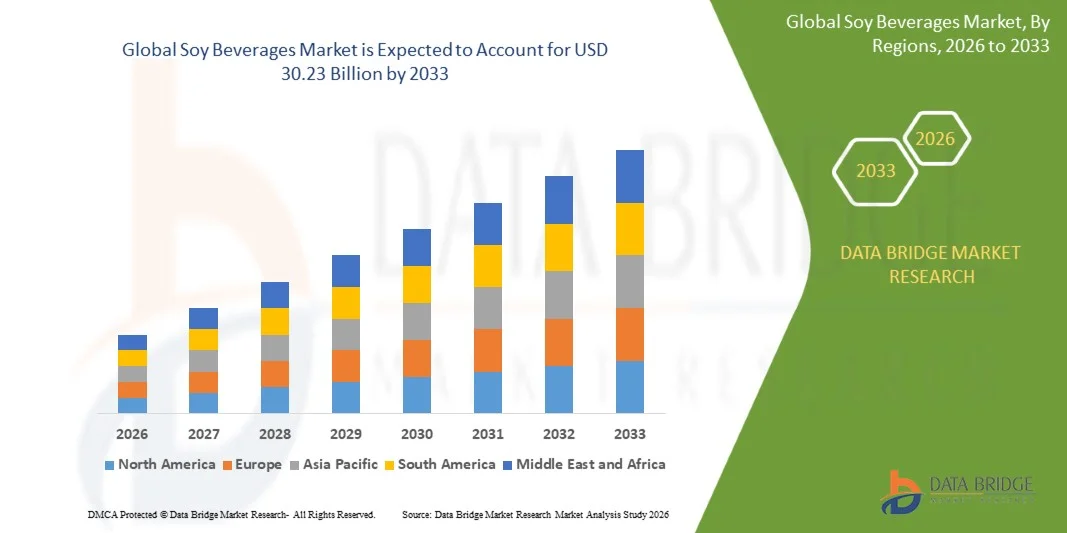
The Soy Beverages Market was valued at USD 18.27 billion in 2025 and is projected to reach USD 30.23 billion by 2033, growing at a CAGR of 6.50% from 2026 to 2033. The market is experiencing steady growth driven by rising consumer preference for plant-based dairy alternatives, increasing awareness regarding lactose intolerance and vegan nutrition, and expanding demand for functional and protein-rich beverages across global markets. Growing adoption of healthy lifestyles and clean-label food products is further accelerating consumption of soy-based beverages among health-conscious consumers.
The increasing shift toward dairy-free and cholesterol-free nutritional products, combined with rising concerns regarding animal-based food consumption and environmental sustainability, is encouraging consumers and food manufacturers to adopt soy beverages across retail and foodservice applications. Fortified soy drinks enriched with calcium, vitamins, and protein are increasingly replacing conventional dairy beverages in many markets, offering nutritional benefits, affordability, and compatibility with vegan dietary preferences. In addition, rapid expansion of plant-based beverage portfolios by major food companies and growing penetration of soy beverages across supermarkets, cafés, and online retail channels are creating strong growth opportunities for the Soy Beverages Market.
Key Market Trends & Insights
- North America dominated the soy beverages market with the largest revenue share of approximately 39.4% in 2025, supported by strong adoption of vegan diets, increasing demand for functional beverages, and expanding availability of fortified plant-based products across supermarkets, cafés, and online retail platforms.
- Asia-Pacific is expected to be the fastest-growing region, recording a CAGR of approximately 7.3% from 2026 to 2033. Growth is driven by rising disposable incomes, increasing urbanization, strong cultural familiarity with soy-based foods, and expanding consumer demand for healthy and affordable plant-based beverages across China, Japan, India, and South Korea.
- The Soy Milk segment held the largest market revenue share of approximately 72.8% in 2025 driven by its widespread consumption as a dairy alternative across breakfast beverages, coffee applications, nutritional drinks, and household consumption. Soy milk is preferred due to its high protein content, affordability, lactose-free properties, and growing adoption among vegan and health-conscious consumers.
- The Soy-Based Drinkable Yogurt segment is projected to register the fastest growth at a CAGR of 7.4% from 2026 to 2033, driven by increasing demand for probiotic-rich plant-based beverages and functional nutrition products. Rising consumer preference for digestive wellness beverages and flavored dairy-free yogurt alternatives is accelerating segment expansion across retail and foodservice channels.
- The Plain Soy Beverages segment held the largest market revenue share of approximately 58.6% in 2025 driven by strong demand from health-conscious consumers seeking low-sugar and minimally processed beverage options. Plain soy beverages are widely used in households, cafés, and nutritional diets due to their versatility and compatibility with smoothies, cereals, and coffee preparations.
- The Flavored Soy Beverages segment is projected to register the fastest growth at a CAGR of 7.1% from 2026 to 2033, driven by increasing product innovation in chocolate, vanilla, coffee, and fruit-based formulations targeting younger consumers and mainstream retail markets. Manufacturers are increasingly launching fortified flavored soy beverages with enhanced taste profiles and nutritional benefits to strengthen product differentiation and improve consumer adoption.
- The Supermarkets/Hypermarkets segment held the largest market revenue share of approximately 46.3% in 2025 driven by strong product visibility, extensive shelf availability, and growing consumer preference for one-stop retail purchasing of plant-based beverages. Large retail chains continue to expand dedicated health food and dairy alternative sections, supporting higher soy beverage sales volumes.
- The Online Retail Stores segment is projected to register the fastest growth at a CAGR of 8.3% from 2026 to 2033 driven by rapid e-commerce expansion, increasing consumer preference for home delivery convenience, and rising penetration of subscription-based grocery platforms. The Convenience Stores segment accounted for approximately 18.5% share in 2025 supported by increasing demand for ready-to-drink soy beverages among urban consumers. Pharmacies/Drug Stores held around 12.7% share due to growing sales of fortified and functional soy beverages positioned for health-conscious consumers, while the Others segment accounted for the remaining market share across specialty organic stores and foodservice distribution channels.
Market Size & Forecast
- Global Market Value (2025): USD 18.27 Billion
- Expected Market Value (2033): USD 30.23 Billion
- Forecast CAGR (2026–2033): 6.50%
- Leading Region in 2025: North America
- Fastest Growing Region: Asia-Pacific
Report Scope and Soy Beverages Market Segmentation
|
Attributes |
Soy Beverages Key Market Insights |
|
Segments Covered |
· By Product: Soy Milk and Soy-Based Drinkable Yogurt · By Flavor: Plain Soy Beverages and Flavored Soy Beverages · By Distribution Channel: Supermarkets/Hypermarkets, Pharmacies/Drug Stores, Online Retail Stores, Convenience Stores, and Others |
|
Countries Covered |
North America · U.S. · Canada · Mexico Europe · Germany · France · U.K. · Netherlands · Switzerland · Belgium · Russia · Italy · Spain · Turkey · Rest of Europe Asia-Pacific · China · Japan · India · South Korea · Singapore · Malaysia · Australia · Thailand · Indonesia · Philippines · Rest of Asia-Pacific Middle East and Africa · Saudi Arabia · U.A.E. · South Africa · Egypt · Israel · Rest of Middle East and Africa South America · Brazil · Argentina · Rest of South America |
|
Key Market Players |
• Danone S.A. (France) |
|
Market Opportunities |
• Expansion Of Functional Plant-Based Beverage Products |
|
Value Added Data Infosets |
In addition to the insights on market scenarios such as market value, growth rate, segmentation, geographical coverage, and major players, the market reports curated by the Data Bridge Market Research also include in-depth expert analysis, pricing analysis, brand share analysis, consumer survey, demography analysis, supply chain analysis, value chain analysis, raw material/consumables overview, vendor selection criteria, PESTLE Analysis, Porter Analysis, and regulatory framework. |
Soy Beverages Market Trends
Trend: Growth In Functional Plant-Based Nutrition And Protein-Enriched Beverage Consumption
Increasing consumer demand for healthy, dairy-free, and protein-rich beverages is driving adoption of soy beverages across retail, foodservice, and nutritional applications. Conventional dairy beverages are increasingly being replaced by plant-based alternatives due to rising lactose intolerance, growing vegan populations, and increasing awareness regarding cholesterol-free and sustainable dietary products.
In modern food and beverage industries, manufacturers are integrating soy-based formulations, For instance in ready-to-drink protein beverages, flavored soy milk, meal replacement drinks, and sports nutrition products, to improve nutritional value and support clean-label product positioning. In fitness and wellness applications, soy beverages are being used as high-protein dairy alternatives capable of supporting muscle recovery and balanced nutrition while offering lower saturated fat content.
The rapid expansion of health-conscious consumer groups and plant-based food retail channels is also increasing demand for fortified soy beverages enriched with calcium, vitamins, and omega fatty acids. In addition, cafés and quick-service restaurants are increasingly incorporating soy milk alternatives in coffee and beverage menus to meet changing consumer preferences. Product launch tracking during 2025 across North America and Europe indicated that plant-based beverage launches containing soy protein ingredients increased by approximately 11–15% year-over-year, reflecting sustained global demand for soy-based nutritional beverages.
Soy Beverages Market Dynamics
Key Market Driver: Rising Adoption Of Vegan And Lactose-Free Dietary Products
Consumers worldwide are increasingly shifting toward vegan and dairy-free lifestyles due to growing health awareness, environmental concerns, and ethical considerations associated with animal-based food products. Increasing prevalence of lactose intolerance and dairy allergies is further accelerating demand for soy beverages as affordable and nutritionally balanced dairy alternatives.
Food and beverage manufacturers are increasingly expanding soy beverage portfolios, For instance through flavored soy drinks, protein-enriched beverages, and fortified nutritional products, to cater to evolving consumer dietary preferences. Major global beverage brands are introducing soy-based alternatives with reduced sugar and enhanced nutritional formulations to strengthen market competitiveness and address rising demand for healthier beverage options.
Similarly, expanding retail penetration and online grocery distribution are improving accessibility to soy beverages across developed and emerging economies. Consumer retail studies conducted in the U.S. and Western Europe during 2024 indicated that plant-based milk alternatives recorded annual sales growth of approximately 8–10%, supporting higher demand for soy-based beverage products in mainstream retail channels.
Key Restraint/Challenge: Allergen Concerns And Fluctuating Soybean Prices
Soy remains one of the major food allergens globally, creating consumption limitations among allergy-sensitive consumer groups and restricting adoption in certain demographic segments. In addition, concerns regarding genetically modified soybean cultivation and consumer preference for non-GMO formulations are increasing sourcing and certification costs for manufacturers.
Fluctuating soybean prices caused by climate variability, trade restrictions, and agricultural supply chain disruptions also create cost instability for beverage producers operating in global markets. Rising raw material and transportation costs further impact product pricing and profit margins, particularly for premium organic and fortified soy beverages.
Agricultural commodity assessments during 2024 showed soybean price fluctuations of approximately 10–14% across international trading markets due to adverse weather conditions and export supply uncertainties in major soybean-producing countries such as Brazil and the U.S., affecting procurement costs for plant-based beverage manufacturers.
Key Market Opportunity: Expansion In Functional Beverages And Sports Nutrition Applications
Modern consumers are increasingly seeking functional beverages that provide protein enrichment, digestive wellness, and nutritional supplementation alongside convenience and clean-label positioning. Soy beverages are gaining strong traction due to their high protein content, low cholesterol profile, and compatibility with fortified nutritional formulations.
Beverage companies are increasingly exploring soy-based innovations, For instance in high-protein shakes, fortified breakfast beverages, children’s nutrition products, and sports recovery drinks, to improve product differentiation and target health-conscious consumers. In sports nutrition applications, soy protein beverages are being adopted as plant-based alternatives for muscle recovery and endurance support among active lifestyle consumers.
In addition, advancements in flavor masking technologies and beverage stabilization systems are improving taste, texture, and shelf-life performance of soy beverages, opening opportunities across premium retail and foodservice channels. Product innovation programs launched during 2025 across Asia-Pacific and North America reported increasing incorporation of soy-based protein ingredients in functional beverage categories, supporting long-term growth opportunities for the Soy Beverages Market.
Soy Beverages Market Scope
The market is segmented on the basis of product, flavor, and distribution channel.
- By Product
On the basis of product, the soy beverages market is segmented into Soy Milk and Soy-Based Drinkable Yogurt. The Soy Milk segment held the largest market revenue share of approximately 72.8% in 2025 driven by its widespread consumption as a dairy alternative across breakfast beverages, coffee applications, nutritional drinks, and household consumption. Soy milk is preferred due to its high protein content, affordability, lactose-free properties, and growing adoption among vegan and health-conscious consumers.
The Soy-Based Drinkable Yogurt segment is projected to register the fastest growth at a CAGR of 7.4% from 2026 to 2033, driven by increasing demand for probiotic-rich plant-based beverages and functional nutrition products. Rising consumer preference for digestive wellness beverages and flavored dairy-free yogurt alternatives is accelerating segment expansion across retail and foodservice channels.
- By Flavor
On the basis of flavor, the market is segmented into Plain Soy Beverages and Flavored Soy Beverages. The Plain Soy Beverages segment held the largest market revenue share of approximately 58.6% in 2025 driven by strong demand from health-conscious consumers seeking low-sugar and minimally processed beverage options. Plain soy beverages are widely used in households, cafés, and nutritional diets due to their versatility and compatibility with smoothies, cereals, and coffee preparations.
The Flavored Soy Beverages segment is projected to register the fastest growth at a CAGR of 7.1% from 2026 to 2033, driven by increasing product innovation in chocolate, vanilla, coffee, and fruit-based formulations targeting younger consumers and mainstream retail markets. Manufacturers are increasingly launching fortified flavored soy beverages with enhanced taste profiles and nutritional benefits to strengthen product differentiation and improve consumer adoption.
- By Distribution Channel
On the basis of distribution channel, the market is segmented into Supermarkets/Hypermarkets, Pharmacies/Drug Stores, Online Retail Stores, Convenience Stores, and Others. The Supermarkets/Hypermarkets segment held the largest market revenue share of approximately 46.3% in 2025 driven by strong product visibility, extensive shelf availability, and growing consumer preference for one-stop retail purchasing of plant-based beverages. Large retail chains continue to expand dedicated health food and dairy alternative sections, supporting higher soy beverage sales volumes.
The Online Retail Stores segment is projected to register the fastest growth at a CAGR of 8.3% from 2026 to 2033 driven by rapid e-commerce expansion, increasing consumer preference for home delivery convenience, and rising penetration of subscription-based grocery platforms. The Convenience Stores segment accounted for approximately 18.5% share in 2025 supported by increasing demand for ready-to-drink soy beverages among urban consumers. Pharmacies/Drug Stores held around 12.7% share due to growing sales of fortified and functional soy beverages positioned for health-conscious consumers, while the Others segment accounted for the remaining market share across specialty organic stores and foodservice distribution channels.
Soy Beverages Market Regional Analysis
North America Soy Beverages Market Insight
North America dominated the soy beverages market with the largest revenue share of approximately 39.4% in 2025, supported by increasing consumer preference for plant-based nutrition, growing awareness regarding lactose intolerance, and rising demand for protein-rich dairy alternatives. Consumers in the region highly value the nutritional benefits, cholesterol-free profile, and convenience offered by soy beverages across retail and foodservice applications. The market is further supported by strong penetration of vegan products, expanding supermarket distribution, and growing adoption of fortified soy drinks among health-conscious consumers.
U.S. Soy Beverages Market Insight
The U.S. soy beverages market captured the largest revenue share in 2025 within North America, fueled by the rapid adoption of plant-based diets and increasing consumer preference for functional nutritional beverages. Consumers are increasingly prioritizing high-protein and low-cholesterol beverage alternatives to support healthy lifestyles and fitness-oriented dietary habits. The growing popularity of vegan cafés, combined with strong demand for ready-to-drink soy beverages and dairy-free coffee additives, is significantly propelling market growth. Moreover, increasing investments by beverage manufacturers in flavored and fortified soy drinks are contributing to the expansion of the soy beverages market across the country.
Europe Soy Beverages Market Insight
The Europe soy beverages market is expected to witness the fastest growth rate from 2026 to 2033, primarily driven by rising adoption of vegan diets, increasing awareness regarding sustainable food consumption, and stringent regulations promoting clean-label food products. The increase in flexitarian consumer populations, coupled with strong demand for dairy-free nutritional products, is fostering adoption of soy beverages across the region. European consumers are also increasingly attracted to fortified soy drinks enriched with vitamins and calcium. The market is experiencing strong growth across retail, cafés, and foodservice sectors, with soy beverages becoming widely incorporated into mainstream beverage offerings.
U.K. Soy Beverages Market Insight
The U.K. soy beverages market is expected to witness strong growth from 2026 to 2033, driven by increasing consumer inclination toward vegan lifestyles and heightened awareness regarding dairy-free nutrition. In addition, concerns regarding obesity, cholesterol management, and sustainable food consumption are encouraging consumers to choose plant-based beverage alternatives. The country’s expanding plant-based food retail industry, alongside robust online grocery penetration and growing café adoption of soy milk options, is expected to continue stimulating market demand across both household and commercial applications.
Germany Soy Beverages Market Insight
The Germany soy beverages market is expected to witness strong growth from 2026 to 2033, fueled by increasing awareness regarding sustainable nutrition and rising demand for organic and functional beverage products. Germany’s strong plant-based food culture, combined with its emphasis on environmental sustainability and healthy lifestyles, promotes widespread adoption of soy beverages across retail and foodservice sectors. The incorporation of fortified soy beverages into sports nutrition and wellness-oriented dietary products is also becoming increasingly prevalent, aligning with local consumer demand for healthier beverage alternatives.
Asia-Pacific Soy Beverages Market Insight
The Asia-Pacific soy beverages market is expected to witness the fastest growth rate from 2026 to 2033, supported by rising disposable incomes, increasing urbanization, and strong cultural familiarity with soy-based food products across countries such as China, Japan, South Korea, and India. The region’s growing health-conscious population, supported by expanding modern retail infrastructure and rising plant-based product awareness, is driving adoption of soy beverages. Furthermore, Asia-Pacific remains a major production and consumption hub for soy-based products, improving product accessibility and affordability across both urban and rural markets.
Japan Soy Beverages Market Insight
The Japan soy beverages market is expected to witness steady growth from 2026 to 2033 due to the country’s long-standing consumption of soy-based foods and growing demand for functional and healthy beverages. The Japanese market places significant emphasis on nutritional balance, convenience, and low-fat dietary products, supporting widespread adoption of soy beverages among both younger and aging populations. The integration of fortified soy drinks into convenience stores, vending machines, and ready-to-drink beverage categories is fueling market growth. Moreover, Japan’s aging population is increasingly encouraging demand for protein-rich and easily digestible beverage alternatives.
China Soy Beverages Market Insight
The China soy beverages market accounted for the largest market revenue share in Asia Pacific in 2025, attributed to the country’s large consumer base, strong cultural acceptance of soy products, and rapid urbanization. China remains one of the largest global consumers of soy beverages, with soy milk widely consumed across breakfast and nutritional beverage categories. The push toward healthier lifestyles, combined with expanding modern retail channels and increasing availability of flavored and fortified soy drinks, is significantly propelling the market in China.
Soy Beverages Market Share
The Soy Beverages industry is primarily led by well-established companies, including:
• Danone S.A. (France)
• Organic Valley (U.S.)
• ZENSOY (U.S.)
• Hain Celestial (U.S.)
• KIKKOMAN SALES USA, INC. (U.S.)
• Eden Foods Inc. (U.S.)
• Pureharvest (Australia)
• THE WHITEWAVE FOODS COMPANY (U.S.)
• American Soy Products (U.S.)
• Vitasoy International Holdings Limited. (Hong Kong)
• SunOpta (Canada)
• Trader Joe's (U.S.)
• Jaffe Bros., Inc. (U.S.)
• Devansoy Inc. (U.S.)
• PACIFIC FOODS OF OREGON, LLC. (U.S.)
• PANOS brands (U.S.)
• Sanitarium (Australia)
Latest Developments in Soy Beverages Market
- In September 2025, Vitasoy International Holdings Limited announced the expansion of its European operations through the establishment of a new manufacturing facility in Germany to strengthen regional production capabilities for soy beverages. The development is expected to improve supply chain efficiency, reduce delivery timelines, and support increasing demand for plant-based beverages across Europe. The expansion also strengthens the company’s competitive positioning while supporting broader market penetration and regional revenue growth within the European soy beverages market.
- In August 2024, THE WHITEWAVE FOODS COMPANY introduced a new portfolio of organic soy beverages targeted toward health-conscious and vegan consumers seeking clean-label dairy alternatives. The product launch was aimed at expanding the company’s organic beverage offerings while strengthening its sustainability-focused product positioning. The development is expected to increase consumer adoption of premium plant-based beverages and intensify competition within the organic soy beverage segment globally.
- In July 2024, Alpro launched a large-scale digital marketing initiative focused on promoting its soy beverage product range across social media and digital engagement platforms. The campaign was designed to strengthen brand visibility among younger consumers and increase awareness regarding plant-based nutritional beverages. The initiative reflects rising digitalization strategies within the food and beverage industry and is expected to improve customer engagement, brand loyalty, and retail sales performance across European markets.

- Interactive Data Analysis Dashboard
- Company Analysis Dashboard for high growth potential opportunities
- Research Analyst Access for customization & queries
- Competitor Analysis with Interactive dashboard
- Latest News, Updates & Trend analysis
- Harness the Power of Benchmark Analysis for Comprehensive Competitor Tracking
Global Soy Beverages Market, Supply Chain Analysis and Ecosystem Framework
To support market growth and help clients navigate the impact of geopolitical shifts, DBMR has integrated in-depth supply chain analysis into its Global Soy Beverages Market research reports. This addition empowers clients to respond effectively to global changes affecting their industries. The supply chain analysis section includes detailed insights such as Global Soy Beverages Market consumption and production by country, price trend analysis, the impact of tariffs and geopolitical developments, and import and export trends by country and HSN code. It also highlights major suppliers with data on production capacity and company profiles, as well as key importers and exporters. In addition to research, DBMR offers specialized supply chain consulting services backed by over a decade of experience, providing solutions like supplier discovery, supplier risk assessment, price trend analysis, impact evaluation of inflation and trade route changes, and comprehensive market trend analysis.
Data collection and base year analysis are done using data collection modules with large sample sizes. The stage includes obtaining market information or related data through various sources and strategies. It includes examining and planning all the data acquired from the past in advance. It likewise envelops the examination of information inconsistencies seen across different information sources. The market data is analysed and estimated using market statistical and coherent models. Also, market share analysis and key trend analysis are the major success factors in the market report. To know more, please request an analyst call or drop down your inquiry.
The key research methodology used by DBMR research team is data triangulation which involves data mining, analysis of the impact of data variables on the market and primary (industry expert) validation. Data models include Vendor Positioning Grid, Market Time Line Analysis, Market Overview and Guide, Company Positioning Grid, Patent Analysis, Pricing Analysis, Company Market Share Analysis, Standards of Measurement, Global versus Regional and Vendor Share Analysis. To know more about the research methodology, drop in an inquiry to speak to our industry experts.
Data Bridge Market Research is a leader in advanced formative research. We take pride in servicing our existing and new customers with data and analysis that match and suits their goal. The report can be customized to include price trend analysis of target brands understanding the market for additional countries (ask for the list of countries), clinical trial results data, literature review, refurbished market and product base analysis. Market analysis of target competitors can be analyzed from technology-based analysis to market portfolio strategies. We can add as many competitors that you require data about in the format and data style you are looking for. Our team of analysts can also provide you data in crude raw excel files pivot tables (Fact book) or can assist you in creating presentations from the data sets available in the report.