


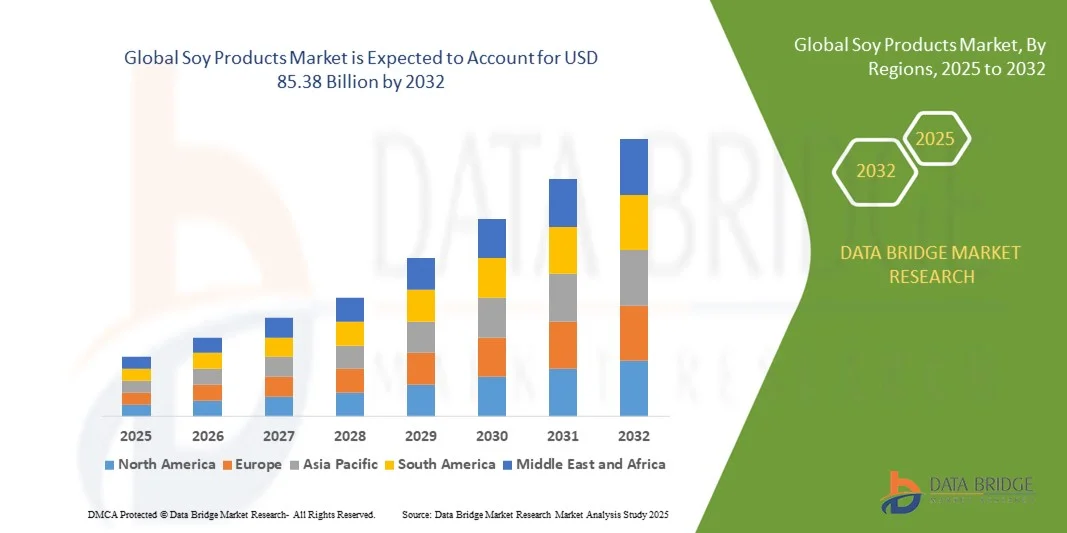
Soy Products Market Size
- The global soy products market size was valued at USD 54.80 billion in 2024 and is expected to reach USD 85.38 billion by 2032, at a CAGR of 5.70% during the forecast period
- The market growth is largely fuelled by the increasing demand for plant-based proteins, rising consumer awareness about health and nutrition, and growing adoption of soy-based ingredients in food and beverages
Soy Products Market Analysis
- The market is witnessing strong growth due to the rising trend of vegan and vegetarian diets, which is driving the consumption of soy-based alternatives such as tofu, soy milk, and soy protein isolates
- Expanding applications of soy in processed foods, snacks, bakery products, and dairy alternatives are further boosting market demand, as manufacturers reformulate products to meet clean-label and high-protein requirements
- North America dominated the soy products market with the largest revenue share in 2024, driven by increasing consumer demand for plant-based protein, growing health awareness, and rising adoption of dairy alternatives and functional foods.
- Asia-Pacific region is expected to witness the highest growth rate in the global soy products market, driven by rapid urbanization, rising disposable incomes, increasing vegan and vegetarian population, and growing investments in food processing and distribution infrastructure
- The Soy Milk segment held the largest market revenue share in 2024, driven by growing consumer preference for plant-based beverages and dairy alternatives. Soy milk’s nutritional benefits, ease of use, and versatility in beverages, cereals, and smoothies make it a preferred choice among health-conscious consumers
Report Scope and Soy Products Market Segmentation
|
Attributes |
Soy Products Key Market Insights |
|
Segments Covered |
|
|
Countries Covered |
North America
Europe
Asia-Pacific
Middle East and Africa
South America
|
|
Key Market Players |
|
|
Market Opportunities |
|
|
Value Added Data Infosets |
In addition to the insights on market scenarios such as market value, growth rate, segmentation, geographical coverage, and major players, the market reports curated by the Data Bridge Market Research also include in-depth expert analysis, pricing analysis, brand share analysis, consumer survey, demography analysis, supply chain analysis, value chain analysis, raw material/consumables overview, vendor selection criteria, PESTLE Analysis, Porter Analysis, and regulatory framework. |
Soy Products Market Trends
Increasing Adoption of Soy-Based Ingredients Across Food and Beverage Applications
- The growing shift toward soy-based products is transforming the food and beverage industry by providing high-protein, plant-based alternatives. Soy’s versatility allows its use in beverages, bakery, snacks, and dairy alternatives, supporting improved nutritional profiles and consumer health. Manufacturers are leveraging soy ingredients to innovate and meet evolving consumer demands for functional and sustainable products, expanding their market reach and brand appeal
- The rising demand for plant-based, vegan, and functional foods is accelerating the adoption of soy ingredients in both developed and emerging markets. These products are particularly effective in meeting dietary guidelines and consumer preference for sustainable, protein-rich foods. Increasing consumer focus on wellness, immunity, and longevity further drives product development using soy derivatives, creating new market segments and opportunities
- The ease of incorporation and neutral flavor of soy-derived ingredients are making them attractive for food manufacturers and household consumers. Companies benefit from product diversification, enhanced nutritional appeal, and alignment with health-conscious trends. In addition, advancements in processing technologies are improving the solubility, taste, and texture of soy products, increasing their application across diverse food categories
- For instance, in 2023, several North American snack and beverage companies reported increased consumer acceptance and sales growth after reformulating products with soy protein isolates and soy milk derivatives. The reformulation also enabled these companies to meet clean-label and plant-based claims, which significantly enhanced brand perception and consumer loyalty
- While soy products are gaining traction across various applications, their market growth depends on continued innovation, cost competitiveness, and consumer awareness. Manufacturers must focus on improved processing, value-added formulations, and sustainable sourcing to fully capitalize on growing demand. Strategic partnerships with technology providers and ingredient suppliers are becoming crucial to scaling production and maintaining consistent quality
Soy Products Market Dynamics
Driver
Rising Demand For Plant-Based Protein And Functional Food Ingredients
- Increasing consumer preference for plant-based diets and protein-rich foods is pushing both food and beverage manufacturers to adopt soy-based ingredients. Soy protein, soy flour, and soy derivatives offer functional benefits supporting overall nutrition and wellness. The demand for healthier snacking, fortified beverages, and dairy alternatives is fueling rapid growth in soy applications across multiple food segments
- Producers are reformulating snacks, beverages, dairy alternatives, and bakery products using soy ingredients to meet health standards and clean-label requirements. The trend is further supported by government dietary guidelines promoting plant protein consumption. Companies are also focusing on organic, non-GMO, and allergen-free soy products to cater to premium and niche consumer segments
- Public sector initiatives and nutrition campaigns promoting sustainable diets are encouraging soy adoption. Educational efforts highlighting the nutritional benefits of soy have strengthened consumer trust and demand across regions. Collaborations between industry associations, research institutions, and food companies are promoting innovation and awareness campaigns to drive market expansion
- For instance, in 2022, the U.S. FDA recognized soy as a high-quality plant protein source, boosting the incorporation of soy ingredients in packaged foods and functional snacks. The recognition also encouraged product diversification and enabled companies to make nutritional claims, enhancing consumer confidence and adoption rates
- While consumer awareness and regulatory support are driving growth, challenges related to ingredient cost, processing infrastructure, and supply chain efficiency need to be addressed to sustain long-term adoption. Investments in automation, cold-chain logistics, and R&D for high-purity soy proteins are essential to meet rising demand while ensuring affordability
Restraint/Challenge
High Cost Of Soy Ingredients And Limited Processing Infrastructure In Emerging Markets
- The premium pricing of soy protein isolates, soy flour, and textured soy compared with conventional cereals and dairy alternatives limits accessibility for small and medium-sized food manufacturers. Cost remains a major barrier to adoption despite nutritional benefits. This challenge is amplified in price-sensitive markets where affordability directly impacts consumer purchasing decisions
- Many regions lack advanced processing infrastructure and technical expertise to produce high-quality soy ingredients, leading to variability in quality and reduced application potential. This hinders market penetration in underdeveloped areas. Manufacturers are compelled to invest in local processing facilities or partner with international suppliers to ensure consistent quality and supply
- Supply chain constraints, including storage, transportation, and seasonal yield fluctuations, restrict consistent availability of soybeans and processed ingredients. Dependence on imports can impact continuity and pricing of soy products. Volatility in raw material supply and global trade policies further complicate planning for manufacturers and distributors
- For instance, in 2023, several manufacturers in Sub-Saharan Africa reported delays in product launches due to limited access to high-quality soy protein isolates and processing facilities, affecting market growth. These delays often resulted in lost sales opportunities and constrained brand expansion in emerging markets
- While processing technologies and formulations continue to advance, addressing cost, infrastructure, and supply chain challenges remains critical for unlocking the full growth potential of the global soy products market. Companies that implement strategic sourcing, localized production, and optimized logistics are better positioned to capitalize on the growing plant-based trend
Soy Products Market Scope
The market is segmented on the basis of product type, category, distribution channel, and end user
- By Product Type
On the basis of product type, the soy products market is segmented into Textured Vegetable Protein, Soy Milk, Soy Oil, Tofu, and Other. The Soy Milk segment held the largest market revenue share in 2024, driven by growing consumer preference for plant-based beverages and dairy alternatives. Soy milk’s nutritional benefits, ease of use, and versatility in beverages, cereals, and smoothies make it a preferred choice among health-conscious consumers.
The Textured Vegetable Protein segment is expected to witness the fastest growth rate from 2025 to 2032, driven by its high protein content and functionality as a meat alternative. TVP is increasingly used in processed foods, snacks, and ready-to-eat meals, offering manufacturers an efficient solution for formulating protein-rich, plant-based products that meet consumer demand for sustainable protein sources.
- By Category
On the basis of category, the soy products market is segmented into Organic and Conventional. The Conventional segment held the largest market revenue share in 2024, driven by widespread availability, competitive pricing, and established manufacturing infrastructure. Conventional soy products remain popular among cost-conscious consumers while maintaining high nutritional value and versatility for multiple applications.
The Organic segment is expected to witness the fastest growth rate from 2025 to 2032, driven by rising consumer preference for clean-label, chemical-free, and sustainably sourced ingredients. Organic soy products are increasingly incorporated into premium beverages, bakery items, and dairy alternatives, appealing to health-conscious and environmentally aware consumers.
- By Distribution Channel
On the basis of distribution channel, the soy products market is segmented into Supermarkets and Hypermarkets, Departmental Stores, Convenience Stores, Online, and Other. Supermarkets and Hypermarkets held the largest revenue share in 2024, driven by product variety, promotional campaigns, and one-stop shopping convenience. These channels attract bulk buyers and regular consumers seeking trusted brands.
The Online segment is expected to witness the fastest growth rate from 2025 to 2032, fueled by increasing digital adoption, home delivery services, and the convenience of e-commerce. Online retail allows consumers to access a wider range of soy products, including niche and specialty items, supporting the growth of subscription-based and direct-to-consumer models.
- By End User
On the basis of end user, the soy products market is segmented into Dairy Alternatives, Meat Alternatives, Bakery and Confectionary, Functional Foods, and Infant Nutrition. The Dairy Alternatives segment held the largest revenue share in 2024, driven by rising consumption of plant-based milk, yogurt, and cream products. Growing awareness of lactose intolerance and vegan diets further supports adoption.
The Meat Alternatives segment is expected to witness the fastest growth rate from 2025 to 2032, driven by increasing demand for plant-based protein in vegetarian, vegan, and flexitarian diets. Soy-based meat substitutes, including textured vegetable protein and soy patties, are being widely adopted in processed foods, snacks, and ready-to-eat meals, meeting consumer demand for sustainable and high-protein alternatives.
Soy Products Market Regional Analysis
- North America dominated the soy products market with the largest revenue share in 2024, driven by increasing consumer demand for plant-based protein, growing health awareness, and rising adoption of dairy alternatives and functional foods.
- Consumers in the region highly value the nutritional benefits, versatility, and convenience of soy-based ingredients, which are used in beverages, snacks, bakery products, and meat alternatives.
- This widespread adoption is further supported by robust retail infrastructure, high disposable incomes, and growing preference for sustainable and protein-rich diets, establishing soy products as a key segment in the food and beverage industry.
U.S. Soy Products Market Insight
The U.S. soy products market captured the largest revenue share in 2024 within North America, fueled by increasing consumer preference for plant-based and protein-rich foods. Rising demand for dairy and meat alternatives, along with functional foods, is propelling product innovation and reformulation across snacks, beverages, and bakery items. Moreover, the integration of soy ingredients into clean-label and fortified foods, supported by regulatory recognition and dietary guidelines, is significantly contributing to market expansion.
Europe Soy Products Market Insight
The Europe soy products market is expected to witness the fastest growth rate from 2025 to 2032, primarily driven by increasing health consciousness, veganism, and the demand for protein-rich diets. The growing adoption of plant-based diets, combined with government campaigns promoting sustainable and nutritious foods, is fostering the use of soy ingredients. European consumers are increasingly incorporating soy into dairy alternatives, bakery products, and functional foods, with significant growth observed across commercial and residential consumption.
U.K. Soy Products Market Insight
The U.K. soy products market is expected to witness rapid growth from 2025 to 2032, driven by rising demand for plant-based protein, vegan-friendly products, and healthier dietary options. Consumers’ preference for clean-label, fortified, and functional foods is encouraging manufacturers to incorporate soy-based ingredients across multiple applications. In addition, the U.K.’s well-developed retail and e-commerce channels are facilitating greater accessibility and convenience, supporting market growth.
Germany Soy Products Market Insight
The Germany soy products market is expected to witness the fastest growth rate from 2025 to 2032, fueled by increasing consumer awareness regarding protein intake, functional foods, and plant-based diets. The country’s strong emphasis on health and nutrition, combined with supportive regulatory policies, promotes soy adoption across bakery, beverages, and meat alternatives. Integration of soy products into foodservice, retail, and packaged foods further drives market penetration and consumer acceptance.
Asia-Pacific Soy Products Market Insight
The Asia-Pacific soy products market is expected to witness the fastest growth rate from 2025 to 2032, driven by rising health consciousness, urbanization, and disposable incomes in countries such as China, Japan, and India. Government initiatives promoting plant-based nutrition, alongside rapid expansion of retail and foodservice channels, are boosting soy adoption. Furthermore, APAC is emerging as a production hub for soy-derived ingredients, improving availability, affordability, and accessibility to a wider consumer base.
Japan Soy Products Market Insight
The Japan soy products market is expected to witness the fastest growth rate from 2025 to 2032 due to the country’s high protein consumption culture, aging population, and rising demand for convenience foods. Consumers are increasingly seeking plant-based alternatives integrated into functional foods, beverages, and bakery products. The use of soy ingredients in combination with other health-promoting additives and IoT-enabled food innovations is further fueling market growth.
China Soy Products Market Insight
The China soy products market accounted for the largest revenue share in Asia-Pacific in 2024, attributed to the country’s growing middle class, increasing urbanization, and rapid adoption of plant-based diets. Soy-based ingredients are becoming increasingly popular in dairy alternatives, snacks, bakery products, and functional foods. The government’s focus on nutrition, the rise of vegan and health-conscious consumers, and strong domestic manufacturing capabilities are key factors propelling the market in China.
Soy Products Market Share
The Soy Products industry is primarily led by well-established companies, including:
- Blue Diamond Growers (U.S.)
- Dean Foods (U.S.)
- Eden Foods Inc. (U.S.)
- House Foods America Corporation (U.S.)
- ADM (U.S.)
- Cargill, Incorporated (U.S.)
- Hain Celestial (U.S.)
- Pulmuone Foods USA (U.S.)
- Vitasoy International Holdings Limited (Hong Kong)
- Tofurky (U.S.)
- Eden Foods (U.S.)
- MORINAGA & CO., LTD. (Japan)
- Kikkoman Corporation (Japan)
- Amy's Kitchen, Inc. (U.S.)
- Schouten (Netherlands)
- Ai' Premium Tofu Mfg.Co.LLP (India)
- Soyarich Foods – Tofu (U.K.)
- Nasoya Foods USA, LLC (U.S.)
- Tonzu (U.S.)
- INVIGORATE FOODS (U.S.)
- Surata Soyfoods Inc (U.S.)
- Bio Nutrients (India) Pvt. Ltd (India)
- Marlow Foods Limited (U.K.)
- Kong Kee Food Corp. (U.S.)

- Interactive Data Analysis Dashboard
- Company Analysis Dashboard for high growth potential opportunities
- Research Analyst Access for customization & queries
- Competitor Analysis with Interactive dashboard
- Latest News, Updates & Trend analysis
- Harness the Power of Benchmark Analysis for Comprehensive Competitor Tracking
Global Soy Products Market, Supply Chain Analysis and Ecosystem Framework
To support market growth and help clients navigate the impact of geopolitical shifts, DBMR has integrated in-depth supply chain analysis into its Global Soy Products Market research reports. This addition empowers clients to respond effectively to global changes affecting their industries. The supply chain analysis section includes detailed insights such as Global Soy Products Market consumption and production by country, price trend analysis, the impact of tariffs and geopolitical developments, and import and export trends by country and HSN code. It also highlights major suppliers with data on production capacity and company profiles, as well as key importers and exporters. In addition to research, DBMR offers specialized supply chain consulting services backed by over a decade of experience, providing solutions like supplier discovery, supplier risk assessment, price trend analysis, impact evaluation of inflation and trade route changes, and comprehensive market trend analysis.
Data collection and base year analysis are done using data collection modules with large sample sizes. The stage includes obtaining market information or related data through various sources and strategies. It includes examining and planning all the data acquired from the past in advance. It likewise envelops the examination of information inconsistencies seen across different information sources. The market data is analysed and estimated using market statistical and coherent models. Also, market share analysis and key trend analysis are the major success factors in the market report. To know more, please request an analyst call or drop down your inquiry.
The key research methodology used by DBMR research team is data triangulation which involves data mining, analysis of the impact of data variables on the market and primary (industry expert) validation. Data models include Vendor Positioning Grid, Market Time Line Analysis, Market Overview and Guide, Company Positioning Grid, Patent Analysis, Pricing Analysis, Company Market Share Analysis, Standards of Measurement, Global versus Regional and Vendor Share Analysis. To know more about the research methodology, drop in an inquiry to speak to our industry experts.
Data Bridge Market Research is a leader in advanced formative research. We take pride in servicing our existing and new customers with data and analysis that match and suits their goal. The report can be customized to include price trend analysis of target brands understanding the market for additional countries (ask for the list of countries), clinical trial results data, literature review, refurbished market and product base analysis. Market analysis of target competitors can be analyzed from technology-based analysis to market portfolio strategies. We can add as many competitors that you require data about in the format and data style you are looking for. Our team of analysts can also provide you data in crude raw excel files pivot tables (Fact book) or can assist you in creating presentations from the data sets available in the report.













