


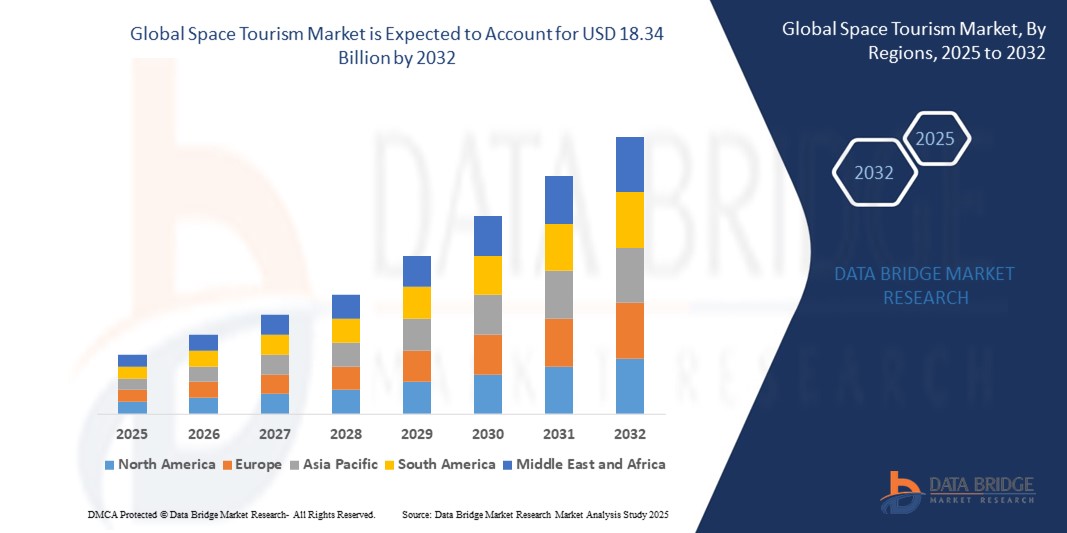
Space Tourism Market Size
- The global space tourism market size was valued at USD 1.23 billion in 2024 and is expected to reach USD 18.34 billion by 2032, at a CAGR of 40.2% during the forecast period
- The market growth is primarily driven by advancements in space exploration technologies, increasing interest in unique travel experiences, and growing investments in commercial space ventures
- Rising demand from high-net-worth individuals (HNWIs) for exclusive and adventurous experiences, coupled with the development of reusable launch vehicles and space tourism infrastructure, is accelerating market expansion
Space Tourism Market Analysis
- Space tourism, encompassing sub-orbital flights, orbital experiences, lunar voyages, inter-planetary missions, and emerging space hotel concepts, is becoming a transformative segment of the global tourism and aerospace industries
- The demand for space tourism is fueled by increasing consumer interest in novel experiences, advancements in reusable rocket technology, and growing collaborations between private space companies and governments
- North America dominated the space tourism market with the largest revenue share of 42.5% in 2024, driven by the presence of leading space companies, significant investments in space infrastructure, and a strong base of high-net-worth individuals
- Asia-Pacific is expected to be the fastest-growing region during the forecast period, propelled by increasing investments in space programs, rising disposable incomes, and growing interest in space tourism among affluent populations
- The sub-orbital space tourism segment dominated the largest market revenue share in 2024 of 34.7% in 2024, driven by its relatively lower cost and quicker flight durations offered by companies such as Virgin Galactic and Blue Origin, making it more accessible to a broader range of adventure-seekers
Report Scope and Space Tourism Market Segmentation
|
Attributes |
Space Tourism Key Market Insights |
|
Segments Covered |
|
|
Countries Covered |
North America
Europe
Asia-Pacific
Middle East and Africa
South America
|
|
Key Market Players |
|
|
Market Opportunities |
|
|
Value Added Data Infosets |
In addition to the market insights such as market value, growth rate, market segments, geographical coverage, market players, and market scenario, the market report curated by the Data Bridge Market Research team includes in-depth expert analysis, import/export analysis, pricing analysis, production consumption analysis, and pestle analysis. |
Space Tourism Market Trends
“Increasing Integration of AI and Big Data Analytics”
- The global space tourism market is experiencing a notable trend of incorporating Artificial Intelligence (AI) and Big Data analytics to enhance operational efficiency and customer experience
- These technologies facilitate advanced data processing, providing insights into spacecraft performance, passenger behavior, and mission optimization
- AI-driven platforms are being developed to analyze flight data, enabling predictive maintenance to prevent system failures and enhance safety during space missions
- For instances, companies are leveraging AI to optimize mission trajectories and personalize passenger experiences, such as tailored in-space activities or real-time health monitoring for tourists
- This trend enhances the appeal of space tourism by offering safer, more customized experiences, attracting both High-Net-Worth Individuals (HNWIs) and commercial operators
- AI algorithms analyze vast datasets, including environmental conditions, passenger preferences, and spacecraft telemetry, to improve mission planning and operational reliability
Space Tourism Market Dynamics
Driver
“Rising Demand for Unique Space Experiences and Advanced Safety Features”
- Growing consumer interest in unique space experiences, such as weightlessness, Earth observation, and lunar visits, is a key driver for the global space tourism market
- Telematics and advanced systems enhance safety through features such as real-time spacecraft monitoring, automated emergency protocols, and precise navigation, appealing to safety-conscious HNWIs
- Government initiatives, such as NASA's partnerships with private companies such as SpaceX and Axiom Space, are promoting commercial space tourism, particularly in North America, which dominates the market with a 38.9% revenue share in 2024
- The proliferation of advanced communication technologies, including satellite-based internet and 5G, supports real-time data transmission, enabling sophisticated in-space services such as live streaming from orbit
- Major players, including SpaceX, Blue Origin, and Virgin Galactic, are increasingly offering integrated space tourism packages to meet consumer demand for exclusive, adventure-driven experiences
Restraint/Challenge
“High Costs and Safety/Regulatory Concerns”
- The high initial costs of spacecraft development, mission planning, and infrastructure, such as spaceports, pose a significant barrier to market adoption, particularly in emerging markets
- Integrating advanced systems into spacecraft is complex and expensive, limiting accessibility for non-HNWI consumers and smaller operators
- Safety concerns, including the inherent risks of space travel and regulatory uncertainties around space tourism operations remain major challenges
- Data security and privacy issues arise from collecting sensitive passenger and mission data, with concerns about breaches and compliance with international regulations, especially in regions with stringent data protection laws
- The fragmented global regulatory landscape for space tourism, varying by country, complicates operations for companies such as SpaceX and Virgin Galactic, potentially slowing market growth in cost-sensitive or highly regulated regions
Space Tourism market Scope
The market is segmented on the basis of type, end user, HNW communities, and sales channel.
- By Type
On the basis of type, the global space tourism market is segmented into Sub-Orbital Space Tourism, Orbital Space Tourism, Lunar Tourism, Inter-Planetary Tourism, and Space Hotel Tourism. The sub-orbital space tourism segment dominated the largest market revenue share in 2024 of 34.7% in 2024, driven by its relatively lower cost and quicker flight durations offered by companies such as Virgin Galactic and Blue Origin, making it more accessible to a broader range of adventure-seekers.
The Orbital Space Tourism segment is expected to witness the fastest growth rate from 2025 to 2032. This growth is anticipated due to continued advancements in spacecraft technology, increased private investment, and the potential for longer, more immersive experiences, including stays on future space stations.
- By End User
On the basis of end user, the global space tourism market is segmented into Government, Commercial, and Others. The Commercial segment held the largest market revenue share in 2024, primarily driven by the significant investments and initiatives from private space companies focused on developing and offering space tourism experiences to the general public.
The Government segment is anticipated to experience robust growth from 2025 to 2032. This is fueled by increasing government support through regulatory frameworks, research and development funding, and partnerships with private entities to foster the overall space economy and enable commercial space endeavors.
- By HNW Communities
On the basis of HNW Communities, the global space tourism market is segmented into 20M to 40M, 40M to 60M, and More than Above Ranges. The "More than Above Ranges" segment (Ultra-High Net Worth Individuals) is expected to hold a significant market revenue share, as these individuals are the primary early adopters of high-cost space tourism experiences. Their considerable financial capacity allows them to invest in exclusive and pioneering space travel opportunities.
The 20M to 40M segment is expected to witness substantial growth from 2025 to 2032. As space tourism becomes more established and costs potentially decrease with technological advancements and increased competition, this segment is such asly to become a growing target market, seeking unique and aspirational travel experiences.
- By Sales Channel
On the basis of sales channel, the global space tourism market is segmented into Launch Provider, Third-Party Partnership, and OTAs. The Launch Provider segment is expected to hold the largest market revenue share, as companies directly offering space flights have been the primary point of sale for space tourism tickets.
The Third-Party Partnership segment is anticipated to witness the fastest growth from 2025 to 2032. This is driven by the potential for specialized travel agencies and luxury experience providers to offer curated space tourism packages, handle complex logistics, and cater to the specific needs and desires of high-net-worth clients, thereby expanding market reach and enhancing customer experience.
Space Tourism Market Regional Analysis
- North America dominated the space tourism market with the largest revenue share of 42.5% in 2024, driven by the presence of leading space companies, significant investments in space infrastructure, and a strong base of high-net-worth individuals
- Consumers prioritize space tourism for its unparalleled adventure, offering weightlessness, Earth observation, and exclusive experiences, particularly in regions with strong technological infrastructure and affluent populations
- Growth is supported by advancements in reusable rocket technology, spacecraft safety, and expanding commercial offerings, including sub-orbital and orbital flights, with increasing interest in lunar and space hotel tourism
U.S. Space Tourism Market Insight
The U.S. space tourism market captured the largest revenue share of 77.6% in 2024 within North America, fueled by strong commercial demand and growing consumer interest in sub-orbital and orbital experiences. Companies such as SpaceX, Blue Origin, and Virgin Galactic lead with innovative offerings, supported by NASA partnerships and a high concentration of HNWIs. The trend toward customized space experiences and regulatory support for commercial spaceflight further boosts market expansion.
Europe Space Tourism Market Insight
The European space tourism market is expected to witness significant growth, supported by a rich space exploration heritage and increasing investments in commercial space ventures. Consumers seek sub-orbital and orbital experiences that offer weightlessness and Earth views while adhering to strict safety regulations. Growth is prominent in both commercial and government-backed initiatives, with countries such as Russia and the U.K. showing notable uptake due to their space infrastructure and consumer interest.
U.K. Space Tourism Market Insight
The U.K. market for space tourism is expected to witness rapid growth, driven by increasing demand for sub-orbital flights and unique space experiences in urban and affluent settings. Growing awareness of the prestige and adventure associated with space travel encourages adoption. Evolving regulatory frameworks ensure safety while supporting commercial ventures, with partnerships between private companies and government agencies enhancing market growth.
Germany Space Tourism Market Insight
Germany is expected to witness a high growth rate in the space tourism market, attributed to its advanced aerospace sector and strong consumer interest in innovative space experiences. German consumers prefer technologically advanced solutions, such as sub-orbital flights and potential lunar tourism, that offer adventure and scientific opportunities. The integration of space tourism in premium travel packages and collaborations with European space agencies supports sustained market growth.
Asia-Pacific Space Tourism Market Insight
The Asia-Pacific region is expected to witness the fastest growth rate, driven by expanding space programs and rising disposable incomes in countries such as China, India, and Japan. Increasing awareness of space tourism’s unique experiences, including weightlessness and Earth observation, boosts demand. Government initiatives promoting space exploration and private-sector investments in advanced spacecraft technologies further encourage market expansion.
Japan Space Tourism Market Insight
Japan’s space tourism market is expected to witness rapid growth due to strong consumer preference for high-quality, technologically advanced space experiences that enhance adventure and prestige. The presence of major aerospace players and government support through agencies such as JAXA accelerates market penetration. Rising interest in lunar tourism, such as SpaceX’s dearMoon project, and aftermarket space travel options also contribute to growth.
China Space Tourism Market Insight
China holds the largest share of the Asia-Pacific space tourism market, propelled by rapid urbanization, increasing HNWI populations, and growing demand for exclusive space travel experiences. The country’s expanding space program, led by the China National Space Administration (CNSA), supports the adoption of sub-orbital and orbital tourism. Strong domestic aerospace capabilities and competitive pricing enhance market accessibility, driving significant growth.
Space Tourism Market Share
The space tourism industry is primarily led by well-established companies, including:
- Virgin Galactic (U.S.)
- Boeing (U.S.)
- SPACEX (U.S.)
- BLUE ORIGIN (U.S.)
- SPACE ADVENTURES (U.S.)
- Bigelow Aerospace (U.S.)
- Lockheed Martin Corporation (U.S.)
- ROCKET LAB USA (U.S.)
- MITSUBISHI HEAVY INDUSTRIES LTD. (Japan)
- Elysium Space, Inc. (U.S.)
- fireflyspace (U.S.)
- China Aerospace Science and Technology Corporation (China)
- World View Enterprises, Inc. (U.S.)
- Space Perspective (U.S.)
What are the Recent Developments in Global Space Tourism Market?
- In January 2024, Axiom Space launched its third private astronaut mission, Ax-3, to the International Space Station (ISS), marking a significant milestone in commercial spaceflight. The multinational crew conducted over 30 scientific experiments during their 21-day stay, showcasing the expanding role of private companies in low Earth orbit exploration. Ax-3 exemplifies the shift toward accessible space travel, enabling broader international participation and laying the groundwork for future space tourism and research initiatives. This mission reflects the growing collaboration between private enterprises and global space agencies to advance human presence beyond Earth
- In June 2024, Blue Origin’s New Shepard spacecraft completed a successful suborbital flight carrying six international passengers, including individuals from Panama, Canada, and New Zealand. The mission marked the company’s 12th crewed flight and highlighted its growing appeal to a global audience. Passengers experienced several minutes of weightlessness and breathtaking views of Earth before safely returning to the West Texas desert. This achievement underscores Blue Origin’s commitment to expanding its space tourism offerings beyond U.S. borders, reinforcing its position in the competitive commercial spaceflight industry
- In September 2024, SpaceX successfully launched the Polaris Dawn mission, the first of three planned private spaceflights under the Polaris Program. Led by billionaire Jared Isaacman, the crew of four spent nearly five days in orbit, reaching a record-breaking altitude of 1,408 km—the highest Earth orbit since Apollo. The mission featured the first-ever commercial spacewalk, tested Starlink laser communications in space, and conducted research on radiation exposure, decompression sickness, and neuro-ocular health effects. Polaris Dawn represents a major leap in commercial spaceflight, blending scientific advancement with the growing potential of space tourism
- In March 2024, Blue Origin unveiled the operational capabilities of its Blue Ring spacecraft during the DarkSky-1 mission, conducted in partnership with the U.S. Defense Innovation Unit. This demonstration validated key systems such as space-based data processing, telemetry, tracking and command (TT&C) hardware, and ground-based radiometric tracking. Blue Ring’s ability to maneuver across multiple orbits and support in-space logistics marks a significant advancement in orbital infrastructure. These capabilities could play a pivotal role in enabling future space tourism, satellite servicing, and broader commercial missions beyond low Earth orbit
- In December 2023, Space Perspective revealed its Excelsior capsule, the centerpiece of its near-space tourism initiative, Spaceship Neptune. Designed for stratospheric balloon flights, Excelsior features a spherical shape with panoramic vertical windows, plush seating, Wi-Fi, gourmet dining, and a Space Spa—all part of the company’s luxurious Space Lounge. The capsule accommodates eight passengers and a captain for a six-hour journey to the edge of space, lifted gently by a hydrogen-powered SpaceBalloon. With over 1,750 tickets already sold, Space Perspective plans to begin commercial flights in 2025, redefining accessible and sustainable space travel

- Interactive Data Analysis Dashboard
- Company Analysis Dashboard for high growth potential opportunities
- Research Analyst Access for customization & queries
- Competitor Analysis with Interactive dashboard
- Latest News, Updates & Trend analysis
- Harness the Power of Benchmark Analysis for Comprehensive Competitor Tracking
Data collection and base year analysis are done using data collection modules with large sample sizes. The stage includes obtaining market information or related data through various sources and strategies. It includes examining and planning all the data acquired from the past in advance. It likewise envelops the examination of information inconsistencies seen across different information sources. The market data is analysed and estimated using market statistical and coherent models. Also, market share analysis and key trend analysis are the major success factors in the market report. To know more, please request an analyst call or drop down your inquiry.
The key research methodology used by DBMR research team is data triangulation which involves data mining, analysis of the impact of data variables on the market and primary (industry expert) validation. Data models include Vendor Positioning Grid, Market Time Line Analysis, Market Overview and Guide, Company Positioning Grid, Patent Analysis, Pricing Analysis, Company Market Share Analysis, Standards of Measurement, Global versus Regional and Vendor Share Analysis. To know more about the research methodology, drop in an inquiry to speak to our industry experts.
Data Bridge Market Research is a leader in advanced formative research. We take pride in servicing our existing and new customers with data and analysis that match and suits their goal. The report can be customized to include price trend analysis of target brands understanding the market for additional countries (ask for the list of countries), clinical trial results data, literature review, refurbished market and product base analysis. Market analysis of target competitors can be analyzed from technology-based analysis to market portfolio strategies. We can add as many competitors that you require data about in the format and data style you are looking for. Our team of analysts can also provide you data in crude raw excel files pivot tables (Fact book) or can assist you in creating presentations from the data sets available in the report.













