


Spare Parts Management (SPM) Market Overview
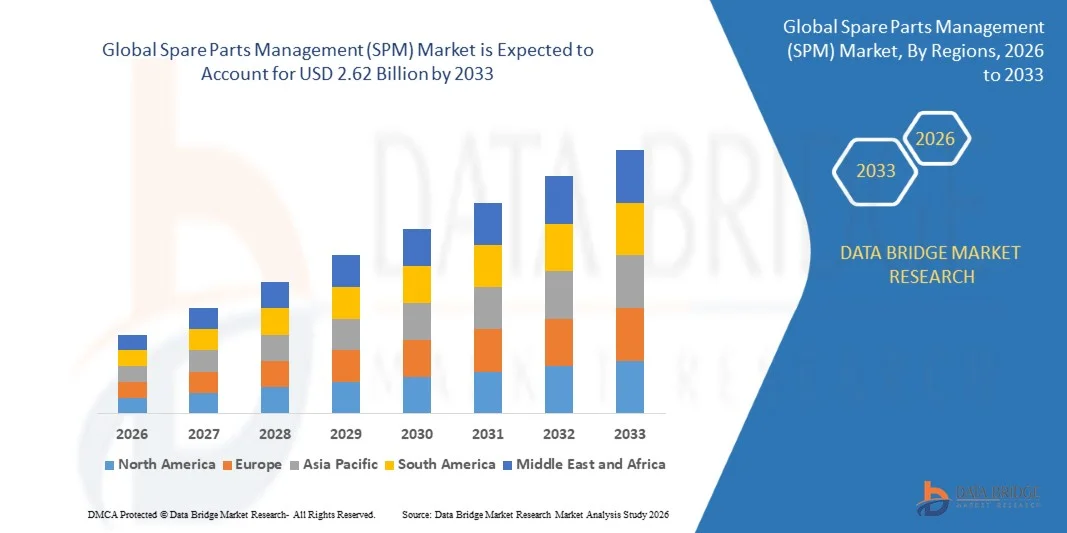
The Spare Parts Management (SPM) Market was valued at USD 1.20 billion in 2025 and is projected to reach USD 2.62 billion by 2033, growing at a CAGR of 10.30% from 2026 to 2033. The market is witnessing strong growth driven by increasing demand for efficient inventory optimization, rising adoption of digital supply chain solutions, and growing need to reduce equipment downtime across manufacturing and industrial sectors.
The expansion of Industry 4.0 technologies, such as IoT-enabled asset tracking, predictive maintenance, and AI-driven inventory forecasting, is significantly improving spare parts visibility and demand planning accuracy. Organizations across automotive, aerospace, energy, and heavy machinery industries are increasingly shifting toward centralized and automated spare parts management systems to enhance operational efficiency and reduce maintenance costs while ensuring uninterrupted production cycles.
Key Market Trends & Insights
- North America dominated the spare parts management (SPM) market with the largest revenue share of approximately 38.6% in 2025, supported by strong adoption of advanced supply chain digitalization, widespread implementation of Industry 4.0 technologies, and high penetration of cloud-based enterprise asset management systems.
- Asia-Pacific SPM market is expected to witness the fastest growth rate from 2026 to 2033, supported by rapid industrialization, expansion of manufacturing hubs, and increasing adoption of digital supply chain solutions in countries such as China, India, and Japan.
- The Software segment held the largest market revenue share of approximately 68.2% in 2025 driven by strong adoption of cloud-based inventory platforms, AI-powered forecasting tools, and ERP-integrated spare parts tracking systems across manufacturing and automotive industries. Organizations prefer software solutions due to real-time visibility, automated stock replenishment, and improved demand forecasting accuracy across global supply chains.
- The Services segment is projected to register steady growth with a significant CAGR of around 9.6% from 2026 to 2033, driven by increasing demand for implementation, consulting, system integration, and managed services. Growing complexity of digital transformation projects and rising need for customized deployment across enterprise ecosystems are further supporting segment expansion.
- The Cloud segment dominated the market with a revenue share of approximately 62.5% in 2025 due to increasing adoption of scalable SaaS-based spare parts platforms, lower infrastructure costs, and remote accessibility across multi-location operations. Cloud deployment is widely preferred by enterprises for real-time data synchronization and predictive maintenance integration.
- The On-premise segment is expected to grow at a moderate pace, accounting for around 37.5% market share, driven by strong adoption in highly regulated industries such as aerospace, defense, and energy where data security and internal control remain critical priorities.
- . Inventory Management held the largest share of approximately 24.1% in 2025 due to rising demand for optimized stock levels, reduced equipment downtime, and improved spare parts visibility across industrial operations.
- Supplier Management accounted for around 18.3%, supported by growing need for streamlined vendor coordination and supply chain transparency, while Procurement Management held approximately 16.4% share driven by automation of purchasing workflows. Warehouse Management contributed nearly 14.2% due to increasing adoption of smart warehousing systems, and Lifecycle Management accounted for around 12.6% driven by demand for predictive asset tracking. The Others segment held approximately 14.4%, covering niche optimization and analytics-based solutions.
- Manufacturing held the largest market share of approximately 28.3% in 2025 driven by high equipment dependency and continuous production requirements that demand efficient spare parts availability.
- Automotive accounted for around 22.6% supported by growing vehicle production and aftermarket service networks, while Aerospace & Defense held approximately 14.2% due to strict maintenance requirements and mission-critical component reliability. Energy & Utilities represented nearly 12.4% driven by aging infrastructure upgrades, Construction & Mining accounted for 10.1% due to heavy machinery maintenance needs, Transportation & Logistics held around 9.3%, and the Others segment contributed approximately 3.1% driven by smaller industrial applications.
Market Size & Forecast
- Global Market Value (2025): USD 1.20 Billion
- Expected Market Value (2033): USD 2.62 Billion
- Forecast CAGR (2026–2033): 10.30%
- Leading Region in 2025: North America
- Fastest Growing Region: Asia-Pacific
Report Scope and Spare Parts Management (SPM) Market Segmentation
|
Attributes |
Spare Parts Management (SPM) Key Market Insights |
|
Segments Covered |
· By Component: Software and Services · By Deployment: Cloud and On-premise · By Solution: Inventory Management, Supplier Management, Procurement Management, Warehouse Management, Lifecycle Management, and Others · By End Use: Automotive, Manufacturing, Aerospace & Defense, Energy & Utilities, Construction & Mining, Transportation & Logistics, and Others |
|
Countries Covered |
North America · U.S. · Canada · Mexico Europe · Germany · France · U.K. · Netherlands · Switzerland · Belgium · Russia · Italy · Spain · Turkey · Rest of Europe Asia-Pacific · China · Japan · India · South Korea · Singapore · Malaysia · Australia · Thailand · Indonesia · Philippines · Rest of Asia-Pacific Middle East and Africa · Saudi Arabia · U.A.E. · South Africa · Egypt · Israel · Rest of Middle East and Africa South America · Brazil · Argentina · Rest of South America |
|
Key Market Players |
• Advanced Technology Services, Inc. (U.S.) |
|
Market Opportunities |
· Expansion Of Predictive Maintenance Solutions · Growth In Cloud-Based Spare Parts Management Platforms |
|
Value Added Data Infosets |
In addition to the market insights such as market value, growth rate, market segments, geographical coverage, market players, and market scenario, the market report curated by the Data Bridge Market Research team includes in-depth expert analysis, import/export analysis, pricing analysis, production consumption analysis, and pestle analysis. |
Spare Parts Management (SPM) Market Trends
Trend: Growth In Digitalization, Predictive Analytics, And Automated Spare Parts Management Systems
Rising demand for real-time inventory visibility, reduced equipment downtime, and cost-efficient maintenance operations is driving the adoption of digital spare parts management solutions across manufacturing, automotive, aerospace, and energy industries. Traditional manual inventory tracking systems are increasingly being replaced by cloud-based platforms and AI-driven forecasting tools that enable accurate demand prediction, automated replenishment, and optimized stock levels.
In modern manufacturing ecosystems, companies are integrating IoT-enabled sensors and ERP-based spare parts tracking systems, For instance Siemens and similar industrial OEMs have deployed predictive maintenance frameworks that reduce unplanned downtime by up to 30–40% through improved spare parts availability and automated alerts. In the automotive sector, connected supply chain platforms are being used to synchronize spare parts distribution across global dealer networks, improving order fulfillment speed and reducing excess inventory holding costs.
The rapid expansion of Industry 4.0 and smart factory initiatives is also increasing demand for centralized spare parts management systems capable of integrating with robotics, machine learning algorithms, and digital twins. In addition, aerospace and defense organizations rely heavily on advanced SPM platforms, such as Boeing’s digital supply chain systems, to ensure mission-critical component availability and reduce aircraft grounding time. Growing implementation of cloud-based enterprise asset management systems in 2025 across large-scale industrial facilities has demonstrated inventory cost reductions of nearly 15–25% through optimized spare parts utilization.
Spare Parts Management (SPM) Market Dynamics
Key Market Driver: Rising Adoption Of Predictive Maintenance And Supply Chain Digitization
Industries worldwide are increasingly focusing on reducing operational downtime, improving asset reliability, and enhancing supply chain efficiency, which is significantly driving demand for advanced spare parts management solutions. Large-scale industrial operations generate massive volumes of equipment usage data that can be leveraged to predict component failures and ensure timely spare parts replacement.
Manufacturing and energy companies are deploying AI-based predictive maintenance systems that automatically trigger spare parts procurement before equipment failure occurs, reducing maintenance delays and production losses. Automotive OEMs and Tier-1 suppliers are increasingly integrating digital spare parts platforms with ERP and warehouse management systems to streamline global inventory flow and reduce excess stock levels.
For instance, General Electric’s industrial digital platforms have reported maintenance cost reductions of around 10–20% through predictive analytics-driven spare parts optimization in turbine and heavy equipment operations. Similarly, logistics-heavy industries such as oil and gas are leveraging cloud-based inventory systems to improve spare parts traceability and reduce emergency procurement costs in remote operations.
Key Restraint/Challenge: High Implementation Costs And Integration Complexity With Legacy Systems
Despite strong adoption momentum, the spare parts management market faces challenges related to high initial deployment costs and complex integration with existing legacy enterprise systems. Many mid-sized enterprises continue to rely on fragmented inventory systems that are difficult to synchronize with modern cloud-based SPM platforms, leading to operational inefficiencies during transition phases.
In addition, customization requirements across different industries such as automotive, aerospace, and heavy machinery increase software deployment complexity and extend implementation timelines. Limited interoperability between older ERP systems and new AI-driven platforms further restricts seamless data exchange and real-time inventory tracking capabilities.
Enterprise adoption studies indicate that large-scale digital transformation projects involving spare parts management systems can require implementation timelines of 6–18 months, with integration-related costs accounting for nearly 25–35% of total deployment budgets, particularly in organizations with highly complex global supply chains.
Key Market Opportunity: Expansion Of Cloud-Based Platforms, IoT Integration, And AI-Driven Inventory Optimization
Growing adoption of cloud computing, IoT-enabled asset tracking, and artificial intelligence is creating significant opportunities in the global spare parts management market. Enterprises are increasingly shifting toward scalable, subscription-based SPM platforms that enable real-time inventory visibility across multiple locations and reduce dependency on manual forecasting methods.
In industrial environments, IoT sensors embedded in machinery are being used to monitor equipment health and automatically update spare parts demand forecasts based on usage patterns and failure probabilities. Automotive and aerospace companies are leveraging AI-driven analytics platforms to optimize global spare parts distribution networks and reduce lead times for critical components.
For instance, major industrial automation firms such as Schneider Electric have implemented cloud-based asset management systems that improve spare parts availability accuracy by over 20–30% while reducing stockouts in critical operations. In addition, rapid adoption of digital twin technology in 2025 across manufacturing facilities in Europe and Asia-Pacific is enabling real-time simulation of equipment wear and spare parts lifecycle prediction, significantly enhancing operational efficiency and cost savings.
Spare Parts Management (SPM) Market Scope
The market is segmented on the basis of component, deployment, solution, and end-use application.
- By Component
On the basis of component, the spare parts management (SPM) market is segmented into Software and Services. The Software segment held the largest market revenue share of approximately 68.2% in 2025 driven by strong adoption of cloud-based inventory platforms, AI-powered forecasting tools, and ERP-integrated spare parts tracking systems across manufacturing and automotive industries. Organizations prefer software solutions due to real-time visibility, automated stock replenishment, and improved demand forecasting accuracy across global supply chains.
The Services segment is projected to register steady growth with a significant CAGR of around 9.6% from 2026 to 2033, driven by increasing demand for implementation, consulting, system integration, and managed services. Growing complexity of digital transformation projects and rising need for customized deployment across enterprise ecosystems are further supporting segment expansion.
- By Deployment
On the basis of deployment, the market is segmented into Cloud and On-premise. The Cloud segment dominated the market with a revenue share of approximately 62.5% in 2025 due to increasing adoption of scalable SaaS-based spare parts platforms, lower infrastructure costs, and remote accessibility across multi-location operations. Cloud deployment is widely preferred by enterprises for real-time data synchronization and predictive maintenance integration.
The On-premise segment is expected to grow at a moderate pace, accounting for around 37.5% market share, driven by strong adoption in highly regulated industries such as aerospace, defense, and energy where data security and internal control remain critical priorities.
- By Solution
On the basis of solution, the market is segmented into Inventory Management, Supplier Management, Procurement Management, Warehouse Management, Lifecycle Management, and Others. Inventory Management held the largest share of approximately 24.1% in 2025 due to rising demand for optimized stock levels, reduced equipment downtime, and improved spare parts visibility across industrial operations.
Supplier Management accounted for around 18.3%, supported by growing need for streamlined vendor coordination and supply chain transparency, while Procurement Management held approximately 16.4% share driven by automation of purchasing workflows. Warehouse Management contributed nearly 14.2% due to increasing adoption of smart warehousing systems, and Lifecycle Management accounted for around 12.6% driven by demand for predictive asset tracking. The Others segment held approximately 14.4%, covering niche optimization and analytics-based solutions.
- By End Use
On the basis of end-use application, the market is segmented into Automotive, Manufacturing, Aerospace & Defense, Energy & Utilities, Construction & Mining, Transportation & Logistics, and Others. Manufacturing held the largest market share of approximately 28.3% in 2025 driven by high equipment dependency and continuous production requirements that demand efficient spare parts availability.
Automotive accounted for around 22.6% supported by growing vehicle production and aftermarket service networks, while Aerospace & Defense held approximately 14.2% due to strict maintenance requirements and mission-critical component reliability. Energy & Utilities represented nearly 12.4% driven by aging infrastructure upgrades, Construction & Mining accounted for 10.1% due to heavy machinery maintenance needs, Transportation & Logistics held around 9.3%, and the Others segment contributed approximately 3.1% driven by smaller industrial applications.
Spare Parts Management (SPM) Market Regional Analysis
North America Spare Parts Management (SPM) Market Insight
North America dominated the spare parts management (SPM) market with the largest revenue share of approximately 38.6% in 2025, supported by strong adoption of advanced supply chain digitalization, widespread implementation of Industry 4.0 technologies, and high penetration of cloud-based enterprise asset management systems. Enterprises in the region prioritize predictive maintenance, real-time inventory visibility, and AI-driven demand forecasting to reduce equipment downtime and optimize spare parts utilization across complex industrial operations. The presence of advanced manufacturing infrastructure, high IT spending capacity, and early adoption of automation technologies further strengthens regional market leadership.
U.S. Spare Parts Management (SPM) Market Insight
The U.S. SPM market captured the largest revenue share within North America in 2025, driven by rapid deployment of AI-powered inventory optimization platforms, strong industrial digitization, and increasing integration of ERP and IoT-based asset tracking systems. Major industries such as automotive, aerospace, and energy are increasingly relying on predictive maintenance frameworks to ensure spare parts availability and reduce operational disruptions. For instance, large-scale manufacturing facilities in the U.S. have reported up to 20–30% reduction in maintenance downtime through adoption of automated spare parts tracking and forecasting systems integrated with digital twin technologies.
Europe Spare Parts Management (SPM) Market Insight
The Europe SPM market is expected to witness the fastest growth rate from 2026 to 2033, primarily driven by strict industrial efficiency regulations, growing focus on sustainability, and increasing adoption of digital supply chain transformation initiatives. European manufacturers are increasingly implementing cloud-based spare parts platforms to improve transparency, reduce waste, and enhance asset lifecycle management. The region is also witnessing strong adoption of predictive maintenance systems across automotive, energy, and heavy machinery sectors, with Germany, France, and the U.K. leading implementation due to strong industrial automation capabilities.
U.K. Spare Parts Management (SPM) Market Insight
The U.K. SPM market is expected to witness strong growth from 2026 to 2033, driven by increasing adoption of smart manufacturing systems, rising demand for efficient inventory optimization, and growing focus on reducing operational costs in industrial and logistics sectors. Companies are increasingly shifting toward cloud-based spare parts platforms integrated with AI analytics to improve procurement efficiency and reduce equipment failure risks. The expansion of advanced manufacturing clusters and growing digital transformation in maintenance operations are further supporting market growth.
Germany Spare Parts Management (SPM) Market Insight
The Germany SPM market is expected to witness strong growth from 2026 to 2033, fueled by the country’s leadership in industrial automation, strong engineering base, and increasing integration of Industry 4.0 technologies. German manufacturers are adopting advanced predictive maintenance and digital twin solutions to optimize spare parts usage and improve machine uptime. For instance, automotive and machinery sectors in Germany are increasingly deploying IoT-enabled monitoring systems that help reduce unplanned downtime by nearly 25–35% through improved spare parts forecasting and maintenance planning.
Asia-Pacific Spare Parts Management (SPM) Market Insight
The Asia-Pacific SPM market is expected to witness the fastest growth rate from 2026 to 2033, supported by rapid industrialization, expansion of manufacturing hubs, and increasing adoption of digital supply chain solutions in countries such as China, India, and Japan. The region is experiencing strong demand for cost-effective and scalable spare parts management systems due to growing production volumes and expanding industrial infrastructure. Government initiatives promoting smart manufacturing and digital transformation are further accelerating market adoption across automotive, electronics, and heavy engineering sectors.
Japan Spare Parts Management (SPM) Market Insight
The Japan SPM market is expected to witness steady growth from 2026 to 2033 due to its highly advanced manufacturing ecosystem, strong emphasis on operational efficiency, and early adoption of robotics and automation technologies. Japanese industries are increasingly integrating AI-driven spare parts forecasting systems with factory automation platforms to ensure uninterrupted production. For instance, leading electronics and automotive manufacturers in Japan have implemented predictive maintenance systems that improve spare parts availability accuracy by over 20–30%, reducing machine downtime in high-precision manufacturing environments.
China Spare Parts Management (SPM) Market Insight
The China SPM market accounted for the largest revenue share in Asia-Pacific in 2025, driven by rapid industrial expansion, strong manufacturing output, and large-scale adoption of smart factory initiatives under national digitalization programs. Chinese enterprises are increasingly investing in cloud-based inventory systems and AI-enabled supply chain platforms to enhance spare parts efficiency and reduce production delays. For instance, large manufacturing clusters in China have reported significant improvements in inventory turnover rates and up to 15–25% reduction in spare parts holding costs through implementation of automated procurement and forecasting systems.
Spare Parts Management (SPM) Market Share
The Spare Parts Management (SPM) industry is primarily led by well-established companies, including:
• Advanced Technology Services, Inc. (U.S.)
• Alterity, LLC (U.S.)
• Argon & Co (France)
• Cognascents (U.S.)
• Deloitte (U.K.)
• DEX (U.S.)
• Kinaxis Inc. (Canada)
• KSB (Germany)
• Linde PLC (Ireland)
• NRX AssetHub (U.S.)
• PTC (U.S.)
• S.A. Talke (Germany)
• Schneider Electric (France)
• SDI, Inc. (U.S.)
• Verusen (U.S.)
Latest Developments in Spare Parts Management (SPM) Market
- In March 2025, Verusen, a strategic partnership expansion, enhanced its collaboration with Advanced Technology Services, Inc. to strengthen AI-driven industrial maintenance solutions. The development involves integrating Verusen’s AI-powered platform with ATS’s industrial maintenance and reliability expertise. It is expected to enable manufacturers to improve demand forecasting, inventory optimization, and spare parts management across MRO supply chains. This collaboration enhances real-time data visibility and decision-making capabilities for industrial operators. The impact on the market includes improved operational efficiency, reduced downtime, and stronger adoption of AI-enabled spare parts management solutions across manufacturing industries.

- Interactive Data Analysis Dashboard
- Company Analysis Dashboard for high growth potential opportunities
- Research Analyst Access for customization & queries
- Competitor Analysis with Interactive dashboard
- Latest News, Updates & Trend analysis
- Harness the Power of Benchmark Analysis for Comprehensive Competitor Tracking
Data collection and base year analysis are done using data collection modules with large sample sizes. The stage includes obtaining market information or related data through various sources and strategies. It includes examining and planning all the data acquired from the past in advance. It likewise envelops the examination of information inconsistencies seen across different information sources. The market data is analysed and estimated using market statistical and coherent models. Also, market share analysis and key trend analysis are the major success factors in the market report. To know more, please request an analyst call or drop down your inquiry.
The key research methodology used by DBMR research team is data triangulation which involves data mining, analysis of the impact of data variables on the market and primary (industry expert) validation. Data models include Vendor Positioning Grid, Market Time Line Analysis, Market Overview and Guide, Company Positioning Grid, Patent Analysis, Pricing Analysis, Company Market Share Analysis, Standards of Measurement, Global versus Regional and Vendor Share Analysis. To know more about the research methodology, drop in an inquiry to speak to our industry experts.
Data Bridge Market Research is a leader in advanced formative research. We take pride in servicing our existing and new customers with data and analysis that match and suits their goal. The report can be customized to include price trend analysis of target brands understanding the market for additional countries (ask for the list of countries), clinical trial results data, literature review, refurbished market and product base analysis. Market analysis of target competitors can be analyzed from technology-based analysis to market portfolio strategies. We can add as many competitors that you require data about in the format and data style you are looking for. Our team of analysts can also provide you data in crude raw excel files pivot tables (Fact book) or can assist you in creating presentations from the data sets available in the report.













