


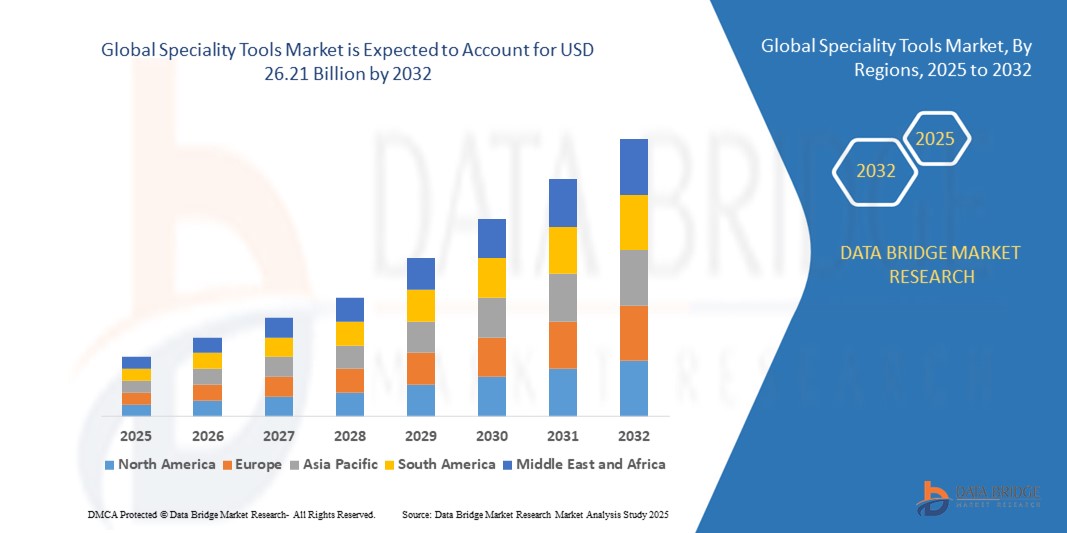
Speciality Tools Market Size
- The global speciality tools market size was valued at USD 17.74 billion in 2024 and is expected to reach USD 26.21 billion by 2032, at a CAGR of 5.0% during the forecast period
- The market growth is largely fueled by increasing industrialization, expansion of construction and manufacturing sectors, and rising demand for high-performance, durable, and precision tools across professional and DIY applications
- Furthermore, technological advancements such as cordless, ergonomic, and IoT-enabled tools, combined with the growing need for efficiency, productivity, and safety in industrial and construction operations, are driving the adoption of specialty tools. These converging factors are accelerating the uptake of advanced hand and power tools, thereby significantly boosting the market’s growth
Speciality Tools Market Analysis
- Specialty tools include hand tools, power tools, and industrial equipment designed for precise, durable, and efficient operations across construction, automotive, manufacturing, and maintenance applications. These tools cater to professionals and artisans while addressing evolving industry requirements
- The escalating demand for specialty tools is primarily driven by rapid industrialization, modernization of manufacturing processes, increasing construction activities, and growing adoption of smart and ergonomically designed tools that enhance productivity, safety, and user experience across multiple sectors
- North America dominated the speciality tools market with a share of 32.44% in 2024, due to rising demand for advanced hand and power tools across construction, automotive, and manufacturing sectors
- Asia-Pacific is expected to be the fastest growing region in the speciality tools market during the forecast period due to rapid urbanization, increasing industrialization, and rising disposable incomes in countries such as China, Japan, and India
- Cutting tools segment dominated the market with a market share of 36.1% in 2024, due to its fundamental role across multiple industries such as construction, automotive, and manufacturing. Cutting tools are widely preferred due to their versatility, high precision, and ability to work with diverse materials, from metals to wood. The demand is further reinforced by the consistent need for tool replacement and upgrades, as well as advancements in materials that enhance durability and cutting efficiency. Professionals often rely on cutting tools for both industrial and DIY applications, ensuring steady revenue generation
Report Scope and Speciality Tools Market Segmentation
|
Attributes |
Speciality Tools Key Market Insights |
|
Segments Covered |
|
|
Countries Covered |
North America
Europe
Asia-Pacific
Middle East and Africa
South America
|
|
Key Market Players |
|
|
Market Opportunities |
|
|
Value Added Data Infosets |
In addition to the market insights such as market value, growth rate, market segments, geographical coverage, market players, and market scenario, the market report curated by the Data Bridge Market Research team includes in-depth expert analysis, import/export analysis, pricing analysis, production consumption analysis, and pestle analysis. |
Speciality Tools Market Trends
Rising Construction Activities
- Increasing construction activities worldwide, driven by urbanization, infrastructure development, and rising demand for residential and commercial spaces, are significantly boosting the speciality tools market, as these tools provide essential precision, safety, and productivity enhancements on construction sites
- For instance, companies such as Hilti Corporation have developed semi-automated construction robots such as Jaibot, which autonomously perform drilling tasks with enhanced accuracy and safety, addressing the increasing complexity and scale of construction projects
- Expansion in both public and private sector construction projects, including new infrastructure, renovation, and maintenance work, is promoting demand for specialty tools that support specialized applications such as cutting, measuring, welding, and heavy lifting
- Technological advancements in specialty tools, including digital upgrades and integration with automation, improve operational efficiency and enable safer working conditions, fueling adoption in construction and allied industries
- Growing regulatory focus on occupational safety, environmental sustainability, and quality standards in construction requires precision tools that comply with strict guidelines and reduce labor risks
- Increasing investments in smart city projects and green building initiatives encourage the use of eco-friendly, energy-efficient, and high-performance specialty tools that align with sustainable construction goals
Speciality Tools Market Dynamics
Driver
Growing Demand in the Automotive Sector
- The automotive industry’s expansion and modernization, including the rise of electric vehicles and advanced manufacturing techniques, drive demand for specialized, high-precision tools critical for assembly, maintenance, and quality control
- For instance, major automotive manufacturers such as Toyota and Volkswagen rely on specialized tools for assembling complex vehicle components and maintaining stringent production standards, which boosts market growth for advanced tool solutions
- Increasing automation and digitalization in automotive manufacturing (Industry 4.0) require sophisticated tooling systems integrated with robotics and AI for precision and efficiency
- Customization and performance requirements in automotive repair and maintenance services promote the adoption of durable, versatile specialty tools designed for multifaceted applications
- Growing automotive aftermarket and increasing vehicle parc in emerging economies create steady replacement and upgrade demand for specialty tools deployed in servicing and retrofitting
Restraint/Challenge
High Initial Investment
- The specialty tools market faces substantial barriers due to the high capital costs associated with purchasing advanced, automated, and digitally integrated tools, limiting accessibility for small and medium enterprises and contractors
- For instance, construction and automotive companies aiming to adopt state-of-the-art automation and robotics-based specialty tools often encounter budget constraints exacerbated by fluctuating raw material costs and supply chain complexities
- Cost-intensive R&D and customization requirements for industry-specific tools increase production costs and limit economies of scale, impacting pricing and availability
- Integration of new specialty tools into existing workflows and legacy systems demands additional investment in training, software, and infrastructure upgrades, increasing upfront expenses
- Market entry barriers due to maintenance, calibration, and technological support needs, along with skilled labor shortages, heighten the total cost of ownership and delay ROI realization
Speciality Tools Market Scope
The market is segmented on the basis of product type, application, and end-user.
- By Product Type
On the basis of product type, the hand tools market is segmented into cutting tools, striking tools, fastening tools, measuring & layout tools, assembly & fastening tools, specialty plumbing tools, automotive specialty tools, electrical specialty tools, woodworking specialty tools, and masonry & concrete specialty tools. The cutting tools segment dominated the market with a share of 36.1% in 2024, driven by its fundamental role across multiple industries such as construction, automotive, and manufacturing. Cutting tools are widely preferred due to their versatility, high precision, and ability to work with diverse materials, from metals to wood. The demand is further reinforced by the consistent need for tool replacement and upgrades, as well as advancements in materials that enhance durability and cutting efficiency. Professionals often rely on cutting tools for both industrial and DIY applications, ensuring steady revenue generation. The segment’s dominance is also supported by the development of ergonomically designed and power-assisted cutting solutions, which improve productivity while reducing manual effort.
The fastening tools segment is anticipated to witness the fastest growth rate from 2025 to 2032, fueled by increasing automation in industrial assembly lines and rising demand in the automotive and construction sectors. Fastening tools facilitate faster, precise, and repeatable connections, making them crucial for efficient operations. Growing adoption of modular construction techniques and smart assembly solutions is further accelerating the uptake of fastening tools. Innovations in cordless, pneumatic, and electrically powered fastening tools also drive adoption by enhancing ease of use and mobility. The segment benefits from its compatibility with both professional trades and DIY enthusiasts, expanding the customer base globally.
- By Application
On the basis of application, the hand tools market is segmented into construction & carpentry, automotive repair & maintenance, plumbing & pipefitting, electrical work, woodworking & furniture making, metalworking & machining, gardening & landscaping, DIY projects, and industrial maintenance. The construction & carpentry segment dominated the market in 2024 due to the ongoing growth of residential, commercial, and infrastructure projects worldwide. Professionals in this sector rely heavily on reliable hand tools for cutting, fastening, measuring, and assembling materials. The demand is further supported by technological upgrades in tools that offer better precision, ergonomics, and productivity. Construction and carpentry work also often require a wide range of tool types, making this segment a consistent revenue driver. In addition, the growth of modular and prefabricated construction techniques has increased the need for specialized hand tools that simplify on-site work.
The automotive repair & maintenance segment is expected to witness the fastest CAGR from 2025 to 2032, driven by the global expansion of automotive manufacturing and increasing vehicle ownership. Technicians require a diverse range of hand tools for repair, diagnostics, and assembly operations. The rise in electric vehicles and hybrid cars is also fueling demand for specialized tools that handle new components safely and efficiently. Advancements in lightweight, ergonomic, and high-durability tools are making automotive repair processes faster and more efficient. The segment’s growth is further strengthened by workshops and service centers seeking standardized and versatile toolkits to enhance productivity.
- By End-User
On the basis of end-user, the hand tools market is segmented into construction, automotive, manufacturing, aerospace & defense, oil & gas, electrical & electronics, plumbing, woodworking & furniture, gardening & landscaping, and home improvement. The construction segment dominated the market in 2024 due to the high reliance on hand tools for a variety of tasks including cutting, assembling, measuring, and finishing. The ongoing urbanization and infrastructure expansion globally sustain consistent demand. Construction professionals prioritize tools that offer durability, accuracy, and ergonomics, ensuring reliable performance across multiple projects. The dominance is further supported by the widespread use of both traditional and power-assisted hand tools in commercial and residential construction projects. In addition, construction companies often invest in premium tools to reduce downtime and improve efficiency, boosting market revenue.
The automotive segment is projected to register the fastest growth from 2025 to 2032, driven by the rising number of vehicle production facilities, repair workshops, and specialized service centers. Hand tools are essential for assembly, maintenance, and repair operations in automotive industries. The shift toward electric and hybrid vehicles is further encouraging the adoption of advanced hand tools designed for precise and safe operations. Growing aftermarket service requirements and vehicle customization trends are also expanding demand. Enhanced ergonomics, portability, and technological integration in automotive hand tools increase efficiency and productivity, positioning this segment for rapid growth.
Speciality Tools Market Regional Analysis
- North America dominated the speciality tools market with the largest revenue share of 32.44% in 2024, driven by rising demand for advanced hand and power tools across construction, automotive, and manufacturing sectors
- Consumers in the region prioritize high-quality, durable, and technologically advanced tools that enhance productivity and efficiency in both professional and DIY applications
- This widespread adoption is supported by high industrialization, strong infrastructure development, and a skilled workforce, establishing specialty tools as essential across residential, commercial, and industrial projects
U.S. Specialty Tools Market Insight
The U.S. specialty tools market captured the largest revenue share in North America in 2024, fueled by the rapid modernization of manufacturing facilities and the expansion of construction and automotive industries. Rising adoption of precision and ergonomically designed tools is driving demand, alongside the increasing trend of DIY projects. Integration of smart tool technologies, such as digital measuring systems and IoT-enabled equipment, is further propelling market growth. Strong industrial output, robust supply chains, and consumer preference for reliable, high-performance tools reinforce the U.S. market’s dominance.
Europe Specialty Tools Market Insight
The Europe specialty tools market is projected to expand at a steady CAGR throughout the forecast period, driven by growing industrialization, urbanization, and the adoption of technologically advanced tools. Stringent safety regulations and the demand for energy-efficient, durable tools are further fostering market growth. The rise in construction, automotive, and manufacturing activities, combined with the integration of advanced tool solutions in both renovation and new projects, supports the market across residential and commercial applications.
U.K. Specialty Tools Market Insight
The U.K. specialty tools market is anticipated to grow at a notable CAGR during the forecast period, driven by the increasing trend of home improvement projects and professional construction activities. Growing demand for high-quality, precision tools, along with the expansion of the automotive repair and manufacturing sectors, is encouraging market adoption. The U.K.’s focus on connected and ergonomic tools, combined with a robust retail and e-commerce infrastructure, is expected to further stimulate growth.
Germany Specialty Tools Market Insight
The Germany specialty tools market is expected to expand at a considerable CAGR during the forecast period, fueled by strong industrialization, high-quality standards, and technological advancements. Germany’s emphasis on precision engineering, automation, and sustainability supports the adoption of specialty tools across manufacturing, automotive, and construction sectors. Integration of digital and smart tool solutions for improved productivity and operational efficiency is becoming increasingly prevalent.
Asia-Pacific Specialty Tools Market Insight
The Asia-Pacific specialty tools market is poised to grow at the fastest CAGR during the forecast period of 2025 to 2032, driven by rapid urbanization, increasing industrialization, and rising disposable incomes in countries such as China, Japan, and India. The growing manufacturing sector, coupled with government initiatives promoting industrial modernization, is fueling adoption. The region’s role as a manufacturing hub for tools also ensures greater affordability and accessibility, expanding the consumer base across residential, commercial, and industrial applications.
Japan Specialty Tools Market Insight
The Japan specialty tools market is gaining momentum due to high technological adoption, precision manufacturing standards, and demand for ergonomically designed tools. The Japanese market prioritizes efficiency, durability, and multifunctionality in tools, driving adoption across industrial, automotive, and construction sectors. Rising DIY culture and integration of digital measuring and monitoring tools further contribute to market growth.
China Specialty Tools Market Insight
The China specialty tools market accounted for the largest revenue share in Asia-Pacific in 2024, attributed to rapid industrial growth, urbanization, and increasing adoption of technologically advanced tools. China’s expanding manufacturing and construction sectors, coupled with the availability of cost-effective specialty tools from domestic manufacturers, are key growth drivers. Government initiatives supporting industrial modernization and smart factory adoption further bolster market expansion.
Speciality Tools Market Share
The speciality tools industry is primarily led by well-established companies, including:
- Robert Bosch GmbH (Germany)
- Stanley Black & Decker (U.S.)
- Snap-on Incorporated (U.S.)
- Hilti AG (Liechtenstein)
- ABB Ltd (Switzerland)
- Makita Corporation (Japan)
- Milwaukee Tool (U.S.)
- Emerson Electric Co. (U.S.)
- Sandvik AB (Sweden)
- Proto Tools (U.S.)
Latest Developments in Global Speciality Tools Market
- In March 2025, Bosch Limited, a leading global supplier of technology and services, announced the launch of its newest range of Hand Tools for professionals and artisans, along with advanced Industrial Tools designed to streamline assembly line operations. These innovations are expected to significantly influence the specialty tools market by enhancing operational efficiency, precision, and user experience. The introduction of ergonomically designed, high-performance tools strengthens Bosch’s position in the professional and industrial segments, while addressing growing demand for reliable, durable, and technologically advanced tools in manufacturing, construction, and repair sectors
- In March 2025, Makita unveiled an expanded lineup of cordless power tools, including the innovative 40V Max XGT StarlockMax® Oscillating Multi-Tool. This launch is poised to significantly impact the specialty tools market by offering professionals advanced battery technology and enhanced performance capabilities. The integration of StarlockMax® accessory compatibility ensures optimal tool performance, catering to the growing demand for versatile and efficient tools in various applications
- In March 2025, DeWalt introduced the Tool Connect™ system, a comprehensive inventory management solution designed to streamline tool tracking and maintenance. By leveraging Bluetooth® technology and a dedicated mobile application, this system enables users to monitor tool usage, schedule maintenance, and prevent loss or theft. The Tool Connect™ system addresses common challenges faced by professionals, enhancing productivity and security on job sites and contributing to the evolving landscape of smart tool solutions
- In September 2023, Hilti (Liechtenstein) unveiled a robotic drilling system aimed at improving safety and efficiency in construction applications. This development is poised to transform the construction tools market by reducing manual labor requirements, minimizing on-site risks, and increasing precision in drilling operations. By integrating automation and robotics into traditional workflows, Hilti strengthens its foothold in the industrial construction segment while promoting the adoption of smart, high-tech tools across large-scale projects
- In September 2023, Bosch introduced a laser measuring tool with enhanced accuracy and connectivity features. This advancement impacts the hand and specialty tools market by enabling professionals to perform precise measurements with ease, integrate data with smart devices, and improve project planning and execution. The connected, high-precision tool reinforces Bosch’s reputation for innovation and encourages wider adoption of digital and smart solutions in construction, woodworking, and engineering applications

- Interactive Data Analysis Dashboard
- Company Analysis Dashboard for high growth potential opportunities
- Research Analyst Access for customization & queries
- Competitor Analysis with Interactive dashboard
- Latest News, Updates & Trend analysis
- Harness the Power of Benchmark Analysis for Comprehensive Competitor Tracking
Data collection and base year analysis are done using data collection modules with large sample sizes. The stage includes obtaining market information or related data through various sources and strategies. It includes examining and planning all the data acquired from the past in advance. It likewise envelops the examination of information inconsistencies seen across different information sources. The market data is analysed and estimated using market statistical and coherent models. Also, market share analysis and key trend analysis are the major success factors in the market report. To know more, please request an analyst call or drop down your inquiry.
The key research methodology used by DBMR research team is data triangulation which involves data mining, analysis of the impact of data variables on the market and primary (industry expert) validation. Data models include Vendor Positioning Grid, Market Time Line Analysis, Market Overview and Guide, Company Positioning Grid, Patent Analysis, Pricing Analysis, Company Market Share Analysis, Standards of Measurement, Global versus Regional and Vendor Share Analysis. To know more about the research methodology, drop in an inquiry to speak to our industry experts.
Data Bridge Market Research is a leader in advanced formative research. We take pride in servicing our existing and new customers with data and analysis that match and suits their goal. The report can be customized to include price trend analysis of target brands understanding the market for additional countries (ask for the list of countries), clinical trial results data, literature review, refurbished market and product base analysis. Market analysis of target competitors can be analyzed from technology-based analysis to market portfolio strategies. We can add as many competitors that you require data about in the format and data style you are looking for. Our team of analysts can also provide you data in crude raw excel files pivot tables (Fact book) or can assist you in creating presentations from the data sets available in the report.













