What is the Specialty Food and Beverage Market Size and Growth Rate?
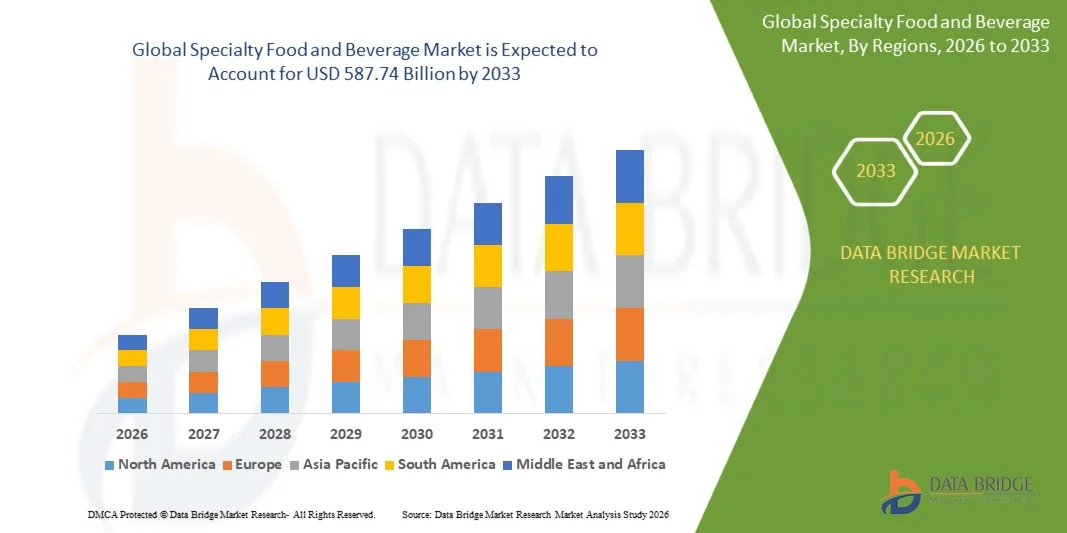
- As per Data Bridge Market Research analysis, the specialty food and beverage market was valued at USD 237.38 billion in 2025 and is projected to reach USD 587.74 billion by 2033, growing at a CAGR of 12.00% from 2026 to 2033.
- The market is experiencing consistent growth driven by rising consumer demand for unique and premium food and beverage products, increasing health and wellness awareness, growing interest in organic and artisanal offerings, and the expanding availability of specialty products through e-commerce and online retail channels.
- The growing preference for high-quality, authentic, organic, non-GMO, and health-oriented products, combined with rising interest in diverse cuisines and exotic flavors, is encouraging manufacturers and retailers to expand specialty food and beverage portfolios. E-commerce and direct-to-consumer channels are further improving access to niche products, while product innovation and sustainability initiatives are supporting market expansion globally.
Market Size & Forecast
- Global Market Value (2025): USD 237.38 Billion
- Expected Market Value (2033): USD 587.74 Billion
- Forecast CAGR (2026–2033): 12.00%
- Leading Region in 2025: North America
- Fastest Growing Region: Asia Pacific
What are the Major Takeaways of the Specialty Food and Beverage Market?
- North America dominated the specialty food and beverage market with the largest revenue share of 40% in 2025, supported by strong consumer spending on premium and organic products and well-established retail and distribution networks.
- Asia-Pacific is expected to be the fastest-growing region at a CAGR of 6.0% from 2026 to 2033, fueled by evolving consumer preferences, rising disposable incomes, urbanization, and increasing exposure to global food trends
- The flavors segment led the market with a 33.3% share in 2025, driven by strong demand for distinctive taste profiles across packaged foods, beverages, bakery products, confectionery, and plant-based products
- Functional food ingredients are the fastest-growing ingredient type, projected to register a CAGR of 4.9%, reflecting the surge in consumer focus on preventive nutrition and health-oriented food products.
- The dairy and frozen foods segment dominated the application category with a 30% revenue share in 2025, led by extensive use of specialty ingredients in dairy products, frozen desserts, ice cream, yogurt, cheese, and dairy-based beverages.
- Household consumers accounted for 40% of the market share in 2025, preferred by increasing consumer interest in premium, functional, organic, clean-label, and specialized food and beverage products
- The bakery and confectionery segment is the fastest-growing application category, with a CAGR of 5.5%, driven by increasing consumer preference for premium, artisanal, innovative, and specialty baked products
Report Scope and Specialty Food and Beverage Market Segmentation
Attributes |
Specialty Food and Beverage Key Market Insights |
|
Segments Covered |
|
|
Countries Covered |
North America
Europe
Asia-Pacific
Middle East and Africa
South America
|
|
Key Market Players |
|
|
Market Opportunities |
|
|
Value Added Data Infosets |
In addition to the insights on market scenarios such as market value, growth rate, segmentation, geographical coverage, and major players, the market reports curated by the Data Bridge Market Research also include in-depth expert analysis, pricing analysis, brand share analysis, consumer survey, demography analysis, supply chain analysis, value chain analysis, raw material/consumables overview, vendor selection criteria, PESTLE Analysis, Porter Analysis, and regulatory framework. |
What is the Key Trend in the Specialty Food and Beverage Market?
- Specialty food and beverage brands are increasingly emphasizing clean-label, functional, premium, and globally inspired products as consumers seek greater transparency, health benefits, distinctive flavors, and convenient formats.
- For instance, in August 2025, Arden’s Garden launched FOCUS+, a functional mushroom beverage containing ingredients such as Lion’s Mane, Reishi, Cordyceps, and adaptogens, demonstrating the growing integration of wellness positioning into specialty beverages.
- Consumers are also showing stronger interest in recognizable ingredients, natural formulations, and products positioned around wellness, sustainability, and authenticity.
- Specialty retailers and brands are responding by expanding functional beverages, protein-rich snacks, organic products, and international flavor profiles across retail and foodservice channels.
- The growth of plant-based and alternative-protein products is encouraging specialty brands to introduce innovative dairy alternatives, meat substitutes, and plant-forward snacks that address changing dietary preferences.
- For instance, in June 2024, the Specialty Food Association highlighted growing consumer interest in global flavors and ingredients, noting particularly strong momentum for Korean and Indian cuisine products in the U.S. specialty food sector
- Premiumization and experiential consumption are encouraging consumers to explore artisanal foods, craft beverages, regional specialties, and limited-edition products that offer differentiated taste and perceived quality.
What are the Key Drivers of the Specialty Food and Beverage Market?
- The rising consumer focus on health, nutrition, food transparency, and personalized wellness is increasing demand for specialty foods and beverages with functional, natural, organic, and clean-label attributes.
- For instance, in June 2025, the Specialty Food Association highlighted that premium and artisanal products continued to grow among selective consumers, while clean-label and functional foods were also gaining popularity.
- The expansion of premiumization and consumers' willingness to pay for differentiated quality is encouraging manufacturers to develop artisanal, gourmet, specialty, and value-added products.
- Digital grocery, e-commerce, and delivery platforms are broadening access to niche specialty products and enabling brands to reach consumers beyond conventional retail locations.
- Growing disposable incomes in emerging economies are allowing consumers to experiment with premium, imported, organic, and specialty products, supporting wider market penetration.
- For instance, in February 2025, the Specialty Food Association reported that specialty food makers were responding to consumer demand for quick-preparation and grab-and-go products featuring authentic global flavors, including Korean chicken, Japanese-inspired products, and Asian-inspired pizzas.
- Increasing multiculturalism and exposure to international cuisines are strengthening demand for ethnic foods, exotic flavors, regional specialties, and globally inspired beverage products.
Which Factors are Challenging the Growth of the Specialty Food and Beverage Market?
- High prices and affordability pressures can restrict adoption of specialty food and beverage products because premium ingredients, certifications, specialized processing, and differentiated packaging can increase retail prices.
- For instance, in May 2023, the Specialty Food Association reported that inflation, recession concerns, and supply-chain challenges had slowed specialty food sales growth, with specialty food unit sales declining
- These cost pressures are particularly challenging when consumers simultaneously seek healthier, cleaner, and more functional products while managing household food budgets.
- Supply-chain complexity can also challenge specialty brands because niche ingredients, organic inputs, international sourcing, cold-chain requirements, and smaller production volumes can raise procurement and distribution costs.
- Regulatory requirements concerning food labeling, health claims, organic certification, ingredient declarations, and product safety can increase compliance costs and lengthen product-development timelines for specialty producers.
- For instance, in August 2022, the Specialty Food Association reported that ingredient and packaging bottlenecks, particularly for imported materials, were causing delays and out-of-stocks across the specialty food supply chain; shortages of mustard seed, chocolate, and other ingredients were also affecting sales
- Limited availability of specialty ingredients and fluctuations in agricultural commodity prices can create procurement uncertainty, particularly for smaller brands that have less purchasing power and fewer supplier alternatives.
How is the Specialty Food and Beverage Market Segmented?
The specialty food and beverage market is segmented on the basis of ingredient, application, end user, distribution channel.
- By Ingredient
On the basis of ingredient, the specialty food and beverage market is segmented into functional food ingredients, sugar substitutes, flavors, specialty starches, acidulants, preservatives, emulsifiers, colors, enzymes, and F&B starter cultures. The flavors segment dominated the market with 33.3% share in 2025, supported by strong demand for distinctive taste profiles across packaged foods, beverages, bakery products, confectionery, and plant-based products. Flavors are extensively used by manufacturers to improve sensory appeal and maintain consumer acceptance. The growing popularity of premium, ethnic, and globally inspired foods is increasing demand for innovative flavor systems. Reformulation of products with reduced sugar, salt, and fat is also creating greater reliance on flavors and taste-enhancing ingredients. Clean-label trends are encouraging manufacturers to develop natural and plant-derived flavor solutions.
The functional food ingredients segment is projected to register the fastest growth at 4.9% CAGR during forecast period, driven by increasing consumer focus on preventive nutrition and health-oriented food products. Functional ingredients such as probiotics, prebiotics, dietary fibers, omega-3 fatty acids, and plant extracts are gaining wider application across food and beverage formulations. Growing awareness of digestive health, immunity, metabolic wellness, and healthy aging is encouraging consumers to seek products with additional nutritional benefits. Food manufacturers are increasingly incorporating functional ingredients into everyday products rather than limiting them to specialized nutrition products. Rising demand for functional beverages, fortified foods, sports nutrition, and wellness-oriented products is further supporting adoption. Advances in formulation technology are improving ingredient stability, bioavailability, and compatibility with different food matrices.
- By Application
On the basis of application, the specialty food and beverage market is segmented into bakery and confectionery, dairy and frozen foods, convenience foods, oil and fats, and others. The dairy and frozen foods segment dominated the market with 30% share in 2025, supported by extensive use of specialty ingredients in dairy products, frozen desserts, ice cream, yogurt, cheese, and dairy-based beverages. Specialty ingredients are used to improve texture, stability, flavor, nutritional characteristics, and shelf life across these products. Demand for premium and value-added dairy products is encouraging manufacturers to introduce functional, reduced-sugar, probiotic, and fortified formulations. Specialty cultures, emulsifiers, flavors, stabilizers, and functional ingredients are particularly important in product development. Increasing consumption of frozen desserts and convenience-oriented dairy products is also supporting demand
The bakery and confectionery segment is projected to register the fastest growth at 5.5% CAGR during forecast period, driven by increasing consumer preference for premium, artisanal, innovative, and specialty baked products. Specialty ingredients are increasingly used to improve taste, texture, appearance, freshness, and product consistency. Growing demand for reduced-sugar, clean-label, fortified, and functional bakery products is encouraging manufacturers to adopt alternative sweeteners, specialty starches, flavors, enzymes, emulsifiers, and functional ingredients. Premium chocolates, pastries, biscuits, cakes, and other confectionery products are also creating opportunities for differentiated ingredient solutions. The expansion of packaged bakery products is supporting demand across both developed and emerging markets. Manufacturers are increasingly experimenting with international flavors and novel formulations to differentiate their products.
- By End User
On the basis of end user, the specialty food and beverage market is segmented into household consumers, restaurants and cafés, hotels and resorts, catering services, and others. The household consumers segment dominated the market with 40% share in 2025, supported by increasing consumer interest in premium, functional, organic, clean-label, and specialized food and beverage products. Consumers are increasingly incorporating specialty products into their everyday diets as awareness of nutrition and wellness increases. Growing availability of specialty products through supermarkets, specialty stores, and digital platforms is improving accessibility for households. Demand for convenient foods with enhanced nutritional or sensory characteristics is also supporting household consumption. Premiumization is encouraging consumers to explore artisanal and differentiated products across multiple food categories. Rising awareness of dietary preferences and ingredient transparency is further influencing household purchasing behavior.
The restaurants and cafés segment is projected to register the fastest growth at 6.0% CAGR during forecast period, driven by increasing demand for differentiated menus, premium ingredients, and distinctive food and beverage experiences. Restaurants and cafés are increasingly using specialty ingredients to create unique flavors, textures, and nutritional profiles. Growing consumer interest in artisanal, ethnic, plant-based, functional, and premium offerings is encouraging foodservice operators to diversify their menus. Specialty ingredients enable businesses to respond to changing dietary preferences while maintaining product quality and sensory appeal. Expansion of café culture and premium dining concepts is creating additional demand for specialty beverages and ingredients. Increasing experimentation with global cuisines is also supporting the use of specialized flavors, cultures, starches, and other ingredients.
- By Distribution Channel
On the basis of distribution channel, the specialty food and beverage market is segmented into supermarkets and hypermarkets, specialty stores, convenience stores, online retail, foodservice, and others. The supermarkets and hypermarkets segment dominated the market with 42% share in 2025, supported by their extensive product assortment, established retail infrastructure, and broad consumer reach. These channels provide consumers with access to specialty, premium, functional, organic, and international food and beverage products. Dedicated specialty sections within large retail stores are improving product visibility and consumer awareness. Established supply chains also enable consistent availability across different geographic markets. Retailers are increasingly expanding premium and private-label specialty product ranges to respond to changing consumer preferences. Promotional activities and the convenience of purchasing specialty products alongside regular groceries further support this channel.
The online retail segment is projected to register the fastest growth at 6.8% CAGR during forecast period, driven by expanding e-commerce adoption and increasing consumer preference for convenient purchasing channels. Online platforms provide access to a wider selection of niche, premium, international, functional, and dietary-specific products than many conventional stores. Digital channels also enable smaller specialty brands to reach consumers beyond their local markets. Increasing smartphone usage, digital payments, and home-delivery services are supporting online food purchases. Consumers can conveniently compare product ingredients, nutritional information, prices, and reviews before purchasing. Direct-to-consumer websites and subscription models are also providing specialty brands with additional routes to consumers
Which Region Holds the Largest Share of the Specialty Food and Beverage Market?
- North America dominated the specialty food and beverage market with the largest revenue share of 40% in 2025, supported by strong consumer spending on premium and organic products and well-established retail and distribution networks
- The region also benefits from a well-established specialty food industry, high consumer purchasing power, extensive modern retail networks, and strong demand for clean-label and innovative products. Increasing adoption of specialty products across supermarkets, specialty stores, foodservice outlets, and online retail channels continues to strengthen North America’s leading position in the global market.
U.S. Specialty Food and Beverage Market Insight
The U.S. specialty food and beverage market is witnessing strong growth due to rising consumer demand for premium, artisanal, functional, and health-oriented food and beverage products. The country’s well-established specialty food industry, along with increasing adoption of clean-label, organic, plant-based, and innovative products, is driving demand across retail and foodservice applications. In addition, growing consumer interest in unique flavors, nutritional benefits, and convenient specialty products is accelerating adoption across supermarkets, specialty stores, restaurants, and online retail channels.
Asia-Pacific Specialty Food and Beverage Market Insight
The Asia-Pacific specialty food and beverage market is expected to witness rapid growth, driven by increasing urbanization, rising disposable incomes, and changing consumer preferences across countries such as China, India, and Japan. Growing awareness regarding functional nutrition, premium foods, and international flavors, along with expanding modern retail infrastructure, is supporting regional market expansion. In addition, the growing presence of foodservice businesses, e-commerce platforms, and innovative food manufacturers is accelerating specialty food and beverage adoption across household and commercial sectors.
Japan Specialty Food and Beverage Market Insight
The Japan specialty food and beverage market is witnessing consistent growth due to rising consumer demand for premium, functional, and health-oriented food products. Food manufacturers, retailers, and foodservice operators are increasingly offering specialty products featuring unique flavors, high-quality ingredients, and nutritional benefits. Moreover, increasing interest in clean-label formulations, functional foods, and convenient premium products, along with the country’s mature food-processing industry, is further contributing to market growth.
China Specialty Food and Beverage Market Insight
The China specialty food and beverage market is growing rapidly, driven by increasing urbanization, rising disposable incomes, and changing dietary preferences among consumers. Growing adoption of premium, functional, organic, and international food products across retail and foodservice channels is significantly boosting market demand. In addition, rising e-commerce penetration, increasing consumer awareness regarding nutrition, and rapid development of innovative food products are positioning China as one of the fastest-growing markets for specialty food and beverages globally.
U.K. Specialty Food and Beverage Market Insight
The U.K. specialty food and beverage market is experiencing steady growth, supported by rising consumer demand for premium, artisanal, organic, and health-focused products. Increasing investments in innovative food formulations and growing demand for distinctive flavors and high-quality ingredients are contributing to market growth. Furthermore, the expansion of specialty retail, online grocery platforms, and premium foodservice channels is improving product accessibility and supporting continued adoption of specialty food and beverage products across the U.K.
Germany Specialty Food and Beverage Market Insight
The Germany specialty food and beverage market is expanding steadily due to the country’s strong food-processing industry, established retail infrastructure, and increasing consumer preference for high-quality and health-oriented products. Food manufacturers, retailers, and foodservice operators are increasingly utilizing specialty ingredients and innovative formulations to meet demand for premium, functional, organic, and clean-label products. Continuous advancements in food technology, growing interest in sustainable products, and increasing demand for distinctive food experiences are further driving market growth in Germany.
Which are the Top Companies in Specialty Food and Beverage Market?
The specialty food and beverage industry is primarily led by well-established companies, including:
- Nestlé (Switzerland)
- PepsiCo, Inc. (U.S.)
- Mondelēz International, Inc. (U.S.)
- The Kraft Heinz Company (U.S.)
- General Mills, Inc. (U.S.)
- McCormick & Company, Incorporated (U.S.)
- Kerry Group plc (Ireland)
- Ingredion Incorporated (U.S.)
- ADM Company (U.S.)
- Cargill, Incorporated (U.S.)
- Conagra Brands, Inc. (U.S.)
- The J.M. Smucker Co. (U.S.)
- Hormel Foods Corporation (U.S.)
- Danone S.A. (France)
- Ferrero International S.A. (Luxembourg)
- Tate & Lyle PLC (U.K.)
- Flowers Foods, Inc. (U.S.)
- The Campbell's Company (U.S.)
- The Hershey Company (U.S.)
- Barry Callebaut AG (Switzerland)
What are Latest Developments in Specialty Food and Beverage Market?
- In June 2025, GINNY announced the launch of its first two non-alcoholic adaptogenic functional spritzers, Blueberry Lavender Calamansi and Hibiscus Yuzu Ginger, at the 2025 Summer Fancy Food Show. The beverages combine adaptogenic herbs with culturally inspired flavors and are positioned around wellness, stress relief, focus, and mood. The launch reflects continued innovation in non-alcoholic and functional specialty beverages, with GINNY also planning to expand its product line and distribution across North America.
- In June 2024, Lassonde Industries announced an agreement to acquire Summer Garden Food Manufacturing for USD 235 million. Summer Garden is a U.S.-based specialty food manufacturer and distributor producing sauces, condiments, dressings, and other specialty products under brands including Gia Russa, Little Italy in the Bronx, and G Hughes. The transaction was intended to expand Lassonde’s specialty food activities and strengthen its North American product portfolio and manufacturing capabilities.
- In May 2023, Javo Beverage launched six new functional energy lemonades and flavored iced teas for foodservice operators. The new beverages included energy lemonades with natural caffeine and L-theanine, alongside new flavored iced tea varieties. The launch focused on clean-label ingredients, emerging flavors, functional benefits, and flexible foodservice applications, demonstrating continued innovation in specialty beverage offerings.
- In February 2022, Daoher Beverage launched its Sio-Sioh lineup of kombucha-infused teas and spritzers. The range combined Taiwanese tea-making and fermentation practices with ready-to-drink beverage formats and included multiple fruit and botanical flavors. The products were positioned around premium taste, wellness, antioxidants, and convenient consumption, representing innovation in functional and specialty beverages.
- In May 2021, PepsiCo launched Soulboost, a sparkling water beverage containing functional ingredients. The product debuted in Lift and Ease varieties, incorporating ingredients such as panax ginseng and L-theanine to support mental stamina and relaxation. The launch expanded PepsiCo’s functional beverage portfolio and responded to growing consumer interest in convenient beverages with wellness-oriented attributes.

- Interactive Data Analysis Dashboard
- Company Analysis Dashboard for high growth potential opportunities
- Research Analyst Access for customization & queries
- Competitor Analysis with Interactive dashboard
- Latest News, Updates & Trend analysis
- Harness the Power of Benchmark Analysis for Comprehensive Competitor Tracking
Global Specialty Food And Beverage Market, Supply Chain Analysis and Ecosystem Framework
To support market growth and help clients navigate the impact of geopolitical shifts, DBMR has integrated in-depth supply chain analysis into its Global Specialty Food And Beverage Market research reports. This addition empowers clients to respond effectively to global changes affecting their industries. The supply chain analysis section includes detailed insights such as Global Specialty Food And Beverage Market consumption and production by country, price trend analysis, the impact of tariffs and geopolitical developments, and import and export trends by country and HSN code. It also highlights major suppliers with data on production capacity and company profiles, as well as key importers and exporters. In addition to research, DBMR offers specialized supply chain consulting services backed by over a decade of experience, providing solutions like supplier discovery, supplier risk assessment, price trend analysis, impact evaluation of inflation and trade route changes, and comprehensive market trend analysis.
Data collection and base year analysis are done using data collection modules with large sample sizes. The stage includes obtaining market information or related data through various sources and strategies. It includes examining and planning all the data acquired from the past in advance. It likewise envelops the examination of information inconsistencies seen across different information sources. The market data is analysed and estimated using market statistical and coherent models. Also, market share analysis and key trend analysis are the major success factors in the market report. To know more, please request an analyst call or drop down your inquiry.
The key research methodology used by DBMR research team is data triangulation which involves data mining, analysis of the impact of data variables on the market and primary (industry expert) validation. Data models include Vendor Positioning Grid, Market Time Line Analysis, Market Overview and Guide, Company Positioning Grid, Patent Analysis, Pricing Analysis, Company Market Share Analysis, Standards of Measurement, Global versus Regional and Vendor Share Analysis. To know more about the research methodology, drop in an inquiry to speak to our industry experts.
Data Bridge Market Research is a leader in advanced formative research. We take pride in servicing our existing and new customers with data and analysis that match and suits their goal. The report can be customized to include price trend analysis of target brands understanding the market for additional countries (ask for the list of countries), clinical trial results data, literature review, refurbished market and product base analysis. Market analysis of target competitors can be analyzed from technology-based analysis to market portfolio strategies. We can add as many competitors that you require data about in the format and data style you are looking for. Our team of analysts can also provide you data in crude raw excel files pivot tables (Fact book) or can assist you in creating presentations from the data sets available in the report.