


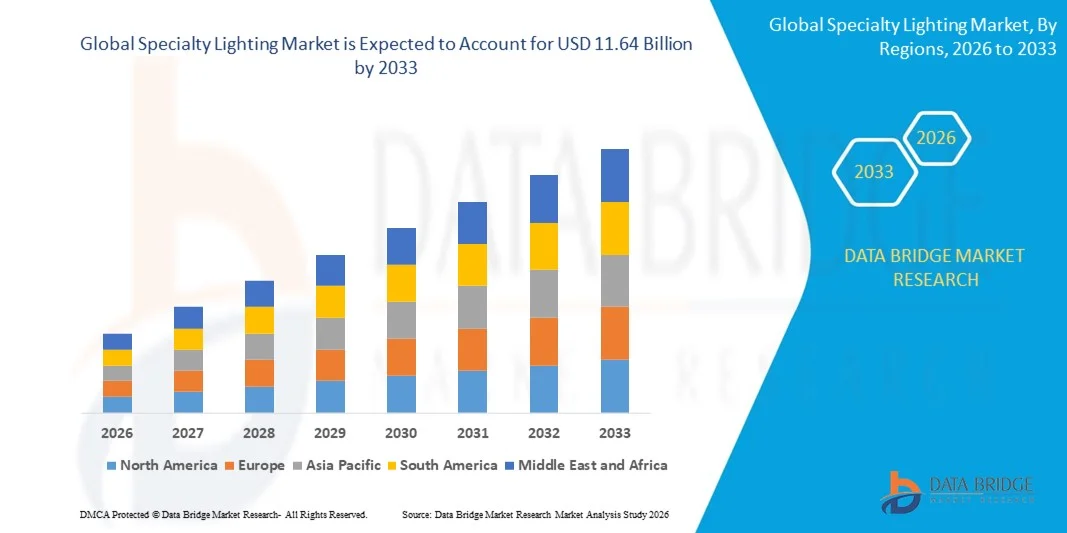
Specialty Lighting Market Size
- The global specialty lighting market size was valued at USD 7.58 billion in 2025 and is expected to reach USD 11.64 billion by 2033, at a CAGR of 5.50% during the forecast period
- The market growth is largely fueled by the increasing adoption of energy-efficient lighting solutions and technological advancements in LED, halogen, and UV-based specialty lighting, leading to enhanced performance and precision in residential, commercial, and industrial applications
- Furthermore, rising demand for customizable, high-intensity, and smart lighting solutions in entertainment, medical, horticultural, and commercial sectors is establishing specialty lighting as a preferred choice for professional and controlled-environment applications. These factors are driving widespread adoption, thereby significantly boosting market growth
Specialty Lighting Market Analysis
- Specialty lighting, offering precise illumination, high energy efficiency, and customizable spectral outputs, is becoming an essential component in entertainment, medical, horticultural, and industrial applications due to its ability to enhance visibility, improve operational efficiency, and support energy-saving initiatives
- The escalating demand for specialty lighting is primarily fueled by technological innovations, growing urbanization, and rising awareness about energy efficiency and smart lighting solutions, coupled with increasing adoption of IoT-enabled and connected lighting systems across residential and commercial environments
- North America dominated the specialty lighting market with a share of 35.5% in 2025, due to rising demand for energy-efficient, high-performance lighting solutions and increasing adoption of advanced lighting in entertainment, healthcare, and architectural applications
- Asia-Pacific is expected to be the fastest growing region in the specialty lighting market during the forecast period due to rising urbanization, growing disposable incomes, and technological advancements in countries such as China, Japan, and India
- Light-Emitting Diode (LED) segment dominated the market with a market share of 65.5% in 2025, due to high energy efficiency, long lifespan, and versatility in color and dimming options. LEDs are preferred in entertainment, medical, and architectural lighting due to precise control, minimal heat generation, and compatibility with smart systems. In addition, manufacturers are innovating with tunable white and programmable effects, further boosting adoption
Report Scope and Specialty Lighting Market Segmentation
|
Attributes |
Specialty Lighting Key Market Insights |
|
Segments Covered |
|
|
Countries Covered |
North America
Europe
Asia-Pacific
Middle East and Africa
South America
|
|
Key Market Players |
|
|
Market Opportunities |
|
|
Value Added Data Infosets |
In addition to the insights on market scenarios such as market value, growth rate, segmentation, geographical coverage, and major players, the market reports curated by the Data Bridge Market Research also include in-depth expert analysis, geographically represented company-wise production and capacity, network layouts of distributors and partners, detailed and updated price trend analysis and deficit analysis of supply chain and demand. |
Specialty Lighting Market Trends
Rising Adoption of Smart and Connected Lighting Solutions
- A significant trend in the specialty lighting market is the increasing adoption of smart and connected lighting solutions across residential, commercial, entertainment, and horticultural applications. These solutions are driven by the growing need for energy efficiency, precise illumination, and automation that enhances convenience and operational control. Smart lighting systems are becoming essential in environments requiring dynamic, programmable lighting for better visual experiences and energy management
- For instance, Signify and OSRAM are supplying advanced smart LED and horticultural lighting systems that integrate with IoT platforms to enable remote monitoring, spectral control, and energy optimization. Such offerings are strengthening market adoption by providing more efficient and user-friendly solutions for lighting-intensive applications
- The entertainment and stage lighting sectors are increasingly implementing connected lighting systems for dynamic effects, color tuning, and synchronization with audio-visual content. This integration is positioning specialty lighting as a core enabler of creative and high-performance visual experiences
- In the healthcare sector, hospitals and laboratories are adopting specialty LED and UV lighting for precise diagnostics, surgical procedures, and sterilization. Applications requiring high-intensity, controllable lighting are driving demand for smart and reliable solutions
- Industrial and commercial facilities are integrating intelligent lighting for energy savings, operational efficiency, and enhanced safety. Specialty lighting that can be automated or remotely controlled is becoming a standard feature in modern facility management
- The market is witnessing strong growth in horticultural lighting where precision spectrum control and energy-efficient LEDs are enhancing crop yield and plant quality. The rising incorporation of smart, connected lighting systems is reinforcing the transition toward more sustainable, high-performance lighting solutions globally
Specialty Lighting Market Dynamics
Driver
Growing Demand for Energy-Efficient and High-Performance Lighting
- The increasing emphasis on sustainability and energy savings is driving the demand for energy-efficient, high-performance specialty lighting in residential, commercial, industrial, and horticultural applications. These solutions provide precise illumination, long lifespans, and reduced operational costs, meeting both environmental and economic objectives
- For instance, Philips and OSRAM offer high-efficiency LED lighting products that deliver superior brightness, spectral accuracy, and energy savings. These solutions are accelerating adoption by offering both cost-effectiveness and high functionality
- The rise in smart buildings, automated facilities, and controlled-environment agriculture is further fueling demand for specialty lighting solutions that combine energy efficiency with high performance. Precise spectrum control, dimming capabilities, and integration with building management systems are key drivers
- The shift toward digital and IoT-enabled infrastructure in commercial and industrial sectors increases the need for lighting systems that are adaptable, programmable, and remotely controllable
- Growing awareness among consumers and businesses about operational efficiency, energy regulations, and sustainability objectives continues to strengthen this driver, establishing specialty lighting as a critical component for modern infrastructure
Restraint/Challenge
High Initial Cost and Technical Complexity of Advanced Specialty Lighting
- The specialty lighting market faces challenges due to the high upfront costs and technical complexity associated with advanced LED, UV, and connected lighting systems. These factors can limit adoption, particularly in price-sensitive residential and small commercial markets
- For instance, implementing horticultural LED systems with smart spectrum control requires significant investment in equipment, installation, and training. This can deter smaller growers from adopting the technology despite its long-term efficiency benefits
- Producing high-performance specialty lighting involves precision engineering, advanced materials, and sophisticated control systems, increasing manufacturing complexity and costs
- The reliance on integrated software, IoT connectivity, and automated control adds further technical challenges for both manufacturers and end-users, requiring specialized skills and maintenance capabilities
- The market continues to face constraints in balancing affordability, advanced performance, and ease of use, which collectively impacts adoption rates across different end-user segments
Specialty Lighting Market Scope
The market is segmented on the basis of light source and application.
- By Light Source
On the basis of light source, the specialty lighting market is segmented into Light-Emitting Diode (LED), Halogen Lamps, Xenon Bulbs, and Incandescent Lamps. The LED segment dominated the market with the largest revenue share of 65.5% in 2025, driven by high energy efficiency, long lifespan, and versatility in color and dimming options. LEDs are preferred in entertainment, medical, and architectural lighting due to precise control, minimal heat generation, and compatibility with smart systems. In addition, manufacturers are innovating with tunable white and programmable effects, further boosting adoption.
The Halogen Lamps segment is expected to witness the fastest growth rate of 18.9% from 2026 to 2033, fueled by superior color rendering and high-intensity output for stage, photography, and architectural applications. For instance, Osram is enhancing halogen designs to deliver focused, bright lighting while meeting energy standards. Halogens are favored for precise illumination and compatibility with dimmers, supporting growing niche applications in entertainment and medical fields.
- By Application
On the basis of application, the specialty lighting market is segmented into Entertainment, Medical, UV Lamps, and Others. The Entertainment segment dominated the market with the largest revenue share of 44.8% in 2025, driven by theaters, concerts, film production, and theme parks requiring dynamic, programmable lighting. Specialty lighting in entertainment enhances visual effects, stage aesthetics, and energy efficiency while supporting smart control systems.
The Medical segment is expected to witness the fastest CAGR from 2026 to 2033, driven by the need for precise, high-intensity lighting in surgeries, diagnostics, and laboratories. For instance, Philips provides advanced medical lighting that ensures consistent illumination with minimal heat, improving accuracy and safety. The segment benefits from rising minimally invasive procedures and demand for sterilizable, high-performance lighting systems.
Specialty Lighting Market Regional Analysis
- North America dominated the specialty lighting market with the largest revenue share of 35.5% in 2025, driven by rising demand for energy-efficient, high-performance lighting solutions and increasing adoption of advanced lighting in entertainment, healthcare, and architectural applications
- Consumers in the region highly value precise illumination, long lifespan, and flexibility offered by specialty lighting for stage productions, medical procedures, and commercial spaces
- This widespread adoption is further supported by high disposable incomes, technologically advanced infrastructure, and growing awareness of energy-saving and smart lighting systems, establishing specialty lighting as a preferred solution across various sectors
U.S. Specialty Lighting Market Insight
The U.S. specialty lighting market captured the largest revenue share in 2025 within North America, fueled by the rapid adoption of LED and halogen lighting technologies across entertainment, healthcare, and commercial applications. Consumers and businesses are increasingly prioritizing energy efficiency, precision, and durability in lighting solutions. The growing trend of smart and connected lighting systems, combined with demand for customizable and programmable lighting effects, further propels market growth. Moreover, integration with advanced control systems and IoT-enabled lighting solutions is significantly contributing to the market expansion.
Europe Specialty Lighting Market Insight
The Europe specialty lighting market is projected to expand at a substantial CAGR during the forecast period, driven by stringent energy efficiency regulations and the rising need for advanced lighting in medical, entertainment, and commercial sectors. Increasing urbanization, along with demand for innovative lighting technologies, is fostering adoption. European consumers and businesses are attracted to the flexibility, longevity, and performance offered by specialty lighting solutions, supporting growth across residential, commercial, and industrial applications.
U.K. Specialty Lighting Market Insight
The U.K. specialty lighting market is anticipated to grow at a noteworthy CAGR during the forecast period, driven by the rising trend of smart and sustainable lighting solutions. Demand for enhanced visual experiences in theaters, studios, and public spaces, combined with energy-saving initiatives, is encouraging adoption. The U.K.’s technological infrastructure and strong commercial and entertainment sectors are expected to continue stimulating market growth.
Germany Specialty Lighting Market Insight
The Germany specialty lighting market is expected to expand at a considerable CAGR during the forecast period, fueled by high awareness of energy-efficient and advanced lighting solutions. Germany’s focus on innovation and sustainability promotes the adoption of LED and halogen lighting across healthcare, entertainment, and commercial buildings. Integration with automated and smart lighting control systems is becoming increasingly common, with a preference for precision and eco-conscious solutions.
Asia-Pacific Specialty Lighting Market Insight
The Asia-Pacific specialty lighting market is poised to grow at the fastest CAGR during the forecast period of 2026 to 2033, driven by rising urbanization, growing disposable incomes, and technological advancements in countries such as China, Japan, and India. Increasing adoption of specialty lighting in entertainment, medical, and commercial sectors, supported by government initiatives promoting smart infrastructure, is fueling market growth. The region’s emergence as a manufacturing hub for advanced lighting components is expanding affordability and accessibility to a wider consumer base.
Japan Specialty Lighting Market Insight
The Japan specialty lighting market is gaining momentum due to the country’s high-tech culture, focus on energy efficiency, and growing demand for smart lighting in entertainment and healthcare sectors. Adoption is driven by precision lighting requirements and integration with IoT-enabled systems for enhanced control and automation. The aging population and need for easier-to-use, high-performance lighting solutions are also contributing to growth across residential and commercial sectors.
China Specialty Lighting Market Insight
The China specialty lighting market accounted for the largest revenue share in Asia-Pacific in 2025, attributed to rapid urbanization, strong technological adoption, and rising demand for LED and halogen lighting in entertainment, medical, and commercial applications. The push for smart cities, government initiatives for energy efficiency, and a strong domestic manufacturing base are key factors driving market growth.
Specialty Lighting Market Share
The specialty lighting industry is primarily led by well-established companies, including:
- Specialty Lighting Industries, Inc. (U.S.)
- Signify Holding (Netherlands)
- OSRAM GmbH (Germany)
- Color Imagination LED Lighting, Ltd. (U.K.)
- Cree, Inc. (U.S.)
- Ushio America, Inc. (U.S.)
- Advanced Specialty Lighting (U.S.)
- Getinge AB (Sweden)
- Herbert Waldmann GmbH & Co. KG (Germany)
- Brandon Medical (U.K.)
- CHAUVET (U.S.)
- SS Lighting (U.S.)
- National Specialty Lighting Ltd. (U.K.)
- HARMAN (U.S.)
- STERIS (U.S.)
- S.I.M.E.O.N. Medical GmbH & Co. KG (Germany)
- Atlantic Ultraviolet Corporation (U.S.)
- Lighting Specialties, Inc. (U.S.)
- Altman Lighting (U.S.)
- Advanced UV, Inc. (U.S.)
- American Ultraviolet (U.S.)
Latest Developments in Global Specialty Lighting Market
- In June 2025 Signify launched Philips GreenPower LED Toplighting Force 4‑channel lamps, enabling growers to precisely control red, blue, white, and far‑red spectra. This innovation allows for optimized crop growth, improved plant quality, and reduced energy consumption. By offering operational flexibility and precise spectral management, the launch strengthens Signify’s position in the high-performance horticultural lighting market and meets the growing demand for smart, customizable lighting solutions
- In June 2025 Signify introduced Philips GrowWise smart spectrum, an intelligent LED system that automatically adjusts lighting based on real-time sunlight conditions. This technology enhances crop growth efficiency while reducing electricity costs, supporting sustainable farming practices. Its integration of automation and smart control is expected to drive wider adoption of energy-efficient, IoT-enabled horticultural lighting systems
- In October 2024 Grodan collaborated with Signify on tomato cultivation trials using spectral dimming combined with adaptive fertigation and dehumidification. This integrated approach significantly improves energy efficiency and reduces operational costs while maintaining optimal yield, fruit quality, and growth consistency. The trial highlights the rising demand for advanced specialty lighting solutions in controlled-environment agriculture and demonstrates how innovation can address both productivity and sustainability goals
- In June 2023 ams OSRAM unveiled the 640 nm Red LED as an extension of its OSLON® Optimal horticultural LED family. The new LED offers broader spectral coverage that supports better plant growth and enhances crop yield quality. This development reinforces ams OSRAM’s competitive edge in the horticultural lighting market and meets increasing market expectations for energy-efficient, high-performance LEDs for indoor farming
- In June 2023 ams OSRAM introduced the third generation of OSLON® Compact PL LEDs, providing eight percent higher brightness than the previous generation. The upgrade delivers improved design flexibility and higher value for lighting manufacturers, enabling more precise and efficient lighting solutions. This advancement strengthens market confidence in high-efficiency LED offerings and drives the adoption of compact, performance-focused specialty lighting

- Interactive Data Analysis Dashboard
- Company Analysis Dashboard for high growth potential opportunities
- Research Analyst Access for customization & queries
- Competitor Analysis with Interactive dashboard
- Latest News, Updates & Trend analysis
- Harness the Power of Benchmark Analysis for Comprehensive Competitor Tracking
Global Specialty Lighting Market, Supply Chain Analysis and Ecosystem Framework
To support market growth and help clients navigate the impact of geopolitical shifts, DBMR has integrated in-depth supply chain analysis into its Global Specialty Lighting Market research reports. This addition empowers clients to respond effectively to global changes affecting their industries. The supply chain analysis section includes detailed insights such as Global Specialty Lighting Market consumption and production by country, price trend analysis, the impact of tariffs and geopolitical developments, and import and export trends by country and HSN code. It also highlights major suppliers with data on production capacity and company profiles, as well as key importers and exporters. In addition to research, DBMR offers specialized supply chain consulting services backed by over a decade of experience, providing solutions like supplier discovery, supplier risk assessment, price trend analysis, impact evaluation of inflation and trade route changes, and comprehensive market trend analysis.
Data collection and base year analysis are done using data collection modules with large sample sizes. The stage includes obtaining market information or related data through various sources and strategies. It includes examining and planning all the data acquired from the past in advance. It likewise envelops the examination of information inconsistencies seen across different information sources. The market data is analysed and estimated using market statistical and coherent models. Also, market share analysis and key trend analysis are the major success factors in the market report. To know more, please request an analyst call or drop down your inquiry.
The key research methodology used by DBMR research team is data triangulation which involves data mining, analysis of the impact of data variables on the market and primary (industry expert) validation. Data models include Vendor Positioning Grid, Market Time Line Analysis, Market Overview and Guide, Company Positioning Grid, Patent Analysis, Pricing Analysis, Company Market Share Analysis, Standards of Measurement, Global versus Regional and Vendor Share Analysis. To know more about the research methodology, drop in an inquiry to speak to our industry experts.
Data Bridge Market Research is a leader in advanced formative research. We take pride in servicing our existing and new customers with data and analysis that match and suits their goal. The report can be customized to include price trend analysis of target brands understanding the market for additional countries (ask for the list of countries), clinical trial results data, literature review, refurbished market and product base analysis. Market analysis of target competitors can be analyzed from technology-based analysis to market portfolio strategies. We can add as many competitors that you require data about in the format and data style you are looking for. Our team of analysts can also provide you data in crude raw excel files pivot tables (Fact book) or can assist you in creating presentations from the data sets available in the report.













