


Specialty PACS Market Analysis
The Specialty PACS (Picture Archiving and Communication System) market is witnessing steady growth, driven by increasing demand for enhanced medical imaging solutions across various specialties, including radiology, cardiology, and dermatology. The market is largely influenced by advancements in imaging technologies and the rising adoption of digital healthcare systems. Healthcare facilities are increasingly seeking specialized PACS solutions tailored to their unique requirements, facilitating improved diagnosis, treatment planning, and patient care.
The market is highly competitive, with several key players focusing on innovation and development of customized PACS solutions. The introduction of cloud-based PACS and integration with Artificial Intelligence (AI) and machine learning algorithms are key trends shaping the market’s evolution. Furthermore, the growing demand for remote access to medical imaging data and the rise of teleradiology services are contributing to the market's growth. Despite challenges such as high initial investments and data security concerns, the specialty PACS market is poised for continued expansion in the coming years.
Specialty PACS Market Size
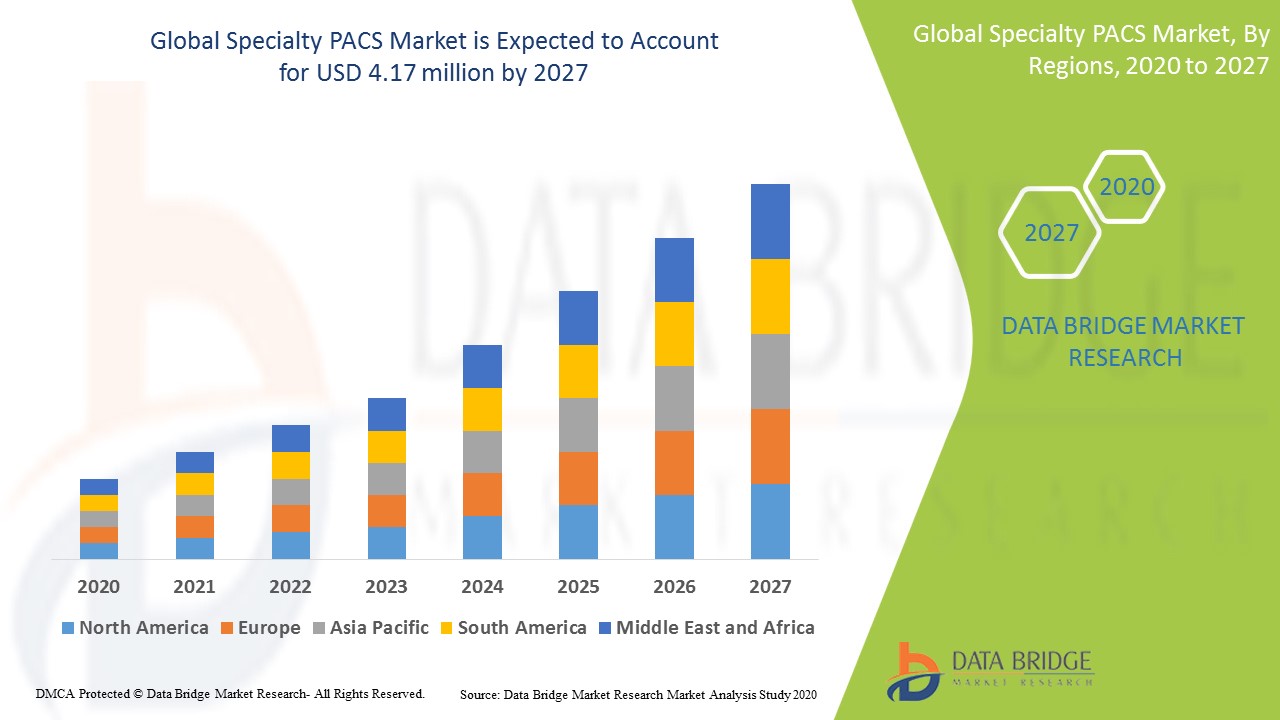
The Specialty PACS market size was valued at USD 3.29 billion in 2024 and is projected to reach USD 5.28 billion by 2032, with a CAGR of 6.10% during the forecast period of 2025 to 2032. In addition to the insights on market scenarios such as market value, growth rate, segmentation, geographical coverage, and major players, the market reports curated by the Data Bridge Market Research also include depth expert analysis, patient epidemiology, pipeline analysis, pricing analysis, and regulatory framework.
Specialty PACS Market Trends
"Increasing Shift towards Cloud-Based PACS Solutions."
The Specialty PACS (Picture Archiving and Communication System) market is experiencing several notable trends that are shaping its future direction. One of the key trends is the increasing shift towards cloud-based PACS solutions, which offer enhanced scalability, cost efficiency, and accessibility. Cloud platforms allow healthcare providers to store and share medical images seamlessly, improving collaboration across multiple locations.
Another significant trend is the integration of Artificial Intelligence (AI) and machine learning into PACS systems. AI-powered tools are being incorporated to assist with image analysis, improving diagnostic accuracy and workflow efficiency. These technologies also enable automated image segmentation, detection, and reporting, reducing the burden on healthcare professionals.
Additionally, the rise of telemedicine and teleradiology is influencing the demand for PACS solutions that support remote access to imaging data. This trend is particularly prevalent in rural areas and regions with limited access to healthcare facilities. Furthermore, there is a growing preference for user-friendly interfaces and intuitive workflows, which help healthcare providers efficiently manage large volumes of imaging data.
Lastly, interoperability between various healthcare IT systems is becoming more important. As medical institutions seek seamless integration across different platforms, there is a growing demand for specialty PACS solutions that can work across diverse technologies and healthcare networks.
Report Scope Specialty PACS Market Segmentation
|
Attributes |
Specialty PACS Key Market Insights |
|
Segments Covered |
|
|
Countries Covered |
U.S., Canada and Mexico in North America, Germany, France, U.K., Netherlands, Switzerland, Belgium, Russia, Italy, Spain, Turkey, Rest of Europe in Europe, China, Japan, India, South Korea, Singapore, Malaysia, Australia, Thailand, Indonesia, Philippines, Rest of Asia-Pacific (APAC) in the Asia-Pacific (APAC), Saudi Arabia, U.A.E, South Africa, Egypt, Israel, Rest of Middle East and Africa (MEA) as a part of Middle East and Africa (MEA), Brazil, Argentina and Rest of South America as part of South America |
|
Key Market Players |
MCKESSON CORPORATION (US), Siemens Healthineers AG (Germany), Koninklijke Philips N.V. (Netherlands), GE HealthCare (US), Agfa-Gevaert Group (Belgium), FUJIFILM Holdings Corporation (Japan), Merative (US), Sectra AB (Sweden), IBM Corporation (US) |
|
Market Opportunities |
|
|
Value Added Data Infosets |
In addition to the insights on market scenarios such as market value, growth rate, segmentation, geographical coverage, and major players, the market reports curated by the Data Bridge Market Research also include depth expert analysis, patient epidemiology, pipeline analysis, pricing analysis, and regulatory framework. |
Specialty PACS Market Definition
The Specialty PACS (Picture Archiving and Communication System) market focuses on advanced digital systems that help healthcare providers store, manage, and share medical images. These systems are tailored for specific medical fields, such as radiology, cardiology, and dermatology. Specialty PACS allows doctors and medical professionals to access and analyze images such as X-rays, MRIs, and CT scans quickly and accurately, improving diagnostic processes.
These systems help healthcare facilities manage large amounts of imaging data efficiently, providing faster access to medical images and enabling better communication between healthcare providers. Specialty PACS systems also integrate with other hospital technologies such as electronic health records (EHR), making it easier to share information across different departments.
The market is evolving with new innovations, including cloud-based PACS, which allows healthcare providers to access images from anywhere securely. Additionally, some systems now include artificial intelligence (AI) to assist with image analysis, making diagnoses more accurate and workflows more efficient.
Specialty PACS Market Dynamics
Drivers
- Increasing Adoption of Digital Healthcare Solutions
The growing trend of digitalization in healthcare is a major driver of the Specialty PACS market. As hospitals and medical Centres move toward more efficient, digital systems for storing and managing medical images, the demand for specialized PACS solutions continues to rise. These systems streamline workflows, reduce manual processes, and offer better image quality and accessibility, driving healthcare providers to invest in PACS for improved patient care and operational efficiency.
- Rising Demand for Remote Healthcare Services
The increasing need for telemedicine and teleradiology is another driver fuelling the Specialty PACS market. Remote consultations and diagnosis have become more prevalent, especially in rural and underserved areas where access to specialists may be limited. PACS systems that offer secure, remote access to imaging data play a critical role in these services, allowing healthcare providers to review images and make informed decisions from any location. This growing trend of remote healthcare services is pushing the demand for cloud-based and easily accessible PACS solutions.
Opportunities
- Integration of AI and Machine Learning
The integration of artificial intelligence (AI) and machine learning (ML) into Specialty PACS presents significant opportunities. AI-powered PACS solutions are capable of automating tasks such as image analysis, detection, and segmentation, which reduces the burden on healthcare professionals. Additionally, AI can enhance diagnostic accuracy and speed by detecting abnormalities that may be overlooked by human eyes. This technological advancement provides opportunities to improve patient care, making PACS systems smarter and more efficient.
- Expansion in Emerging Markets
Emerging markets, especially in Asia-Pacific and Latin America, present substantial growth opportunities for the Specialty PACS market. As these regions invest in healthcare infrastructure and digital technologies, the demand for specialized PACS systems increases. These markets are experiencing rapid advancements in medical technology and healthcare services, creating a growing need for efficient medical imaging solutions. Providers who offer affordable, scalable PACS solutions have a significant opportunity to tap into these developing markets.
Restraints/Challenges
- High Initial Costs
One of the major restraints to the growth of the Specialty PACS market is the high initial cost associated with implementing these systems. The setup of both software and hardware components, along with ongoing maintenance and support, can be costly for healthcare organizations, particularly smaller clinics and rural hospitals. This financial barrier may hinder the adoption of specialized PACS solutions in some regions, limiting market growth.
- Data Security and Privacy Concerns
As PACS systems store and transmit sensitive patient data, ensuring robust data security and privacy is a major challenge. Healthcare providers need to comply with stringent regulations such as HIPAA (Health Insurance Portability and Accountability Act) to protect patient information. Any data breaches or security lapses could lead to severe consequences, including legal repercussions and loss of trust. Ensuring the secure transmission and storage of medical images is a critical challenge for PACS vendors and healthcare organizations.
This market report provides details of new recent developments, trade regulations, import-export analysis, production analysis, value chain optimization, market share, impact of domestic and localized market players, analyses opportunities in terms of emerging revenue pockets, changes in market regulations, strategic market growth analysis, market size, category market growths, application niches and dominance, product approvals, product launches, geographic expansions, technological innovations in the market. To gain more info on the market contact Data Bridge Market Research for an Analyst Brief, our team will help you take an informed market decision to achieve market growth.
Specialty PACS Market Scope
The market is segmented on the basis of type, components, deployment method, and end user growth amongst these segments will help you analyze meagre growth segments in the industries and provide the users with a valuable market overview and market insights to help them make strategic decisions for identifying core market applications.
Type
- Radiology PACS
- Cardiology PACS
- Pathology PACS
- Ophthalmology PACS
- Orthopedics PACS
- Women’s Health PACS
- Dermatology PACS
- Neurology PACS
- Endoscopy PACS
- Oncology PACS
- Other Specialty PACS
Component
- Software
- Services
- Hardware
Deployment Model
- On-Premise Specialty PACS
- Web/Cloud-Based Specialty PACS
End User
- Hospitals
- Ambulatory Surgery Centres & Clinics
- Diagnostic Imaging Centres
- Other
Specialty PACS Market Regional Analysis
The market is analysed and market size insights and trends are provided by country, type, components, deployment method, and end user as referenced above.
The countries covered in the market report are U.S., Canada, Mexico in North America, Germany, Sweden, Poland, Denmark, Italy, U.K., France, Spain, Netherland, Belgium, Switzerland, Turkey, Russia, Rest of Europe in Europe, Japan, China, India, South Korea, New Zealand, Vietnam, Australia, Singapore, Malaysia, Thailand, Indonesia, Philippines, Rest of Asia-Pacific (APAC) in Asia-Pacific (APAC), Brazil, Argentina, Rest of South America as a part of South America, U.A.E, Saudi Arabia, Oman, Qatar, Kuwait, South Africa, Rest of Middle East and Africa (MEA) as a part of Middle East and Africa (MEA).
North America is dominating the market through its advanced healthcare infrastructure, high adoption rates of digital health technologies, and substantial investments in healthcare digitization. The region’s healthcare providers, research institutions, and hospitals are early adopters of specialized PACS systems, contributing to its substantial market share. Furthermore, the presence of major players and strong government initiatives to improve healthcare delivery further solidify North America’s dominance.
Asia-Pacific region is experiencing the fastest growth in the Specialty PACS market. This rapid growth is driven by the expanding healthcare sector in countries such as China, India, and Japan, coupled with a large and diverse patient population. Governments in the region are heavily investing in healthcare modernization, which includes the adoption of advanced medical technologies such as PACS. The growing prevalence of chronic diseases and the increasing demand for accurate and timely diagnostic imaging are additional factors fuelling market expansion. Moreover, technological advancements in medical imaging and rising awareness among healthcare providers in emerging markets are contributing to the surge in demand for Specialty PACS solutions in the Asia-Pacific region.
The country section of the report also provides individual market impacting factors and changes in regulation in the market domestically that impacts the current and future trends of the market. Data points such as down-stream and upstream value chain analysis, technical trends and porter's five forces analysis, case studies are some of the pointers used to forecast the market scenario for individual countries. Also, the presence and availability of global brands and their challenges faced due to large or scarce competition from local and domestic brands, impact of domestic tariffs and trade routes are considered while providing forecast analysis of the country data.
Specialty PACS Treatment Market Share
The market competitive landscape provides details by competitor. Details included are company overview, company financials, revenue generated, market potential, investment in research and development, new market initiatives, global presence, production sites and facilities, production capacities, company strengths and weaknesses, product launch, product width and breadth, application dominance. The above data points provided are only related to the companies' focus related to market.
Specialty PACS Market Leaders Operating in the Market Are:
- MCKESSON CORPORATION (US)
- Siemens Healthineers AG (Germany)
- Koninklijke Philips N.V. (Netherlands)
- GE HealthCare (US)
- Agfa-Gevaert Group (Belgium)
- FUJIFILM Holdings Corporation (Japan)
- Merative (US)
- Sectra AB (Sweden)
- IBM Corporation (US)
Latest Developments in Specialty PACS Market
- In April 2023, Philips partnered with Amazon Web Services (AWS) to move its Philips HealthSuite Imaging PACS to the cloud. This shift will enable healthcare providers to store, manage, and access medical imaging data more securely and efficiently. The integration of AI-powered tools will assist clinicians in making faster and more accurate diagnoses. Cloud technology offers enhanced scalability, flexibility, and real-time collaboration among healthcare professionals, improving diagnostic workflows and supporting telemedicine. This collaboration is set to reduce operational costs, improve accessibility to patient data, and enhance overall patient care, all while maintaining high standards of data security
- In January 2024, Philips expanded its cloud-based imaging solutions with the launch of IntelliSpace Radiology on AWS, incorporating remote reading and AI capabilities to enhance patient care. This innovation enables radiologists to access medical imaging data from any location, streamlining diagnostic workflows. The integration of AI tools helps improve the speed and accuracy of diagnoses, facilitating better clinical decision-making. By leveraging the cloud, healthcare providers gain scalability, flexibility, and reduced operational costs, while maintaining secure data management. This advancement aims to improve overall patient outcomes by enhancing efficiency and supporting telemedicine and remote healthcare services
- In January 2025, Sutter Health and GE Healthcare have partnered to enhance AI-powered imaging solutions. This collaboration will improve diagnostic accuracy and streamline imaging workflows, benefiting both physicians and patients. By integrating AI with Specialty PACS systems, the partnership aims to assist clinicians in making quicker and more precise diagnoses, ultimately improving patient care and efficiency in healthcare settings. The move is expected to drive advancements in imaging technology, enhancing overall healthcare outcomes

- Interactive Data Analysis Dashboard
- Company Analysis Dashboard for high growth potential opportunities
- Research Analyst Access for customization & queries
- Competitor Analysis with Interactive dashboard
- Latest News, Updates & Trend analysis
- Harness the Power of Benchmark Analysis for Comprehensive Competitor Tracking
Data collection and base year analysis are done using data collection modules with large sample sizes. The stage includes obtaining market information or related data through various sources and strategies. It includes examining and planning all the data acquired from the past in advance. It likewise envelops the examination of information inconsistencies seen across different information sources. The market data is analysed and estimated using market statistical and coherent models. Also, market share analysis and key trend analysis are the major success factors in the market report. To know more, please request an analyst call or drop down your inquiry.
The key research methodology used by DBMR research team is data triangulation which involves data mining, analysis of the impact of data variables on the market and primary (industry expert) validation. Data models include Vendor Positioning Grid, Market Time Line Analysis, Market Overview and Guide, Company Positioning Grid, Patent Analysis, Pricing Analysis, Company Market Share Analysis, Standards of Measurement, Global versus Regional and Vendor Share Analysis. To know more about the research methodology, drop in an inquiry to speak to our industry experts.
Data Bridge Market Research is a leader in advanced formative research. We take pride in servicing our existing and new customers with data and analysis that match and suits their goal. The report can be customized to include price trend analysis of target brands understanding the market for additional countries (ask for the list of countries), clinical trial results data, literature review, refurbished market and product base analysis. Market analysis of target competitors can be analyzed from technology-based analysis to market portfolio strategies. We can add as many competitors that you require data about in the format and data style you are looking for. Our team of analysts can also provide you data in crude raw excel files pivot tables (Fact book) or can assist you in creating presentations from the data sets available in the report.













