


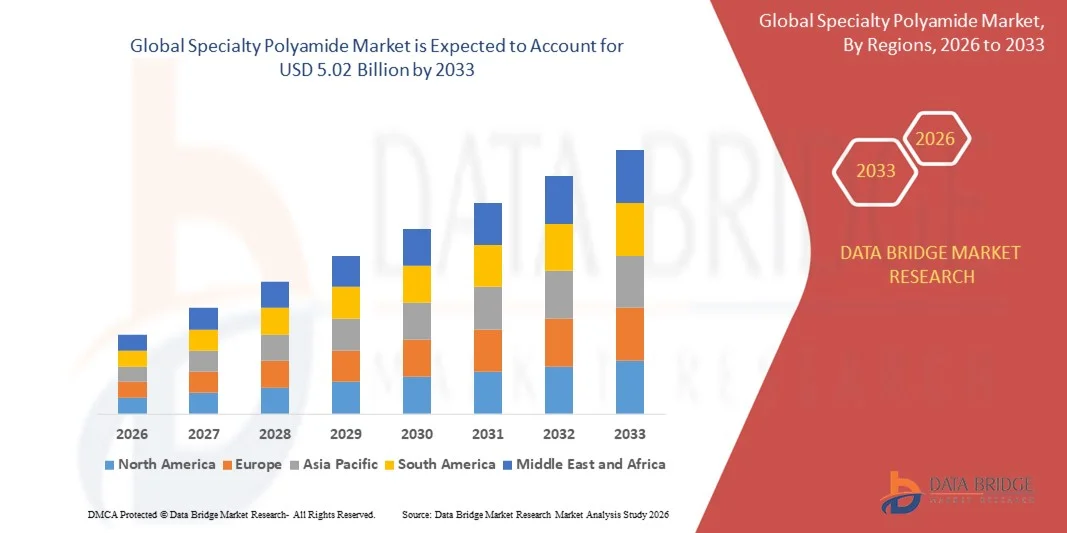
Specialty Polyamide Market Size
- The global specialty polyamide market size was valued at USD 3.50 billion in 2025 and is expected to reach USD 5.02 billion by 2033, at a CAGR of 4.60% during the forecast period
- The market growth is largely fueled by the increasing adoption of specialty polyamides in high-performance applications across automotive, electronics, industrial, and consumer goods sectors, driven by their superior mechanical strength, chemical resistance, and thermal stability
- Furthermore, rising demand for lightweight, durable, and sustainable materials in industries such as automotive and electronics is encouraging manufacturers to replace traditional materials with specialty polyamides. These converging factors are accelerating the uptake of advanced polyamide solutions, thereby significantly boosting the market's growth
Specialty Polyamide Market Analysis
- Specialty polyamides, offering high-performance thermoplastic properties, are increasingly essential in modern engineering and manufacturing applications due to their enhanced mechanical performance, chemical stability, and versatility in processing technologies
- The escalating demand for specialty polyamides is primarily fueled by technological advancements in polymer engineering, growing emphasis on sustainability, and rising consumer preference for durable, high-performance products in automotive, electronics, and industrial sectors
- Asia-Pacific dominated the specialty polyamide market with a share of 43.77% in 2025, due to expanding automotive production, increasing demand for high-performance engineering plastics, and a strong presence of polymer manufacturing hubs
- North America is expected to be the fastest growing region in the specialty polyamide market during the forecast period due to robust demand for high-performance polymers in automotive, aerospace, and electronics applications
- High temperature segment dominated the market with a market share of 47.74% in 2025, due to increasing demand for materials that can withstand extreme temperatures in automotive, aerospace, and electronics applications. High temperature polyamides offer excellent thermal stability, dimensional integrity, and resistance to hydrolysis and chemicals, making them suitable for engine components, electrical connectors, and high-performance coatings. For instance, Solvay has been actively promoting high temperature polyamides in automotive under-the-hood applications to replace metal components while reducing weight. The growth is further supported by rising adoption in energy-efficient devices and advanced industrial machinery that require materials capable of long-term performance under thermal stress. Increasing awareness of sustainability and lightweighting also encourages manufacturers to shift from metals to high temperature polyamides, driving market expansion
Report Scope and Specialty Polyamide Market Segmentation
|
Attributes |
Specialty Polyamide Key Market Insights |
|
Segments Covered |
|
|
Countries Covered |
North America
Europe
Asia-Pacific
Middle East and Africa
South America
|
|
Key Market Players |
|
|
Market Opportunities |
|
|
Value Added Data Infosets |
In addition to the insights on market scenarios such as market value, growth rate, segmentation, geographical coverage, and major players, the market reports curated by the Data Bridge Market Research also include import export analysis, production capacity overview, production consumption analysis, price trend analysis, climate change scenario, supply chain analysis, value chain analysis, raw material/consumables overview, vendor selection criteria, PESTLE Analysis, Porter Analysis, and regulatory framework. |
Specialty Polyamide Market Trends
Increasing Use of Specialty Polyamides in Automotive and Industrial Applications
- The specialty polyamide market is witnessing robust growth as manufacturers increasingly adopt high-performance polyamides for automotive, electronics, industrial machinery, and consumer goods. These materials provide superior mechanical strength, chemical resistance, thermal stability, and design flexibility, making them suitable for demanding applications requiring both performance and durability
- For instance, Arkema’s Rilsan® Clear bio-based polyamide is being increasingly used in automotive components and industrial equipment, offering high thermal resistance, mechanical strength, and reduced environmental impact, which is accelerating adoption of specialty polyamides in the market
- The growing emphasis on lightweight materials in automotive and industrial sectors is driving demand for specialty polyamides, enabling manufacturers to reduce weight without compromising performance. These polymers are increasingly replacing metals and conventional plastics in structural components, enhancing fuel efficiency, reducing emissions, and improving overall system performance
- Specialty polyamides are also gaining traction due to their excellent chemical and moisture resistance, which ensures longevity and reliability in harsh operating environments. Their adaptability to various processing methods such as injection molding, extrusion, and compounding further supports widespread utilization across multiple industries
- The integration of specialty polyamides into advanced manufacturing applications, including electric vehicles, industrial robotics, and high-performance electronics, is reinforcing their importance as essential engineering materials. Companies such as DuPont and Evonik are investing in R&D to expand product portfolios with enhanced properties tailored for these applications
- The demand for specialty polyamides in automotive and industrial applications is expected to continue rising, driven by ongoing innovation, sustainability initiatives, and the need for high-performance materials capable of meeting stringent regulatory and operational requirements
Specialty Polyamide Market Dynamics
Driver
Rising Demand for High-Strength, Chemical-Resistant, and Heat-Stable Materials
- The demand for specialty polyamides is being fueled by industries requiring high-performance materials that can withstand mechanical stress, chemical exposure, and elevated temperatures, ensuring reliability and durability in critical applications
- For instance, in July 2025, Arkema expanded its Rilsan® Clear production in Singapore to meet rising demand for bio-based, high-performance polyamides in automotive and electronics applications. Such initiatives by key players are expected to drive significant market growth during the forecast period
- Automotive manufacturers are increasingly using specialty polyamides for under-the-hood components, structural parts, and electrical housings due to their high strength-to-weight ratio, thermal stability, and resistance to fuels and chemicals
- Electronics and industrial equipment sectors are adopting specialty polyamides for housings, connectors, and insulating components, as these polymers provide excellent dimensional stability and resistance to moisture and chemical degradation, ensuring long-term performance
- The growing need for reliable, high-performance engineering plastics across industries is expected to sustain market growth, supported by continuous R&D, introduction of advanced grades, and the increasing trend of replacing conventional materials with specialty polyamides for superior performance
Restraint/Challenge
Limited Availability of Raw Materials
- The specialty polyamide market faces challenges due to the limited availability and high cost of high-purity monomers and feedstocks required for advanced polyamide production, which can restrict scaling and increase production expenses
- For instance, fluctuations in global castor oil supply have impacted bio-based polyamide production, affecting companies such as BASF and Arkema that rely on renewable feedstocks. Such constraints can slow market expansion and affect supply chain stability
- The dependency on specific raw materials limits flexibility in manufacturing, particularly for bio-based and high-performance grades, making producers vulnerable to market fluctuations and geopolitical risks
- High costs associated with procuring and processing specialty monomers can pose barriers for smaller manufacturers and new entrants, potentially restricting market competitiveness and innovation
- Addressing raw material availability challenges through strategic partnerships, recycling initiatives, and alternative feedstock development is essential to ensure sustained growth and long-term stability of the specialty polyamide market
Specialty Polyamide Market Scope
The market is segmented on the basis of product and application.
- By Product
On the basis of product, the specialty polyamide market is segmented into long chain, high temperature, and MXD6/PARA. The high temperature segment dominated the market with the largest market revenue share of 47.74% in 2025, driven by increasing demand for materials that can withstand extreme temperatures in automotive, aerospace, and electronics applications. High temperature polyamides offer excellent thermal stability, dimensional integrity, and resistance to hydrolysis and chemicals, making them suitable for engine components, electrical connectors, and high-performance coatings. For instance, Solvay has been actively promoting high temperature polyamides in automotive under-the-hood applications to replace metal components while reducing weight. The growth is further supported by rising adoption in energy-efficient devices and advanced industrial machinery that require materials capable of long-term performance under thermal stress. Increasing awareness of sustainability and lightweighting also encourages manufacturers to shift from metals to high temperature polyamides, driving market expansion.
The long chain polyamide segment is anticipated to witness the fastest growth rate from 2026 to 2033, fueled by its superior mechanical strength, chemical resistance, and flexibility in high-performance applications. Industries such as automotive and industrial equipment widely adopt long chain polyamides due to their ability to withstand abrasion, impact, and high-stress conditions. The demand for lightweight yet durable materials in transportation and consumer goods further fuels the adoption of long chain polyamides. For instance, companies such as BASF and Evonik utilize long chain polyamides in automotive components and industrial parts to enhance durability while reducing weight. The segment also benefits from compatibility with reinforcement fibers and fillers, which improves performance in specialized applications. Its versatility across multiple industries ensures sustained dominance in the global specialty polyamide market, and ongoing R&D initiatives continue to expand its utility and cost-effectiveness.
- By Application
On the basis of application, the specialty polyamide market is segmented into transportation, energy, consumer goods, industrial coatings, electronics, and others. The transportation segment dominated the market with the largest revenue share in 2025, driven by the increasing adoption of lightweight materials for fuel efficiency, emission reduction, and enhanced performance. Specialty polyamides are extensively used in automotive fuel lines, gears, and structural components due to their mechanical strength, heat resistance, and chemical stability. For instance, DSM Engineering Materials integrates specialty polyamides in automotive applications to replace metals and reduce vehicle weight while maintaining safety and durability standards. The segment also benefits from growing demand in electric vehicles, where high-performance polyamides provide insulation and structural support for batteries and electronic systems. Government regulations promoting sustainable and fuel-efficient vehicles further reinforce the adoption of specialty polyamides in transportation.
The electronics segment is expected to witness the fastest CAGR from 2026 to 2033, driven by rising demand for miniaturized, high-performance electronic devices and components. Specialty polyamides offer excellent dielectric properties, thermal resistance, and dimensional stability, making them ideal for connectors, housings, and insulating components in smartphones, wearables, and industrial electronics. For instance, Celanese has been expanding its portfolio of polyamide materials specifically for electronics applications to improve heat dissipation and mechanical reliability. The growth is also supported by the increasing trend of IoT and smart devices, which require materials that maintain performance under continuous operation. Continuous innovations in electronic designs and consumer demand for durable, compact devices are expected to drive robust growth in this segment throughout the forecast period.
Specialty Polyamide Market Regional Analysis
- Asia-Pacific dominated the specialty polyamide market with the largest revenue share of 43.77% in 2025, driven by expanding automotive production, increasing demand for high-performance engineering plastics, and a strong presence of polymer manufacturing hubs
- The region’s cost-effective manufacturing landscape, rising investments in specialty polymer production, and growing exports of polyamide-based components are accelerating market expansion
- The availability of skilled labor, favorable government policies, and rapid industrialization across developing economies are contributing to increased consumption of specialty polyamides in both automotive and electronics sectors
China Specialty Polyamide Market Insight
China held the largest share in the Asia-Pacific specialty polyamide market in 2025, owing to its status as a global leader in polymer and automotive component manufacturing. The country's robust industrial base, supportive government initiatives for advanced materials, and extensive export capabilities for high-performance plastics are major growth drivers. Demand is further strengthened by ongoing investments in specialty polymers for electronics, automotive, and industrial applications.
India Specialty Polyamide Market Insight
India is witnessing the fastest growth in the Asia-Pacific region, fueled by rapid expansion of the automotive and electrical & electronics sectors, increasing adoption of lightweight and high-strength materials, and rising investments in polymer processing infrastructure. For instance, Reliance Industries’ investments in engineering plastics production are reinforcing local supply capabilities. In addition, government initiatives promoting Make in India and self-reliance in specialty materials are enhancing demand for polyamides.
Europe Specialty Polyamide Market Insight
The Europe specialty polyamide market is expanding steadily, supported by high demand for engineering-grade polymers, stringent environmental regulations, and growing investments in sustainable and bio-based polyamides. The region emphasizes product quality, performance, and compliance with ecological standards, particularly in automotive, aerospace, and industrial sectors. Increasing use of polyamides in lightweight structural components and high-performance applications is further driving market growth.
Germany Specialty Polyamide Market Insight
Germany’s specialty polyamide market is driven by its leadership in automotive engineering, strong polymer manufacturing expertise, and focus on precision components. The country has well-established R&D networks and collaborations between academic institutions and polymer manufacturers, fostering continuous innovation in high-performance polyamides. Demand is particularly strong for polyamide applications in automotive, machinery, and electrical components.
U.K. Specialty Polyamide Market Insight
The U.K. market is supported by a mature engineering and manufacturing sector, growing emphasis on lightweight automotive materials, and rising demand for specialty polymers in high-performance applications. For instance, BASF’s initiatives in developing high-strength polyamide compounds for automotive parts are enhancing domestic capabilities. In addition, increasing R&D investments and collaborations between industry and universities are driving innovation and adoption of specialty polyamides in advanced applications.
North America Specialty Polyamide Market Insight
North America is projected to grow at the fastest CAGR from 2026 to 2033, driven by robust demand for high-performance polymers in automotive, aerospace, and electronics applications. The region’s strong focus on lightweight materials, innovation in polymer engineering, and increasing use of polyamide composites in end-use industries are supporting growth. Growing reshoring of manufacturing and expansion of specialty polymer production capacities are further boosting market potential.
U.S. Specialty Polyamide Market Insight
The U.S. accounted for the largest share in the North America market in 2025, underpinned by its expansive automotive and electronics industries, strong R&D infrastructure, and significant investment in high-performance polymer production. For instance, DuPont’s production of engineering-grade polyamides for automotive and industrial applications strengthens local supply chains. The country’s focus on sustainability, innovation, and compliance with regulatory standards continues to support high adoption of specialty polyamides across multiple sectors.
Specialty Polyamide Market Share
The specialty polyamide industry is primarily led by well-established companies, including:
- Evonik Industries (Germany)
- BASF SE (Germany)
- Arkema (France)
- DuPont (U.S.)
- DSM (Netherlands)
- Asahi Kasei Corporation (Japan)
- LG Chem (South Korea)
- INVISTA (U.S.)
- Solvay (Belgium)
- Radici Partecipazioni SpA (Italy)
- LANXESS (Germany)
- LEALEA ENTERPRISE CO., LTD (Taiwan)
- Honeywell International Inc (U.S.)
- Koch Industries, Inc (U.S.)
Latest Developments in Global Specialty Polyamide Market
- In July 2025, Arkema announced a US$ 20 million investment to establish a new production unit in Singapore for its Rilsan® Clear transparent bio-based polyamide. This expansion will triple Arkema’s global capacity for renewable-castor-oil-based polyamides, meeting increasing demand in electronics, optics, medical devices, and other high-performance applications. The initiative positions Arkema as a key supplier of sustainable specialty polyamides and accelerates market adoption of bio-based polymers in industries that require both high performance and environmental compliance
- In March 2025, BASF began operations at its first commercial-scale Loopamid® plant in Shanghai, producing recycled PA‑6 derived entirely from textile waste. This development significantly strengthens the specialty polyamide market’s shift toward sustainable and circular solutions, offering high-performance polyamides with reduced environmental impact. The new production facility enhances the availability of eco-friendly polymers for automotive, electronics, and industrial applications, supporting manufacturers’ goals of reducing carbon footprint while maintaining high-performance material standards
- In April 2024, NYCOA launched NXTamid L, a plasticizer-free long-chain polyamide developed as a sustainable alternative to PA11 and PA12. This material provides equivalent performance to conventional resins while offering higher service temperature, enhanced flexibility, chemical resistance, lower moisture absorption, and improved dimensional stability. Its versatility across multiple applications and processing technologies strengthens the specialty polyamide market by enabling manufacturers to meet evolving performance and sustainability requirements
- In March 2024, Toray Advanced Composites introduced Toray Cetex TC915 PA+, a high-performance thermoplastic polyamide that delivers improved strength, advanced stiffness, better temperature stability, and reduced moisture absorption. This innovation supports applications in high-performance industrial uses, sporting goods, automotive structures, energy solutions, urban air mobility, and unmanned aerial systems. The launch highlights the growing adoption of specialty polyamides in sectors demanding superior mechanical and thermal properties
- In June 2023, Intel invested approximately US$ 4.6 billion in a semiconductor chip assembly and testing facility in Poland, marking the largest Greenfield investment in the country’s history. This project strengthens Poland’s position in the global semiconductor supply chain and drives indirect demand for specialty polyamides used in high-performance electronic components, chip packaging, and semiconductor manufacturing. The development underscores the increasing role of specialty polyamides in supporting advanced technological infrastructure and high-precision applications

- Interactive Data Analysis Dashboard
- Company Analysis Dashboard for high growth potential opportunities
- Research Analyst Access for customization & queries
- Competitor Analysis with Interactive dashboard
- Latest News, Updates & Trend analysis
- Harness the Power of Benchmark Analysis for Comprehensive Competitor Tracking
Global Specialty Polyamide Market, Supply Chain Analysis and Ecosystem Framework
To support market growth and help clients navigate the impact of geopolitical shifts, DBMR has integrated in-depth supply chain analysis into its Global Specialty Polyamide Market research reports. This addition empowers clients to respond effectively to global changes affecting their industries. The supply chain analysis section includes detailed insights such as Global Specialty Polyamide Market consumption and production by country, price trend analysis, the impact of tariffs and geopolitical developments, and import and export trends by country and HSN code. It also highlights major suppliers with data on production capacity and company profiles, as well as key importers and exporters. In addition to research, DBMR offers specialized supply chain consulting services backed by over a decade of experience, providing solutions like supplier discovery, supplier risk assessment, price trend analysis, impact evaluation of inflation and trade route changes, and comprehensive market trend analysis.
Data collection and base year analysis are done using data collection modules with large sample sizes. The stage includes obtaining market information or related data through various sources and strategies. It includes examining and planning all the data acquired from the past in advance. It likewise envelops the examination of information inconsistencies seen across different information sources. The market data is analysed and estimated using market statistical and coherent models. Also, market share analysis and key trend analysis are the major success factors in the market report. To know more, please request an analyst call or drop down your inquiry.
The key research methodology used by DBMR research team is data triangulation which involves data mining, analysis of the impact of data variables on the market and primary (industry expert) validation. Data models include Vendor Positioning Grid, Market Time Line Analysis, Market Overview and Guide, Company Positioning Grid, Patent Analysis, Pricing Analysis, Company Market Share Analysis, Standards of Measurement, Global versus Regional and Vendor Share Analysis. To know more about the research methodology, drop in an inquiry to speak to our industry experts.
Data Bridge Market Research is a leader in advanced formative research. We take pride in servicing our existing and new customers with data and analysis that match and suits their goal. The report can be customized to include price trend analysis of target brands understanding the market for additional countries (ask for the list of countries), clinical trial results data, literature review, refurbished market and product base analysis. Market analysis of target competitors can be analyzed from technology-based analysis to market portfolio strategies. We can add as many competitors that you require data about in the format and data style you are looking for. Our team of analysts can also provide you data in crude raw excel files pivot tables (Fact book) or can assist you in creating presentations from the data sets available in the report.













