


Sperm Analyzer Systems Market Size
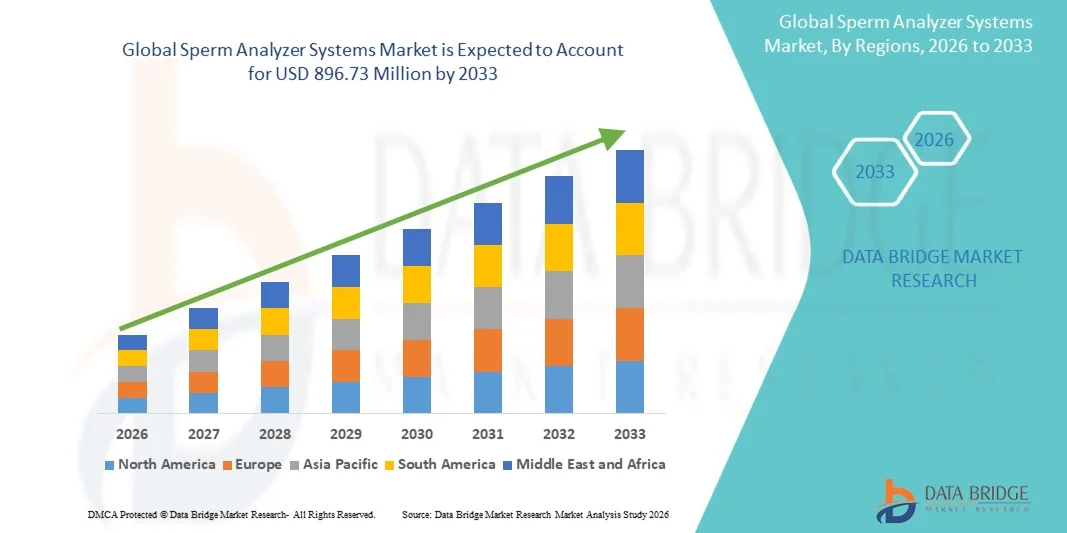
- The global sperm analyzer systems market size was valued at USD 450.04 million in 2025 and is expected to reach USD 896.73 million by 2033, at a CAGR of 9.00% during the forecast period
- The market growth is largely fueled by the increasing prevalence of male infertility, rising awareness about reproductive health, and advancements in automated semen analysis technologies, leading to more efficient and accurate diagnostics in fertility clinics and laboratories
- Furthermore, growing demand for user-friendly, high-throughput, and integrated analysis solutions is driving adoption across clinical, research, and veterinary applications. These converging factors are accelerating the uptake of sperm analyzer systems, thereby significantly boosting the industry's growth
Sperm Analyzer Systems Market Analysis
- Sperm analyzer systems, providing automated or digital analysis of semen samples, are becoming essential tools in fertility clinics, hospitals, and research laboratories due to their accuracy, speed, and ability to integrate with laboratory information management systems (LIMS)
- The rising demand for sperm analyzer systems is primarily driven by increasing male infertility rates, growing awareness about reproductive health, and the need for precise and standardized semen analysis in clinical diagnostics and assisted reproductive technology (ART) procedures
- North America dominated the sperm analyzer systems market with the largest revenue share of 39.7% in 2025, supported by advanced healthcare infrastructure, high adoption of fertility treatments, and a strong presence of key industry players, with the U.S. witnessing substantial growth in automated semen analysis solutions driven by technological innovations and integration with AI-based diagnostic tools
- Asia-Pacific is expected to be the fastest growing region in the sperm analyzer systems market during the forecast period due to increasing investments in fertility clinics, rising awareness of reproductive health, and improving healthcare accessibility
- Windows system segment dominated the sperm analyzer systems market with a market share of 42.1% in 2025, driven by its user-friendly interface, compatibility with most laboratory software, and widespread adoption across fertility clinics and hospitals
Report Scope and Sperm Analyzer Systems Market Segmentation
|
Attributes |
Sperm Analyzer Systems Key Market Insights |
|
Segments Covered |
|
|
Countries Covered |
North America
Europe
Asia-Pacific
Middle East and Africa
South America
|
|
Key Market Players |
|
|
Market Opportunities |
|
|
Value Added Data Infosets |
In addition to the insights on market scenarios such as market value, growth rate, segmentation, geographical coverage, and major players, the market reports curated by the Data Bridge Market Research also include in-depth expert analysis, patient epidemiology, pipeline analysis, pricing analysis, and regulatory framework |
Sperm Analyzer Systems Market Trends
“Automation and AI-Enhanced Analysis”
- A significant and accelerating trend in the global sperm analyzer systems market is the integration of artificial intelligence (AI) and advanced image processing algorithms, enhancing the speed, accuracy, and reproducibility of semen analysis in clinical and research settings
- For instance, CASA (Computer-Aided Sperm Analysis) systems now leverage AI to automatically detect sperm motility, morphology, and concentration, reducing manual intervention and human error in routine fertility assessments
- AI integration enables predictive analytics, such as assessing fertility potential or identifying abnormal sperm patterns, while software improvements allow for real-time data visualization and reporting, streamlining lab workflows
- The seamless integration of sperm analyzer systems with laboratory information management systems (LIMS) and electronic health records facilitates centralized management of patient and research data, improving operational efficiency
- This trend towards more automated, intelligent, and interconnected diagnostic systems is fundamentally reshaping expectations for clinical fertility assessments, with companies such as Microptic and Hamilton Thorne developing AI-enabled analyzers that provide comprehensive sperm quality reports and workflow automation
- The demand for sperm analyzer systems with AI-assisted automation and advanced software analytics is growing rapidly across fertility clinics, hospitals, and research laboratories, as healthcare providers increasingly prioritize accuracy, efficiency, and reproducibility
- Collaborations between technology providers and fertility clinics to integrate sperm analyzer systems with telemedicine platforms are emerging, enabling remote consultations and broader accessibility to reproductive health services
Sperm Analyzer Systems Market Dynamics
Driver
“Increasing Male Infertility Awareness and Fertility Clinic Demand”
- The rising prevalence of male infertility, combined with growing awareness about reproductive health, is a significant driver for the heightened demand for sperm analyzer systems
- For instance, in March 2025, Hamilton Thorne introduced an AI-based CASA system designed for high-throughput clinical laboratories to streamline semen analysis with greater accuracy, driving market adoption
- As fertility clinics and hospitals seek standardized, reproducible, and rapid diagnostic tools, sperm analyzer systems offer advanced features such as automated motility tracking, morphology assessment, and integrated reporting dashboards
- Furthermore, increasing investments in fertility clinics, particularly in North America and Asia-Pacific, are making sperm analyzer systems essential for both clinical diagnostics and assisted reproductive technology (ART) procedures
- The demand for more accurate, reliable, and user-friendly analysis solutions, combined with the need to meet growing patient volumes, is propelling the adoption of sperm analyzer systems across clinical and research settings
- Expanding government initiatives and insurance coverage for fertility treatments in developed and emerging markets are encouraging clinics to adopt advanced sperm analysis technologies
- Rising collaborations between academic institutions and healthcare providers to improve reproductive health research are driving demand for high-precision sperm analyzer system
Restraint/Challenge
“High Cost and Regulatory Compliance Hurdles”
- The high initial cost of advanced sperm analyzer systems and associated software can be a barrier for small clinics and laboratories, particularly in developing regions or budget-constrained facilities
- For instance, portable and fully automated CASA systems with AI-based analytics often come at a premium price, limiting adoption in cost-sensitive markets
- In addition, stringent regulatory requirements and certification standards for clinical diagnostic devices pose challenges to market entry, requiring manufacturers to comply with ISO, FDA, and CE guidelines
- Variability in healthcare infrastructure and differences in regional regulatory frameworks can slow deployment and adoption, particularly in emerging markets where compliance and maintenance support may be limited
- Overcoming these challenges through cost-effective product development, flexible financing options, and robust regulatory strategy will be crucial for sustained market growth and broader adoption of sperm analyzer systems
- Limited technical expertise among laboratory personnel to operate advanced sperm analyzer systems can hinder adoption, requiring additional training and support from manufacturers
- Concerns regarding data privacy and integration with patient health records may pose challenges, necessitating secure software solutions and adherence to healthcare data protection regulations
Sperm Analyzer Systems Market Scope
The market is segmented on the basis of product type and end use.
- By Product Type
On the basis of product type, the sperm analyzer systems market is segmented into Windows system, XP system, and Other. The Windows system segment dominated the market with the largest market revenue share of 42.1% in 2025, driven by its user-friendly interface, broad software compatibility, and ease of integration into existing laboratory setups. Fertility clinics and hospitals often prefer Windows-based systems for their stability, extensive support, and compatibility with other laboratory instruments. The segment benefits from widespread adoption in North America and Europe, where laboratories prioritize standardized, reliable solutions for routine semen analysis. In addition, Windows systems allow for advanced reporting and data management, making them highly suitable for both clinical and research applications. Manufacturers such as Microptic and Hamilton Thorne offer customizable Windows-based analyzers that cater to diverse lab requirements, further reinforcing their market dominance.
The XP system segment is anticipated to witness the fastest growth during the forecast period from 2026 to 2033, fueled by demand in emerging markets and cost-effective deployment. XP systems often offer simplified hardware requirements, lower initial investment, and sufficient functionality for clinics and hospitals with moderate testing volumes. These systems are gaining traction in Asia-Pacific and Latin America due to their affordability and ability to deliver reliable results without extensive IT infrastructure. XP-based sperm analyzers are also appealing for smaller fertility clinics and research facilities looking for automated analysis at a lower price point. The growth of this segment is further supported by collaborations between local distributors and international manufacturers to expand market reach.
- By End Use
On the basis of end use, the sperm analyzer systems market is segmented into fertility clinics, hospitals, and other. The fertility clinics segment dominated the market with the largest market revenue share of 50.2% in 2025, driven by the increasing prevalence of male infertility and rising demand for assisted reproductive technologies (ART). Fertility clinics require precise, high-throughput, and standardized sperm analysis solutions to support procedures such as IVF and IUI. Clinics also prefer systems that integrate with laboratory information management systems (LIMS) for efficient patient data management. The segment benefits from growing awareness of male reproductive health, technological advancements in CASA systems, and expanding fertility services in developed and emerging regions. Key players are increasingly offering tailored solutions for fertility clinics, including automated motility and morphology assessments, to streamline workflow and enhance diagnostic accuracy.
The hospitals segment is expected to witness the fastest growth during the forecast period from 2026 to 2033, fueled by expanding hospital fertility programs, investments in reproductive health, and rising demand for in-house diagnostic solutions. Hospitals are adopting sperm analyzer systems to provide comprehensive fertility assessments alongside other clinical services, improving patient convenience and care continuity. Portable and compact analyzers are particularly gaining traction for hospital use due to space constraints and point-of-care testing needs. The segment is also growing as hospitals increasingly focus on preventive reproductive health screenings and standardized diagnostics, creating opportunities for integrated systems with reporting and telemedicine compatibility. Expansion in emerging economies and government-supported fertility initiatives further boost adoption in hospital settings.
Sperm Analyzer Systems Market Regional Analysis
- North America dominated the sperm analyzer systems market with the largest revenue share of 39.7% in 2025, supported by advanced healthcare infrastructure, high adoption of fertility treatments, and a strong presence of key industry players
- Clinics and hospitals in the region highly value the accuracy, efficiency, and automation provided by sperm analyzer systems, which streamline semen analysis and improve diagnostic reliability
- This widespread adoption is further supported by high disposable incomes, technologically advanced laboratories, and growing demand for assisted reproductive technologies (ART), establishing sperm analyzer systems as essential diagnostic tools in both clinical and research settings
U.S. Sperm Analyzer Systems Market Insight
The U.S. sperm analyzer systems market captured the largest revenue share of 79% in 2025 within North America, fueled by the high prevalence of male infertility and the widespread adoption of advanced fertility treatments. Clinics and hospitals are increasingly prioritizing automated, high-accuracy semen analysis systems to improve diagnostic efficiency and outcomes. The growing trend of integrating AI and digital reporting with laboratory information management systems (LIMS) further propels the market. Moreover, rising awareness about reproductive health, coupled with strong healthcare infrastructure and technological advancements, is significantly contributing to market expansion.
Europe Sperm Analyzer Systems Market Insight
The Europe sperm analyzer systems market is projected to expand at a substantial CAGR throughout the forecast period, primarily driven by increasing awareness of male infertility and stringent healthcare regulations for diagnostic laboratories. The growth of fertility clinics and the rising demand for assisted reproductive technology (ART) procedures are fostering the adoption of automated semen analysis systems. European healthcare providers are drawn to the efficiency, standardization, and reproducibility offered by these systems. The region is experiencing growth across fertility clinics, hospitals, and research centers, with sperm analyzer systems increasingly incorporated into routine diagnostics and clinical trials.
U.K. Sperm Analyzer Systems Market Insight
The U.K. sperm analyzer systems market is anticipated to grow at a noteworthy CAGR during the forecast period, driven by the rising prevalence of infertility and the increasing adoption of modern fertility diagnostics. Hospitals and clinics are adopting automated semen analysis systems to enhance accuracy and reduce manual intervention. In addition, the growing emphasis on reproductive health awareness and expanding fertility services is encouraging healthcare providers to invest in advanced sperm analyzer solutions. The U.K.’s well-established healthcare infrastructure and strong focus on innovation and technology in diagnostics are expected to continue supporting market growth.
Germany Sperm Analyzer Systems Market Insight
The Germany sperm analyzer systems market is expected to expand at a considerable CAGR during the forecast period, fueled by the increasing prevalence of male infertility and growing investments in fertility research and clinical diagnostics. Germany’s advanced healthcare infrastructure and focus on precision medicine promote the adoption of automated sperm analysis systems in hospitals and research laboratories. The integration of AI-based tools and automated reporting features is becoming increasingly prevalent, with a preference for high-accuracy, reliable, and reproducible solutions. Growing collaborations between research institutions and healthcare providers further support the market’s expansion in Germany.
Asia-Pacific Sperm Analyzer Systems Market Insight
The Asia-Pacific sperm analyzer systems market is poised to grow at the fastest CAGR of 22% during the forecast period of 2026 to 2033, driven by rising awareness of male infertility, increasing fertility clinic setups, and improving healthcare infrastructure in countries such as China, Japan, and India. The region's growing adoption of digital and automated diagnostic tools, supported by government initiatives to improve reproductive healthcare, is driving market growth. Furthermore, the availability of cost-effective and locally manufactured sperm analyzer systems is expanding access to advanced diagnostics for a wider patient base across Asia-Pacific.
Japan Sperm Analyzer Systems Market Insight
The Japan sperm analyzer systems market is gaining momentum due to the country’s high healthcare standards, rapid urbanization, and increasing focus on reproductive health. Hospitals and fertility clinics are adopting advanced, AI-enabled semen analysis systems to improve diagnostic accuracy and workflow efficiency. The integration of these systems with digital health records and laboratory information management platforms is fueling growth. In addition, Japan’s aging population and government initiatives supporting fertility research are likely to spur demand for efficient, automated sperm analysis solutions in both clinical and research settings.
India Sperm Analyzer Systems Market Insight
The India sperm analyzer systems market accounted for the largest market revenue share in Asia-Pacific in 2025, attributed to the country’s rising awareness of male infertility, expanding fertility clinic networks, and growing healthcare expenditure. India represents a large and increasingly technology-friendly market for automated diagnostic solutions. The push towards modern fertility diagnostics, availability of affordable sperm analyzer systems, and increasing adoption of AI-enabled solutions in urban hospitals and clinics are key factors propelling the market. In addition, government initiatives promoting reproductive health and rising demand for assisted reproductive technology (ART) are expected to sustain market growth in India.
Sperm Analyzer Systems Market Share
The Sperm Analyzer Systems industry is primarily led by well-established companies, including:
- Hamilton Thorne Inc. (U.S.)
- Medical Electronic Systems (U.S.)
- MICROPTIC S.L.U. (Spain)
- iSperm Medical Ltd. (China)
- Vitrolife (Sweden)
- CooperSurgical, Inc. (U.S.)
- Bioline Technologies Pvt. Ltd. (India)
- Lab IVF Asia PTE. LTD. (Singapore)
- MotilityCount ApS (Denmark)
- FlowLabs (U.K.)
- Androfert (Portugal)
- NW Cryobank (U.S.)
- Midland Fertility (U.S.)
- DNA Diagnostics Center, Inc. (U.S.)
- Synergy Medical Systems (U.S.)
- Proiser R+D S.L. (Spain)
- MMCSoft (Italy)
- FertiPro N.V. (Belgium)
- BaseCare Medical (China)
- Hamilton Thorne Ltd. (U.K.)
What are the Recent Developments in Global Sperm Analyzer Systems Market?
- In April 2025, BaseCare Medical unveiled its first portable home sperm quality analyzer (model BKP200), the first consumer‑facing device capable of delivering lab‑level sperm concentration and motility analysis in just ~15 seconds using an integrated HD camera and algorithms opening a new frontier for at‑home male fertility assessment
- In February 2025, MotilityCount’s SwimCount® Harvester received US FDA 510(k) clearance, enabling the product’s launch in the United States and expanding global availability for clinical sperm processing and fertility treatment applications
- In January 2025, Korean startups showcased home sperm health tech at CES 2025, including smartphone‑based sperm observation devices for at‑home use, signaling broader innovation and consumer‑oriented fertility tech adoption in the reproductive diagnostics field
- In November 2024, BaseCare Medical’s intelligent live sperm analyzer (BKA210) was launched, marking the world’s first device able to detect unstained live sperm and significantly advancing beyond traditional CASA diagnostic methods with faster, AI‑based analysis of morphology, vitality, and concentration
- In October 2024, MotilityCount ApS obtained EU MDR approval for its SwimCount™ Harvester, a novel microfluidic method for sperm purification used in ART (IVF, ICSI, IUI) that enhances selection of high‑quality sperm and reduces lab processing complexity under stricter European regulatory standards

- Interactive Data Analysis Dashboard
- Company Analysis Dashboard for high growth potential opportunities
- Research Analyst Access for customization & queries
- Competitor Analysis with Interactive dashboard
- Latest News, Updates & Trend analysis
- Harness the Power of Benchmark Analysis for Comprehensive Competitor Tracking
Data collection and base year analysis are done using data collection modules with large sample sizes. The stage includes obtaining market information or related data through various sources and strategies. It includes examining and planning all the data acquired from the past in advance. It likewise envelops the examination of information inconsistencies seen across different information sources. The market data is analysed and estimated using market statistical and coherent models. Also, market share analysis and key trend analysis are the major success factors in the market report. To know more, please request an analyst call or drop down your inquiry.
The key research methodology used by DBMR research team is data triangulation which involves data mining, analysis of the impact of data variables on the market and primary (industry expert) validation. Data models include Vendor Positioning Grid, Market Time Line Analysis, Market Overview and Guide, Company Positioning Grid, Patent Analysis, Pricing Analysis, Company Market Share Analysis, Standards of Measurement, Global versus Regional and Vendor Share Analysis. To know more about the research methodology, drop in an inquiry to speak to our industry experts.
Data Bridge Market Research is a leader in advanced formative research. We take pride in servicing our existing and new customers with data and analysis that match and suits their goal. The report can be customized to include price trend analysis of target brands understanding the market for additional countries (ask for the list of countries), clinical trial results data, literature review, refurbished market and product base analysis. Market analysis of target competitors can be analyzed from technology-based analysis to market portfolio strategies. We can add as many competitors that you require data about in the format and data style you are looking for. Our team of analysts can also provide you data in crude raw excel files pivot tables (Fact book) or can assist you in creating presentations from the data sets available in the report.













