


Sperm Bank Market Size
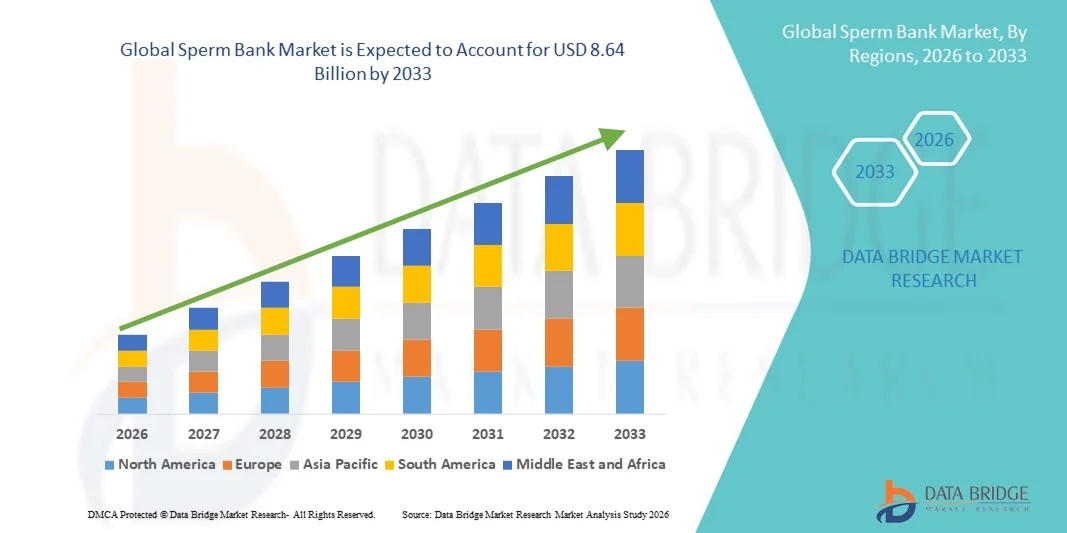
- The global sperm bank market size was valued at USD 5.80 billion in 2025 and is expected to reach USD 8.64 billion by 2033, at a CAGR of 5.1% during the forecast period
- The market growth is largely fueled by the rising prevalence of infertility, increasing awareness about assisted reproductive technologies (ART), and growing acceptance of donor sperm services in both developed and emerging regions
- Furthermore, advancements in cryopreservation techniques, coupled with rising consumer demand for safe, reliable, and ethically managed sperm banking services, are positioning sperm banks as a crucial component of reproductive healthcare. These converging factors are accelerating the adoption of sperm bank services, thereby significantly boosting the industry's growth
Sperm Bank Market Analysis
- Sperm banks, providing the collection, storage, and distribution of donor sperm for assisted reproductive procedures, are increasingly critical components of modern fertility and reproductive healthcare services due to their reliability, regulatory compliance, and ability to support diverse family-building options in both clinical and personal settings
- The rising demand for sperm banks is primarily fueled by increasing infertility rates, growing awareness and acceptance of assisted reproductive technologies (ART), and a rising preference for donor sperm services among single individuals and same-sex couples
- North America dominated the sperm bank market with the largest revenue share of 39.8% in 2025, characterized by advanced fertility clinics, high awareness of ART services, and a strong presence of leading sperm bank providers, with the U.S. experiencing substantial growth in sperm donations and storage services, particularly in metropolitan areas, driven by innovations in cryopreservation, genetic screening, and donor matching technologies
- Asia-Pacific is expected to be the fastest-growing region in the sperm bank market during the forecast period due to increasing awareness of fertility solutions, supportive government initiatives, and rising disposable incomes
- Anonymous donor segment dominated the sperm bank market with a market share of 43.2% in 2025, driven by its widespread adoption in fertility treatments, confidentiality assurance, and compatibility with a range of assisted reproductive procedures
Report Scope and Sperm Bank Market Segmentation
|
Attributes |
Sperm Bank Key Market Insights |
|
Segments Covered |
|
|
Countries Covered |
North America
Europe
Asia-Pacific
Middle East and Africa
South America
|
|
Key Market Players |
|
|
Market Opportunities |
|
|
Value Added Data Infosets |
In addition to the insights on market scenarios such as market value, growth rate, segmentation, geographical coverage, and major players, the market reports curated by the Data Bridge Market Research also include in-depth expert analysis, patient epidemiology, pipeline analysis, pricing analysis, and regulatory framework |
Sperm Bank Market Trends
Advancements in Cryopreservation and Genetic Screening
- A significant and accelerating trend in the global sperm bank market is the adoption of advanced cryopreservation techniques and genetic screening technologies, improving the quality, viability, and safety of stored sperm for assisted reproductive procedures
- For instance, many leading sperm banks now offer vitrification-based storage and comprehensive genetic testing of donors to minimize hereditary risks and enhance reproductive outcomes for recipients
- Integration of these technologies enables fertility clinics to provide higher success rates for procedures such as IVF and IUI, ensuring better patient confidence and optimized treatment planning
- Digital platforms and lab management systems are increasingly allowing seamless tracking, reporting, and management of donor samples, improving transparency and operational efficiency
- This trend towards technologically advanced, safe, and highly monitored sperm storage solutions is fundamentally reshaping expectations for fertility services. Consequently, companies such as Fairfax Cryobank are adopting AI-enabled tracking and genetic screening systems for enhanced donor-recipient matching
- The demand for sperm bank services that incorporate advanced cryopreservation and genetic screening is growing rapidly across both clinical and personal fertility sectors, as patients increasingly prioritize safety, reliability, and treatment success
- Growing integration of telemedicine and online consultation services is enabling remote patient engagement and personalized fertility planning, enhancing accessibility to sperm bank services worldwide
- Increasing collaborations between sperm banks and fertility clinics for research and donor program optimization are driving innovation and improving overall service quality in the sector
Sperm Bank Market Dynamics
Driver
Rising Infertility Rates and Acceptance of Assisted Reproductive Technologies
- The increasing prevalence of infertility, coupled with growing awareness and acceptance of assisted reproductive technologies (ART), is a significant driver for the heightened demand for sperm bank services
- For instance, in March 2025, California Cryobank reported a surge in donor sperm requests, citing rising infertility cases and higher adoption of IVF and IUI procedures
- As more individuals and couples seek fertility solutions, sperm banks provide critical services such as donor screening, storage, and matching, offering a trusted pathway to parenthood
- Growing societal acceptance of single parenthood and same-sex parenting further fuels demand for donor sperm, expanding the patient base for sperm banks worldwide
- The convenience of regulated donor programs, combined with online donor selection platforms and transparent genetic reporting, are key factors propelling the adoption of sperm bank services across fertility clinics and private users
- Increasing government and private insurance support for fertility treatments is boosting affordability and accessibility of sperm bank services, encouraging higher adoption rates
- Rising investment in research for improved ART success rates and donor matching technologies is enhancing the efficacy and appeal of sperm bank offerings
Restraint/Challenge
Regulatory Compliance and Ethical Concerns
- Stringent regulatory requirements and ethical concerns surrounding donor anonymity, consent, and sample handling pose a significant challenge to broader market growth
- For instance, regulatory variations across countries often restrict international sperm shipment or impose strict reporting obligations, limiting cross-border service expansion
- Addressing these legal and ethical challenges through standardized protocols, robust donor screening, and compliance with local and international guidelines is crucial for building trust among patients and healthcare providers
- The relatively high cost of sperm banking services, particularly for long-term storage and advanced genetic testing, can also be a barrier for price-sensitive patients or smaller fertility clinics
- While demand is increasing, navigating complex regulatory frameworks and maintaining ethical transparency remain vital for sustained growth, requiring continuous investment in compliance, staff training, and patient education
- Limited public awareness in certain regions about sperm donation procedures and benefits can restrict market penetration, necessitating targeted awareness campaigns and educational initiatives
- Potential cultural and religious opposition to donor programs in some countries may pose adoption challenges, requiring careful community engagement and culturally sensitive strategies
Sperm Bank Market Scope
The market is segmented on the basis of donor type, services type, vials type, and end use.
- By Donor Type
On the basis of donor type, the sperm bank market is segmented into known donor, anonymous donor, and ID disclosure donors. The anonymous donor segment dominated the market with the largest revenue share of 43.2% in 2025, driven by widespread adoption in fertility treatments and the assurance of confidentiality for both donors and recipients. Anonymous donors are preferred by individuals and couples seeking privacy and a simplified legal framework regarding parental rights. Sperm banks often maintain large anonymous donor pools to meet increasing demand, ensuring consistent availability for ART procedures such as IVF and IUI. The popularity of this segment is further strengthened by robust screening and quality control measures, providing recipients with reliable, safe, and high-quality sperm samples. Clinics and banks actively promote anonymous donor programs due to their operational efficiency and alignment with privacy-focused patient preferences.
The ID disclosure donors segment is anticipated to witness the fastest growth rate of 19.5% from 2026 to 2033, fueled by rising consumer interest in genetic transparency and the desire for potential future contact with biological donors. This segment is particularly appealing to single parents and same-sex couples who prioritize access to donor identity information for medical, psychological, or familial reasons. Increasing awareness of legal frameworks supporting donor identity disclosure and enhanced record-keeping practices by sperm banks are also driving adoption. Furthermore, digital platforms that allow secure tracking and management of ID disclosure donors are enhancing convenience and trust, boosting demand across fertility clinics globally.
- By Services Type
On the basis of services type, the sperm bank market is segmented into sperm storage, semen analysis, genetic consultation, specimen storage, donor screening, and other services. The sperm storage segment dominated the market in 2025, holding the largest revenue share, driven by the essential role of cryopreservation in preserving fertility for ART procedures and long-term family planning. Sperm storage provides flexibility to individuals, couples, and clinics in scheduling procedures such as IVF or IUI, ensuring high-quality samples are available when needed. The segment benefits from increasing awareness of fertility preservation among cancer patients, older couples, and career-focused individuals. Advanced cryogenic technology and secure storage facilities further strengthen consumer confidence, supporting consistent demand. Regulatory compliance and safety standards maintained by top sperm banks enhance reliability and reinforce the dominance of this segment.
The genetic consultation segment is expected to witness the fastest growth rate from 2026 to 2033, fueled by the rising emphasis on genetic screening to reduce hereditary risks and optimize ART success. Genetic consultation allows recipients to select donors based on health history, carrier status, and other personalized factors, increasing demand for comprehensive fertility solutions. The integration of AI and genetic databases by leading sperm banks is enhancing efficiency, accuracy, and personalization in donor selection. Growing patient awareness and willingness to invest in advanced fertility services are driving the adoption of genetic consultation globally.
- By Vials Type
On the basis of vials type, the sperm bank market is segmented into intrauterine insemination (IUI), intracervical insemination (ICI), and in-vitro fertilization (IVF). The IUI segment dominated the market in 2025 with the largest revenue share, owing to its simplicity, cost-effectiveness, and widespread adoption in fertility treatments. IUI procedures are minimally invasive, allowing for outpatient treatment with a higher frequency of cycles, making it a preferred choice for both clinics and patients. The segment benefits from high success rates when combined with sperm from screened anonymous donors. Sperm banks ensure quality control and cryopreservation standards, which are critical for the efficiency of IUI procedures. Awareness campaigns highlighting IUI as a first-line ART treatment option have also contributed to market dominance.
The IVF segment is expected to witness the fastest growth from 2026 to 2033, driven by increasing infertility rates, technological advancements in ART, and growing patient preference for high-success fertility treatments. IVF requires higher quality sperm and precise donor-recipient matching, fueling demand for specialized IVF vials. Innovations in cryopreservation, sperm selection, and genetic testing further support the adoption of IVF-focused vials. Rising awareness about the success rates of IVF and its applicability to complex fertility cases is enhancing the segment’s growth globally.
- By End Use
On the basis of end use, the sperm bank market is segmented into donor insemination and in-vitro fertilization. The donor insemination segment dominated the market in 2025, driven by its extensive use in IUI and ICI procedures and accessibility for single parents and same-sex couples. Donor insemination is widely adopted due to its relatively lower cost, minimal invasiveness, and well-established clinical protocols. The segment benefits from large anonymous donor pools, robust screening, and legal frameworks ensuring privacy and safety for both donors and recipients. Fertility clinics rely heavily on donor insemination services to meet increasing patient demand while maintaining efficiency and affordability. Strong patient awareness campaigns and support from top fertility providers further solidify market dominance.
The in-vitro fertilization segment is anticipated to witness the fastest growth rate from 2026 to 2033, fueled by technological advancements in IVF procedures, growing adoption of ART, and rising infertility rates. IVF procedures often require highly customized donor selection, including genetic consultation and advanced cryopreservation techniques, which are increasing demand for specialized sperm bank services. The rising success rates, improved patient education, and expansion of fertility clinics globally contribute to rapid growth in this end-use segment. Digital platforms for donor management and AI-based matching systems further accelerate adoption in IVF-focused treatments.
Sperm Bank Market Regional Analysis
- North America dominated the sperm bank market with the largest revenue share of 39.8% in 2025, characterized by advanced fertility clinics, high awareness of ART services, and a strong presence of leading sperm bank providers
- Consumers in the region highly value the reliability, safety, and regulated donor programs offered by sperm banks, along with advanced services such as genetic screening, donor-recipient matching, and secure cryopreservation
- This widespread adoption is further supported by high disposable incomes, supportive healthcare policies, and the growing acceptance of fertility treatments among single individuals and same-sex couples, establishing sperm banks as a preferred solution for reproductive planning and family-building needs
U.S. Sperm Bank Market Insight
The U.S. sperm bank market captured the largest revenue share of 82% in 2025 within North America, fueled by rising infertility rates and the widespread adoption of assisted reproductive technologies (ART). Consumers are increasingly prioritizing safe, reliable, and regulated donor sperm services for family-building, including single parents and same-sex couples. The growing preference for personalized fertility solutions, such as genetic screening and donor-recipient matching, further propels the sperm bank industry. Moreover, the increasing integration of digital platforms for donor selection, tracking, and secure sample management is significantly contributing to market expansion.
Europe Sperm Bank Market Insight
The Europe sperm bank market is projected to expand at a substantial CAGR throughout the forecast period, primarily driven by supportive reproductive healthcare policies and the rising demand for fertility services in both clinical and private settings. Increasing awareness about infertility treatments and donor programs, coupled with growing urbanization, is fostering adoption across the region. European consumers are also drawn to the safety, quality, and transparency offered by regulated sperm banks. The region is experiencing significant growth across fertility clinics, hospitals, and research centers, with sperm bank services being incorporated into both established and newly developed reproductive healthcare facilities.
U.K. Sperm Bank Market Insight
The U.K. sperm bank market is anticipated to grow at a noteworthy CAGR during the forecast period, driven by increasing acceptance of ART and the rising prevalence of infertility. In addition, societal openness toward single parenthood and same-sex parenting is encouraging individuals and couples to utilize donor sperm services. The U.K.’s robust healthcare infrastructure and advanced fertility clinics, alongside strong patient awareness and digital donor selection platforms, are expected to continue stimulating market growth.
Germany Sperm Bank Market Insight
The Germany sperm bank market is expected to expand at a considerable CAGR during the forecast period, fueled by rising infertility awareness, advanced reproductive healthcare facilities, and increasing demand for technologically sophisticated fertility solutions. Germany’s emphasis on innovation, regulatory compliance, and high-quality healthcare services promotes the adoption of sperm bank offerings. The integration of donor sperm services with genetic consultation and cryopreservation technologies is becoming increasingly prevalent, aligning with local consumer expectations for safe, reliable, and transparent reproductive care.
Asia-Pacific Sperm Bank Market Insight
The Asia-Pacific sperm bank market is poised to grow at the fastest CAGR of 22% during the forecast period of 2026 to 2033, driven by increasing urbanization, rising disposable incomes, and growing awareness of fertility treatments in countries such as China, Japan, and India. The region’s growing inclination towards assisted reproductive technologies, supported by government initiatives promoting reproductive healthcare, is driving the adoption of sperm bank services. Furthermore, the emergence of new fertility clinics and domestic sperm banks is improving accessibility and affordability, expanding the market to a wider consumer base.
Japan Sperm Bank Market Insight
The Japan sperm bank market is gaining momentum due to rising infertility awareness, an aging population, and increasing demand for convenient fertility solutions. The Japanese market places significant emphasis on safety, reliability, and genetic screening, and the adoption of sperm bank services is driven by the growing number of ART procedures and fertility clinics. Integration of digital donor platforms, genetic consultation, and cryopreservation services is fueling growth. Moreover, the need for accessible fertility solutions for older couples and single parents is expected to further boost demand in both clinical and private settings.
India Sperm Bank Market Insight
The India sperm bank market accounted for the largest market revenue share in Asia-Pacific in 2025, attributed to the country’s expanding middle class, increasing infertility awareness, and rapid growth of fertility clinics. India stands as one of the largest markets for ART and donor sperm services, with rising adoption in both urban and semi-urban areas. Government support for reproductive health initiatives, combined with affordable domestic sperm bank services, is driving market growth. The push toward fertility awareness programs and the availability of digital donor management platforms are key factors propelling the market in India.
Sperm Bank Market Share
The Sperm Bank industry is primarily led by well-established companies, including:
- California Cryobank (U.S.)
- Fairfax Cryobank, Inc. (U.S.)
- Cryos International (Denmark)
- Xytex Corporation (U.S.)
- New England Cryogenic Center (U.S.)
- Seattle Sperm Bank (U.S.)
- Cryogenic Laboratories, Inc. (U.S.)
- European Sperm Bank (Denmark)
- ANDROCRYOS (Greece)
- Indian Spermtech (India)
- London Sperm Bank (U.K.)
- ReproTech (U.S.)
- Cryo Save AG (Switzerland)
- The Sperm Bank of California (U.S.)
- Cryobank America, LLC (U.S.)
- Baby Quest Cryobank Pvt. Ltd. (India)
- Nordic Cryobank Group (Denmark)
- FNCB – French National Cryobank (France)
- SpermFreez (Israel)
What are the Recent Developments in Global Sperm Bank Market?
- In October 2025, Scientists introduced a deep-learning (DL) model for sperm morphology analysis, in a BMC Urology publication, that segments and classifies full sperm structures. This brings more consistent, rapid, and automated assessments of sperm quality helping standardize male fertility testing and possibly boosting success rates in clinics
- In June 2025, A coalition of EU health ministers proposed setting international donation limits per sperm or egg donor (“super-donor” regulation), to address ethical and psychosocial concerns over donor-conceived children having dozens or hundreds of half-siblings. The proposal suggests a Europe‑wide register to track donations and enforce quotas
- In May 2025, Researchers published a study on an AI model capable of assessing unstained, live sperm morphology using confocal laser scanning microscopy. Unsuch as traditional methods that fix and stain sperm (which makes them unusable for ART), this AI-based approach lets clinicians evaluate healthy sperm in real time potentially improving selection for procedures such as ICSI while preserving viability
- In March 2025, Basecare Medical announced that its BSG800 ultra‑low temperature storage system, deployed at Guangdong Provincial Reproductive Hospital’s “smart sperm bank,” achieved zero‑error sample storage. The company combined this with its BKA210 AI‑powered live sperm analyzer to build an integrated fertility-health ecosystem, signaling a push toward fully automated, AI-driven cryopreservation and quality control
- In October 2024, In the U.K., sperm donor compensation was raised from £35 to £45 per clinic visit to help address a donor shortage. The increase, though still modest, reflects growing concern over declining donor numbers and the financial (and logistical) burdens on potential donors

- Interactive Data Analysis Dashboard
- Company Analysis Dashboard for high growth potential opportunities
- Research Analyst Access for customization & queries
- Competitor Analysis with Interactive dashboard
- Latest News, Updates & Trend analysis
- Harness the Power of Benchmark Analysis for Comprehensive Competitor Tracking
Data collection and base year analysis are done using data collection modules with large sample sizes. The stage includes obtaining market information or related data through various sources and strategies. It includes examining and planning all the data acquired from the past in advance. It likewise envelops the examination of information inconsistencies seen across different information sources. The market data is analysed and estimated using market statistical and coherent models. Also, market share analysis and key trend analysis are the major success factors in the market report. To know more, please request an analyst call or drop down your inquiry.
The key research methodology used by DBMR research team is data triangulation which involves data mining, analysis of the impact of data variables on the market and primary (industry expert) validation. Data models include Vendor Positioning Grid, Market Time Line Analysis, Market Overview and Guide, Company Positioning Grid, Patent Analysis, Pricing Analysis, Company Market Share Analysis, Standards of Measurement, Global versus Regional and Vendor Share Analysis. To know more about the research methodology, drop in an inquiry to speak to our industry experts.
Data Bridge Market Research is a leader in advanced formative research. We take pride in servicing our existing and new customers with data and analysis that match and suits their goal. The report can be customized to include price trend analysis of target brands understanding the market for additional countries (ask for the list of countries), clinical trial results data, literature review, refurbished market and product base analysis. Market analysis of target competitors can be analyzed from technology-based analysis to market portfolio strategies. We can add as many competitors that you require data about in the format and data style you are looking for. Our team of analysts can also provide you data in crude raw excel files pivot tables (Fact book) or can assist you in creating presentations from the data sets available in the report.













