


What is the Split Glow Cell Assay Reagents Market Size and Overview ?
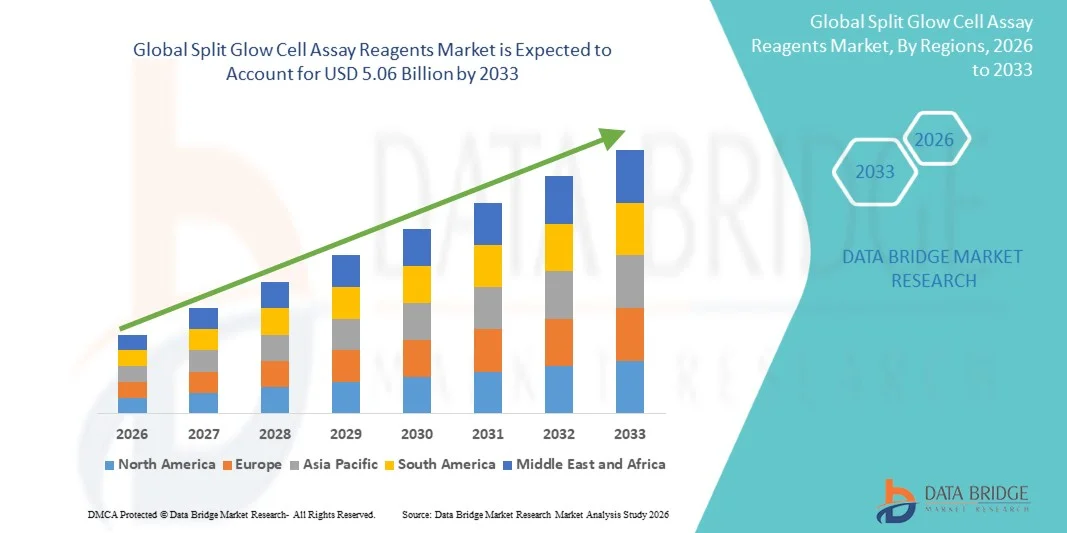
As per Data Bridge Market Research Analysis the Split Glow Cell Assay Reagents Market was valued at USD 2.95 billion in 2025 and is projected to reach USD 5.06 billion by 2033, growing at a CAGR of 7.0% from 2026 to 2033. The market is witnessing steady expansion driven by increasing adoption of advanced cell-based assay technologies, rising demand for high-sensitivity drug discovery tools, and growing investment in life sciences research and biopharmaceutical development.
The rising prevalence of chronic and infectious diseases, along with the accelerating pace of biologics and precision medicine research, is significantly boosting the use of split luciferase and other glow-based assay reagents in cellular signaling, protein interaction studies, and target validation. In addition, continuous advancements in high-throughput screening platforms and improved assay sensitivity are enabling researchers to achieve more accurate and reproducible results, further strengthening market adoption across pharmaceutical companies, biotechnology firms, and academic research institutes.
Market Size & Forecast
- Global Market Value (2025): USD 2.95 Billion
- Expected Market Value (2033): USD 5.06 Billion
- Forecast CAGR (2026–2033): 7.0%
- Leading Region in 2025: North America
- Fastest Growing Region: Asia Pacific
What are the Major Takeaways of Split Glow Cell Assay Reagents Market ?
- North America dominated the Split Glow Cell Assay Reagents Market with the largest revenue share of 38.6% in 2025, supported by strong biopharmaceutical R&D spending, advanced life sciences infrastructure, and the presence of major drug discovery companies and research institutes.
- The Mammalian segment led the market with a 58.60% share in 2025, driven by strong relevance in human disease modeling, drug discovery, and advanced cellular pathway studies.
- Asia-Pacific is expected to be the fastest-growing region at a CAGR of 8.1% from 2026 to 2033, fueled by expanding biotechnology research, increasing clinical trials activity, and rising investments in pharmaceutical innovation in China, India, and South Korea.
- Bacterial is the fastest-growing type, projected to register a CAGR of 7.5%, reflecting the surge in demand for cost-effectiveness, rapid growth rate, and ease of genetic manipulation
- The C-terminal segment dominated the category with a 55.57% revenue share in 2025, led by its higher stability, improved signal reconstitution efficiency, and broader compatibility with protein fusion constructs.
- Protein–Protein Interaction Assays accounted for 40.42% of the market, preferred by understanding molecular interactions is central to modern drug discovery and target identification.
- The Signal Transduction Assays segment is the fastest-growing assay type category, with a CAGR of 7.8%, driven by increasing focus on pathway-level understanding of disease mechanisms.
Report Scope and Split Glow Cell Assay Reagents Market Segmentation
|
Attributes |
Split Glow Cell Assay Reagents Key Market Insights |
|
Segments Covered |
|
|
Countries Covered |
North America
Europe
Asia-Pacific
Middle East and Africa
South America
|
|
Key Market Players |
|
|
Market Opportunities |
|
|
Value Added Data Infosets |
In addition to the insights on market scenarios such as market value, growth rate, segmentation, geographical coverage, and major players, the market reports curated by the Data Bridge Market Research also include in-depth expert analysis, patient epidemiology, pipeline analysis, pricing analysis, and regulatory framework. |
What is the Key Trend in the Split Glow Cell Assay Reagents Market ?
Trend: Rising Adoption of High-Sensitivity Cell-Based Assay Platforms
Pharmaceutical and biotechnology companies are increasingly shifting toward split glow cell assay reagents because they enable highly sensitive, real-time monitoring of biological processes such as protein–protein interactions, gene expression, and intracellular signaling pathways. Unlike conventional assay methods, split luciferase and glow-based systems provide stronger signal intensity with minimal background interference, making them highly suitable for complex cellular studies. The integration of these reagents with automated high-throughput screening (HTS) systems is significantly improving experimental efficiency, reducing manual error, and accelerating drug discovery timelines. In addition, advancements in luminescence imaging technologies and multiplex assay capabilities are allowing researchers to study multiple biological targets simultaneously within a single experiment. For instance, modern split luciferase reporter platforms are widely used in cancer biology and neuroscience research to monitor dynamic changes in cellular pathways under drug treatment conditions.
Split Glow Cell Assay Reagents Market Dynamics
Key Market Driver: Expanding Drug Discovery and Precision Medicine Research
The increasing global focus on precision medicine and targeted therapeutics is a major factor driving demand for split glow cell assay reagents, as they play a critical role in identifying and validating molecular drug targets. Pharmaceutical companies are investing heavily in biologics, gene therapies, and personalized treatment approaches, all of which require highly accurate cell-based functional assays during early-stage research. These reagents enable researchers to study complex biological interactions in living cells, providing deeper insights into disease mechanisms and drug efficacy. In addition, rising prevalence of chronic diseases such as cancer, cardiovascular disorders, and infectious diseases is pushing R&D pipelines toward more advanced and predictive testing methods. For instance, biopharmaceutical firms use split luciferase-based assays extensively in preclinical screening to evaluate compound activity, toxicity profiles, and receptor binding efficiency before clinical trials.
Key Restraint/Challenge: High Cost and Technical Complexity of Advanced Assay Systems
Despite strong demand, the market faces significant barriers due to the high cost associated with advanced assay reagents, specialized detection instruments, and integrated screening platforms. Setting up a fully functional luminescence-based assay system often requires substantial capital investment, which can be challenging for academic laboratories, small biotech startups, and research institutions in developing regions. In addition to equipment costs, operational expenses such as reagent replenishment, software licensing, and system maintenance further increase the total cost of ownership. Another major challenge is the technical complexity involved in designing, optimizing, and interpreting split glow assays, which often require skilled personnel with expertise in molecular biology and assay development. Even minor inconsistencies in experimental conditions can impact signal accuracy and reproducibility. For instance, split luciferase complementation systems require precise protein expression balance to generate reliable luminescent signals, making standardization across laboratories difficult.
Key Market Opportunity: Integration of AI-Driven High-Throughput Screening Platforms
The convergence of artificial intelligence (AI) with cell-based assay technologies is emerging as a transformative opportunity in the split glow cell assay reagents market. AI-powered platforms can analyze large volumes of luminescence data, identify patterns, and predict biological responses much faster than traditional manual methods. This is significantly improving hit identification rates in drug discovery programs and reducing the time required for lead optimization. Moreover, cloud-based high-throughput screening systems are enabling remote access to advanced analytical tools, making sophisticated assay technologies more accessible to smaller research organizations. The combination of AI, machine learning, and automated imaging systems is also enhancing assay scalability and reproducibility across multi-site research programs.
For instance, AI-driven luminescence data analysis platforms are being used in oncology research to rapidly screen thousands of compounds and identify potential drug candidates with high therapeutic potential, thereby streamlining early-stage pharmaceutical development pipelines.
How is the Split Glow Cell Assay Reagents Market Segmented ?
The split glow cell assay reagents market is segmented on the basis of type, category, assay type, and end user.
- By Type
On the basis of type, the Split Glow Cell Assay Reagents Market is segmented into mammalian, bacterial, and others. The Mammalian segment dominated the market with the largest share of 58.60% in 2025, driven by its strong relevance in human disease modeling, drug discovery, and advanced cellular pathway studies. Mammalian systems closely mimic human physiological conditions, making them the preferred choice for protein interaction studies and gene expression analysis. Their compatibility with luciferase-based reporter assays further strengthens their widespread adoption in oncology, immunology, and neuroscience research. Pharmaceutical and biotechnology companies extensively rely on mammalian cells for preclinical validation of drug candidates due to higher translational accuracy. Continuous improvements in cell line engineering and transfection efficiency are further enhancing experimental reliability. As a result, this segment continues to maintain clear dominance across academic and industrial research settings.
The Bacterial segment is expected to be the fastest-growing at a CAGR of 7.5% from 2026 to 2033, driven by its cost-effectiveness, rapid growth rate, and ease of genetic manipulation. Bacterial systems are increasingly being used for high-throughput screening of protein–protein interactions and synthetic biology applications. Their simple structure allows faster experimental turnaround times compared to mammalian models. Growing adoption in early-stage drug screening and protein expression studies is further accelerating demand. In addition, advancements in engineered bacterial biosensors are expanding their role in real-time biochemical monitoring. Increasing use in academic research and industrial enzyme studies is also contributing to strong growth momentum.
- By Category
On the basis of category, the market is segmented into N-terminal and C-terminal split systems. The C-terminal segment dominated the market with a share of 55.57% in 2025, owing to its higher stability, improved signal reconstitution efficiency, and broader compatibility with protein fusion constructs. C-terminal tagging is widely preferred in protein–protein interaction assays because it minimizes steric hindrance and preserves native protein function. It is extensively used in drug discovery workflows where accurate interaction mapping is critical. Pharmaceutical companies favor this configuration due to its strong signal-to-noise ratio in luminescence-based detection systems. Its reliability across multiple assay platforms further reinforces its dominant position. Continuous optimization of luciferase fragment complementation is strengthening its application scope in complex cellular environments.
The N-terminal segment is projected to be the fastest-growing at a CAGR of 7.2% from 2026 to 2033, driven by increasing use in structural biology and functional genomics studies. N-terminal tagging offers better flexibility for certain protein classes where C-terminal modifications may interfere with function. Researchers are increasingly adopting this format for studying membrane proteins and signaling receptors. Advancements in protein engineering techniques are improving stability and expression efficiency of N-terminal constructs. Growing demand for diversified assay designs in precision medicine research is further boosting adoption. In addition, its increasing use in synthetic biology applications is expanding its research footprint globally.
- By Assay Type
On the basis of assay type, the market is segmented into protein–protein interaction assays, gene expression assays, signal transduction assays, receptor binding assays, and enzyme activity assays. The Protein–Protein Interaction Assays segment dominated the market with the largest share of 40.42% in 2025, as understanding molecular interactions is central to modern drug discovery and target identification. Split glow systems are particularly effective in detecting real-time protein interactions due to their high sensitivity and low background noise. Pharmaceutical companies extensively use these assays for target validation in oncology and immunology research. Their ability to provide quantitative and dynamic interaction data makes them indispensable in early-stage R&D. Integration with high-throughput screening platforms further enhances their utility in large-scale compound testing. Continuous expansion of interactome mapping studies is reinforcing this segment’s dominance.
The Signal Transduction Assays segment is expected to be the fastest-growing at a CAGR of 7.8% from 2026 to 2033, driven by increasing focus on pathway-level understanding of disease mechanisms. These assays are critical for studying how cells respond to external stimuli such as drugs, hormones, or environmental stress. Growing interest in precision medicine and targeted therapies is fueling demand for pathway-specific analysis tools. Advances in luminescent reporter systems are improving real-time monitoring of intracellular signaling events. Pharmaceutical firms are increasingly adopting these assays to evaluate drug efficacy and mechanism of action. Expanding applications in cancer research and immunology are further accelerating growth.
- By End User
On the basis of end user, the market is segmented into CROs, biopharma companies, and research institutes. The Biopharma Companies segment dominated the market with a share of approximately 50.52% in 2025, driven by large-scale investment in drug discovery, biologics development, and high-throughput screening technologies. These companies rely heavily on split glow cell assay reagents for target validation, compound screening, and preclinical testing. Their strong R&D budgets enable adoption of advanced luminescence-based platforms and automation systems. Increasing focus on precision therapeutics and biologics is further strengthening demand. Integration of AI and data analytics into drug discovery pipelines is also enhancing assay utilization. Continuous expansion of pharmaceutical pipelines globally reinforces this segment’s leadership.
The CROs (Contract Research Organizations) segment is projected to be the fastest-growing at a CAGR of 7.6% from 2026 to 2033, driven by increasing outsourcing of drug discovery and preclinical research activities. Pharmaceutical companies are increasingly partnering with CROs to reduce operational costs and accelerate development timelines. CROs are investing in advanced assay technologies to offer high-quality screening and validation services. Rising complexity of drug development processes is further boosting reliance on specialized external service providers. Expansion of biotechnology startups is also contributing to CRO demand growth. In addition, globalization of clinical research activities is strengthening the role of CROs in the market ecosystem.
Which Region Holds the Largest Share of the Split Glow Cell Assay Reagents Market ?
North America dominated the Split Glow Cell Assay Reagents Market with the largest revenue share of 38.6% in 2025, supported by strong biopharmaceutical R&D spending, advanced life sciences infrastructure, and the presence of major drug discovery companies and research institutes. The region also benefits from high adoption of luminescence-based assay technologies, extensive use of high-throughput screening platforms, and strong academic–industry collaboration in drug discovery research. Increasing focus on precision medicine, oncology research, and biologics development continues to strengthen North America’s leadership position in the global market.
U.S. Split Glow Cell Assay Reagents Market Insight
The U.S. split glow cell assay reagents market is witnessing strong and sustained expansion due to its leadership in pharmaceutical innovation and biotechnology research. High R&D expenditure by global biopharma companies, coupled with advanced infrastructure for drug discovery, is driving widespread adoption of luminescence-based cell assays. These reagents are extensively used in oncology, immunology, and neuroscience research for target validation and pathway analysis. The strong presence of leading pharmaceutical companies and research universities further accelerates innovation in assay development. In addition, increasing integration of AI-driven drug discovery platforms and high-throughput screening systems is improving research efficiency and reducing development timelines. Growing focus on biologics, gene therapies, and precision medicine continues to reinforce the country’s dominance in this market.
Europe Split Glow Cell Assay Reagents Market Insight
The Europe split glow cell assay reagents market remains highly developed, supported by strong government funding for biomedical research and a well-established pharmaceutical industry. The region has a robust ecosystem of academic institutes, biotech companies, and contract research organizations actively using advanced cell-based assay technologies. Increasing emphasis on rare disease research, oncology studies, and translational medicine is driving steady adoption of luminescence-based assays. Europe also benefits from stringent regulatory frameworks that encourage the use of reliable and reproducible preclinical testing methods. Collaboration between universities and pharmaceutical companies is further enhancing innovation in assay design and application. Continuous investment in precision medicine and molecular biology research is expected to sustain long-term market growth.
U.K. Split Glow Cell Assay Reagents Market Insight
The U.K. split glow cell assay reagents market is expanding steadily due to strong academic research capabilities and a growing biotechnology sector. Leading universities and research institutes are playing a critical role in advancing cell-based assay technologies for drug discovery and disease modeling. Increasing reliance on CROs for early-stage drug development is also boosting demand for high-sensitivity luminescence reagents. The country’s focus on innovation-driven healthcare research is encouraging adoption of advanced screening platforms. Integration of AI analytics and automation in laboratory workflows is further improving assay accuracy and throughput. In addition, strong government support for life sciences innovation is positioning the U.K. as a key European hub for molecular biology research.
Germany Split Glow Cell Assay Reagents Market Insight
The Germany split glow cell assay reagents market is growing steadily, supported by its strong pharmaceutical manufacturing base and advanced research infrastructure. The country has a well-developed biotechnology ecosystem that heavily relies on cell-based assays for drug discovery and preclinical testing. Increasing focus on oncology, immunology, and metabolic disease research is driving demand for luminescence-based assay reagents. German research institutions and pharmaceutical companies are also investing in automation and high-throughput screening technologies to enhance efficiency. Strong engineering capabilities support the development of advanced laboratory instruments used in assay workflows. Continuous innovation in precision medicine and molecular diagnostics is further strengthening market expansion in Germany.
Asia-Pacific Split Glow Cell Assay Reagents Market Insight
The Asia-Pacific split glow cell assay reagents market is witnessing rapid expansion driven by increasing investment in biotechnology research and pharmaceutical development. Countries such as China, India, Japan, and South Korea are significantly increasing funding for life sciences innovation and drug discovery infrastructure. Rising outsourcing of research activities to cost-effective Asian CROs is also boosting reagent demand. Growing prevalence of chronic diseases and increasing focus on precision medicine are further accelerating adoption of advanced assay technologies. Expansion of academic research institutions and biotechnology startups is strengthening the regional research ecosystem. In addition, improving access to high-throughput screening and automation technologies is enhancing market scalability across the region.
Japan Split Glow Cell Assay Reagents Market Insight
The Japan split glow cell assay reagents market is experiencing steady growth due to strong investment in pharmaceutical innovation and advanced biomedical research. The country’s focus on precision medicine and regenerative therapies is driving adoption of high-sensitivity cell-based assays. Japanese pharmaceutical companies are increasingly using luminescence-based technologies for protein interaction studies and drug validation processes. Strong integration of robotics, automation, and digital laboratory systems is enhancing research productivity. Academic institutions and research organizations are actively contributing to advancements in molecular biology and assay development. Continuous technological innovation and government support for healthcare research are reinforcing Japan’s position as a high-value market.
China Split Glow Cell Assay Reagents Market Insight
The China split glow cell assay reagents market is expanding rapidly due to strong government support for biotechnology innovation and increasing pharmaceutical R&D investment. The country has a fast-growing biotechnology sector with rising demand for advanced drug discovery tools and cell-based assay technologies. Expansion of domestic pharmaceutical companies and CROs is significantly increasing reagent consumption. Growing adoption of high-throughput screening, AI-driven drug discovery platforms, and precision medicine approaches is further accelerating market growth. Academic and research institutions are increasingly focusing on molecular biology and cancer research applications. In addition, China’s large patient population and strong clinical research pipeline continue to position it as one of the fastest-growing regional markets globally.
Which are the Top Companies in Split Glow Cell Assay Reagents Market ?
The split glow cell assay reagents industry is primarily led by well-established companies, including:
- Promega Corporation (U.S.)
- Thermo Fisher Scientific Inc. (U.S.)
- Revvity, Inc. (U.S.)
- Eurofins Scientific SE (Luxembourg)
- Sartorius AG (Germany)
- Merck KGaA (Germany)
- Bio-Rad Laboratories, Inc. (U.S.)
- Agilent Technologies, Inc. (U.S.)
- Danaher (U.S.)
- BD (U.S.)
- BPS Bioscience, Inc. (U.S.)
- Abcam plc (U.K.)
- Cayman Chemical Company (U.S.)
- Cell Signaling Technology, Inc. (U.S.)
- Takara Bio Inc. (Japan)
- Hoffmann-La Roche Ltd (Switzerland)
- Lonza Group AG (Switzerland)
- Advanced Chemistry Development (Canada)
- Bio-Techne Corporation (U.S.)
What are Latest Developments in Split Glow Cell Assay Reagents Market ?
- In March 2025, BPS Bioscience expanded its luminescent cell-based assay portfolio, introducing upgraded assay kits designed for enhanced sensitivity and improved compatibility with high-throughput screening platforms. These developments strengthen applications in protein–protein interaction studies and oncology drug discovery workflows, enabling more accurate and rapid compound screening in early-stage research. The expansion reflects increasing demand for scalable cell-based luminescence tools across biotechnology and pharmaceutical R&D pipelines
- In April 2024, Promega Corporation advanced its NanoBiT and HiBiT split luciferase technologies, improving real-time monitoring of protein–protein interactions in live-cell environments. These innovations enhance assay sensitivity and expand applications in functional genomics, oncology, and drug discovery research. The upgraded systems support high-throughput screening and AI-enabled analytical workflows in modern laboratories. This development reinforces Promega’s leadership in luminescence-based assay technologies
- In September 2023, Revvity (formerly PerkinElmer) advanced its DiscoverX PathHunter enzyme fragment complementation platform, enhancing capabilities for GPCR, kinase, and protein–protein interaction analysis. The upgrade improved assay sensitivity and broadened applications in real-time cellular signaling studies critical for drug discovery. This development supports more precise functional characterization of drug targets in complex biological systems. It also reinforces the growing role of split-enzyme luminescence technologies in modern pharmaceutical research
- In June 2022, Thermo Fisher Scientific expanded its luciferase reporter and cell-based assay portfolio, focusing on improving detection sensitivity and workflow efficiency in cellular analysis. These enhancements support gene expression studies, signal transduction research, and high-throughput drug screening applications. The upgraded solutions are designed for integration with automated laboratory systems and advanced imaging platforms. This expansion strengthens Thermo Fisher’s position in the global cell-based assay reagents ecosystem
- In August 2021, Eurofins DiscoverX enhanced its PathHunter assay platform, improving enzyme fragment complementation technology used for protein interaction and GPCR research. The upgrade enabled greater assay flexibility and broader applicability in drug discovery and molecular pathway analysis. This technology is widely used to detect intracellular interactions through luminescent signal generation in living cells. The enhancement further supports high-throughput screening and pharmaceutical target validation workflows

- Interactive Data Analysis Dashboard
- Company Analysis Dashboard for high growth potential opportunities
- Research Analyst Access for customization & queries
- Competitor Analysis with Interactive dashboard
- Latest News, Updates & Trend analysis
- Harness the Power of Benchmark Analysis for Comprehensive Competitor Tracking
Data collection and base year analysis are done using data collection modules with large sample sizes. The stage includes obtaining market information or related data through various sources and strategies. It includes examining and planning all the data acquired from the past in advance. It likewise envelops the examination of information inconsistencies seen across different information sources. The market data is analysed and estimated using market statistical and coherent models. Also, market share analysis and key trend analysis are the major success factors in the market report. To know more, please request an analyst call or drop down your inquiry.
The key research methodology used by DBMR research team is data triangulation which involves data mining, analysis of the impact of data variables on the market and primary (industry expert) validation. Data models include Vendor Positioning Grid, Market Time Line Analysis, Market Overview and Guide, Company Positioning Grid, Patent Analysis, Pricing Analysis, Company Market Share Analysis, Standards of Measurement, Global versus Regional and Vendor Share Analysis. To know more about the research methodology, drop in an inquiry to speak to our industry experts.
Data Bridge Market Research is a leader in advanced formative research. We take pride in servicing our existing and new customers with data and analysis that match and suits their goal. The report can be customized to include price trend analysis of target brands understanding the market for additional countries (ask for the list of countries), clinical trial results data, literature review, refurbished market and product base analysis. Market analysis of target competitors can be analyzed from technology-based analysis to market portfolio strategies. We can add as many competitors that you require data about in the format and data style you are looking for. Our team of analysts can also provide you data in crude raw excel files pivot tables (Fact book) or can assist you in creating presentations from the data sets available in the report.













