


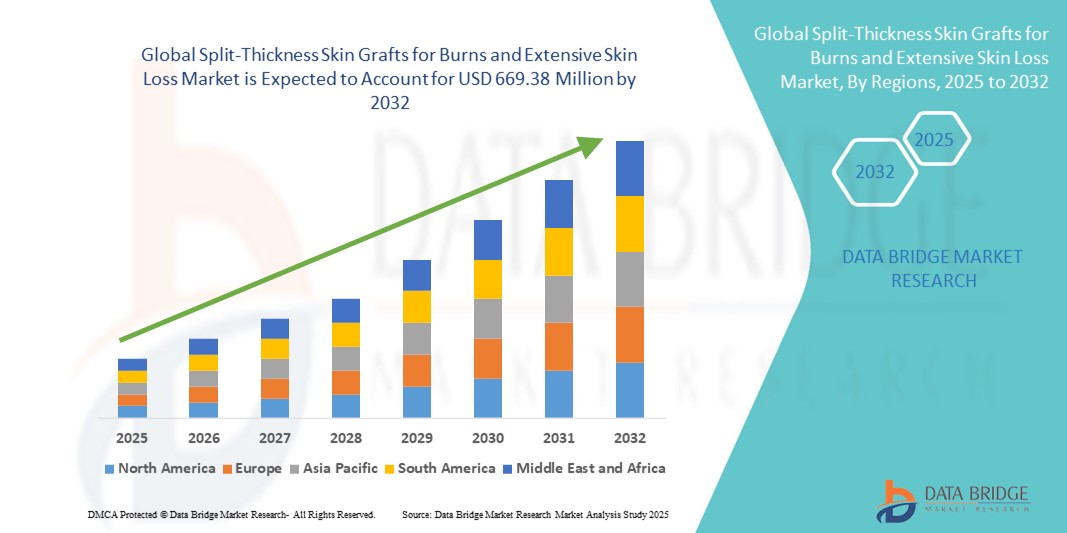
Split-Thickness Skin Grafts for Burns and Extensive Skin Loss Market Size
- The global split-thickness skin grafts for burns and extensive skin loss market size was valued at USD 312.27 million in 2024 and is expected to reach USD 669.38 million by 2032, at a CAGR of 10.00% during the forecast period
- The market growth is largely fueled by the increasing incidence of burn injuries and traumatic skin loss cases, along with the rising demand for effective and timely wound management solutions across healthcare settings
- Furthermore, advancements in graft harvesting techniques and supportive government initiatives for burn care infrastructure are enhancing clinical outcomes, thereby strengthening the adoption of split-thickness grafts. These aligned factors are propelling market expansion and reinforcing the role of grafts in critical wound care interventions
Split-Thickness Skin Grafts for Burns and Extensive Skin Loss Market Analysis
- Split-thickness skin grafts, involving the removal of the epidermis and a portion of the dermis, are increasingly critical in managing severe burns and extensive skin loss due to their ability to cover large wound areas, promote faster healing, and reduce infection risks in both acute and reconstructive care settings
- The rising demand for these grafts is primarily driven by the growing incidence of burn injuries, expanding trauma care services, and advancements in surgical techniques that enhance graft take rates and patient outcomes
- North America dominated the split-thickness skin grafts for burns and extensive skin loss market with the largest revenue share of 42.2% in 2024, supported by advanced healthcare systems, high awareness about burn care treatments, and a growing number of reconstructive surgeries, with the U.S. leading due to its extensive burn care infrastructure and adoption of skin grafting technologies
- Asia-Pacific is expected to be the fastest growing region in the split-thickness skin grafts for burns and extensive skin loss market during the forecast period, fueled by high burn prevalence, increasing healthcare investments, and rising accessibility to surgical interventions across emerging economies
- Grafts segment dominated the split-thickness skin grafts for burns and extensive skin loss market with a 67.9% share in 2024, owing to their essential role in effective wound closure and long-term recovery in patients with severe burns and traumatic skin loss
Report Scope and Split-Thickness Skin Grafts for Burns and Extensive Skin Loss Market Segmentation
|
Attributes |
Split-Thickness Skin Grafts for Burns and Extensive Skin Loss Key Market Insights |
|
Segments Covered |
|
|
Countries Covered |
North America
Europe
Asia-Pacific
Middle East and Africa
South America
|
|
Key Market Players |
|
|
Market Opportunities |
|
|
Value Added Data Infosets |
In addition to the insights on market scenarios such as market value, growth rate, segmentation, geographical coverage, and major players, the market reports curated by the Data Bridge Market Research also include in-depth expert analysis, pricing analysis, brand share analysis, consumer survey, demography analysis, supply chain analysis, value chain analysis, raw material/consumables overview, vendor selection criteria, PESTLE Analysis, Porter Analysis, and regulatory framework. |
Split-Thickness Skin Grafts for Burns and Extensive Skin Loss Market Trends
Technological Advancements in Graft Harvesting and Wound Management
- A significant and accelerating trend in the global split-thickness skin grafts market is the ongoing advancement in graft harvesting techniques and wound care technologies. These innovations are enhancing surgical precision, reducing donor site morbidity, and improving graft take rates, thereby optimizing patient outcomes in both acute and reconstructive settings
- For instance, recent developments in powered dermatomes, such as Zimmer® air dermatome systems, allow for consistent graft thickness and precise excision, leading to improved graft adherence and healing. Similarly, the integration of hydrogel-based dressings and negative pressure wound therapy (NPWT) is supporting optimal graft protection and reducing infection risks post-surgery
- Advances in biologically derived skin substitutes and synthetic graft enhancers are also gaining traction. Products such as Integra® Dermal Regeneration Template offer scaffold support for skin regeneration, making them valuable in cases of extensive full-thickness injuries requiring split-thickness coverage
- Furthermore, smart digital platforms that track graft application, wound progression, and patient recovery are emerging, aiding clinicians in evidence-based decision-making. These tools enhance monitoring and help personalize postoperative care, contributing to improved graft success rates
- This shift toward more refined, technology-assisted grafting solutions is fundamentally changing the standard of care in burn treatment. Consequently, companies such as Smith+Nephew and MIMEDX are investing in product innovation, aiming to expand the capabilities of split-thickness graft solutions through biologics and device integration
- The demand for efficient, minimally invasive, and technologically advanced grafting methods is rising globally, especially in high-burden regions, driven by a growing need for improved wound healing, reduced hospital stays, and better functional and cosmetic outcomes
Split-Thickness Skin Grafts for Burns and Extensive Skin Loss Market Dynamics
Driver
Rising Incidence of Burns and Trauma-Related Skin Injuries
- The increasing global incidence of burn injuries, road accidents, industrial hazards, and trauma-related skin loss is a primary driver accelerating the demand for split-thickness skin grafts. These grafts offer effective coverage for large wound areas, minimizing infection risks and facilitating rapid epithelialization
- For instance, according to WHO, over 180,000 deaths annually are caused by burns, with a majority occurring in low- and middle-income countries. This high burden has prompted governments and health organizations to invest in burn care units and training for advanced skin graft procedures
- In addition, expanding access to surgical interventions in developing nations and greater awareness of the benefits of timely skin grafting are further propelling market growth. The increased emphasis on functional recovery and aesthetic restoration post-burn also supports the rising utilization of split-thickness grafts
- In specialized centers and trauma units, these grafts are often part of standardized care protocols, underscoring their importance in both emergency and reconstructive treatment pathways
Restraint/Challenge
Graft Failure Risk and Limited Donor Site Availability
- A key challenge in the adoption of split-thickness skin grafts is the potential for graft failure due to factors such as infection, poor vascularization, or improper handling, which can prolong healing and necessitate additional interventions
- For instance, patients with extensive burns may have limited healthy donor sites, complicating graft planning and often requiring staged procedures or the use of temporary skin substitutes. In cases of poor nutritional status or comorbidities such as diabetes, graft adherence and survival can be further compromised
- Moreover, training and expertise in graft harvesting and postoperative care are not uniformly available, particularly in under-resourced healthcare settings, limiting the widespread adoption of this treatment
- To address these barriers, there is a growing need for advanced graft preparation systems, improved wound care products, and clinician training programs. Biologic alternatives and tissue engineering approaches are also being explored to expand graft availability and reduce reliance on donor skin, presenting future opportunities while highlighting current limitations
Split-Thickness Skin Grafts for Burns and Extensive Skin Loss Market Scope
The market is segmented on the basis of type and end user.
- By Type
On the basis of type, the split-thickness skin grafts for burns and extensive skin loss market is segmented into equipment and grafts. The grafts segment dominated the market with the largest revenue share of 67.9% in 2024, due to its critical role in surgical wound management for patients with burns and extensive skin loss. Grafts are widely utilized in both acute trauma and reconstructive procedures as they promote rapid epithelialization, minimize infection risk, and support functional and aesthetic restoration. Their direct clinical application and essential therapeutic value drive their widespread use across global healthcare systems.
The equipment segment is anticipated to witness the fastest growth rate from 2025 to 2032, driven by ongoing innovations in graft harvesting tools such as powered dermatomes, graft meshers, and skin staplers. These devices enable more precise and efficient grafting, reduce procedure time, and improve outcomes, particularly in high-volume trauma and burn centers. The growing demand for minimally invasive surgical solutions and the need for enhanced operating room efficiency are contributing to this segment’s rapid expansion.
- By End User
On the basis of end user, the split-thickness skin grafts for burns and extensive skin loss market is segmented into hospitals, ambulatory surgical centers, dermatology clinics, and others. The hospitals segment held the largest market share of 54.2% in 2024, supported by the high volume of acute burn and trauma cases managed in inpatient settings. Hospitals often have the infrastructure, surgical expertise, and multidisciplinary care teams necessary to perform grafting procedures and manage complex wound care cases effectively.
Ambulatory surgical centers (ASCs) are expected to be the fastest growing segment from 2025 to 2032, fueled by the rise in outpatient reconstructive procedures, shorter recovery times, and cost-effective service delivery models. ASCs offer an efficient alternative to hospital-based surgeries, especially for patients requiring split-thickness grafts for less extensive injuries or elective skin reconstruction. The shift toward value-based care and increased investments in ambulatory infrastructure further enhance growth prospects in this segment.
Split-Thickness Skin Grafts for Burns and Extensive Skin Loss Market Regional Analysis
- North America dominated the split-thickness skin grafts for burns and extensive skin loss market with the largest revenue share of 42.2% in 2024, supported by advanced healthcare systems, high awareness about burn care treatments, and a growing number of reconstructive surgeries, with the U.S. leading due to its extensive burn care infrastructure and adoption of skin grafting technologies
- Consumers and healthcare providers in the region place high value on rapid healing, reduced infection risk, and effective long-term outcomes, which split-thickness grafts offer, particularly in severe burn and trauma cases
- This strong market presence is further supported by increased government funding for specialized burn units, the presence of leading graft solution providers, and a growing number of reconstructive procedures, positioning North America as a leader in advanced burn and wound care solutions
U.S. Split-Thickness Skin Grafts for Burns and Extensive Skin Loss Market Insight
The U.S. split-thickness skin grafts for burns and extensive skin loss market captured the largest revenue share of 82% in 2024 within North America, driven by the high prevalence of burn injuries, advanced trauma care infrastructure, and increasing surgical interventions for skin restoration. The nation’s strong focus on reconstructive and cosmetic procedures, along with the presence of specialized burn centers, significantly supports market growth. In addition, continuous R&D investments and favorable reimbursement policies are enhancing the accessibility and adoption of split-thickness grafts across healthcare institutions.
Europe Split-Thickness Skin Grafts Market Insight
The Europe split-thickness skin grafts for burns and extensive skin loss market is projected to grow at a steady CAGR throughout the forecast period, bolstered by rising awareness of burn management protocols and increasing demand for advanced wound care treatments. The region’s aging population, coupled with the growing incidence of chronic wounds and surgical skin loss, is driving the adoption of grafting procedures. Government initiatives promoting high-standard burn care and the presence of technologically advanced healthcare systems further contribute to market expansion in both public and private sectors.
U.K. Split-Thickness Skin Grafts Market Insight
The U.K. split-thickness skin grafts for burns and extensive skin loss market is anticipated to grow at a notable CAGR during the forecast period, supported by the rise in burn cases, increasing elective surgeries, and the availability of skilled surgeons. The National Health Service (NHS) emphasizes early wound closure and skin regeneration, encouraging hospitals to adopt effective grafting techniques. In addition, growing patient awareness of cosmetic recovery and scar reduction is driving demand for split-thickness grafts in reconstructive and post-trauma care.
Germany Split-Thickness Skin Grafts Market Insight
The Germany split-thickness skin grafts for burns and extensive skin loss market is expected to witness significant growth, owing to the country’s strong emphasis on healthcare quality, surgical precision, and technological advancement. Germany’s focus on innovation in medical devices, combined with widespread adoption of minimally invasive surgical procedures, is supporting the growth of graft applications. Moreover, a high prevalence of burn incidents related to industrial settings and the increasing use of regenerative solutions are shaping a favorable market environment.
Asia-Pacific Split-Thickness Skin Grafts Market Insight
The Asia-Pacific split-thickness skin grafts for burns and extensive skin loss market is expected to register the fastest CAGR of 25.6% from 2025 to 2032, driven by rising burn injury rates, improving healthcare access, and a growing demand for trauma care services across countries such as India, China, and Southeast Asia. Increasing investments in hospital infrastructure, along with greater awareness of wound management, are fueling regional market expansion. In addition, the growing presence of medical device manufacturers and international collaborations are making graft products more accessible and affordable.
Japan Split-Thickness Skin Grafts Market Insight
The Japan split-thickness skin grafts for burns and extensive skin loss market is gaining traction due to the country’s aging population, high rate of surgical procedures, and demand for rapid wound recovery. Japan’s advanced healthcare technology landscape supports the use of precision grafting tools and regenerative solutions. Moreover, rising cases of skin-related injuries and chronic ulcers among the elderly population are contributing to increased utilization of graft procedures across hospitals and specialty clinics.
India Split-Thickness Skin Grafts Market Insight
The India split-thickness skin grafts for burns and extensive skin loss market accounted for the largest revenue share in Asia-Pacific in 2024, fueled by a high incidence of burn injuries, expanding trauma care facilities, and increasing awareness of surgical wound treatment. Government programs focused on emergency care improvement and investments in healthcare infrastructure are driving demand. In addition, the availability of cost-effective grafting options and a surge in cosmetic and reconstructive procedures are accelerating the market's growth in urban and semi-urban regions.
Split-Thickness Skin Grafts for Burns and Extensive Skin Loss Market Share
The split-thickness skin grafts for burns and extensive skin loss industry is primarily led by well-established companies, including:
- Smith+Nephew (U.K.)
- MIMEDX Group, Inc. (U.S.)
- Avita Medical, Inc. (U.S.)
- Organogenesis Inc. (U.S.)
- Integra LifeSciences (U.S.)
- Mölnlycke AB (Sweden)
- 3M (U.S.)
- B. Braun SE (Germany)
- Zimmer Biomet (U.S.)
- Coloplast A/S (Denmark)
- ConvaTec Group PLC (U.K.)
- MedSkin Solutions Dr. Suwelack AG (Germany)
- KCI Licensing, Inc. (U.S.)
- Gunze Limited (Japan)
- BSN medical GmbH (Germany)
- RenovaCare, Inc. (U.S.)
- Tissue Regenix Group plc (U.K.)
- Vericel Corporation (U.S.)
- PolarityTE, Inc. (U.S.)
- Amniox Medical, Inc. (U.S.)
What are the Recent Developments in Global Split-Thickness Skin Grafts for Burns and Extensive Skin Loss Market?
- In April 2023, Smith+Nephew, a global leader in advanced wound management, launched a new educational initiative in partnership with burn care centers across Europe, aimed at enhancing clinician training in split-thickness skin graft procedures. The program focuses on improving surgical outcomes through hands-on training and sharing best practices in graft harvesting and application, underscoring the company’s commitment to advancing clinical excellence in burn treatment and wound care
- In March 2023, MIMEDX Group, Inc., a developer of regenerative biologics, expanded its product line with the introduction of a new placental-derived skin substitute optimized for use alongside split-thickness grafts. This next-generation product is designed to support wound bed preparation and graft integration, especially in patients with extensive burns or chronic wounds. The innovation demonstrates MIMEDX’s strategic focus on enhancing healing outcomes through biologically active materials
- In February 2023, Integra LifeSciences announced the global rollout of its advanced graft integration system, which combines dermal regeneration templates with split-thickness skin grafts for improved healing of complex burn wounds. This solution is tailored for use in severe trauma and reconstructive cases, offering surgeons a two-layered approach to wound coverage. The launch reflects Integra’s efforts to provide comprehensive, clinically effective skin repair technologies
- In February 2023, Avita Medical, Inc. collaborated with major U.S. burn centers to expand clinical trials of its RECELL System, a technology that works in conjunction with split-thickness grafts to reduce donor site requirements. By enabling broader skin regeneration with smaller donor areas, RECELL is gaining traction in both clinical research and real-world application, reinforcing Avita’s role in advancing skin graft alternatives and supportive technologies
- In January 2023, Organogenesis Holdings Inc. introduced a clinical awareness campaign focused on the use of skin grafting and regenerative solutions in diabetic foot ulcers and post-surgical wounds. The campaign includes updated clinical guidelines and promotes the use of split-thickness skin grafts in combination with advanced wound care products. This initiative highlights the growing role of skin grafts beyond burns, in broader indications such as chronic wound management and limb preservation

- Interactive Data Analysis Dashboard
- Company Analysis Dashboard for high growth potential opportunities
- Research Analyst Access for customization & queries
- Competitor Analysis with Interactive dashboard
- Latest News, Updates & Trend analysis
- Harness the Power of Benchmark Analysis for Comprehensive Competitor Tracking
Data collection and base year analysis are done using data collection modules with large sample sizes. The stage includes obtaining market information or related data through various sources and strategies. It includes examining and planning all the data acquired from the past in advance. It likewise envelops the examination of information inconsistencies seen across different information sources. The market data is analysed and estimated using market statistical and coherent models. Also, market share analysis and key trend analysis are the major success factors in the market report. To know more, please request an analyst call or drop down your inquiry.
The key research methodology used by DBMR research team is data triangulation which involves data mining, analysis of the impact of data variables on the market and primary (industry expert) validation. Data models include Vendor Positioning Grid, Market Time Line Analysis, Market Overview and Guide, Company Positioning Grid, Patent Analysis, Pricing Analysis, Company Market Share Analysis, Standards of Measurement, Global versus Regional and Vendor Share Analysis. To know more about the research methodology, drop in an inquiry to speak to our industry experts.
Data Bridge Market Research is a leader in advanced formative research. We take pride in servicing our existing and new customers with data and analysis that match and suits their goal. The report can be customized to include price trend analysis of target brands understanding the market for additional countries (ask for the list of countries), clinical trial results data, literature review, refurbished market and product base analysis. Market analysis of target competitors can be analyzed from technology-based analysis to market portfolio strategies. We can add as many competitors that you require data about in the format and data style you are looking for. Our team of analysts can also provide you data in crude raw excel files pivot tables (Fact book) or can assist you in creating presentations from the data sets available in the report.













