


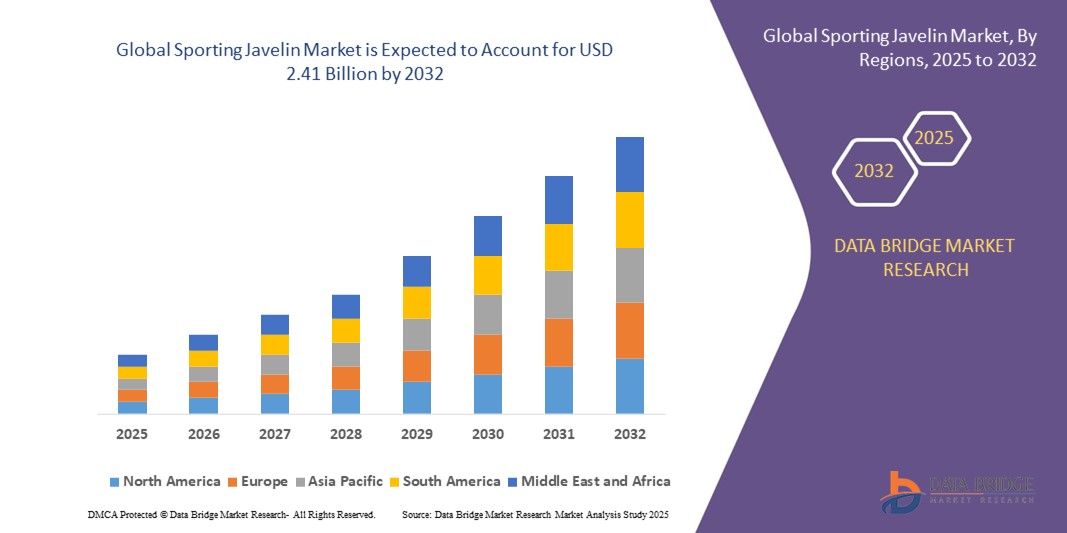
Sporting Javelin Market Size
- The global sporting javelin market size was valued at USD 1.60 billion in 2024 and is expected to reach USD 2.41 billion by 2032, at a CAGR of 5.20% during the forecast period
- The market growth is largely fuelled by the increasing popularity of track and field sports worldwide and rising investments in sports infrastructure and training facilities
- Growing awareness of athletics as a professional career, along with the inclusion of javelin events in major international competitions, is driving demand for high-quality sporting javelins
Sporting Javelin Market Analysis
- Rising participation in athletics at school, college, and professional levels is promoting the demand for standardized and durable javelins
- Manufacturers are focusing on advanced materials and innovative designs to enhance performance, durability, and safety, meeting the expectations of professional athletes
- North America dominated the sporting javelin market with the largest revenue share of 38.50% in 2024, driven by the increasing popularity of athletics, competitive track events, and the presence of established sports training facilities
- Asia-Pacific region is expected to witness the highest growth rate in the global sporting javelin market, driven by rising participation in athletics, rapid development of sports infrastructure, and increasing investments in training academies. Countries such as China, Japan, and Australia are actively promoting competitive sports, encouraging the adoption of high-quality javelins
- The Carbon Fiber Javelins segment held the largest market revenue share in 2024, driven by their lightweight design, superior aerodynamics, and enhanced throwing performance. Carbon fiber javelins are preferred by professional athletes and competitive sports academies for maximizing distance and precision during competitions
Report Scope and Sporting Javelin Market Segmentation
|
Attributes |
Sporting Javelin Key Market Insights |
|
Segments Covered |
|
|
Countries Covered |
North America
Europe
Asia-Pacific
Middle East and Africa
South America
|
|
Key Market Players |
|
|
Market Opportunities |
• Rising Adoption Of Professional Athletics And Track Events |
|
Value Added Data Infosets |
In addition to the insights on market scenarios such as market value, growth rate, segmentation, geographical coverage, and major players, the market reports curated by the Data Bridge Market Research also include in-depth expert analysis, pricing analysis, brand share analysis, consumer survey, demography analysis, supply chain analysis, value chain analysis, raw material/consumables overview, vendor selection criteria, PESTLE Analysis, Porter Analysis, and regulatory framework. |
Sporting Javelin Market Trends
Increasing Popularity of Athletics and Competitive Track Events
• The rising participation in athletics and competitive track and field events is transforming the sporting javelin market by driving demand for high-quality, performance-oriented equipment. Modern javelins are designed to enhance throw distance, accuracy, and overall athlete performance, contributing to improved competition outcomes. This trend is further supported by global sports federations emphasizing standardized equipment for fair play and consistency across competitions
• Growing interest in school, collegiate, and professional athletics across regions is accelerating adoption of advanced javelins that cater to diverse skill levels, from amateur enthusiasts to elite athletes. This trend is further supported by sports federations and training academies promoting standardized equipment. In addition, sponsorships and government-backed sports programs are encouraging young talent to access professional-grade javelins, expanding the market base
• The affordability, durability, and precision of contemporary javelins make them attractive for repeated use in practice and competitions, enabling athletes and teams to improve consistency and performance without frequent replacements. Manufacturers are also offering modular designs and interchangeable parts, allowing customization based on athlete preference and event type, which further drives adoption
• For instance, in 2023, several international track and field meets in Europe and North America reported increased usage of carbon fiber and composite javelins, leading to higher athlete satisfaction and elevated competition standards. The introduction of certified, lightweight javelins at national tournaments also promoted wider acceptance among amateur and semi-professional athletes
• While demand for sporting javelins is rising, manufacturers must focus on continuous innovation, material improvements, and compliance with international athletic regulations to fully capture market growth potential. Strategic partnerships with sports academies and federations, coupled with targeted marketing campaigns, are essential to maintain market leadership and brand recognition
Sporting Javelin Market Dynamics
Driver
Rising Investments in Athletics Training and Sports Infrastructure
• Increased investment in sports infrastructure, including training centers, stadiums, and track and field facilities, is boosting demand for high-quality javelins that meet international standards. Improved infrastructure allows athletes to train under optimal conditions, enhancing performance outcomes. Moreover, expansion of youth development programs is driving early adoption of competitive javelins, creating long-term market growth potential
• Sports organizations and athletic federations are actively promoting the use of certified and technologically advanced javelins, improving athlete preparedness for national and international competitions. This also encourages consistent adoption among schools, colleges, and professional clubs. Collaborative initiatives with manufacturers to provide subsidized or sponsored equipment further accelerate market penetration and brand visibility
• Manufacturers are responding with innovative designs, including aerodynamic, lightweight, and balanced javelins, enhancing athlete precision, grip, and throwing distance. These improvements drive repeat purchases and brand loyalty. In addition, advancements in composite materials and coating technologies enhance durability and performance under varied environmental conditions, supporting professional and recreational use alike
• For instance, in 2022, several North American and European sports academies upgraded their equipment to include composite javelins for elite athlete training, boosting market demand in the premium segment. These upgrades also facilitated better talent development pipelines, encouraging more athletes to compete at higher levels and increasing long-term equipment demand
• While investments in sports infrastructure fuel market growth, continuous focus on R&D, athlete education, and compliance with international competition regulations is necessary to sustain long-term adoption. Active engagement with regulatory bodies and periodic product certification help maintain market credibility and consumer trust
Restraint/Challenge
High Cost of Advanced Javelins and Limited Accessibility in Emerging Markets
• Premium sporting javelins made from carbon fiber or composite materials often involve higher production costs, making them less accessible to amateur athletes and budget-conscious sports clubs. Cost remains a primary barrier for widespread adoption. Limited distribution networks in emerging regions exacerbate this challenge, preventing timely access to certified equipment
• In emerging regions, limited awareness of high-performance javelins and their benefits, such as increased throwing distance and precision, restricts market penetration and slows adoption among young athletes and local sports programs. Cultural preferences for traditional equipment, coupled with minimal exposure to professional competitions, further reduce acceptance of modern javelins
• Supply chain challenges, including availability of specialized materials and compliance with international standards, can hinder timely production and distribution, affecting market growth in certain geographies. Import restrictions, shipping delays, and lack of local manufacturing capabilities increase costs, creating barriers for smaller sports clubs and schools
• For instance, in 2023, several athletics training centers in Sub-Saharan Africa reported difficulties in sourcing certified composite javelins due to cost and material scarcity, limiting access for competitive athletes. These constraints also impacted the ability of local federations to host recognized competitions, slowing regional market development
• To overcome these challenges, stakeholders must focus on cost-effective manufacturing, localized distribution, training programs, and awareness initiatives to increase adoption and expand market reach across untapped regions. Strategic collaborations with local sports authorities, equipment leasing programs, and bulk procurement for training academies can further mitigate these barriers
Sporting Javelin Market Scope
The market is segmented on the basis of product type, price range, end-user, and distribution channel.
- By Product Type
On the basis of product type, the sporting javelin market is segmented into Aluminum Javelins, Steel Javelins, and Carbon Fiber Javelins. The Carbon Fiber Javelins segment held the largest market revenue share in 2024, driven by their lightweight design, superior aerodynamics, and enhanced throwing performance. Carbon fiber javelins are preferred by professional athletes and competitive sports academies for maximizing distance and precision during competitions.
The Aluminum Javelins segment is expected to witness the fastest growth rate from 2025 to 2032, owing to their affordability, durability, and suitability for amateur athletes and training purposes. Aluminum javelins offer a reliable and cost-effective option for schools, universities, and sports clubs, supporting skill development without compromising on performance.
- By Price Range
On the basis of price range, the market is segmented into Budget, Mid-range, and Premium. The Premium segment dominated in 2024 due to growing adoption by elite athletes and professional training centers seeking high-performance javelins with advanced materials and certifications.
The Budget segment is expected to witness the fastest growth rate from 2025 to 2032, driven by increased interest in athletics among students and amateur sports enthusiasts seeking cost-effective javelin options for training and local competitions.
- By End-User
On the basis of end-user, the market is segmented into Professional Athletes, School and Universities, and Sports Clubs and Organizations. The Professional Athletes segment held the largest revenue share in 2024 due to rising participation in national and international track and field events, where certified and performance-optimized javelins are mandatory.
The Schools and Universities segment is expected to witness the fastest growth rate from 2025 to 2032032, as educational institutions increasingly invest in sports infrastructure and provide high-quality equipment for student training and competitions.
- By Distribution Channel
On the basis of distribution channel, the market is segmented into Sports Equipment Stores, Department Stores, Online/E-commerce, and Others. The Sports Equipment Stores segment held the largest revenue share in 2024 due to the preference of professional athletes and training centers for hands-on product selection and expert guidance during purchase.
The Online/E-commerce segment is expected to witness the fastest growth rate from 2025 to 2032, fueled by the convenience of direct-to-consumer sales, wider product variety, and the ability to access premium and specialized javelins that may not be available locally.
Sporting Javelin Market Regional Analysis
• North America dominated the sporting javelin market with the largest revenue share of 38.50% in 2024, driven by the increasing popularity of athletics, competitive track events, and the presence of established sports training facilities
• Athletes and sports organizations in the region highly value high-quality javelins that enhance performance, precision, and durability, making them the preferred choice for both professional and amateur users
• This widespread adoption is further supported by government investments in sports infrastructure, organized athletic programs, and growing participation in schools and universities, establishing sporting javelins as essential equipment for competitive and recreational events
U.S. Sporting Javelin Market Insight
The U.S. sporting javelin market captured the largest revenue share in 2024 within North America, fueled by robust investment in athletics training centers and national sports programs. The focus on improving athlete performance, combined with rising interest in track and field events at school, collegiate, and professional levels, further propels the market. Moreover, sports federations promoting certified equipment and competitive competitions are significantly contributing to the expansion of javelin adoption.
Europe Sporting Javelin Market Insight
The Europe sporting javelin market is expected to witness the fastest growth rate from 2025 to 2032, primarily driven by growing participation in athletics and government support for organized sports events. Increased awareness of standardized, high-performance javelins, coupled with the expansion of track and field academies, is fostering adoption. The region is witnessing significant growth across professional, collegiate, and amateur athletics, with javelins being incorporated into both competitive events and training programs.
U.K. Sporting Javelin Market Insight
The U.K. sporting javelin market is expected to witness the fastest growth rate from 2025 to 2032, driven by the rising trend of athletic competitions and government initiatives promoting youth sports programs. Concerns regarding performance optimization and compliance with international athletic regulations are encouraging schools, universities, and sports clubs to invest in certified javelins. The U.K.’s well-developed sports infrastructure and robust athletic culture are expected to continue to stimulate market growth.
Germany Sporting Javelin Market Insight
The Germany sporting javelin market is expected to witness the fastest growth rate from 2025 to 2032, fueled by the emphasis on professional sports training and high-quality equipment adoption. Germany’s strong athletic institutions and advanced training facilities promote the use of technologically enhanced javelins, particularly in competitive events and youth development programs. Integration of modern materials and designs with international performance standards is also becoming increasingly prevalent, meeting local athletes’ expectations.
Asia-Pacific Sporting Javelin Market Insight
The Asia-Pacific sporting javelin market is expected to witness the fastest growth rate from 2025 to 2032, driven by increasing participation in athletics, expansion of sports academies, and government support for track and field programs in countries such as China, Japan, and India. Rising awareness of performance-optimized equipment and the growing trend of competitive school and collegiate sports are driving adoption. Furthermore, as APAC emerges as a manufacturing hub for composite and carbon fiber javelins, the affordability and availability of high-performance javelins are expanding to a wider athlete base.
Japan Sporting Javelin Market Insight
The Japan sporting javelin market is expected to witness the fastest growth rate from 2025 to 2032 due to the country’s strong athletics culture, rapid urbanization, and focus on youth sports development. Japanese athletes and schools are increasingly adopting lightweight, precision-engineered javelins to improve training outcomes. The integration of international-standard equipment in national and regional competitions is fueling growth. Moreover, the emphasis on innovation and durability in javelin design is likely to spur demand for advanced sporting javelins in both professional and educational institutions.
China Sporting Javelin Market Insight
The China sporting javelin market accounted for the largest market revenue share in Asia Pacific in 2024, attributed to the growing popularity of athletics, increasing investment in sports infrastructure, and rising competitive school and university events. China is emerging as a significant market for high-quality aluminum, steel, and carbon fiber javelins. The focus on international competitions, athlete development programs, and availability of affordable premium javelins alongside strong domestic manufacturers are key factors driving market growth.
Sporting Javelin Market Share
The Sporting Javelin industry is primarily led by well-established companies, including:
- Nike, Inc. (U.S.)
- Adidas AG (Germany)
- Asics Corporation (Japan)
- Puma SE (Germany)
- New Balance Athletics, Inc. (U.S.)
- Under Armour, Inc. (U.S.)
- Joma Sport (Spain)
- Mizuno Corporation (Japan)
- Decathlon S.A. (France)
- Reebok International Ltd. (U.S.)
- Skechers USA, Inc. (U.S.)
- T.E.A.M. (U.S.)
- Hurdle Pro (Australia)
- Obersee Sport (Germany)
- Athletic Works (U.S.)
- ProForm (U.S.)
- BodyGlide (U.S.)
- Arena Italia S.p.A. (Italy)
- SlingShot Sports (U.S.)
Latest Developments in Global Sporting Javelin Market
- In April 2023, Javelin Sports, a Toronto-based sports management software, announced the completion of its first USD 1 million CAD fundraising round. Founded by Justin Ford and Coleman Chan, this new funding will allow Javelin Sports to extend its worldwide reach and provide even more interesting features and possibilities to consumers via its mobile app

- Interactive Data Analysis Dashboard
- Company Analysis Dashboard for high growth potential opportunities
- Research Analyst Access for customization & queries
- Competitor Analysis with Interactive dashboard
- Latest News, Updates & Trend analysis
- Harness the Power of Benchmark Analysis for Comprehensive Competitor Tracking
Data collection and base year analysis are done using data collection modules with large sample sizes. The stage includes obtaining market information or related data through various sources and strategies. It includes examining and planning all the data acquired from the past in advance. It likewise envelops the examination of information inconsistencies seen across different information sources. The market data is analysed and estimated using market statistical and coherent models. Also, market share analysis and key trend analysis are the major success factors in the market report. To know more, please request an analyst call or drop down your inquiry.
The key research methodology used by DBMR research team is data triangulation which involves data mining, analysis of the impact of data variables on the market and primary (industry expert) validation. Data models include Vendor Positioning Grid, Market Time Line Analysis, Market Overview and Guide, Company Positioning Grid, Patent Analysis, Pricing Analysis, Company Market Share Analysis, Standards of Measurement, Global versus Regional and Vendor Share Analysis. To know more about the research methodology, drop in an inquiry to speak to our industry experts.
Data Bridge Market Research is a leader in advanced formative research. We take pride in servicing our existing and new customers with data and analysis that match and suits their goal. The report can be customized to include price trend analysis of target brands understanding the market for additional countries (ask for the list of countries), clinical trial results data, literature review, refurbished market and product base analysis. Market analysis of target competitors can be analyzed from technology-based analysis to market portfolio strategies. We can add as many competitors that you require data about in the format and data style you are looking for. Our team of analysts can also provide you data in crude raw excel files pivot tables (Fact book) or can assist you in creating presentations from the data sets available in the report.













