


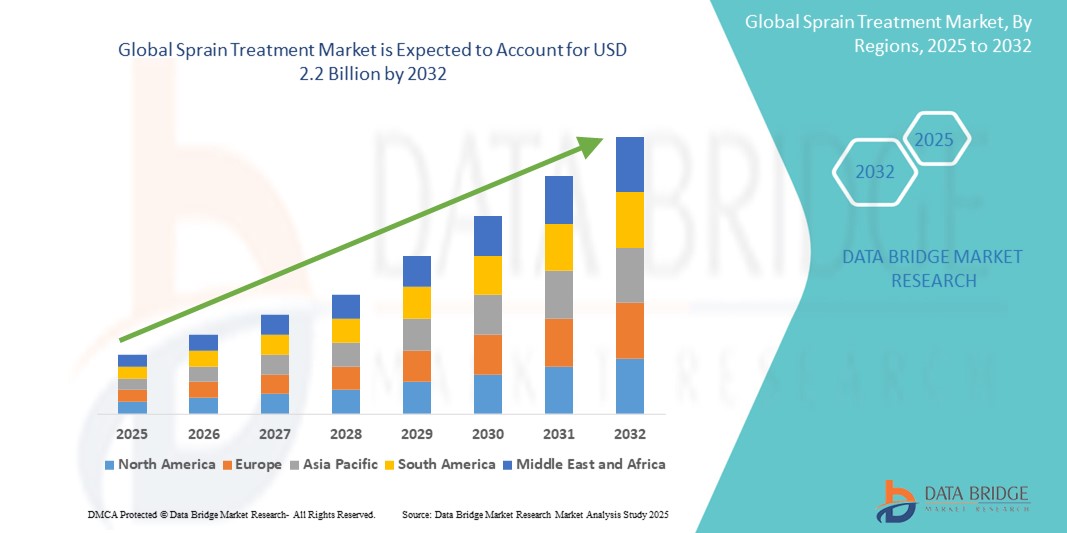
Sprain Treatment Market Size
- The global sprain treatment market size was valued at USD 1.1 billion in 2024 and is expected to reach USD 2.2 billion by 2032, at a CAGR of 7.9% during the forecast period
- The market growth is primarily driven by the increasing incidence of sports injuries, accidents, and musculoskeletal disorders, combined with advancements in treatment technologies such as improved braces, physiotherapy devices, and minimally invasive interventions.
- The rising awareness among consumers and healthcare providers regarding the benefits of early and effective sprain treatment is fueling demand for innovative and accessible treatment solutions. These converging factors are accelerating the uptake of Sprain Treatment solutions, thereby significantly boosting the industry's growth
Sprain Treatment Market Analysis
- Sprain treatment solutions, including braces, supports, physiotherapy devices, and minimally invasive intervention tools, are becoming increasingly essential in managing musculoskeletal injuries due to their effectiveness in accelerating recovery and preventing further damage.
- The growing prevalence of sports injuries, accidents, and age-related musculoskeletal disorders is the primary driver for the rising demand for sprain treatment products and therapies globally. Increasing awareness about the importance of early intervention and rehabilitation is further boosting market growth.
- North America dominates the global sprain treatment market with the largest revenue share of approximately 40.01% in 2024. This dominance is attributed to high healthcare spending, a well-established healthcare infrastructure, and strong adoption of advanced treatment technologies. The U.S. market shows robust growth, supported by increasing sports participation and innovation in treatment methods by leading medical device manufacturers.
- Asia-Pacific is expected to be the fastest-growing region in the sprain treatment market during the forecast period, driven by rapid urbanization, improving healthcare infrastructure, and rising disposable incomes. Additionally, growing awareness about physical fitness and increasing sports activities in countries like China and India contribute to market expansion.
- The braces and supports segment is expected to dominate the sprain treatment market with a market share of around 43.2% in 2024, due to their widespread use, affordability, and proven efficacy in providing stability and support during the healing process.
Report Scope and Sprain Treatment Market Segmentation
|
Attributes |
Sprain Treatment Key Market Insights |
|
Segments Covered |
|
|
Countries Covered |
North America
Europe
Asia-Pacific
Middle East and Africa
South America
|
|
Key Market Players |
|
|
Market Opportunities |
|
|
Value Added Data Infosets |
In addition to the insights on market scenarios such as market value, growth rate, segmentation, geographical coverage, and major players, the market reports curated by the Data Bridge Market Research also include in-depth expert analysis, pricing analysis, brand share analysis, consumer survey, demography analysis, supply chain analysis, value chain analysis, raw material/consumables overview, vendor selection criteria, PESTLE Analysis, Porter Analysis, and regulatory framework. |
Sprain Treatment Market Trends
“Rising Adoption of Wearable and Smart Rehabilitation Devices”
- A significant and accelerating trend in the global sprain treatment market is the increasing adoption of wearable and smart rehabilitation devices that enable real-time monitoring and personalized treatment of sprain injuries. These devices often incorporate sensors, Bluetooth connectivity, and mobile apps to track progress and guide therapy
- For instance, smart braces equipped with motion sensors provide feedback on joint movement and stability, helping patients and therapists optimize recovery exercises. Devices like the Rehago smart brace allow users to receive guided physical therapy routines through smartphone integration, enhancing convenience and treatment adherence
- The integration of IoT (Internet of Things) technology in sprain treatment products enables continuous data collection on patient activity, swelling, and pain levels, allowing for more accurate and timely adjustments in therapy. This can reduce recovery time and improve patient outcomes
- Wearable devices also facilitate remote monitoring by healthcare professionals, making tele-rehabilitation and home-based treatment more accessible and effective, especially important given the increasing demand for non-hospital care
- This trend reflects a broader shift toward personalized, technology-enabled healthcare solutions that empower patients in their recovery journey. Companies like Bausch Health and Teva Pharmaceutical are investing in R&D to develop smart sprain treatment devices with enhanced user interfaces and connectivity features
- The demand for wearable and smart rehabilitation solutions is expected to grow rapidly across sports medicine, orthopedics, and homecare segments, driven by consumer preference for convenient, data-driven treatment options that improve clinical outcomes
Sprain Treatment Market Dynamics
Driver
“Increasing Incidence of Sports Injuries and Musculoskeletal Disorders”
- The rising participation in sports, fitness activities, and physically demanding occupations has led to an increased prevalence of sprains and related musculoskeletal injuries worldwide, driving demand for effective sprain treatment solutions.
- For instance, the growing popularity of contact and adventure sports has contributed to a surge in ankle and wrist sprains, encouraging healthcare providers and consumers to seek advanced treatment options such as braces, physical therapy, and minimally invasive interventions.
- As awareness about the long-term complications of untreated sprains increases, patients and medical professionals emphasize early diagnosis and comprehensive treatment to prevent chronic instability and joint damage.
- Furthermore, the expanding geriatric population is more susceptible to falls and injuries, increasing the need for specialized sprain treatment and rehabilitation products tailored to older adults.
- Innovations in treatment technologies, including wearable supports and home-based physiotherapy devices, along with rising healthcare expenditure, are enabling better management of sprain injuries, further propelling market growth globally.
Restraint/Challenge
“Limited Awareness and High Treatment Costs in Emerging Markets”
- Limited awareness about the importance of early and proper sprain treatment, especially in developing and emerging markets, poses a significant challenge to market growth. Many patients opt for self-medication or ignore mild sprains, which can lead to chronic complications but limits demand for professional treatment solutions.
- For instance, in several low- and middle-income countries, a lack of trained healthcare professionals and insufficient rehabilitation facilities restrict access to effective sprain management, resulting in underutilization of advanced treatment options.
- Additionally, the relatively high cost of innovative sprain treatment devices, physical therapy sessions, and surgical interventions compared to conservative home remedies can deter price-sensitive consumers from seeking timely care. This is particularly evident in regions with lower healthcare spending and limited insurance coverage.
- While companies like Pfizer Inc. and Sanofi are working to improve affordability through product diversification and partnerships, the perceived high treatment cost remains a barrier to wider adoption in price-sensitive markets.
- Addressing these challenges requires increased patient education, government initiatives to improve healthcare infrastructure, and the development of cost-effective treatment solutions to ensure broader accessibility and sustained market growth.
Sprain Treatment Market Scope
The market is segmented on the basis of type, treatment type, route of administration, end users, and distribution channel..
By Type
On the basis of type, the sprain treatment market is segmented into inversion sprain, eversion sprain, and others. The inversion sprain segment holds the largest market revenue share in 2024, owing to its higher prevalence compared to other sprain types. Inversion sprains commonly affect the ankle and require specialized treatment solutions such as braces and physiotherapy devices designed to stabilize the joint and promote healing. The segment is also driven by increased sports-related injuries where inversion sprains are frequent.
The eversion sprain segment is expected to witness a steady growth rate over the forecast period, fueled by rising awareness and improved diagnostic practices facilitating timely treatment.
• By Treatment Type
On the basis of treatment type, the market is segmented into physical therapy, conservative treatment, medication, surgery, and others. The physical therapy segment dominates the market share due to its non-invasive nature and effectiveness in rehabilitation post-injury. Physical therapy approaches, including targeted exercises and manual therapy, are increasingly preferred for reducing recovery time and preventing recurrence.
Conservative treatment is expected to witness a steady growth rate. Treatments such as immobilization and rest are expected to be growing particularly for mild to moderate sprains. Surgical intervention is reserved for severe cases and is growing steadily due to advancements in minimally invasive techniques.
• By Route of Administration
On the basis of route of administration, the market is segmented into oral, topical, and others. The oral segment holds the largest revenue share as oral medications, including pain relievers and anti-inflammatory drugs, are widely used for managing pain and swelling associated with sprains.
The topical segment is expected to witness fast growth rate due to introduction of medicated creams and gels that provide localized relief with fewer systemic side effects. Emerging delivery mechanisms such as patches and sprays are also contributing to the growth of the topical segment.
• By End Users
On the basis of end users, the market is segmented into hospitals, homecare, specialty clinics, and others. Hospitals constitute the largest end-user segment due to the availability of specialized care and rehabilitation services. The homecare segment is rapidly growing as patients increasingly prefer recovery in the comfort of their homes, supported by portable devices and tele-rehabilitation programs.
Specialty segment is expected to witness fast growth rate due to clinics focused on sports medicine and orthopedics contributors, especially in urban regions with high sports activity.
• By Distribution Channel
On the basis of distribution channel, the market is segmented into hospital pharmacy, retail pharmacy, online pharmacy, and others. Retail pharmacies currently dominate the market share, offering wide accessibility and availability of treatment products including braces, medications, and rehabilitation aids.
The online pharmacy segment is witnessing the fastest growth rate, driven by increasing e-commerce penetration, convenience of doorstep delivery, and a broader range of available products. Hospital pharmacies maintain strong relevance due to direct access for inpatients and post-surgical care products
Sprain Treatment Market Regional Analysis
- North America dominates the sprain treatment market with the largest revenue share of 39.5% in 2024, driven by increasing sports participation, advanced healthcare infrastructure, and high awareness of injury management.
- Consumers and healthcare providers in the region emphasize early diagnosis and comprehensive treatment options including physical therapy, advanced braces, and surgical interventions.
- This strong demand is further supported by high healthcare expenditure, growing geriatric population prone to musculoskeletal injuries, and the availability of technologically advanced treatment devices.
U.S. Sprain Treatment Market Insight
The U.S. sprain treatment market captured the largest revenue share of 82% within North America in 2024, fueled by widespread adoption of digital health technologies and tele-rehabilitation services. The country’s well-established sports medicine sector, combined with increasing insurance coverage for physiotherapy, supports market growth. Additionally, rising consumer preference for homecare rehabilitation and non-invasive treatments propels the demand for innovative sprain treatment products.
• Europe
Europe Sprain treatment market is expected to expand at a steady CAGR throughout the forecast period, driven by increasing awareness of sports injuries and musculoskeletal health. The presence of advanced healthcare facilities and stringent regulations for patient care ensure a strong focus on effective treatment and rehabilitation protocols. Growing urbanization and a focus on improving elderly care further boost demand across hospitals, specialty clinics, and homecare services.
U.K. Sprain Treatment Market Insight
The U.K. sprain treatment market is anticipated to grow moderately due to rising sports injuries and an aging population. Increased government support for musculoskeletal health initiatives and the growth of private physiotherapy clinics contribute to the market’s expansion.
Germany Sprain Treatment Market Insight
Germany exhibits robust market growth fueled by technological advancements in treatment devices and a high standard of healthcare infrastructure. A rising preference for minimally invasive surgeries and wearable rehabilitation devices supports the evolving treatment landscape. Strong patient awareness and insurance reimbursement policies further enhance market prospects.
Asia-Pacific Sprain Treatment Market Insight
Asia-Pacific sprain treatment market is poised to grow at the fastest CAGR of over 22% from 2024 onward, supported by rising urbanization, increasing disposable incomes, and expanding healthcare infrastructure in countries like China, India, and Japan. The region’s growing sports culture and government initiatives to improve healthcare accessibility are key growth drivers. Emerging telehealth and homecare rehabilitation services are rapidly gaining traction, enhancing treatment accessibility in remote areas.
Japan Sprain Treatment Market Insight
Japan’s market growth is propelled by its technologically advanced healthcare system, an aging population with high susceptibility to sprains, and increasing adoption of smart rehabilitation devices. The integration of treatment solutions with IoT and AI technologies is a notable trend.
China Sprain Treatment Market Insight
China holds the largest market share in Asia-Pacific due to its vast population, rapid urbanization, and significant investments in healthcare infrastructure. The country’s expanding middle class and rising health awareness support demand for modern sprain treatment options including physical therapy centers and online rehabilitation services.
Sprain Treatment Market Share
The sprain treatment industry is primarily led by well-established companies, including:
- Sanofi (France)
- Nuvo Pharmaceuticals Inc. (Canada)
- Galen Limited (India)
- Dev Life Corporation (India)
- LUPIN (India)
- Bausch Health (Canada)
- Dr. Reddy’s Laboratories Ltd. (India)
- Pfizer Inc. (U.S.)
- Perrigo Company plc. (Ireland)
- Teva Pharmaceutical Industries Ltd. (Israel)
- Sun Pharmaceutical Industries Ltd. (India)
- Color Health, Inc. (U.S.)
- Sema4 (U.S.)
- Helix (U.S.)
- Exact Sciences Corporation (U.S.)
- Guardant Health (U.S.)
- Natera, Inc. (U.S.)
- Foundation Medicine, Inc. (U.S.)
- Thermo Fisher Scientific Inc. (U.S.)
- Illumina, Inc. (U.S.)
- QIAGEN (Germany)
- Agilent Technologies, Inc. (U.S.)
- PerkinElmer Inc. (U.S.)
Latest Developments in Global Sprain Treatment Market
- In July 2021, Stryker announced the acquisition of OrthoSpace, Ltd., with an aim to enlarge its sports medicine product offerings, including surgical products for rotator cuff tear treatment.
- In December 2021, DePuy Synthes announced the launch of Inhance, a fully integrated shoulder arthroplasty system.
- n August 2023, Kaneka Corporation, a chemical company from Japan, started testing a treatment called KA-301 made from stem cells derived from human amnion (part of the placenta) on people with acute spinal cord injuries.
- In September 2023, NervGen Pharma Corporation, a biotech company, announced that they'd given the first dose of their experimental drug NVG-291 to someone in a trial for spinal cord injuries

- Interactive Data Analysis Dashboard
- Company Analysis Dashboard for high growth potential opportunities
- Research Analyst Access for customization & queries
- Competitor Analysis with Interactive dashboard
- Latest News, Updates & Trend analysis
- Harness the Power of Benchmark Analysis for Comprehensive Competitor Tracking
Data collection and base year analysis are done using data collection modules with large sample sizes. The stage includes obtaining market information or related data through various sources and strategies. It includes examining and planning all the data acquired from the past in advance. It likewise envelops the examination of information inconsistencies seen across different information sources. The market data is analysed and estimated using market statistical and coherent models. Also, market share analysis and key trend analysis are the major success factors in the market report. To know more, please request an analyst call or drop down your inquiry.
The key research methodology used by DBMR research team is data triangulation which involves data mining, analysis of the impact of data variables on the market and primary (industry expert) validation. Data models include Vendor Positioning Grid, Market Time Line Analysis, Market Overview and Guide, Company Positioning Grid, Patent Analysis, Pricing Analysis, Company Market Share Analysis, Standards of Measurement, Global versus Regional and Vendor Share Analysis. To know more about the research methodology, drop in an inquiry to speak to our industry experts.
Data Bridge Market Research is a leader in advanced formative research. We take pride in servicing our existing and new customers with data and analysis that match and suits their goal. The report can be customized to include price trend analysis of target brands understanding the market for additional countries (ask for the list of countries), clinical trial results data, literature review, refurbished market and product base analysis. Market analysis of target competitors can be analyzed from technology-based analysis to market portfolio strategies. We can add as many competitors that you require data about in the format and data style you are looking for. Our team of analysts can also provide you data in crude raw excel files pivot tables (Fact book) or can assist you in creating presentations from the data sets available in the report.












