Sprinkler Gun Market Size
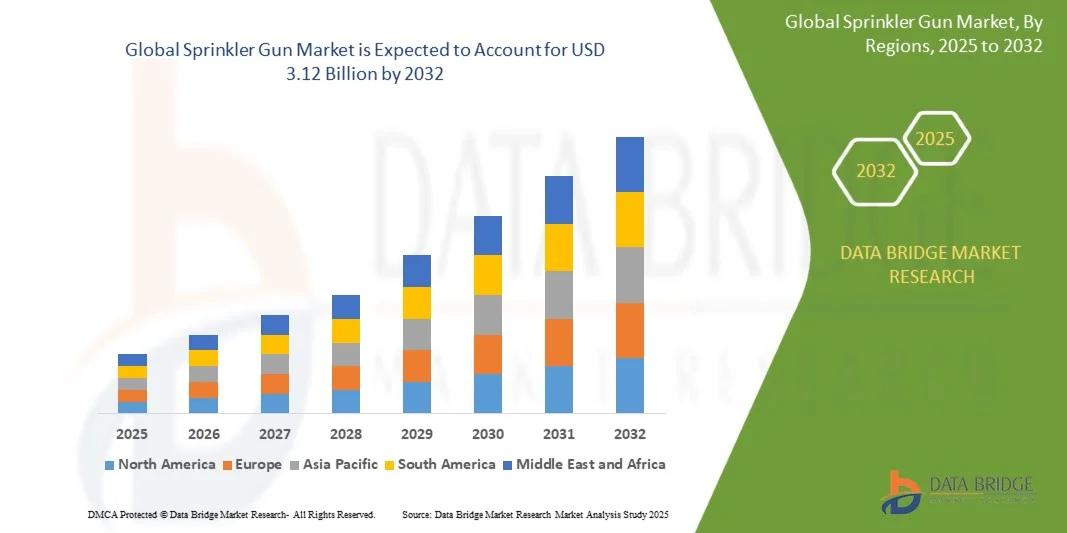
- The global sprinkler gun market size was valued at USD 2.20 billion in 2024 and is expected to reach USD 3.12 billion by 2032, at a CAGR of 4.5% during the forecast period
- The market growth is largely fueled by increasing adoption of modern irrigation techniques and precision farming solutions, leading to improved water management and enhanced crop yields across agricultural and commercial landscapes
- Furthermore, rising awareness about water conservation, labor efficiency, and sustainable farming practices is driving the demand for advanced sprinkler systems. These factors are accelerating the uptake of handheld and fixed sprinkler guns, thereby significantly boosting the overall market growth
Sprinkler Gun Market Analysis
- Sprinkler guns are irrigation devices designed to distribute water evenly across agricultural fields, nurseries, lawns, and gardens. These systems can be handheld for targeted watering or fixed for large-area coverage, providing flexibility and efficiency in irrigation practices
- The escalating demand for sprinkler guns is primarily fueled by the need for water-efficient irrigation, growing adoption of automated and smart irrigation solutions, and increasing focus on sustainable agriculture and landscaping practices
- North America dominated the sprinkler gun market with a share of 36.72% in 2024, due to high adoption of modern irrigation practices and growing awareness of water-efficient farming technologies
- Asia-Pacific is expected to be the fastest growing region in the sprinkler gun market during the forecast period due to rising urbanization, increasing agricultural modernization, and technological adoption in countries such as China, India, and Japan
- Agricultural crops segment dominated the market with a market share of 62% in 2024, due to the critical need for efficient water management to improve crop yields and reduce resource wastage. Large-scale farmers prefer sprinkler systems for their uniform water distribution, adaptability to different crop types, and ability to optimize irrigation schedules. Government initiatives promoting modern irrigation techniques and subsidies for water-efficient equipment have further supported market dominance. The segment also benefits from increasing adoption of precision agriculture practices and awareness about sustainable farming
Report Scope and Sprinkler Gun Market Segmentation
|
Attributes |
Sprinkler Gun Key Market Insights |
|
Segments Covered |
|
|
Countries Covered |
North America
Europe
Asia-Pacific
Middle East and Africa
South America
|
|
Key Market Players |
|
|
Market Opportunities |
|
|
Value Added Data Infosets |
In addition to the insights on market scenarios such as market value, growth rate, segmentation, geographical coverage, and major players, the market reports curated by the Data Bridge Market Research also include import export analysis, production capacity overview, production consumption analysis, price trend analysis, climate change scenario, supply chain analysis, value chain analysis, raw material/consumables overview, vendor selection criteria, PESTLE Analysis, Porter Analysis, and regulatory framework. |
Sprinkler Gun Market Trends
Growing Use of Automated Irrigation Systems
- The sprinkler gun market is witnessing rapid growth due to the increasing adoption of automated irrigation systems, which reduce dependency on manual watering methods. Farmers are shifting to mechanized solutions that provide uniform water coverage and optimize agricultural productivity, particularly in regions facing water scarcity
- For instance, Jain Irrigation Systems has been expanding its portfolio of automated sprinkler guns designed for efficient coverage of large fields with minimal labor input. Rain Bird Corporation has also introduced advanced irrigation systems integrated with smart controllers that adjust water distribution based on soil and weather conditions
- The use of sprinkler guns in modern irrigation systems enhances efficiency by delivering precise water application and reducing wastage. This capability supports farmers in optimizing crop yield while preserving water resources, which has become critical under increasing climatic uncertainties and resource limitations
- Technological innovation in sprinkler guns has led to the development of models with adjustable pressure, wide spray coverage, and compatibility with automation controllers. These advancements empower farmers to maintain consistent irrigation schedules while reducing operational costs over time
- Commercial farming enterprises and irrigation service providers are investing heavily in digital and automated irrigation solutions, further accelerating the integration of smart sprinkler gun systems. This convergence of automation, remote monitoring, and precision farming is reshaping irrigation practices in large-scale agriculture
- The growing reliance on automated sprinkler irrigation aligns with global sustainability goals and food security initiatives. As agriculture modernizes, sprinkler guns are evolving as an integral part of irrigation systems that ensure water efficiency, crop resilience, and long-term agricultural sustainability
Sprinkler Gun Market Dynamics
Driver
Rising Focus on Water-Efficient and Sustainable Farming
- An increasing emphasis on sustainable farming practices and efficient use of natural resources is driving demand for sprinkler guns. By providing targeted water application, they significantly reduce water wastage compared to traditional flood irrigation methods and allow farmers to manage resources responsibly
- For instance, Netafim has been developing sprinkler-based irrigation systems optimized for arid regions, offering solutions that reduce water consumption while sustaining high agricultural output. Jain Irrigation Systems similarly markets sprinkler guns as part of its water-efficient farming technologies portfolio, catering to farmers in both emerging and developed economies
- Growing water stress and rising global food demand are compelling farmers to adopt irrigation systems that deliver high productivity with minimal inputs. Sprinkler guns offer an efficient and sustainable option, enhancing crop health while preserving limited water supplies in regions with challenging climates
- Government programs promoting micro-irrigation adoption are also playing an important role in boosting demand for sprinkler guns. Subsidies and policy guidelines encouraging precision irrigation support farmers in transitioning from outdated methods to resource-efficient technologies
- The increasing focus on achieving sustainable levels of agricultural productivity while managing water scarcity ensures that water-efficient irrigation technologies will stay at the forefront of farming practices. The sprinkler gun market is therefore expected to expand steadily as a critical enabler of sustainable agriculture
Restraint/Challenge
High Initial Cost of Advanced Sprinklers
- The high initial investment required for advanced sprinkler gun systems presents a significant barrier to adoption, particularly for small and marginal farmers. The cost of equipment, installation, and maintenance often outweighs immediate budget constraints, even though long-term benefits are considerable
- For instance, smaller farmers in India and parts of Africa face difficulties in adopting high-quality sprinkler guns marketed by Rain Bird or Toro due to their premium pricing. Affordability issues delay mass adoption in developing nations, where farming relies heavily on traditional and cost-effective irrigation practices
- Maintenance expenses for precision sprinkler guns, including nozzle replacement, pump upkeep, and pressure regulation, add to the overall operational costs. These recurring expenses discourage farmers who lack access to credit facilities or financial incentives to support such investments
- The high capital investment also results in significant adoption disparity between large commercial farms and smallholders. While large enterprises benefit from mechanized sprinkler gun systems, the penetration among resource-constrained farmers remains limited, restricting overall market expansion
- In conclusion, the affordability challenge of advanced sprinkler gun systems continues to limit widespread adoption. Addressing this issue through government subsidies, cost reductions via localized manufacturing, and innovative financing models will be critical to expanding adoption and ensuring equitable benefits from modern irrigation technologies
Sprinkler Gun Market Scope
The market is segmented on the basis of type and application.
• By Type
On the basis of type, the sprinkler gun market is segmented into handheld irrigation sprinklers and fixed irrigation sprinklers. The handheld irrigation sprinklers segment dominated the largest market revenue share in 2024, driven by their versatility and ease of use across diverse farming and gardening scenarios. Farmers and landscapers often prefer handheld sprinklers for their mobility, precise control over water distribution, and ability to target specific areas, reducing water wastage. The segment also benefits from widespread adoption in small-scale farming and home gardening, where portability and flexible irrigation patterns are crucial. In addition, handheld sprinklers often come with adjustable nozzles and pressure controls, further enhancing their functionality. Their compatibility with both manual and automated systems has cemented their leading position in the market.
The fixed irrigation sprinklers segment is anticipated to witness the fastest growth rate from 2025 to 2032, driven by increasing mechanization and the demand for efficient large-scale irrigation solutions. Fixed sprinklers provide consistent water coverage over larger areas, making them ideal for commercial farms, golf courses, and sports fields. Their integration with automated irrigation systems reduces labor costs and improves water use efficiency. Rising awareness about sustainable water management practices is further boosting the adoption of fixed sprinklers. The ability to schedule irrigation remotely and maintain uniform crop growth is also fueling market expansion.
• By Application
On the basis of application, the sprinkler gun market is segmented into agricultural crops, nursery crops, lawns and gardens, and others. The agricultural crops segment held the largest market revenue share of 62% in 2024, driven by the critical need for efficient water management to improve crop yields and reduce resource wastage. Large-scale farmers prefer sprinkler systems for their uniform water distribution, adaptability to different crop types, and ability to optimize irrigation schedules. Government initiatives promoting modern irrigation techniques and subsidies for water-efficient equipment have further supported market dominance. The segment also benefits from increasing adoption of precision agriculture practices and awareness about sustainable farming.
The lawns and gardens segment is expected to witness the fastest growth rate from 2025 to 2032, fueled by the rising popularity of residential landscaping, urban green spaces, and recreational areas. Homeowners, landscapers, and municipal authorities increasingly prefer sprinkler systems to maintain lawns, parks, and gardens efficiently. The ease of installation, programmable irrigation schedules, and compatibility with smart irrigation controllers make sprinklers an attractive solution for water conservation and aesthetic maintenance. Growing trends in home gardening, urban beautification, and climate-conscious landscaping practices are further driving the expansion of this segment.
Sprinkler Gun Market Regional Analysis
- North America dominated the sprinkler gun market with the largest revenue share of 36.72% in 2024, driven by high adoption of modern irrigation practices and growing awareness of water-efficient farming technologies
- Farmers and landscapers in the region highly value precision irrigation, ease of operation, and adaptability of sprinkler systems for both small-scale and commercial applications
- This widespread adoption is further supported by well-developed agricultural infrastructure, high investment in mechanized farming, and strong government incentives promoting efficient water management
U.S. Sprinkler Gun Market Insight
The U.S. sprinkler gun market captured the largest revenue share in 2024 within North America, fueled by increasing adoption of automated irrigation systems and precision farming solutions. Farmers are increasingly prioritizing consistent crop watering and labor-efficient irrigation methods. The demand for handheld and fixed sprinklers integrated with timers and controllers is rising, while smart irrigation technologies compatible with mobile apps are further propelling market growth. Moreover, ongoing research in water conservation and government subsidies for sustainable irrigation practices are significantly contributing to the market expansion.
Europe Sprinkler Gun Market Insight
The Europe sprinkler gun market is projected to expand at a substantial CAGR throughout the forecast period, primarily driven by strict water management regulations and increasing investment in modern irrigation solutions. The rise in greenhouse cultivation, urban farming, and commercial landscaping is fostering demand. European consumers are also drawn to sprinkler systems offering energy efficiency, durability, and precise water delivery. The market is experiencing strong growth across both agricultural crops and ornamental landscapes, with sprinklers being adopted in both new installations and retrofitting projects.
U.K. Sprinkler Gun Market Insight
The U.K. sprinkler gun market is anticipated to grow at a noteworthy CAGR during the forecast period, driven by the growing trend of sustainable irrigation and demand for convenience in lawn, garden, and commercial farming applications. Concerns about water scarcity and efficiency are encouraging farmers and homeowners to adopt sprinkler systems. The country’s well-established horticulture and landscaping sectors, combined with rising awareness of precision irrigation technologies, are expected to continue stimulating market growth.
Germany Sprinkler Gun Market Insight
The Germany sprinkler gun market is expected to expand at a considerable CAGR during the forecast period, fueled by increasing awareness of water conservation, advanced irrigation technologies, and mechanized farming solutions. Germany’s focus on sustainability and technological innovation promotes adoption of sprinkler systems across agricultural, horticultural, and landscaping applications. The integration of automated and fixed irrigation systems is becoming increasingly common, with strong preference for energy-efficient and high-precision watering solutions aligned with local agricultural practices.
Asia-Pacific Sprinkler Gun Market Insight
The Asia-Pacific sprinkler gun market is poised to grow at the fastest CAGR during the forecast period of 2025 to 2032, driven by rising urbanization, increasing agricultural modernization, and technological adoption in countries such as China, India, and Japan. The region's growing demand for efficient water management and high-yield crop production is driving the adoption of handheld and fixed sprinkler systems. Furthermore, government initiatives promoting smart agriculture, irrigation modernization programs, and increasing production of affordable sprinkler systems are expanding accessibility to a wider consumer base.
Japan Sprinkler Gun Market Insight
The Japan sprinkler gun market is gaining momentum due to the country’s high-tech agriculture practices, compact farm sizes, and strong focus on water conservation. Adoption is fueled by the need for precise and labor-saving irrigation solutions for both crops and landscaping. Integration with automated irrigation controllers and mobile-based scheduling systems is boosting market growth, while increasing focus on sustainable farming practices is encouraging broader adoption of sprinkler systems.
China Sprinkler Gun Market Insight
The China sprinkler gun market accounted for the largest market revenue share in Asia-Pacific in 2024, driven by rapid urbanization, the expansion of commercial farms, and high adoption of modern irrigation equipment. Both handheld and fixed sprinklers are increasingly used for large-scale crop cultivation, nurseries, and urban landscaping. Government support for water-efficient technologies, rising awareness of precision agriculture, and strong domestic manufacturing capabilities are key factors propelling market growth in China.
Sprinkler Gun Market Share
The sprinkler gun industry is primarily led by well-established companies, including:
- Nelson Irrigation (U.S.)
- Wade Rain, Inc. (U.S.)
- Komet Austria GmbH (Austria)
- Rainer Irrigation Ltd. (New Zealand)
- Kifco (U.S.)
- Jain Irrigation Systems Ltd. (India)
- Sathish Agro Tech (India)
- SIME IDROMECCANICA Srl (Italy)
- Novedades Agrícolas S.A. (Spain)
- OASIS IRRIGATION EQUIPMENT CO.LTD. (China)
- Guangzhou Cleaning-spray Equipment Co., Ltd. (China)
Latest Developments in Global Sprinkler Gun Market
- In 2024, Rain Bird Corporation launched an AI-enabled sprinkler gun system with automated moisture sensing and adaptive watering schedules, enhancing precision irrigation. This development is expected to significantly boost adoption among commercial farms and large-scale agricultural operations by optimizing water usage, reducing labor costs, and improving crop yields, positioning Rain Bird as a leader in smart irrigation solutions
- In 2023, multiple companies announced strategic partnerships to develop advanced irrigation management software integrated with sprinkler guns, enabling real-time monitoring and data-driven irrigation decisions. This move is driving the digitalization of the sprinkler gun market, improving efficiency for farmers and landscapers, and encouraging the adoption of connected and automated irrigation systems
- In 2022, Nelson Irrigation introduced a water-efficient nozzle design for sprinkler guns, reducing water consumption by 15%. This innovation is enhancing the sustainability of irrigation practices, lowering operational costs for agricultural and landscaping applications, and strengthening Nelson’s market presence in environmentally conscious regions
- In 2021, Jain Irrigation Systems launched a new line of smart sprinkler guns with integrated sensors capable of monitoring soil moisture and weather conditions. This development is accelerating the shift toward precision irrigation in both small-scale and commercial farming, increasing demand for technologically advanced sprinkler systems and promoting water conservation
- In 2020, Toro Company unveiled a high-capacity fixed sprinkler gun designed for large-scale agricultural fields with enhanced coverage and durability. This launch is helping farmers achieve uniform irrigation over vast areas, reducing labor requirements and water wastage, and reinforcing Toro’s position in the industrial and commercial sprinkler market

- Interactive Data Analysis Dashboard
- Company Analysis Dashboard for high growth potential opportunities
- Research Analyst Access for customization & queries
- Competitor Analysis with Interactive dashboard
- Latest News, Updates & Trend analysis
- Harness the Power of Benchmark Analysis for Comprehensive Competitor Tracking
Data collection and base year analysis are done using data collection modules with large sample sizes. The stage includes obtaining market information or related data through various sources and strategies. It includes examining and planning all the data acquired from the past in advance. It likewise envelops the examination of information inconsistencies seen across different information sources. The market data is analysed and estimated using market statistical and coherent models. Also, market share analysis and key trend analysis are the major success factors in the market report. To know more, please request an analyst call or drop down your inquiry.
The key research methodology used by DBMR research team is data triangulation which involves data mining, analysis of the impact of data variables on the market and primary (industry expert) validation. Data models include Vendor Positioning Grid, Market Time Line Analysis, Market Overview and Guide, Company Positioning Grid, Patent Analysis, Pricing Analysis, Company Market Share Analysis, Standards of Measurement, Global versus Regional and Vendor Share Analysis. To know more about the research methodology, drop in an inquiry to speak to our industry experts.
Data Bridge Market Research is a leader in advanced formative research. We take pride in servicing our existing and new customers with data and analysis that match and suits their goal. The report can be customized to include price trend analysis of target brands understanding the market for additional countries (ask for the list of countries), clinical trial results data, literature review, refurbished market and product base analysis. Market analysis of target competitors can be analyzed from technology-based analysis to market portfolio strategies. We can add as many competitors that you require data about in the format and data style you are looking for. Our team of analysts can also provide you data in crude raw excel files pivot tables (Fact book) or can assist you in creating presentations from the data sets available in the report.