What is the Sprinkler Irrigation Systems Market Size and Growth Rate?
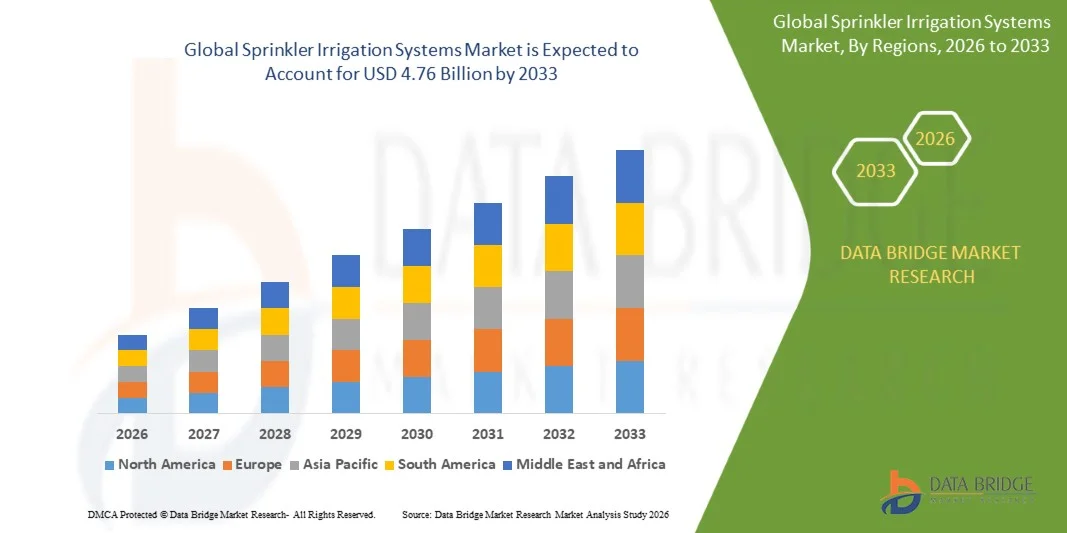
- As per Data Bridge Market Research analysis the sprinkler irrigation systems market was valued at USD 1.83 billion in 2025 and is projected to reach USD 4.76 billion by 2033, growing at a CAGR of 12.70% from 2026 to 2033.
- The market is experiencing robust growth driven by increasing global food demand, the urgent need for water-efficient agricultural practices, and the rising adoption of precision farming technologies. The shift from traditional flood irrigation to advanced sprinkler systems is being accelerated by growing water scarcity, unpredictable rainfall patterns due to climate change, and government initiatives promoting sustainable irrigation infrastructure.
- The integration of smart technologies such as IoT sensors, AI-driven analytics, and automated controls is transforming the market, enabling real-time monitoring and optimization of water usage. This technological evolution is making sprinkler irrigation systems more efficient, cost-effective, and accessible to a broader range of farmers, from smallholders to large commercial operations. The market's expansion is also supported by the growing awareness of water conservation and the need to enhance agricultural productivity while minimizing environmental impact.
Market Size & Forecast
- Market Value (2025): USD 1.83 Billion
- Expected Market Value (2033): USD 4.76 Billion
- Forecast CAGR (2026–2033): 12.70%
- Leading Region in 2025: North America
- Fastest Growing Region: Asia-Pacific
What are the Major Takeaways of the Sprinkler Irrigation Systems Market?
- North America dominated the sprinkler irrigation systems market with the largest revenue in 2025, supported by large-scale agricultural land holdings, widespread adoption of modern irrigation systems, and increasing emphasis on water-efficient farming.
- The Asia-Pacific sprinkler irrigation systems market is expected to witness the fastest growth during the forecast period, supported by the significant role of agriculture in economies such as China and India, increasing population, and growing demand for agricultural productivity.
- The center pivot segment dominated the market, supported by its efficient water distribution, automation capabilities, large-area coverage, and increasing adoption across field crop cultivation.
- The lateral move segment is expected to witness significant growth during the forecast period, driven by increasing demand for flexible irrigation systems that can efficiently cover rectangular and irregularly shaped agricultural fields.
- The stationary segment accounted for a significant share of the market, owing to its suitability for permanent agricultural installations, orchards, landscaping applications, and areas requiring regular irrigation.
- The towable segment is projected to register strong growth during the forecast period, driven by its flexibility, lower installation requirements, and ability to serve multiple field locations using the same irrigation equipment.
Report Scope and Sprinkler Irrigation Systems Market Segmentation
|
Attributes |
Sprinkler Irrigation Systems Key Market Insights |
|
Segments Covered |
|
|
Countries Covered |
North America
Europe
Asia-Pacific
Middle East and Africa
South America
|
|
Key Market Players |
|
|
Market Opportunities |
|
|
Value Added Data Infosets |
In addition to the insights on market scenarios such as market value, growth rate, segmentation, geographical coverage, and major players, the market reports curated by the Data Bridge Market Research also include import export analysis, production capacity overview, production consumption analysis, price trend analysis, climate change scenario, supply chain analysis, value chain analysis, raw material/consumables overview, vendor selection criteria, PESTLE Analysis, Porter Analysis, and regulatory framework. |
What is the Key Trend in the Sprinkler Irrigation Systems Market?
- The increasing integration of automation, sensors, weather information, and digital monitoring is emerging as a key trend in the sprinkler irrigation systems market, enabling farmers to improve irrigation scheduling, optimize water application, and reduce unnecessary water use.
- For instance, in August 2025, Netafim introduced Mega-PULSAR™, a full-coverage pulsing sprinkler system designed to provide overhead protection for orchards during periods of extreme heat and heat stress. The system is targeted at high-value crops, including avocado, mango, and lychee, and demonstrates the growing use of advanced sprinkler technologies to address climate-related agricultural challenges.
- Smart irrigation technologies are also expanding across landscape and turf applications, with manufacturers incorporating weather-based scheduling, soil-moisture monitoring, mobile connectivity, and automated controls to improve irrigation efficiency.
- For instance, in January 2025, Aiper introduced its IrriSense Smart Irrigation Sprinkler at CES 2025, featuring app-based spray mapping, weather-based scheduling, soil-moisture sensing, and automated irrigation management. The system was designed to improve coverage and reduce unnecessary watering.
- The integration of digital controls and sensing technologies is enabling sprinkler systems to respond more effectively to changing crop, soil, and weather conditions while reducing manual intervention.
- As water scarcity, climate variability, and the need to improve agricultural productivity increase, the adoption of automated and precision-enabled sprinkler irrigation systems is expected to accelerate, making intelligent water management an important trend in the global market.
What are the Key Drivers of the Sprinkler Irrigation Systems Market?
- Growing pressure to improve agricultural water-use efficiency amid water scarcity, climate variability, and increasing food-production requirements is a major driver of the sprinkler irrigation systems market. Sprinkler systems provide relatively uniform water distribution and can be used across field crops, orchards, vegetables, cereals, pulses, and other agricultural applications.
- For instance, Netafim India highlights sprinkler irrigation for open-field and orchard applications, where sprinkler systems can distribute water across different crop types and operate across flat, sloped, and undulating agricultural land.
- Government initiatives focused on water conservation, irrigation modernization, and agricultural productivity are also supporting the transition from conventional irrigation practices toward mechanized and water-efficient irrigation systems.
- For instance, in 2025, the Government of India continued implementation of the Pradhan Mantri Krishi Sinchayee Yojana (PMKSY), which includes measures aimed at improving irrigation efficiency and expanding access to water-management infrastructure. Such initiatives support investment in efficient irrigation technologies across agricultural regions.
- Technological developments are further supporting market growth as manufacturers introduce sprinkler systems with improved distribution uniformity, automated controls, pressure regulation, and digital monitoring capabilities. These developments enable farmers to improve water application and reduce operational inefficiencies.
- Increasing pressure to conserve freshwater, improve crop productivity, reduce labor requirements, and adapt irrigation practices to changing climatic conditions is expected to sustain demand for sprinkler irrigation systems across agricultural markets.
Which Factors are Challenging the Growth of the Sprinkler Irrigation Systems Market?
- High initial investment and infrastructure requirements remain significant challenges for sprinkler irrigation adoption, particularly among small and marginal farmers. Pumps, pipes, sprinklers, filtration equipment, pressure-control components, and installation services can increase upfront costs compared with simpler irrigation methods.
- Sprinkler systems also require appropriate water pressure, adequate pumping capacity, suitable system design, and regular maintenance to achieve effective water distribution. Improper installation, clogged sprinkler components, pressure fluctuations, and inadequate maintenance can reduce application uniformity and system efficiency.
- Government-supported irrigation modernization programs illustrate the importance of financial and infrastructure support in expanding access to efficient irrigation technologies, particularly among farmers with limited capital availability.
- Energy requirements can also increase operating costs because sprinkler systems generally require pumping water through pressurized distribution networks. Electricity or fuel costs can therefore influence the economic viability of sprinkler irrigation, particularly in areas with limited or unreliable agricultural power infrastructure.
- Advanced smart sprinkler systems introduce additional requirements for sensors, controllers, connectivity, software, and technical maintenance. Limited digital literacy, unreliable connectivity, and inadequate technical support can create further barriers to adoption among farmers in developing agricultural regions.
- Consequently, high capital expenditure, pumping and energy requirements, system-maintenance needs, and technological complexity can constrain sprinkler irrigation adoption, particularly among small-scale and cost-sensitive farmers, despite the increasing need for efficient agricultural water management.
How is the Sprinkler Irrigation Systems Market Segmented?
- By Type
On the basis of type, the sprinkler irrigation systems market is segmented into center pivot, lateral move, solid sets, and others. The center pivot segment dominated the market, supported by its efficient water distribution, automation capabilities, large-area coverage, and increasing adoption across field crop cultivation. Center pivot systems enable farmers to irrigate large agricultural areas with relatively low labor requirements while maintaining consistent application of water and fertilizers. Their integration with sensors, remote monitoring, and precision irrigation technologies further supports their adoption in modern commercial farming operations.
The lateral move segment is expected to witness significant growth during the forecast period, driven by increasing demand for flexible irrigation systems that can efficiently cover rectangular and irregularly shaped agricultural fields. Lateral move systems offer uniform water application and can be repositioned across multiple field sections, making them suitable for farms where center pivot systems have limited applicability. Growing emphasis on water conservation and efficient irrigation practices is further supporting segment expansion.
- By Mobility
On the basis of mobility, the sprinkler irrigation systems market is segmented into stationary and towable. The stationary segment accounted for a significant share of the market, owing to its suitability for permanent agricultural installations, orchards, landscaping applications, and areas requiring regular irrigation. Stationary sprinkler systems provide reliable and consistent water delivery and can be integrated with automated controllers, soil-moisture sensors, and fertigation systems, supporting their adoption among commercial farms and high-value crop producers.
The towable segment is projected to register strong growth during the forecast period, driven by its flexibility, lower installation requirements, and ability to serve multiple field locations using the same irrigation equipment. Towable systems are particularly beneficial for farms with fragmented plots or seasonal irrigation requirements, as equipment can be moved between fields according to crop and water requirements. Increasing mechanization of agricultural operations and the need to optimize irrigation equipment utilization are further contributing to segment growth.
- By Application
On the basis of application, the sprinkler irrigation systems market is segmented into field crops, orchard crops, landscape & turf, and others. The field crops segment dominated the market, driven by the extensive cultivation of cereals, grains, oilseeds, pulses, and other large-scale agricultural crops. Sprinkler irrigation systems enable relatively uniform water distribution across large cultivated areas while reducing water losses associated with conventional surface irrigation. Growing adoption of mechanized farming, precision agriculture practices, and water-efficient irrigation technologies is further supporting demand for sprinkler systems in field crop production.
The orchard crops segment is expected to witness significant growth during the forecast period, supported by increasing adoption of efficient irrigation technologies for high-value fruit and nut crops. Sprinkler systems provide controlled water application and can be integrated with fertigation, automation, and soil-moisture monitoring technologies. Rising emphasis on improving crop productivity, reducing water consumption, and maintaining consistent moisture levels in orchard environments is expected to accelerate the adoption of sprinkler irrigation systems in this segment.
Which Region Holds the Largest Share of the Sprinkler Irrigation Systems Market?
- North America dominated the sprinkler irrigation systems market with the largest revenue in 2025, supported by large-scale agricultural land holdings, widespread adoption of modern irrigation systems, and increasing emphasis on water-efficient farming.
- The region benefits from Advancement in precision irrigation techniques and their increasing adoption by countries such as Canada, where water scarcity is emerging as a major issue for crop production, is anticipated to support the growth of these irrigation practices in the upcoming years.
U.S. Sprinkler Irrigation Systems Market Insight
The U.S. sprinkler irrigation systems market accounted for the largest share within North America, driven by increasing emphasis on efficient agricultural water management, precision irrigation, and crop productivity. The country's large-scale farming operations and high adoption of automated irrigation equipment are supporting demand for sprinkler systems. Furthermore, growing concerns regarding water availability and continued technological advancements in irrigation are encouraging farmers to adopt more efficient irrigation solutions.
Europe Sprinkler Irrigation Systems Market Insight
The Europe sprinkler irrigation systems market is expected to witness steady growth during the forecast period, supported by high awareness of modern irrigation technologies and widespread utilization of sprinkler systems across agricultural applications. Countries including France, Italy, Spain, and Russia have substantial areas under sprinkler irrigation, supporting regional demand. In addition, increasing emphasis on sustainable water management and efficient agricultural practices is encouraging farmers to adopt modern sprinkler systems for crop production.
U.K. Sprinkler Irrigation Systems Market Insight
The U.K. sprinkler irrigation systems market is expected to experience steady growth during the forecast period, supported by increasing emphasis on efficient agricultural water management and the adoption of modern farming technologies. Growing awareness of water conservation and the need for reliable irrigation practices are encouraging farmers to improve irrigation efficiency. The increasing integration of mechanized and automated irrigation solutions is also expected to support the adoption of sprinkler systems across agricultural applications.
Germany Sprinkler Irrigation Systems Market Insight
The Germany sprinkler irrigation systems market is expected to witness steady growth during the forecast period, driven by increasing adoption of efficient agricultural technologies and growing emphasis on sustainable water management. The country's technologically advanced agricultural sector supports the use of mechanized irrigation equipment, while increasing awareness of resource-efficient farming practices encourages the adoption of modern sprinkler systems. Demand for automated and precision-oriented irrigation solutions is also expected to contribute to market development.
Asia-Pacific Sprinkler Irrigation Systems Market Insight
The Asia-Pacific sprinkler irrigation systems market is expected to witness the fastest growth during the forecast period, supported by the significant role of agriculture in economies such as China and India, increasing population, and growing demand for agricultural productivity. Government support and subsidies for modern irrigation systems are encouraging farmers to adopt sprinkler technologies to improve water-use efficiency. Increasing awareness of water conservation, agricultural mechanization, and precision farming is further strengthening the adoption of sprinkler irrigation systems across the region.
Japan Sprinkler Irrigation Systems Market Insight
The Japan sprinkler irrigation systems market is expected to witness steady growth during the forecast period, supported by the country's emphasis on agricultural efficiency, water conservation, and modern farming technologies. The adoption of mechanized and technologically advanced agricultural equipment is encouraging the use of efficient irrigation systems. Furthermore, the need to improve productivity while optimizing water use is expected to support demand for sprinkler irrigation solutions across agricultural applications.
China Sprinkler Irrigation Systems Market Insight
The China sprinkler irrigation systems market is expected to witness significant growth during the forecast period, driven by the country's large agricultural sector, increasing awareness of water conservation, and government support for modern irrigation technologies. The growing need to improve agricultural productivity while reducing water wastage is encouraging farmers to adopt sprinkler systems. Government subsidies and increasing adoption of precision farming practices are further supporting the expansion of sprinkler irrigation across China.
Which are the Top Companies in Sprinkler Irrigation Systems Market?
The sprinkler irrigation systems industry is primarily led by well-established companies, including:
- Rain Bird Corporation (U.S.)
- Netafim Limited (Israel)
- Jain Irrigation Systems Ltd. (India)
- The Toro Company (U.S.)
- Lindsay Corporation (U.S.)
- Valmont Industries, Inc. (U.S.)
- Rivulis (Israel)
- Hunter Industries (U.S.)
- Reinke Manufacturing Co., Inc. (U.S.)
- Nelson Irrigation Corporation (U.S.)
- Irritec S.p.A. (Italy)
- Alkhorayef Group (Saudi Arabia)
- T-L Irrigation Company (U.S.)
- Pierce Corporation (U.S.)
What are Latest Developments in Sprinkler Irrigation Systems Market?
- In February 2026, R M Drip & Sprinklers Systems announced its expansion into IoT-enabled smart irrigation and digital farming solutions. The company plans to introduce connected technologies, mobile-based monitoring, and data analysis tools to improve irrigation control. This move is intended to enable farmers manage water use more efficiently, simplify irrigation operations, and support better crop growth through technology-driven farming practices.
- In December 2025, Lindsay Corporation signed an agreement to supply Zimmatic irrigation systems and FieldNET remote irrigation management technology in the Middle East and North Africa region. The project, worth about USD 80 million, aims to improve local food production by helping farmers use water more efficiently and increase crop yield in regions facing water shortages.
- In October 2025, Rain Bird Corporation acquired Rachio, Inc. to strengthen its connected irrigation and smart controller capabilities. The acquisition aims to accelerate innovation, expand Rain Bird’s sustainable irrigation portfolio, and enhance customer engagement through advanced digital watering technologies, supporting the company’s commitment to intelligent water management and environmentally responsible irrigation solutions.

- Interactive Data Analysis Dashboard
- Company Analysis Dashboard for high growth potential opportunities
- Research Analyst Access for customization & queries
- Competitor Analysis with Interactive dashboard
- Latest News, Updates & Trend analysis
- Harness the Power of Benchmark Analysis for Comprehensive Competitor Tracking
Data collection and base year analysis are done using data collection modules with large sample sizes. The stage includes obtaining market information or related data through various sources and strategies. It includes examining and planning all the data acquired from the past in advance. It likewise envelops the examination of information inconsistencies seen across different information sources. The market data is analysed and estimated using market statistical and coherent models. Also, market share analysis and key trend analysis are the major success factors in the market report. To know more, please request an analyst call or drop down your inquiry.
The key research methodology used by DBMR research team is data triangulation which involves data mining, analysis of the impact of data variables on the market and primary (industry expert) validation. Data models include Vendor Positioning Grid, Market Time Line Analysis, Market Overview and Guide, Company Positioning Grid, Patent Analysis, Pricing Analysis, Company Market Share Analysis, Standards of Measurement, Global versus Regional and Vendor Share Analysis. To know more about the research methodology, drop in an inquiry to speak to our industry experts.
Data Bridge Market Research is a leader in advanced formative research. We take pride in servicing our existing and new customers with data and analysis that match and suits their goal. The report can be customized to include price trend analysis of target brands understanding the market for additional countries (ask for the list of countries), clinical trial results data, literature review, refurbished market and product base analysis. Market analysis of target competitors can be analyzed from technology-based analysis to market portfolio strategies. We can add as many competitors that you require data about in the format and data style you are looking for. Our team of analysts can also provide you data in crude raw excel files pivot tables (Fact book) or can assist you in creating presentations from the data sets available in the report.