


Stadium LED Lighting Market Size
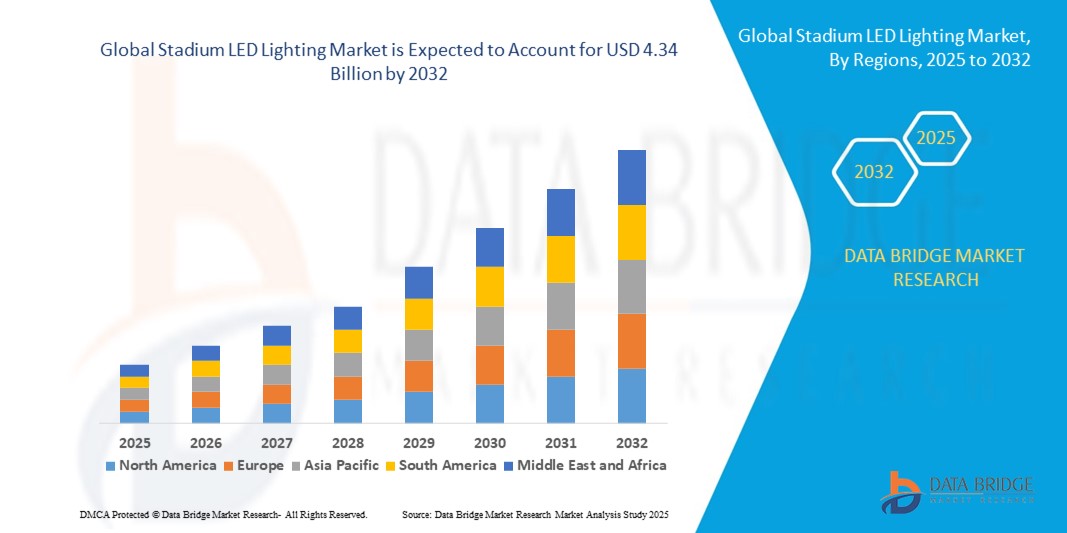
- The global stadium LED lighting market size was valued at USD 1.81 billion in 2024 and is expected to reach USD 4.34 billion by 2032, at a CAGR of 11.50% during the forecast period
- The market growth is largely fuelled by the rising demand for energy-efficient lighting solutions in sports arenas, stadiums, and large outdoor venues, as well as increasing adoption of smart and controllable LED lighting systems
- Additional factors driving growth include stringent regulations on energy consumption, the need for high-quality illumination for broadcasts, and growing investments in infrastructure for sports and entertainment events
Stadium LED Lighting Market Analysis
- The market is witnessing strong adoption in football, cricket, and multi-purpose stadiums, where high-intensity, uniform, and energy-efficient lighting is critical for both live audiences and broadcast quality
- Furthermore, the growing trend of hosting night-time events and international tournaments is driving demand for advanced LED lighting solutions that ensure optimal visibility and enhance spectator experiences
- North America dominated the stadium LED lighting market with the largest revenue share of 38.5% in 2024, driven by increasing investments in professional sports infrastructure, advanced stadium designs, and the adoption of energy-efficient lighting solutions
- Asia-Pacific region is expected to witness the highest growth rate in the global stadium LED lighting market, driven by large-scale stadium construction projects, government initiatives promoting energy efficiency, and the rising number of concerts, festivals, and outdoor events requiring high-quality LED illumination
- The floodlights segment held the largest market revenue share in 2024, driven by their ability to provide high-intensity, uniform illumination for large outdoor stadiums and multi-purpose sports arenas. Floodlights are preferred for their energy efficiency, durability, and adaptability to different lighting angles, making them the most widely adopted solution in major sports venues
Report Scope and Stadium LED Lighting Market Segmentation
|
Attributes |
Stadium LED Lighting Key Market Insights |
|
Segments Covered |
|
|
Countries Covered |
North America
Europe
Asia-Pacific
Middle East and Africa
South America
|
|
Key Market Players |
|
|
Market Opportunities |
|
|
Value Added Data Infosets |
In addition to the insights on market scenarios such as market value, growth rate, segmentation, geographical coverage, and major players, the market reports curated by the Data Bridge Market Research also include in-depth expert analysis, geographically represented company-wise production and capacity, network layouts of distributors and partners, detailed and updated price trend analysis and deficit analysis of supply chain and demand. |
Stadium LED Lighting Market Trends
Rise of Energy-Efficient and Smart LED Solutions in Stadiums
- The growing adoption of energy-efficient LED lighting is transforming stadium infrastructure by enabling high-intensity illumination with lower energy consumption. These systems allow stadium operators to reduce electricity costs while maintaining consistent lighting quality for both live audiences and broadcast requirements. This results in improved visibility, enhanced spectator experience, and reduced operational expenses
- The high demand for smart and controllable LED systems in large stadiums is accelerating the integration of IoT-enabled lighting and automated controls. These solutions are particularly effective in venues hosting multi-purpose events, helping optimize lighting based on event type, occupancy, and broadcast needs. The trend is further supported by stadium owners and governments focusing on sustainability and green building certifications
- The affordability, longer lifespan, and reduced maintenance requirements of modern LED systems are making them attractive for retrofitting existing stadiums, leading to improved operational efficiency. Operators benefit from more reliable and cost-effective lighting without frequent replacement or technical downtime, which ultimately enhances event quality and safety
- For instance, in 2023, several major sports arenas in Europe reported a 35% reduction in energy consumption after installing smart LED systems. These installations allowed adaptive lighting control, improving broadcast quality and spectator comfort while lowering energy and maintenance costs
- While LED stadium lighting is accelerating energy efficiency and supporting advanced event management, its impact depends on continued innovation, interoperability with smart controls, and affordability. Manufacturers must focus on scalable product development and deployment strategies to fully capitalize on this growing demand
Stadium LED Lighting Market Dynamics
Driver
Growing Investments in Sports Infrastructure and Energy-Efficient Solutions
- The rise in global sports infrastructure projects is pushing stadium owners and operators to adopt LED lighting as a core component of modern venues. Stadiums hosting international tournaments increasingly require high-quality illumination for live audiences, broadcasts, and security, driving market growth. In addition, major investments in multi-purpose arenas and the growing number of professional sports leagues worldwide are accelerating demand for standardized, high-performance lighting solutions
- Event organizers and stadium operators are increasingly aware of the operational and environmental benefits of LED lighting, including lower energy costs, reduced carbon footprint, and improved visibility. This awareness has led to wider adoption across both new stadium constructions and renovation projects. The ability to control light intensity, color temperature, and zoning in real time also enhances audience experience and supports dynamic event requirements
- Government initiatives, sports federations, and private investments are strengthening infrastructure development and sustainability standards. From subsidized stadium upgrades to mandatory energy-efficient lighting regulations, supportive frameworks are helping operators implement LED systems effectively. Public-private partnerships, green building certifications, and tax incentives further encourage stadium operators to invest in modern, energy-saving lighting solutions
- For instance, in 2022, several stadiums in the Middle East upgraded to smart LED lighting for major international events, boosting demand for adaptive, high-lumen LED systems across the region. These upgrades allowed real-time lighting adjustments, improved broadcast quality, and reduced operational costs, setting benchmarks for future stadium projects in the region
- While infrastructure investment and sustainability mandates are driving the market, there is still a need to improve accessibility, reduce installation costs, and integrate advanced controls for efficient long-term usage to ensure sustained adoption. Stakeholders are now focusing on modular, scalable LED solutions and training programs to optimize operation, maintenance, and energy efficiency across diverse stadium sizes and types
Restraint/Challenge
High Installation Costs and Technical Complexity of LED Stadium Systems
- The high initial cost of advanced LED stadium lighting systems, including smart and IoT-enabled solutions, limits adoption among smaller or budget-constrained stadiums. Large, commercial arenas typically absorb these costs, but smaller venues may delay upgrades due to financial constraints. In addition, ongoing maintenance and software updates add to the total cost of ownership
- In many regions, stadium operators lack trained personnel to manage complex LED systems and smart controls, which can reduce efficiency and delay adoption. Infrastructure gaps, such as inadequate power supply or outdated electrical systems, further hinder deployment. This often results in underutilization of advanced features and increases the risk of system downtime during events
- Market penetration is also affected by integration challenges with existing broadcast, security, and automation systems. Coordinating LED systems with other stadium technologies requires expertise and additional investment. These factors can discourage adoption, particularly in retrofitting older stadiums with legacy infrastructure
- For instance, in 2023, several medium-sized stadiums in Sub-Saharan Africa reported delayed LED lighting installations, citing high upfront costs and technical complexity as the primary barriers. Many continued using conventional lighting systems, which increased energy consumption and maintenance requirements
- While LED technology continues to advance, addressing cost, training, and integration challenges remains critical. Manufacturers and stakeholders must focus on modular, user-friendly, and scalable solutions to bridge the adoption gap and unlock long-term market potential
Stadium LED Lighting Market Scope
The market is segmented on the basis of product type, application, installation type, and end user.
- By Product Type
On the basis of product type, the stadium LED lighting market is segmented into floodlights, high-bay lights, spotlights, and others. The floodlights segment held the largest market revenue share in 2024, driven by their ability to provide high-intensity, uniform illumination for large outdoor stadiums and multi-purpose sports arenas. Floodlights are preferred for their energy efficiency, durability, and adaptability to different lighting angles, making them the most widely adopted solution in major sports venues.
The high-bay lights segment is expected to witness the fastest growth rate from 2025 to 2032, fueled by increasing demand for indoor arenas, multi-level stadiums, and covered event spaces. High-bay LED systems are valued for their focused lighting, long lifespan, and reduced maintenance needs, allowing event organizers and stadium operators to enhance visibility while minimizing energy costs.
- By Application
On the basis of application, the market is segmented into sports stadiums, concert venues and outdoor events, and others. The sports stadiums segment held the largest revenue share in 2024, driven by rising investments in professional sports infrastructure, international tournaments, and the need for high-quality lighting for both live spectators and broadcast purposes.
The concert venues and outdoor events segment is expected to witness the fastest growth rate from 2025 to 2032 due to the increasing number of live music events, festivals, and entertainment shows worldwide. LED lighting provides energy-efficient, controllable illumination for large-scale events, enhancing both audience experience and operational efficiency.
- By Installation Type
On the basis of installation type, the market is segmented into new installations and retrofit installations. The new installations segment held the largest market share in 2024, driven by the construction of modern stadiums, arenas, and multi-purpose venues incorporating LED lighting as a standard solution for energy efficiency and high-quality illumination.
The retrofit installations segment is expected to witness the fastest growth rate from 2025 to 2032, fueled by stadium operators upgrading older conventional lighting systems to energy-efficient, smart LED solutions. Retrofit projects are particularly popular for reducing operational costs and improving broadcast quality in existing venues.
- By End User
On the basis of end user, the market is segmented into professional sports teams, event organizers, municipalities, and private venue owners. The professional sports teams segment held the largest revenue share in 2024, driven by high-profile leagues and international tournaments requiring advanced lighting for match quality, broadcast standards, and fan experience.
The event organizers segment is expected to witness the fastest growth rate from 2025 to 2032 due to the increasing number of concerts, festivals, and outdoor events. LED lighting solutions provide flexibility, scalability, and cost efficiency, allowing organizers to deliver high-impact visual experiences while reducing energy consumption.
Stadium LED Lighting Market Regional Analysis
- North America dominated the stadium LED lighting market with the largest revenue share of 38.5% in 2024, driven by increasing investments in professional sports infrastructure, advanced stadium designs, and the adoption of energy-efficient lighting solutions
- Stadium operators in the region value high-intensity, uniform, and broadcast-quality illumination, along with the ability to integrate LED systems with smart controls for real-time event management
- This widespread adoption is further supported by high operational budgets, advanced technical expertise, and government incentives promoting energy efficiency, establishing LED lighting as a standard solution for both sports and multi-purpose venues
U.S. Stadium LED Lighting Market Insight
The U.S. stadium LED lighting market captured the largest revenue share in 2024 within North America, fueled by the rapid construction of new arenas and the modernization of existing stadiums. Stadium operators are increasingly prioritizing LED solutions to reduce energy costs, enhance broadcast quality, and provide dynamic lighting for various events. The growing demand for smart and adaptive lighting controls, coupled with a high number of professional sports leagues and international tournaments, further propels the market.
Europe Stadium LED Lighting Market Insight
The Europe stadium LED lighting market is expected to witness the fastest growth rate from 2025 to 2032, primarily driven by regulations promoting energy-efficient solutions and the renovation of historic stadiums. Increasing urbanization and investments in multi-purpose sports and entertainment arenas are fostering LED adoption. European operators are also drawn to the long lifespan, low maintenance, and adaptability of LED lighting systems, which are being integrated into both new constructions and retrofitting projects.
U.K. Stadium LED Lighting Market Insight
The U.K. stadium LED lighting market is expected to witness the fastest growth rate from 2025 to 2032, driven by the modernization of football stadiums and rising concerns for energy efficiency and sustainability. The adoption of LED systems is further encouraged by government initiatives supporting green infrastructure and the increasing number of televised sporting events requiring high-quality illumination.
Germany Stadium LED Lighting Market Insight
The Germany stadium LED lighting market is expected to witness the fastest growth rate from 2025 to 2032, fueled by technological advancements in smart lighting and the demand for energy-efficient stadium solutions. Germany’s strong engineering expertise, emphasis on sustainability, and investment in sports infrastructure promote the adoption of LED systems, particularly in large-scale arenas and multi-purpose venues.
Asia-Pacific Stadium LED Lighting Market Insight
The Asia-Pacific stadium LED lighting market is expected to witness the fastest growth rate from 2025 to 2032 , driven by large-scale stadium construction in countries such as China, India, and Japan, along with rising investments in international sports events. Government initiatives promoting energy efficiency, digitalization, and “smart city” projects are further driving adoption. APAC is also emerging as a manufacturing hub for LED components, improving affordability and accessibility for stadium operators across the region.
Japan Stadium LED Lighting Market Insight
The Japan stadium LED lighting market is expected to witness the fastest growth rate from 2025 to 2032 due to rapid urbanization, increasing international sports events, and a strong focus on high-quality, energy-efficient lighting. The integration of LED systems with smart controls and IoT devices is driving adoption in both new stadiums and renovated arenas. Moreover, Japan’s aging population and demand for safer, well-lit venues for public events are expected to boost market growth in residential, commercial, and professional sectors.
China Stadium LED Lighting Market Insight
The China stadium LED lighting market accounted for the largest revenue share in Asia-Pacific in 2024, attributed to rapid urbanization, a growing middle class, and substantial investments in professional sports infrastructure. China is home to some of the largest stadiums in the world, and the push toward smart, energy-efficient lighting for broadcast-quality events is fueling demand. The presence of strong domestic LED manufacturers and government-backed stadium modernization programs further supports market growth.
Stadium LED Lighting Market Share
The Stadium LED Lighting industry is primarily led by well-established companies, including:
- Panasonic Corporation (Japan)
- Cree, Inc. (U.S.)
- General Electric (GE) (U.S.)
- Eaton Corporation (U.S.)
- Schneider Electric (France)
- Acuity Brands (U.S.)
- Flicker Free (Canada)
- Lumenpulse (Canada)
- Toshiba Lighting (Japan)
- Samsung Electronics (South Korea)
- LiteHarbor (U.S.)
- LG Electronics (South Korea)
- Valoya (Finland)

- Interactive Data Analysis Dashboard
- Company Analysis Dashboard for high growth potential opportunities
- Research Analyst Access for customization & queries
- Competitor Analysis with Interactive dashboard
- Latest News, Updates & Trend analysis
- Harness the Power of Benchmark Analysis for Comprehensive Competitor Tracking
Global Stadium Led Lighting Market, Supply Chain Analysis and Ecosystem Framework
To support market growth and help clients navigate the impact of geopolitical shifts, DBMR has integrated in-depth supply chain analysis into its Global Stadium Led Lighting Market research reports. This addition empowers clients to respond effectively to global changes affecting their industries. The supply chain analysis section includes detailed insights such as Global Stadium Led Lighting Market consumption and production by country, price trend analysis, the impact of tariffs and geopolitical developments, and import and export trends by country and HSN code. It also highlights major suppliers with data on production capacity and company profiles, as well as key importers and exporters. In addition to research, DBMR offers specialized supply chain consulting services backed by over a decade of experience, providing solutions like supplier discovery, supplier risk assessment, price trend analysis, impact evaluation of inflation and trade route changes, and comprehensive market trend analysis.
Data collection and base year analysis are done using data collection modules with large sample sizes. The stage includes obtaining market information or related data through various sources and strategies. It includes examining and planning all the data acquired from the past in advance. It likewise envelops the examination of information inconsistencies seen across different information sources. The market data is analysed and estimated using market statistical and coherent models. Also, market share analysis and key trend analysis are the major success factors in the market report. To know more, please request an analyst call or drop down your inquiry.
The key research methodology used by DBMR research team is data triangulation which involves data mining, analysis of the impact of data variables on the market and primary (industry expert) validation. Data models include Vendor Positioning Grid, Market Time Line Analysis, Market Overview and Guide, Company Positioning Grid, Patent Analysis, Pricing Analysis, Company Market Share Analysis, Standards of Measurement, Global versus Regional and Vendor Share Analysis. To know more about the research methodology, drop in an inquiry to speak to our industry experts.
Data Bridge Market Research is a leader in advanced formative research. We take pride in servicing our existing and new customers with data and analysis that match and suits their goal. The report can be customized to include price trend analysis of target brands understanding the market for additional countries (ask for the list of countries), clinical trial results data, literature review, refurbished market and product base analysis. Market analysis of target competitors can be analyzed from technology-based analysis to market portfolio strategies. We can add as many competitors that you require data about in the format and data style you are looking for. Our team of analysts can also provide you data in crude raw excel files pivot tables (Fact book) or can assist you in creating presentations from the data sets available in the report.













