


Standalone Personal Emergency Response Systems Market Size
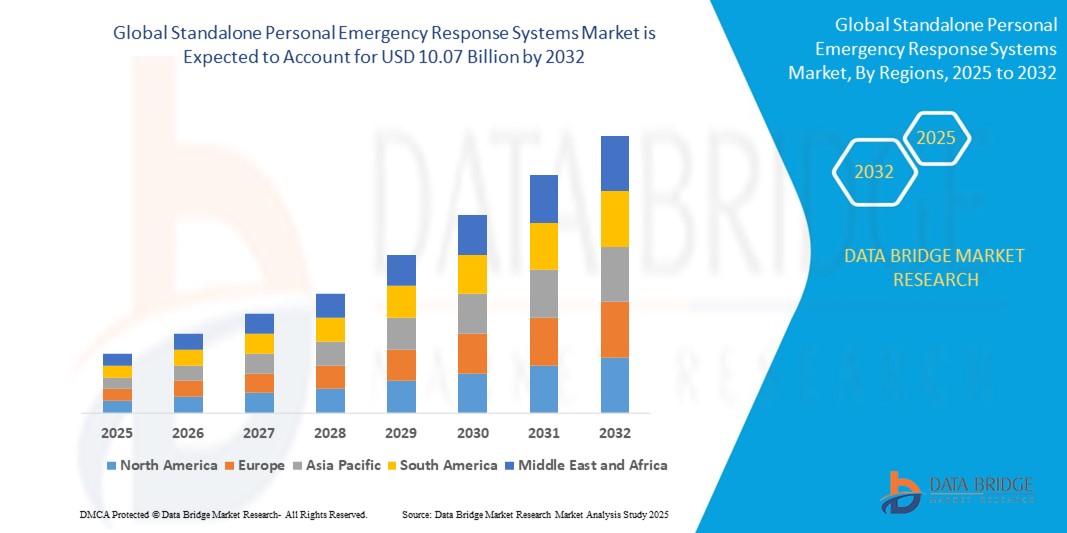
- The global standalone personal emergency response systems market size was valued at USD 6.22 billion in 2024 and is expected to reach USD 10.07 billion by 2032, at a CAGR of 6.2% during the forecast period
- The market growth is primarily driven by the increasing aging population, growing awareness of personal safety, and advancements in sensor-based technologies, leading to greater adoption in home-based and institutional settings
- Rising consumer demand for reliable, user-friendly, and integrated emergency response solutions is positioning standalone personal emergency response systems as a critical component of modern healthcare and safety ecosystems
Standalone Personal Emergency Response Systems Market Analysis
- Standalone personal emergency response systems, designed to provide immediate assistance during emergencies through devices such as smoke detectors, bed sensors, and fall detection sensors, are vital for ensuring safety in both residential and institutional environments due to their ease of use, rapid response capabilities, and integration with healthcare systems
- The surge in demand is fueled by growing concerns about elderly safety, increasing prevalence of chronic conditions, and a preference for independent living among seniors, supported by technological advancements in sensor accuracy and connectivity
- North America dominated the market with the largest revenue share of 42.5% in 2024, driven by early adoption of healthcare technologies, high healthcare spending, and a strong presence of key industry players
- Asia-Pacific is expected to be the fastest-growing region during the forecast period, propelled by rapid urbanization, increasing elderly populations, and rising disposable incomes in countries such as China, Japan, and India
- The fall detection sensors segment dominated the largest market revenue share of 38.5% in 2024, driven by their critical role in detecting sudden movements indicative of falls, a common cause of injury among older adults
Report Scope and Standalone Personal Emergency Response Systems Market Segmentation
|
Attributes |
Standalone Personal Emergency Response Systems Key Market Insights |
|
Segments Covered |
|
|
Countries Covered |
North America
Europe
Asia-Pacific
Middle East and Africa
South America
|
|
Key Market Players |
|
|
Market Opportunities |
|
|
Value Added Data Infosets |
In addition to the insights on market scenarios such as market value, growth rate, segmentation, geographical coverage, and major players, the market reports curated by the Data Bridge Market Research also include in-depth expert analysis, geographically represented company-wise production and capacity, network layouts of distributors and partners, detailed and updated price trend analysis and deficit analysis of supply chain and demand. |
Standalone Personal Emergency Response Systems Market Trends
“Increasing Integration of AI and IoT Technologies”
- The standalone personal emergency response systems (PERS) market is experiencing a significant trend toward integrating Artificial Intelligence (AI) and Internet of Things (IoT) technologies
- These technologies enable advanced data processing and real-time monitoring, providing deeper insights into user health, activity patterns, and emergency needs
- AI-powered PERS solutions allow for proactive emergency detection, such as identifying falls or irregular behaviors before they escalate into critical situations
- For instance, companies are developing AI-driven platforms that analyze user movement patterns to detect anomalies or integrate with smart home devices for seamless emergency alerts
- This trend enhances the functionality of standalone PERS, making them more appealing to home-based users, senior living facilities, and assisted living facilities
- AI algorithms can analyze various user behaviors, such as mobility patterns, sleep disturbances, or irregular heart rates, to provide personalized safety solutions and improve response times
Standalone Personal Emergency Response Systems Market Dynamics
Driver
“Rising Demand for Independent Living and Enhanced Safety Features”
- The increasing demand for solutions that support aging-in-place and independent living, particularly among the elderly, is a major driver for the standalone PERS market
- Standalone PERS enhance user safety by providing features such as automatic fall detection, 24/7 emergency response, and integration with smart home systems for environmental monitoring
- Government initiatives, particularly in North America, which dominates the market, are promoting the adoption of PERS through healthcare policies and subsidies for elderly care
- The proliferation of IoT and advancements in 5G technology are enabling faster data transmission and lower latency, supporting more sophisticated PERS applications, such as real-time location tracking and voice-activated alerts
- Manufacturers are increasingly offering standalone PERS with advanced features, such as GPS-enabled wearables and two-way communication, to meet user expectations and enhance safety
Restraint/Challenge
“High Costs and Data Privacy Concerns”
- The substantial initial investment required for hardware, software, and integration of standalone PERS can be a significant barrier to adoption, particularly in cost-sensitive markets such as parts of Asia-Pacific, despite it being the fastest-growing region
- Integrating PERS devices into existing environments, such as homes or assisted living facilities, can be complex and costly
- Data security and privacy concerns are major challenges, as standalone PERS collect and transmit sensitive user data, including health and location information, raising risks of breaches or misuse
- The fragmented regulatory landscape across countries regarding data protection and privacy compliance complicates operations for global manufacturers and service providers
- These factors may deter potential users and limit market expansion, especially in regions with high awareness of data privacy or where cost sensitivity is a significant factor
Standalone Personal Emergency Response Systems market Scope
The market is segmented on the basis of component, services, and end user.
- By Component
On the basis of component, the Global Standalone Personal Emergency Response Systems Market is segmented into smoke detectors, bed sensors, fall detection sensors, and others. The fall detection sensors segment dominated the largest market revenue share of 38.5% in 2024, driven by their critical role in detecting sudden movements indicative of falls, a common cause of injury among older adults. These sensors automatically trigger emergency responses, enhancing user safety and independence, particularly for home-based users.
The bed sensors segment is expected to witness the fastest growth rate of 7.8% from 2025 to 2032, driven by increasing demand for non-intrusive monitoring solutions that track movement and inactivity, enabling timely alerts for caregivers in assisted living facilities and home settings. Advancements in sensor accuracy and integration with IoT further accelerate adoption.
- By Services
On the basis of services, the Global Standalone Personal Emergency Response Systems Market is segmented into monthly, yearly, and others. The monthly services segment held the largest market revenue share of 52.3% in 2024, driven by their flexibility and affordability, appealing to a wide range of users, including home-based seniors and assisted living facilities. Monthly subscriptions allow users to access 24/7 monitoring and emergency response without long-term commitments.
The yearly services segment is anticipated to experience the fastest growth rate of 8.2% from 2025 to 2032, as cost-conscious consumers and facilities opt for annual plans that offer discounts and ensure continuous service. The growing adoption of PERS in senior living facilities, coupled with rising awareness of long-term care benefits, supports this segment’s growth.
- By End User
On the basis of end user, the Global Standalone Personal Emergency Response Systems Market is segmented into home-based users, senior living facilities, and assisted living facilities. The home-based users segment dominated the market with a revenue share of 49.7% in 2024, driven by the increasing preference for aging in place among seniors who seek to maintain independence while ensuring access to emergency assistance. The integration of PERS with smart home technologies further enhances adoption among this group.
The assisted living facilities segment is expected to witness the fastest growth rate of 8.9% from 2025 to 2032, fueled by the rising number of seniors in these facilities and the integration of PERS as a standard safety feature. These systems provide real-time monitoring and rapid response capabilities, ensuring resident safety and offering peace of mind to families and caregivers.
Standalone Personal Emergency Response Systems Market Regional Analysis
- North America dominated the market with the largest revenue share of 42.5% in 2024, driven by early adoption of healthcare technologies, high healthcare spending, and a strong presence of key industry players
- Consumers prioritize PERS for enhancing safety, enabling rapid emergency response, and providing peace of mind, particularly for seniors and individuals with chronic conditions in regions with high healthcare awareness
- Growth is supported by advancements in system technology, including AI-powered fall detection, GPS tracking, and 4G LTE connectivity, alongside rising adoption in both home-based and institutional settings
U.S. Standalone Personal Emergency Response Systems Market Insight
The U.S. standalone personal emergency response systems market captured the largest revenue share of 76.7% in 2024 within North America, fueled by strong demand from home-based users and increasing awareness of safety and health monitoring benefits. The trend toward aging-in-place solutions and supportive government initiatives for elderly care further boost market expansion. Integration of advanced features such as automatic fall detection and voice-activated systems complements both home and institutional applications, creating a robust market ecosystem.
Europe Standalone Personal Emergency Response Systems Market Insight
The Europe standalone PERS market is expected to witness significant growth, supported by regulatory emphasis on elderly care and safety. Consumers seek systems that enhance independence while ensuring rapid emergency response. Growth is prominent in both home-based installations and senior living facilities, with countries such as Germany and France showing significant uptake due to increasing geriatric populations and healthcare technology advancements.
U.K. Standalone Personal Emergency Response Systems Market Insight
The U.K. market for standalone PERS is expected to witness rapid growth, driven by demand for enhanced safety and independence in urban and suburban settings. Increased awareness of fall detection and health monitoring benefits encourages adoption. Evolving healthcare regulations influence consumer choices, balancing advanced system features with compliance, further supporting market growth.
Germany Standalone Personal Emergency Response Systems Market Insight
Germany is expected to witness rapid growth in the standalone PERS market, attributed to its advanced healthcare sector and high consumer focus on safety and independent living. German consumers prefer technologically advanced systems with features such as AI-driven fall detection and GPS tracking to enhance safety and reduce healthcare costs. Integration in senior living facilities and home-based settings supports sustained market growth.
Asia-Pacific Standalone Personal Emergency Response Systems Market Insight
The Asia-Pacific region is expected to witness the fastest growth rate, driven by expanding healthcare infrastructure and rising elderly populations in countries such as China, India, and Japan. Increasing awareness of safety, health monitoring, and independent living solutions boosts demand. Government initiatives promoting elderly care and technological advancements further encourage the adoption of advanced standalone PERS.
Japan Standalone Personal Emergency Response Systems Market Insight
Japan’s standalone PERS market is expected to witness rapid growth due to strong consumer preference for high-quality, technologically advanced systems that enhance safety and independence. The presence of major healthcare technology providers and integration of PERS in home-based and senior living settings accelerate market penetration. Rising interest in health monitoring and emergency response solutions also contributes to growth.
China Standalone Personal Emergency Response Systems Market Insight
China holds the largest share of the Asia-Pacific standalone PERS market, propelled by rapid urbanization, rising elderly population, and increasing demand for safety and health monitoring solutions. The country’s growing middle class and focus on healthcare technology support the adoption of advanced PERS. Strong domestic manufacturing capabilities and competitive pricing enhance market accessibility.
Standalone Personal Emergency Response Systems Market Share
The standalone personal emergency response systems industry is primarily led by well-established companies, including:
- Koninklijke Philips N.V. (Netherlands)
- Tunstall Canada (Canada)
- GUARDIAN ALARM (U.S.)
- Connect America (U.S.)
- ADT (U.S.)
- Medical Guardian, LLP (U.S.)
- MobileHelp (U.S.)
- Nortek Security & Control LLC (U.S.)
- Galaxy Medical Alert Systems (U.S.)
- Critical Signal Technologies (U.S.)
- Freeus (U.S.)
- ALERTONE SERVICES LLC (U.S.)
- LifeFone Medical Alert Services (U.S.)
- Bay Alarm Medical & GetSafe (U.S.)
- Cisco Systems (U.S.)
- jupl (U.S.)
- HomeCentris Healthcare, LLC (U.S.)
- GreatCall (U.S.)
- Essence (Israel)
What are the Recent Developments in Global Standalone Personal Emergency Response Systems Market?
- In May 2025, Medical Guardian announced the acquisition of MobileHelp from Advocate Aurora Enterprises, significantly expanding its footprint in the personal emergency response system (PERS) market. This strategic move enhances Medical Guardian’s ability to deliver comprehensive healthcare solutions for older adults, integrating MobileHelp’s technology and customer base into its existing platform. The acquisition brings Medical Guardian’s total reach to over 600,000 members, strengthening its offerings in safety, engagement, and wellness services. This development reflects the growing demand for connected health solutions that support aging in place and proactive care
- In February 2025, LogicMark, Inc. launched the next generation of its best-selling Guardian Alert 911 Plus medical alert device. This upgraded version features 4G LTE connectivity, built-in fall detection, and a sleeker, more discreet design, offering direct-to-911 communication without the need for a monthly subscription. The device provides 24/7 emergency access, even if the user is unable to press the button, making it ideal for older adults and individuals with medical conditions. With up to six days of battery life, water resistance, and over-the-air updates, the new Guardian Alert 911 Plus enhances safety, independence, and peace of mind
- In January 2025, Nomo Smart Care launched its AI-powered in-home care technology, offering a privacy-first alternative to traditional monitoring systems. Instead of cameras, Nomo uses a network of smart sensors—including a hub, satellites, and tags—to track daily routines, detect falls, and identify unusual activity patterns. The system sends real-time alerts directly to caregivers via the Nomo app, enabling proactive responses to potential health concerns. This innovation supports independent living while preserving dignity and safety, making it especially valuable for older adults and individuals with chronic conditions
- In November 2024, LogicMark, Inc. launched the Freedom Alert Max, a groundbreaking medical alert device that redefines personal safety for older adults and vulnerable individuals. Equipped with 4G LTE connectivity, the device features 24/7 U.S.-based monitoring, proprietary fall detection, and is the first of its kind to offer emergency video for caregivers via the Care Village app. Additional innovations include GPS tracking, geofencing, over-the-air updates, and a pre-programmed 988 Suicide & Crisis Lifeline. Designed for ease of use and independence, Freedom Alert Max empowers users with real-time protection and caregivers with instant visibility and alerts
- In November 2024, Vesta Healthcare and Medical Guardian announced a strategic partnership aimed at transforming chronic care management and remote patient monitoring (RPM) for Medicaid and Medicare members. This collaboration integrates Medical Guardian’s cellular-connected vitals monitoring devices and personal emergency response systems (PERS) with Vesta Healthcare’s 24/7 clinical oversight. The system enables real-time tracking of vital signs such as blood pressure, oxygen levels, weight, and includes fall detection and emergency response capabilities

- Interactive Data Analysis Dashboard
- Company Analysis Dashboard for high growth potential opportunities
- Research Analyst Access for customization & queries
- Competitor Analysis with Interactive dashboard
- Latest News, Updates & Trend analysis
- Harness the Power of Benchmark Analysis for Comprehensive Competitor Tracking
Global Standalone Personal Emergency Response Systems Market, Supply Chain Analysis and Ecosystem Framework
To support market growth and help clients navigate the impact of geopolitical shifts, DBMR has integrated in-depth supply chain analysis into its Global Standalone Personal Emergency Response Systems Market research reports. This addition empowers clients to respond effectively to global changes affecting their industries. The supply chain analysis section includes detailed insights such as Global Standalone Personal Emergency Response Systems Market consumption and production by country, price trend analysis, the impact of tariffs and geopolitical developments, and import and export trends by country and HSN code. It also highlights major suppliers with data on production capacity and company profiles, as well as key importers and exporters. In addition to research, DBMR offers specialized supply chain consulting services backed by over a decade of experience, providing solutions like supplier discovery, supplier risk assessment, price trend analysis, impact evaluation of inflation and trade route changes, and comprehensive market trend analysis.
Data collection and base year analysis are done using data collection modules with large sample sizes. The stage includes obtaining market information or related data through various sources and strategies. It includes examining and planning all the data acquired from the past in advance. It likewise envelops the examination of information inconsistencies seen across different information sources. The market data is analysed and estimated using market statistical and coherent models. Also, market share analysis and key trend analysis are the major success factors in the market report. To know more, please request an analyst call or drop down your inquiry.
The key research methodology used by DBMR research team is data triangulation which involves data mining, analysis of the impact of data variables on the market and primary (industry expert) validation. Data models include Vendor Positioning Grid, Market Time Line Analysis, Market Overview and Guide, Company Positioning Grid, Patent Analysis, Pricing Analysis, Company Market Share Analysis, Standards of Measurement, Global versus Regional and Vendor Share Analysis. To know more about the research methodology, drop in an inquiry to speak to our industry experts.
Data Bridge Market Research is a leader in advanced formative research. We take pride in servicing our existing and new customers with data and analysis that match and suits their goal. The report can be customized to include price trend analysis of target brands understanding the market for additional countries (ask for the list of countries), clinical trial results data, literature review, refurbished market and product base analysis. Market analysis of target competitors can be analyzed from technology-based analysis to market portfolio strategies. We can add as many competitors that you require data about in the format and data style you are looking for. Our team of analysts can also provide you data in crude raw excel files pivot tables (Fact book) or can assist you in creating presentations from the data sets available in the report.













