


What is the Global Standard Duty Commercial Beverage Blender Market Size and Growth Rate?
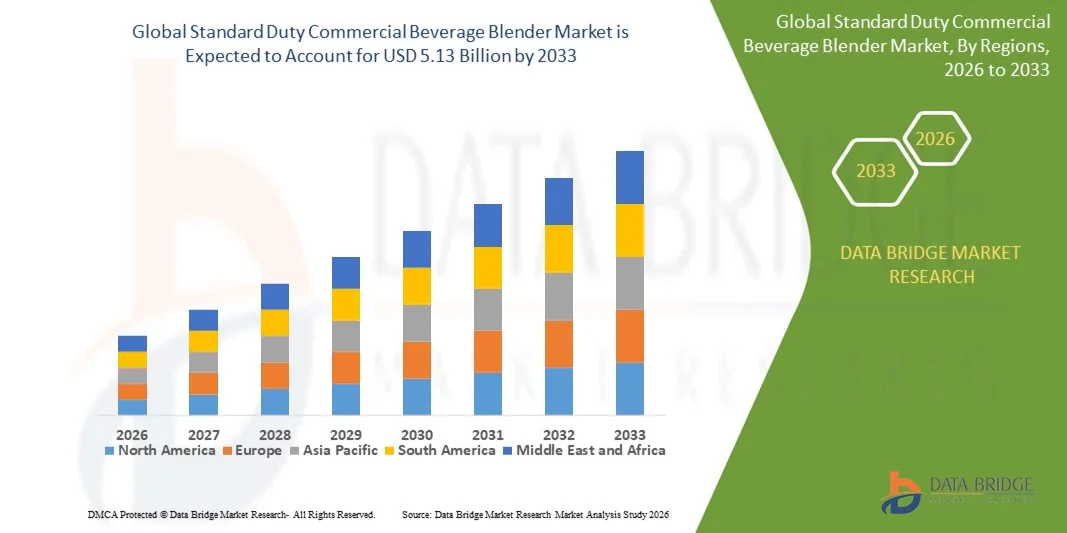
- As per Data Bridge Market Research Analysis the global standard duty commercial beverage blender market size was valued at USD 3.34 billion in 2025 and is expected to reach USD 5.13 billion by 2033, at a CAGR of5.50% during the forecast period
- Rise in the number of food service outlets that are offering blended beverages to the upcoming generation and health-conscious individuals is the major driver escalating the market growth, also rise in the disposable income, rise in the research and development activities in the market and increase in the demand from emerging economies are the major factors driving the standard duty commercial beverage blender market growth.
Market Size & Forecast
- Global Market Value (2025): USD 3.34 billion
- Expected Market Value (2033): USD 5.13 billion
- Forecast CAGR (2026–2033):5.50%
- Leading Region in 2025: North America
- Fastest Growing Region: Asia-Pacific
What are the Major Takeaways of Standard Duty Commercial Beverage Blender Market?
- Rise in the research and development activities and increase in the technological advancements and modernization in the market will further create new opportunities for the standard duty commercial beverage blender market manufacturers
- However, rise in the cost of research and development activities acts as the major factor acting as a restraint, and will further challenge the growth of standard duty commercial beverage blender market
- North America dominated the standard duty commercial beverage blender market with a 41.8% revenue share in 2025, driven by strong growth in café culture, quick-service restaurants, juice bars, and expanding foodservice infrastructure across the U.S. and Canada
- Asia-Pacific is projected to register the fastest CAGR of 10.4% from 2026 to 2033, driven by rapid urbanization, expanding foodservice chains, and rising disposable incomes across China, India, Japan, South Korea, and Southeast Asia
- The Plastic segment dominated the market with a 48.7% share in 2025, owing to its lightweight nature, cost-effectiveness, impact resistance, and ease of handling in commercial foodservice environments
Report Scope and Standard Duty Commercial Beverage Blender Market Segmentation
|
Attributes |
Standard Duty Commercial Beverage Blender Key Market Insights |
|
Segments Covered |
|
|
Countries Covered |
North America
Europe
Asia-Pacific
Middle East and Africa
South America
|
|
Key Market Players |
|
|
Market Opportunities |
|
|
Value Added Data Infosets |
In addition to the insights on market scenarios such as market value, growth rate, segmentation, geographical coverage, and major players, the market reports curated by the Data Bridge Market Research also include in-depth expert analysis, pricing analysis, brand share analysis, consumer survey, demography analysis, supply chain analysis, value chain analysis, raw material/consumables overview, vendor selection criteria, PESTLE Analysis, Porter Analysis, and regulatory framework. |
What is the Key Trend in the Standard Duty Commercial Beverage Blender Market?
Increasing Shift Toward High-Speed, Compact, and Energy-Efficient Standard Duty Commercial Beverage Blenders
- The standard duty commercial beverage blender market is witnessing growing adoption of compact, high-speed, and energy-efficient blenders designed for cafés, juice bars, quick-service restaurants, and small foodservice outlets
- Manufacturers are introducing powerful motors, durable blades, noise-reduction enclosures, and digital control interfaces to improve blending efficiency, consistency, and user convenience
- Rising demand for space-saving, lightweight, and cost-effective blending equipment is driving adoption across coffee shops, smoothie bars, bakeries, and institutional foodservice environments
- For instance, companies such as Blendtec, Hamilton Beach, Waring, Ceado, and Sammic have upgraded their standard-duty blender portfolios with improved motor performance, programmable speed controls, and enhanced jar durability
- Increasing need for fast beverage preparation, consistent texture, and reduced downtime is accelerating the shift toward reliable, easy-to-maintain standard duty blenders
- As beverage menus expand and service speed becomes critical, Standard Duty Commercial Beverage Blenders will remain essential for efficient daily operations in foodservice establishments
What are the Key Drivers of Standard Duty Commercial Beverage Blender Market?
- Rising demand for smoothies, shakes, iced coffees, and blended beverages across cafés, restaurants, and foodservice chains is a key growth driver
- For instance, in 2025, leading manufacturers such as Blendtec, Hamilton Beach, and Waring introduced upgraded standard-duty models featuring improved motor cooling, longer service life, and enhanced blending performance
- Rapid expansion of quick-service restaurants, café chains, juice bars, and cloud kitchens across the U.S., Europe, and Asia-Pacific is boosting blender adoption
- Advancements in motor efficiency, blade design, jar materials, and vibration control have improved durability and reduced operational noise
- Growing preference for affordable, easy-to-operate, and low-maintenance equipment among small and mid-sized foodservice operators supports market expansion
- Supported by steady investments in foodservice infrastructure and evolving beverage consumption trends, the Standard Duty Commercial Beverage Blender market is expected to witness stable long-term growth
Which Factor is Challenging the Growth of the Standard Duty Commercial Beverage Blender Market?
- Higher upfront costs of branded commercial blenders restrict adoption among small cafés and independent foodservice operators
- For instance, during 2024–2025, fluctuations in raw material prices, motor components, and logistics costs increased manufacturing expenses for several global vendors
- Limited durability of standard-duty models compared to heavy-duty alternatives can affect adoption in high-volume environments
- Lack of awareness among small operators regarding performance differences, warranty coverage, and total cost of ownership slows purchasing decisions
- Competition from low-cost unbranded blenders, refurbished equipment, and heavy-duty models creates pricing pressure and impacts product differentiation
- To address these challenges, manufacturers are focusing on cost-optimized designs, extended warranties, improved after-sales support, and energy-efficient technologies to expand global adoption of standard duty commercial beverage blenders
How is the Standard Duty Commercial Beverage Blender Market Segmented?
The market is segmented on the basis of type and end-user.
- By Type
On the basis of type, the standard duty commercial beverage blender market is segmented into Glass, Plastic, Stainless Steel, and Other Types. The Plastic segment dominated the market with a 48.7% share in 2025, owing to its lightweight nature, cost-effectiveness, impact resistance, and ease of handling in commercial foodservice environments. Plastic jars are widely preferred in juice bars, cafés, and quick-service restaurants due to their durability, reduced breakage risk, and suitability for high-frequency blending operations. Advances in BPA-free and high-strength polymer materials have further strengthened adoption.
The Stainless Steel segment is expected to grow at the fastest CAGR from 2026 to 2033, driven by rising demand for premium, hygienic, and temperature-resistant blender containers. Stainless steel jars are increasingly adopted in hotels, catering services, and high-end foodservice establishments due to their durability, longer lifespan, and suitability for hot and cold beverage preparation.
- By End-User
On the basis of end-user, the standard duty commercial beverage blender market is segmented into Juice Bars, Hotels, Catering Companies, Clubs, and Other End Users. The Juice Bars segment accounted for the largest market share of 41.3% in 2025, supported by rapid growth in smoothie consumption, healthy beverage trends, and the expansion of independent and franchise-based juice outlets. Standard duty blenders are extensively used for preparing smoothies, protein shakes, fruit blends, and iced beverages due to their affordability, compact size, and sufficient power for daily operations.
The Hotels segment is projected to register the fastest CAGR from 2026 to 2033, driven by increasing demand for premium beverage offerings, breakfast services, and in-house cafés. Rising investments in hospitality infrastructure, menu diversification, and customer experience enhancement are accelerating adoption of reliable and aesthetically appealing standard duty commercial blenders across hotels globally.
Which Region Holds the Largest Share of the Standard Duty Commercial Beverage Blender Market?
- North America dominated the standard duty commercial beverage blender market with a 41.8% revenue share in 2025, driven by strong growth in café culture, quick-service restaurants, juice bars, and expanding foodservice infrastructure across the U.S. and Canada
- High consumption of smoothies, shakes, iced beverages, and blended coffee drinks, along with rising health-conscious consumer trends, continues to fuel demand for standard duty commercial blenders
- Leading manufacturers in the region are introducing high-speed motors, noise-reduction technology, durable jars, and energy-efficient designs, strengthening North America’s technological and brand leadership
- Strong presence of global brands, high purchasing power, and rapid adoption of premium foodservice equipment further reinforce regional market dominance
U.S. Standard Duty Commercial Beverage Blender Market Insight
The U.S. is the largest contributor in North America, supported by a dense network of cafés, juice chains, fast-casual restaurants, and hospitality establishments. Rising demand for customized beverages, menu diversification, and operational efficiency is driving widespread adoption of reliable and cost-effective standard duty blenders. Strong brand presence, frequent product upgrades, and emphasis on speed and consistency further accelerate market growth.
Canada Standard Duty Commercial Beverage Blender Market Insight
Canada contributes significantly to regional growth, driven by expanding café culture, increasing smoothie consumption, and growing adoption of commercial kitchen equipment in restaurants and hotels. Rising focus on healthy beverages and sustainable foodservice operations supports steady market expansion across the country.
Asia-Pacific Standard Duty Commercial Beverage Blender Market
Asia-Pacific is projected to register the fastest CAGR of 10.4% from 2026 to 2033, driven by rapid urbanization, expanding foodservice chains, and rising disposable incomes across China, India, Japan, South Korea, and Southeast Asia. Growth of quick-service restaurants, juice bars, cafés, and cloud kitchens is significantly increasing demand for affordable and compact commercial beverage blenders. Rising westernization of diets, increasing health awareness, and growing popularity of blended beverages support accelerated regional growth.
China Standard Duty Commercial Beverage Blender Market Insight
China is the largest contributor to Asia-Pacific, supported by rapid expansion of foodservice outlets, rising café chains, and increasing demand for modern kitchen equipment. Domestic manufacturing capabilities and competitive pricing further boost adoption across commercial establishments.
Japan Standard Duty Commercial Beverage Blender Market Insight
Japan shows steady growth due to strong café culture, premium hospitality standards, and demand for high-quality, durable foodservice equipment. Focus on reliability, noise reduction, and compact designs supports consistent market expansion.
India Standard Duty Commercial Beverage Blender Market Insight
India is emerging as a key growth market, driven by rapid expansion of juice bars, cafés, hotels, and cloud kitchens. Increasing youth population, rising health trends, and growing investments in foodservice infrastructure accelerate market penetration.
South Korea Standard Duty Commercial Beverage Blender Market Insight
South Korea contributes significantly due to a strong café ecosystem, high demand for specialty beverages, and rapid adoption of modern foodservice equipment. Innovation in compact and aesthetically designed blenders supports sustained market growth.
Which are the Top Companies in Standard Duty Commercial Beverage Blender Market?
The standard duty commercial beverage blender industry is primarily led by well-established companies, including:
- Blendtec (U.S.)
- Hamilton Beach Brands, Inc. (U.S.)
- Keepsun Electrical (China)
- SANTOS (France)
- JTC Electronics (Taiwan)
- Waring (U.S.)
- Ceado (Italy)
- Sammic SL (Spain)
- Optimum (Australia)

- Interactive Data Analysis Dashboard
- Company Analysis Dashboard for high growth potential opportunities
- Research Analyst Access for customization & queries
- Competitor Analysis with Interactive dashboard
- Latest News, Updates & Trend analysis
- Harness the Power of Benchmark Analysis for Comprehensive Competitor Tracking
Global Standard Duty Commercial Beverage Blender Market, Supply Chain Analysis and Ecosystem Framework
To support market growth and help clients navigate the impact of geopolitical shifts, DBMR has integrated in-depth supply chain analysis into its Global Standard Duty Commercial Beverage Blender Market research reports. This addition empowers clients to respond effectively to global changes affecting their industries. The supply chain analysis section includes detailed insights such as Global Standard Duty Commercial Beverage Blender Market consumption and production by country, price trend analysis, the impact of tariffs and geopolitical developments, and import and export trends by country and HSN code. It also highlights major suppliers with data on production capacity and company profiles, as well as key importers and exporters. In addition to research, DBMR offers specialized supply chain consulting services backed by over a decade of experience, providing solutions like supplier discovery, supplier risk assessment, price trend analysis, impact evaluation of inflation and trade route changes, and comprehensive market trend analysis.
Data collection and base year analysis are done using data collection modules with large sample sizes. The stage includes obtaining market information or related data through various sources and strategies. It includes examining and planning all the data acquired from the past in advance. It likewise envelops the examination of information inconsistencies seen across different information sources. The market data is analysed and estimated using market statistical and coherent models. Also, market share analysis and key trend analysis are the major success factors in the market report. To know more, please request an analyst call or drop down your inquiry.
The key research methodology used by DBMR research team is data triangulation which involves data mining, analysis of the impact of data variables on the market and primary (industry expert) validation. Data models include Vendor Positioning Grid, Market Time Line Analysis, Market Overview and Guide, Company Positioning Grid, Patent Analysis, Pricing Analysis, Company Market Share Analysis, Standards of Measurement, Global versus Regional and Vendor Share Analysis. To know more about the research methodology, drop in an inquiry to speak to our industry experts.
Data Bridge Market Research is a leader in advanced formative research. We take pride in servicing our existing and new customers with data and analysis that match and suits their goal. The report can be customized to include price trend analysis of target brands understanding the market for additional countries (ask for the list of countries), clinical trial results data, literature review, refurbished market and product base analysis. Market analysis of target competitors can be analyzed from technology-based analysis to market portfolio strategies. We can add as many competitors that you require data about in the format and data style you are looking for. Our team of analysts can also provide you data in crude raw excel files pivot tables (Fact book) or can assist you in creating presentations from the data sets available in the report.













