


What is the Starch Blends Biodegradable Plastic Market Size and Overview?
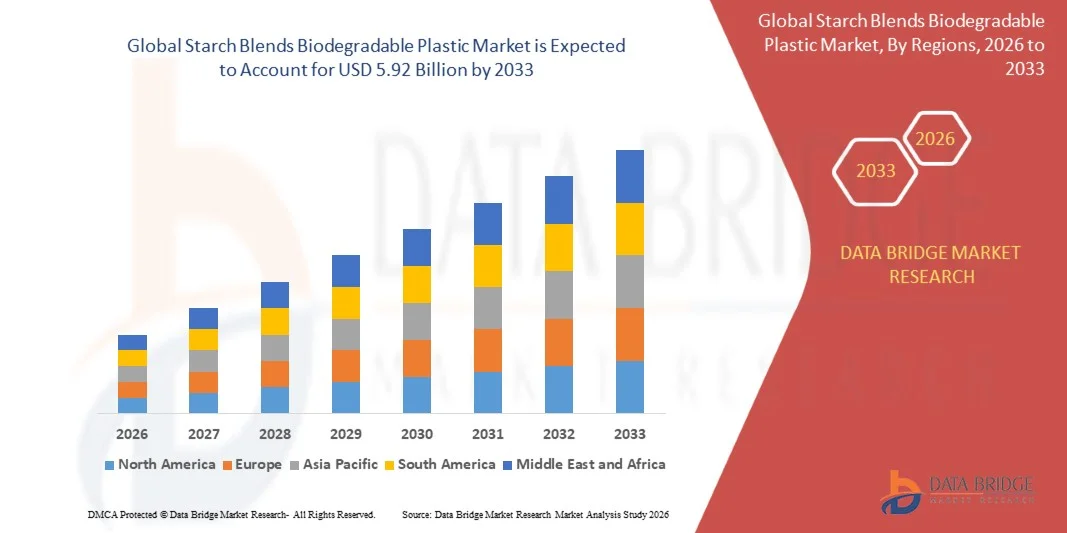
As per Data Bridge Market Research analysis, the starch blends biodegradable plastic market was valued at USD 2.54 billion in 2025 and is projected to reach USD 5.92 billion by 2033, growing at a CAGR of 11.16% from 2026 to 2033. The market is experiencing consistent growth driven by increasing demand for sustainable packaging solutions, rising environmental concerns regarding conventional plastics, and strengthening regulations promoting biodegradable and bio-based materials.
The growing emphasis on reducing plastic waste, combined with increasing adoption of compostable materials across packaging, agriculture, and consumer goods applications, is accelerating the use of starch blend biodegradable plastics worldwide. Technological advancements in starch-polymer formulations, expanding investments in bioplastic manufacturing, and the availability of renewable agricultural feedstocks are further supporting market expansion, while manufacturers continue to develop high-performance biodegradable materials that reduce dependence on petroleum-based plastics and comply with evolving environmental regulation
Market Size & Forecast
- Global Market Value (2025): USD 2.54 Billion
- Expected Market Value (2033): USD 5.92 Billion
- Forecast CAGR (2026–2033): 11.16%
- Leading Region in 2025: North America
- Fastest Growing Region: Asia Pacific
Key Market Trends & Insights
- North America dominated the starch blends biodegradable plastic market with the largest revenue share of 36.8% in 2025, supported by increasing adoption of sustainable packaging materials, stringent environmental regulations, and expanding investments in bioplastic manufacturing facilities
- The polylactic acid (PLA) segment led the market with a 39.4% share in 2025, driven by its widespread use in biodegradable packaging, disposable tableware, food containers, and agricultural applications
- Asia-Pacific is expected to be the fastest-growing region at a CAGR of 12.4% from 2026 to 2033, fueled by expanding packaging industries, increasing government support for biodegradable materials, and rising adoption across China, India, and Southeast Asia
- Polyhydroxyalkanoates (PHA) are the fastest-growing type, projected to register a CAGR of 13.7%, reflecting the surge in demand for fully bio-based and marine-biodegradable plastic materials
- The extrusion segment dominated the technology category with a 54.2% revenue share in 2025, led by its extensive use in the production of biodegradable films, sheets, bags, mulch films, and flexible packaging products
- Packaging and bags accounted for 47.6% of the market, preferred by growing demand for compostable and biodegradable packaging solutions across food, beverage, retail, and e-commerce industries
- The injection molding segment is the fastest-growing technology category, with a CAGR of 12.9%, driven by rising demand for biodegradable consumer products, food-service items, and industrial components
Report Scope and Starch Blends Biodegradable Plastic Market Segmentation
|
Attributes |
Starch Blends Biodegradable Plastic Key Market Insights |
|
Segments Covered |
|
|
Countries Covered |
North America
Europe
Asia-Pacific
Middle East and Africa
South America
|
|
Key Market Players |
|
|
Market Opportunities |
|
|
Value Added Data Infosets |
In addition to the insights on market scenarios such as market value, growth rate, segmentation, geographical coverage, and major players, the market reports curated by the Data Bridge Market Research also include import export analysis, production capacity overview, production consumption analysis, price trend analysis, climate change scenario, supply chain analysis, value chain analysis, raw material/consumables overview, vendor selection criteria, PESTLE Analysis, Porter Analysis, and regulatory framework. |
What is the Key Trend in the Starch Blends Biodegradable Plastic Market?
Trend: Rising Adoption of Compostable Starch-Based Packaging Materials
Food, beverage, retail, and consumer goods manufacturers are increasingly adopting starch blend biodegradable plastics to replace conventional petroleum-based plastics in response to tightening environmental regulations and growing consumer demand for sustainable packaging. Advances in starch-polymer blending technologies are improving the mechanical strength, flexibility, moisture resistance, and processability of these materials, enabling wider commercialization across packaging, agricultural films, and disposable products. Research is also focused on enhancing the performance of starch blends through combinations with PLA, PBAT, and other biodegradable polyesters to expand industrial applications. For instance, In January 2024, Novamont introduced new home-compostable Mater-Bi grades for food trays and coffee capsules, providing PFAS-free barrier properties, industrial and home compostability, and recyclability within the paper stream, demonstrating continued innovation in starch-based biodegradable packaging.
The growing transition toward compostable packaging is accelerating the adoption of starch blend biodegradable plastics across multiple end-use industries.
Starch Blends Biodegradable Plastic Market Dynamics
Key Market Driver: Growing Demand for Sustainable Packaging Solutions
The increasing environmental awareness, government restrictions on single-use plastics, and corporate sustainability commitments are driving demand for starch blends biodegradable plastics as renewable alternatives to conventional plastics. These materials help reduce dependence on fossil-based polymers while supporting circular economy initiatives through compostability and biodegradability. Expanding investments in bioplastic manufacturing and the increasing use of biodegradable materials in food packaging, consumer goods, and agriculture continue to strengthen market growth. For instance, in June 2024, Novamont launched the TERRIFIC project, a USD 18.24 million initiative funded by the Circular Bio-based Europe (CBE) Joint Undertaking, bringing together 19 partners from 9 European countries to develop and demonstrate innovative packaging solutions based on renewable, compostable biopolyesters and biomaterials with over 95% renewable content. The project highlights growing investments in starch-based biodegradable plastics for sustainable packaging applications.
Rising sustainability regulations and packaging circularity initiatives continue to be the primary growth engine for the starch blends biodegradable plastic market.
Key Restraint/Challenge: Performance Limitations Compared with Conventional Plastics
A major challenge for the starch blends biodegradable plastic market is balancing biodegradability with the mechanical strength, moisture resistance, thermal stability, and barrier performance required for demanding commercial applications. Although starch-based blends offer significant environmental benefits, many formulations still require blending with biodegradable polyesters or additional material modifications to achieve performance comparable to conventional plastics, increasing development complexity and production costs. For instance, in March 2024 an article published in the Journal of Agriculture and Food Research highlighted that starch-based biodegradable polymers require blending and material modification to improve mechanical properties, water resistance, and commercial competitiveness for packaging applications.
Improving material performance while maintaining biodegradability remains one of the industry's most significant commercialization challenges.
Key Market Opportunity: Expanding Adoption in Agricultural and Compostable Applications
The growing investments in sustainable agriculture and compostable products present significant opportunities for starch blend biodegradable plastics. Increasing adoption of biodegradable mulch films, agricultural twines, clips, compost bags, and food packaging is supported by improvements in composting infrastructure and technological advancements in starch-polymer formulations. These applications help reduce plastic waste accumulation while simplifying organic waste management and supporting circular economy objectives. For instance, In June 2024, Bayer CropScience and Novamont completed a one-year trial in Spain demonstrating that Mater-Bi compostable twines and clips could be composted together with crop residues, eliminating plastic separation while producing high-quality compost after industrial composting.
Expanding agricultural and compostable product applications are expected to create substantial long-term growth opportunities for starch blends biodegradable plastics
How is the Starch Blends Biodegradable Plastic Market Segmented?
The starch blends biodegradable plastic market is segmented on the basis of type, technology, and end-use
- By Type
On the basis of type, the starch blends biodegradable plastic market is segmented into polylactic acid (PLA), biodegradable polyesters, polyhydroxyalkanoates (PHA), and others. The polylactic acid (PLA) segment dominated the market with an estimated 39.4% share in 2025, owing to its widespread use in biodegradable packaging, disposable tableware, food containers, and agricultural applications. PLA is derived from renewable resources such as corn starch and sugarcane, making it one of the most commercially established bioplastics. The material offers good transparency, processability, and compostability, supporting its adoption across food and consumer packaging industries. Increasing regulatory restrictions on single-use plastics are encouraging manufacturers to replace conventional polymers with PLA-based alternatives. Strong production capacity expansions by leading bioplastic manufacturers have further strengthened market penetration. Its compatibility with starch blends and established industrial composting infrastructure continue to support its dominant position.
The polyhydroxyalkanoates (PHA) segment is projected to register the fastest growth at a CAGR of 13.7% from 2026 to 2033, driven by increasing demand for fully bio-based and marine-biodegradable plastic materials. PHA is produced through microbial fermentation and offers biodegradability across soil, freshwater, marine, and composting environments. Rising concerns regarding microplastic pollution are encouraging the adoption of PHA in packaging, agricultural films, and medical applications. Continuous research activities are improving production efficiency and reducing manufacturing costs. Government support for next-generation sustainable materials and growing investments in biotechnology are accelerating commercialization. The segment is also benefiting from increasing demand for environmentally safe alternatives in regions with strict plastic waste regulations.
- By Technology
On the basis of technology, the starch blends biodegradable plastic market is segmented into blow molding, extrusion, injection molding, and others. The extrusion segment dominated the market with an estimated 54.2% share in 2025 owing to its extensive use in the production of biodegradable films, sheets, bags, mulch films, and flexible packaging products. Extrusion technology provides high production efficiency, lower processing costs, and compatibility with a wide range of starch-based biodegradable polymers. The process is widely utilized across packaging and agricultural applications where large-volume manufacturing is required. Manufacturers prefer extrusion because it enables continuous production and facilitates blending of starch with biodegradable polyesters such as PLA and PBAT. Increasing demand for sustainable packaging materials is further driving technology adoption. Its scalability and operational efficiency continue to make extrusion the leading processing technology in the market.
The injection molding segment is expected to witness the fastest growth at a CAGR of 12.9% from 2026 to 2033 due to rising demand for biodegradable consumer products, food-service items, and industrial components. Injection molding enables the production of complex shapes with high precision and consistency, making it suitable for a wide variety of end-use applications. Growing adoption of biodegradable cutlery, containers, household products, and personal care packaging is driving demand for this technology. Continuous improvements in material formulations are enhancing the processability of starch blend plastics in injection molding systems. Increasing focus on replacing petroleum-based molded products with sustainable alternatives is supporting market expansion. The segment is also benefiting from advancements in automated manufacturing technologies and sustainable product design initiatives.
- By End Use Industry
On the basis of end-use industry, the starch blends biodegradable plastic market is segmented into packaging and bags, consumer goods, agriculture and horticulture, textile, and others. The packaging and bags segment dominated the market with an estimated 47.6% revenue share in 2025, driven by growing demand for compostable and biodegradable packaging solutions across food, beverage, retail, and e-commerce industries. Increasing regulatory bans on conventional plastic bags and packaging materials are encouraging the adoption of starch blend biodegradable plastics. These materials offer favorable compostability characteristics while helping organizations achieve sustainability goals and reduce environmental impact. Food manufacturers and retailers are increasingly incorporating biodegradable packaging into their operations to meet consumer preferences for eco-friendly products. Rising investments in sustainable packaging innovation are further supporting segment growth. The segment continues to benefit from strong demand for flexible packaging, shopping bags, and disposable food packaging applications.
The agriculture and horticulture segment is projected to register the fastest growth at a CAGR of 13.4% from 2026 to 2033, driven by increasing adoption of biodegradable mulch films, plant clips, compostable twines, seed coatings, and controlled-release agricultural products. Farmers are increasingly utilizing biodegradable materials to reduce plastic waste accumulation in agricultural fields and lower disposal costs. Growing emphasis on sustainable farming practices and circular economy initiatives is accelerating demand for starch-based biodegradable products. Government programs promoting environmentally friendly agricultural inputs are further supporting market growth. Technological advancements are improving the durability and field performance of biodegradable agricultural materials. The segment is also benefiting from rising awareness regarding soil health, plastic pollution reduction, and sustainable crop production practices.
Which Region Holds the Largest Share of the Starch Blends Biodegradable Plastic Market?
North America dominated the starch blends biodegradable plastic market with the largest revenue share of 36.8% in 2025, supported by increasing adoption of sustainable packaging materials, stringent environmental regulations, and expanding investments in bioplastic manufacturing facilities. The region benefits from a well-established packaging industry, growing consumer preference for eco-friendly products, and the presence of leading biodegradable plastic manufacturers. Rising regulatory pressure to reduce single-use plastic waste is encouraging food, beverage, retail, and consumer goods companies to adopt starch-based biodegradable alternatives. Continuous advancements in biopolymer technologies, expanding composting infrastructure, and increasing corporate sustainability commitments are further accelerating market development. Growing focus on circular economy initiatives and reducing dependence on fossil-based plastics continues to strengthen North America's leadership position in the global market.
U.S. Starch Blends Biodegradable Plastic Market Insight
The U.S. starch blends biodegradable plastic market is witnessing strong growth due to increasing demand for sustainable packaging solutions, growing corporate sustainability commitments, and supportive regulatory initiatives aimed at reducing plastic waste. The country's well-established food packaging, retail, and consumer goods industries are accelerating the adoption of biodegradable materials as alternatives to conventional plastics. In addition, increasing investments in biopolymer production technologies and compostable packaging infrastructure are supporting market expansion. In October 2024, Avantium signed a conditional offtake agreement with Plastipak to supply its 100% plant-based, recyclable PEF polymer for beverage and food packaging in the United States, reflecting growing commercial adoption of sustainable packaging materials in the U.S. market.
Europe Starch Blends Biodegradable Plastic Market Insight
The Europe starch blends biodegradable plastic market remains a major contributor to global revenue, driven by stringent environmental regulations, ambitious circular economy policies, and strong consumer preference for sustainable packaging. The widespread adoption of biodegradable materials across packaging, agriculture, and consumer goods applications continues to support regional market expansion. Increasing investments in bio-based material innovation and composting infrastructure further strengthen market growth. The European Union's Single-Use Plastics Directive continues to accelerate the replacement of conventional plastics with biodegradable and compostable alternatives across member states, creating significant demand for starch-based bioplastics.
U.K. Starch Blends Biodegradable Plastic Market Insight
The U.K. starch blends biodegradable plastic market is experiencing steady growth, supported by increasing adoption of sustainable packaging materials, growing corporate environmental commitments, and government measures targeting plastic waste reduction. Rising investments in compostable packaging solutions and circular economy initiatives are contributing to market development. Furthermore, growing consumer demand for environmentally responsible products is encouraging manufacturers to transition toward biodegradable materials. The Plastic Packaging Tax, implemented in April 2022, has encouraged businesses to increase the use of recycled and sustainable packaging materials while reducing dependence on conventional plastics.
Germany Starch Blends Biodegradable Plastic Market Insight
The Germany starch blends biodegradable plastic market is expanding steadily due to the country's strong manufacturing sector, advanced sustainability initiatives, and increasing focus on circular economy practices. Packaging manufacturers, food producers, and consumer goods companies are increasingly incorporating biodegradable plastics into their product portfolios to meet environmental targets. Continuous innovation in biopolymer technologies and strong research capabilities are further supporting market growth. In November 2025, Germany's Federal Statistical Office (Destatis) reported that Germany recycled 69% of its municipal waste in 2023, among the highest recycling rates in Europe, reflecting the country's advanced circular economy infrastructure and strong commitment to sustainable waste management, which supports the adoption of biodegradable plastics.
Asia-Pacific Starch Blends Biodegradable Plastic Market Insight
The Asia-Pacific starch blends biodegradable plastic market is expected to witness rapid growth, driven by expanding packaging industries, increasing environmental awareness, and rising government initiatives to reduce plastic pollution across China, India, Japan, and Southeast Asia. Growing investments in bioplastic manufacturing facilities and abundant availability of agricultural feedstocks are supporting regional market expansion. In addition, increasing adoption of biodegradable materials in food packaging and agricultural applications is accelerating demand. According to European Bioplastics, Asia accounts for more than 45% of global bioplastics production capacity, highlighting the region's importance in the biodegradable plastics supply chain and manufacturing ecosystem.
Japan Starch Blends Biodegradable Plastic Market Insight
The Japan starch blends biodegradable plastic market is witnessing consistent growth due to increasing investments in sustainable materials, strong environmental policies, and rising adoption of biodegradable packaging solutions. Food manufacturers, retailers, and consumer goods companies are increasingly incorporating bio-based materials into packaging strategies to meet sustainability objectives. Moreover, continuous advancements in biodegradable polymer technologies and government support for circular economy initiatives are further contributing to market growth. Japan's Plastic Resource Circulation Act, which came into force in April 2022, promotes reduced plastic consumption and greater utilization of environmentally friendly alternatives, supporting demand for biodegradable plastics.
China Starch Blends Biodegradable Plastic Market Insight
The China starch blends biodegradable plastic market is growing rapidly, driven by increasing government efforts to curb plastic pollution, expanding bioplastic production capacity, and rising demand for sustainable packaging solutions. Growing adoption of biodegradable materials across food service, retail, e-commerce, and agricultural sectors is significantly boosting market demand. In addition, substantial investments in biopolymer manufacturing and supportive regulatory policies are positioning China as one of the fastest-growing biodegradable plastics markets globally. China's National Development and Reform Commission continues to implement nationwide restrictions on non-degradable plastic bags and disposable plastic products under its plastic pollution control program, accelerating demand for biodegradable alternatives.
Which are the Top Companies in Starch Blends Biodegradable Plastic Market?
The starch blends biodegradable plastic industry is primarily led by well-established companies, including:
- NatureWorks LLC (U.S.)
- TotalEnergies Corbion (Netherlands)
- Novamont S.p.A. (Italy)
- BASF (Germany)
- FKuR (Germany)
- BIOTEC Biologische Naturverpackungen GmbH & Co. KG. (Germany)
- Danimer Scientific, Inc. (U.S.)
- TianAn Biologic Materials Co., Ltd. (China)
- Zhejiang Hisun Biomaterials Co., Ltd. (China)
- Kingfa Sci. & Tech. Co., Ltd. (China)
- Mitsubishi Chemical Group Corporation (Japan)
- Toray Industries, Inc. (Japan)
- Kaneka Corporation (Japan)
- Braskem S.A. (Brazil)
- Biosphere Plastic LLC (U.S.)
- Cardia Bioplastics Limited (Australia)
- BioBag International AS (Norway)
- Grabio Greentech Corporation (China)
- Rodenburg Biopolymers (Netherlands)
What are Latest Developments in Starch Blends Biodegradable Plastic Market?
- In March 2025, NatureWorks launched Ingeo™ Extend 4950D, a new PLA biopolymer grade designed to improve manufacturing efficiency and accelerate biodegradation performance for compostable packaging applications. The new material platform enables faster disintegration and biodegradation compared with conventional PLA grades and is targeted for applications such as coffee capsules, candy wrappers, and single-portion packaging. This launch strengthens the adoption of PLA-based biodegradable plastics by improving processing performance and end-of-life sustainability
- In June 2024, Novamont and Bayer CropScience introduced compostable agricultural products made from Mater-Bi, including twines and clips designed for greenhouse farming applications. The products were developed to replace conventional plastic agricultural accessories and enable composting together with crop residues after use. This development demonstrates the expanding application of starch-based biodegradable plastics beyond packaging into sustainable agriculture and horticulture markets.
- In January 2024, Novamont launched new home-compostable Mater-Bi grades developed for food trays and coffee capsule applications. The new starch-based biodegradable bioplastic solutions provide improved technical performance, including thermal resistance, gas barrier properties, waterproofing, and compatibility with industrial and home composting systems. The product development supports the expansion of compostable packaging solutions for the food industry and strengthens the role of starch-based polymers in sustainable packaging applications
- In November 2022, Eco-Products launched a new line of compostable straws made from PHA-based plant plastic, designed to provide a sustainable alternative to conventional plastic straws. The new products are manufactured using polyhydroxyalkanoate (PHA) derived from canola oil and are certified compostable under commercial composting facilities and home compost conditions. This product launch highlights the growing adoption of PHA-based biodegradable plastics in food-service applications and supports the expansion of bio-based alternatives for single-use plastic products
- In May 2021, TerraVerdae Bioworks launched a new range of PHA-based bioplastic resin products developed for blown film, cast film, injection molding, and thermoforming applications. The new resin portfolio was designed to provide biodegradable and bio-based plastic solutions with improved performance characteristics for commercial applications. The launch supported the expansion of PHA materials across packaging, consumer goods, and industrial applications, strengthening the development of next-generation biodegradable plastic alternatives

- Interactive Data Analysis Dashboard
- Company Analysis Dashboard for high growth potential opportunities
- Research Analyst Access for customization & queries
- Competitor Analysis with Interactive dashboard
- Latest News, Updates & Trend analysis
- Harness the Power of Benchmark Analysis for Comprehensive Competitor Tracking
Global Starch Blends Biodegradable Plastic Market, Supply Chain Analysis and Ecosystem Framework
To support market growth and help clients navigate the impact of geopolitical shifts, DBMR has integrated in-depth supply chain analysis into its Global Starch Blends Biodegradable Plastic Market research reports. This addition empowers clients to respond effectively to global changes affecting their industries. The supply chain analysis section includes detailed insights such as Global Starch Blends Biodegradable Plastic Market consumption and production by country, price trend analysis, the impact of tariffs and geopolitical developments, and import and export trends by country and HSN code. It also highlights major suppliers with data on production capacity and company profiles, as well as key importers and exporters. In addition to research, DBMR offers specialized supply chain consulting services backed by over a decade of experience, providing solutions like supplier discovery, supplier risk assessment, price trend analysis, impact evaluation of inflation and trade route changes, and comprehensive market trend analysis.
Data collection and base year analysis are done using data collection modules with large sample sizes. The stage includes obtaining market information or related data through various sources and strategies. It includes examining and planning all the data acquired from the past in advance. It likewise envelops the examination of information inconsistencies seen across different information sources. The market data is analysed and estimated using market statistical and coherent models. Also, market share analysis and key trend analysis are the major success factors in the market report. To know more, please request an analyst call or drop down your inquiry.
The key research methodology used by DBMR research team is data triangulation which involves data mining, analysis of the impact of data variables on the market and primary (industry expert) validation. Data models include Vendor Positioning Grid, Market Time Line Analysis, Market Overview and Guide, Company Positioning Grid, Patent Analysis, Pricing Analysis, Company Market Share Analysis, Standards of Measurement, Global versus Regional and Vendor Share Analysis. To know more about the research methodology, drop in an inquiry to speak to our industry experts.
Data Bridge Market Research is a leader in advanced formative research. We take pride in servicing our existing and new customers with data and analysis that match and suits their goal. The report can be customized to include price trend analysis of target brands understanding the market for additional countries (ask for the list of countries), clinical trial results data, literature review, refurbished market and product base analysis. Market analysis of target competitors can be analyzed from technology-based analysis to market portfolio strategies. We can add as many competitors that you require data about in the format and data style you are looking for. Our team of analysts can also provide you data in crude raw excel files pivot tables (Fact book) or can assist you in creating presentations from the data sets available in the report.













