


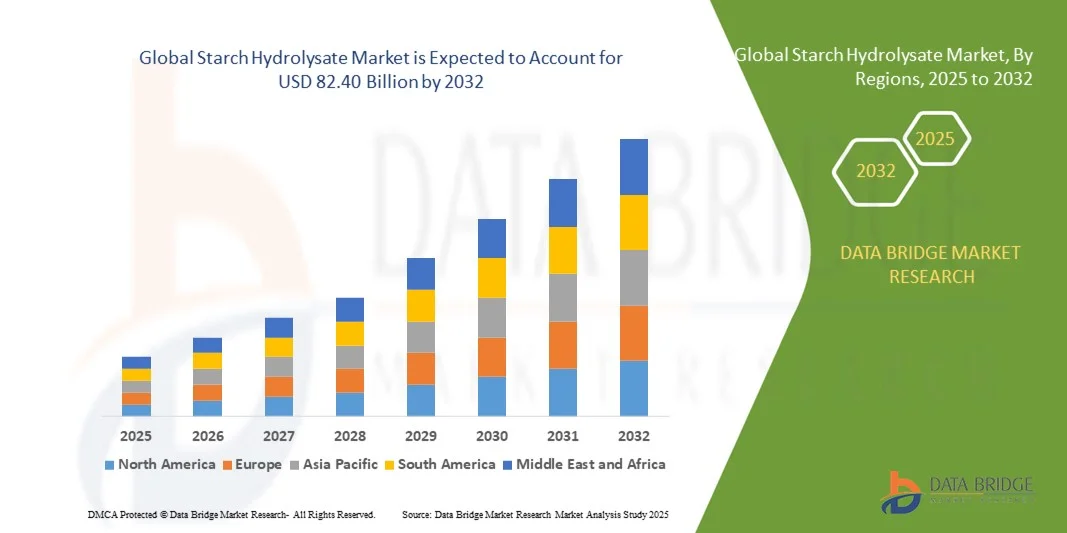
Global Starch Hydrolysate Market Size
- The global Starch Hydrolysate Market size was valued at USD 60.21 billion in 2024 and is expected to reach USD 82.40 billion by 2032, at a CAGR of 4.00% during the forecast period.
- The market growth is primarily driven by increasing demand for processed and convenience foods, along with the expanding use of starch hydrolysates in beverages, confectionery, and pharmaceutical applications, supporting broader industrial adoption.
- Additionally, rising consumer preference for natural and functional ingredients, coupled with advancements in enzymatic hydrolysis and production technologies, is driving innovation and efficiency in starch hydrolysate products. These factors collectively are accelerating market penetration, thereby substantially propelling industry growth.
Global Starch Hydrolysate Market Analysis
- Starch hydrolysates, including glucose syrup, maltodextrin, and high-fructose syrup, are increasingly vital ingredients in the food, beverage, pharmaceutical, and industrial sectors due to their versatility, functional properties, and ability to enhance sweetness, texture, and shelf life.
- The escalating demand for starch hydrolysates is primarily fueled by the growing consumption of processed and convenience foods, rising health-conscious trends favoring functional ingredients, and the expanding use of starch derivatives in pharmaceuticals and nutraceuticals.
- Europe dominated the Global Starch Hydrolysate Market with the largest revenue share of 35.8% in 2024, characterized by high industrialization, well-established food and beverage industries, and strong presence of key market players, with the U.S. witnessing substantial growth in the use of starch hydrolysates in beverages, confectionery, and nutritional products, driven by innovations from both established manufacturers and startups focusing on clean-label and natural ingredient solutions.
- Asia-Pacific is expected to be the fastest-growing region in the Global Starch Hydrolysate Market during the forecast period due to increasing urbanization, rising disposable incomes, and expanding demand for processed and convenience foods.
- The conventional segment dominated the market with the largest revenue share of 68.5% in 2024, driven by its widespread availability, cost-effectiveness, and extensive use across processed foods, beverages, and pharmaceutical products.
Report Scope and Global Starch Hydrolysate Market Segmentation
|
Attributes |
Starch Hydrolysate Key Market Insights |
|
Segments Covered |
|
|
Countries Covered |
North America
Europe
Asia-Pacific
Middle East and Africa
South America
|
|
Key Market Players |
|
|
Market Opportunities |
|
|
Value Added Data Infosets |
In addition to the insights on market scenarios such as market value, growth rate, segmentation, geographical coverage, and major players, the market reports curated by the Data Bridge Market Research also include in-depth expert analysis, pricing analysis, brand share analysis, consumer survey, demography analysis, supply chain analysis, value chain analysis, raw material/consumables overview, vendor selection criteria, PESTLE Analysis, Porter Analysis, and regulatory framework. |
Global Starch Hydrolysate Market Trends
Enhanced Functionality Through Advanced Production and Formulation Technologies
- A significant and accelerating trend in the global Starch Hydrolysate Market is the adoption of advanced enzymatic and biotechnological processes for production, alongside innovative formulations that improve functionality, stability, and nutritional profile. These innovations are significantly enhancing product versatility and application potential across food, beverage, and pharmaceutical industries.
- For instance, maltodextrin produced using modern enzymatic hydrolysis can be tailored for specific sweetness levels, viscosity, or solubility, enabling its use in a wide range of products from sports drinks to confectionery. Similarly, high-fructose syrups with optimized purity and composition are increasingly used in beverages and baked goods to improve texture and shelf life.
- Advanced production technologies allow manufacturers to create starch hydrolysates with targeted functionalities, such as prebiotic effects, low glycemic index, or controlled sweetness. For example, some companies now produce resistant maltodextrins that support gut health while providing textural benefits. Furthermore, precision formulation enables better incorporation into ready-to-drink beverages, nutritional supplements, and pharmaceutical excipients.
- The integration of these advanced production and formulation technologies facilitates the development of multifunctional ingredients that can simultaneously act as sweeteners, texturizers, and stabilizers. This allows food and beverage manufacturers to simplify formulations while meeting consumer demands for clean-label, natural, and functional ingredients.
- This trend towards more versatile, health-focused, and technologically enhanced starch hydrolysates is fundamentally reshaping industry standards. Consequently, companies such as Cargill, Ingredion, and Roquette are developing specialized starch hydrolysates with tailored functional properties for diverse applications in nutrition, confectionery, and beverages.
- The demand for starch hydrolysates with enhanced functionality and tailored properties is growing rapidly across both food and pharmaceutical sectors, as manufacturers seek ingredients that offer multiple benefits while meeting evolving consumer preferences for health, convenience, and high-quality products.
Global Starch Hydrolysate Market Dynamics
Driver
Growing Need Due to Rising Demand for Processed Foods and Functional Ingredients
- The increasing consumption of processed and convenience foods, coupled with the growing demand for functional and natural ingredients, is a significant driver for the heightened demand for starch hydrolysates.
- For instance, in 2024, Ingredion introduced a new range of specialty maltodextrins designed to enhance texture and sweetness while supporting clean-label claims in beverages and confectionery. Such innovations by key companies are expected to drive the starch hydrolysate market growth during the forecast period.
- As manufacturers seek to improve taste, texture, shelf life, and nutritional value, starch hydrolysates offer versatile solutions across food, beverage, and pharmaceutical applications, providing a compelling alternative to traditional sweeteners and texturizers.
- Furthermore, the rising popularity of functional and fortified foods, along with expanding applications in nutraceuticals and pharmaceuticals, is making starch hydrolysates an integral ingredient in product formulation, enabling improved solubility, controlled sweetness, and prebiotic benefits.
- The flexibility of starch hydrolysates in various industrial applications, coupled with increasing demand in emerging markets and the growing focus on clean-label, natural ingredients, is driving adoption across both food and non-food sectors. Advances in enzymatic processing and tailored formulations further contribute to market growth.
Restraint/Challenge
Regulatory Constraints and Price Volatility of Raw Materials
- Regulatory restrictions on food additives and functional ingredients, as well as fluctuating prices of raw materials such as corn, wheat, and cassava starch, pose significant challenges to broader market expansion. Variations in government policies and labeling requirements can affect product formulation and market entry strategies.
- For instance, stringent regulations in the European Union regarding high-fructose syrups and labeling compliance have made some manufacturers cautious in product development and marketing.
- Addressing these challenges through compliance with food safety standards, transparent labeling, and strategic sourcing of raw materials is crucial for maintaining consumer trust and market stability. Companies such as Cargill, Roquette, and ADM emphasize high-quality sourcing and adherence to regulatory guidelines to reassure manufacturers and end-users.
- Additionally, price fluctuations in raw materials can affect the cost competitiveness of starch hydrolysates, particularly for smaller manufacturers or in price-sensitive regions. While technological improvements in enzymatic processing are helping optimize production efficiency, premium formulations can still be more expensive than conventional sweeteners.
- Overcoming these challenges through improved supply chain management, cost-effective production methods, and compliance with international food regulations will be vital for sustained growth of the starch hydrolysate market.
Global Starch Hydrolysate Market Scope
Starch hydrolysate market is segmented on the basis of nature, functionality, end-use, source, form and type.
- By Nature
On the basis of nature, the Global Starch Hydrolysate Market is segmented into organic and conventional. The conventional segment dominated the market with the largest revenue share of 68.5% in 2024, driven by its widespread availability, cost-effectiveness, and extensive use across processed foods, beverages, and pharmaceutical products. Conventional starch hydrolysates are preferred by manufacturers due to consistent quality, established supply chains, and compatibility with large-scale production.
the organic segment is expected to witness the fastest CAGR of 19.3% from 2025 to 2032, fueled by rising consumer awareness and demand for clean-label, non-GMO, and naturally derived ingredients. Organic starch hydrolysates are increasingly incorporated in premium bakery, confectionery, and beverage products where natural and sustainable sourcing is a key marketing differentiator, making this segment highly attractive for innovative food and beverage manufacturers targeting health-conscious consumers.
- By Functionality
On the basis of functionality, the market is segmented into sweetening, moisture retainer, and texturizing applications. The sweetening segment dominated the market with a revenue share of 44.1% in 2024, driven by the widespread use of glucose, maltitol, and sorbitol syrups in beverages, confectionery, and bakery products. Sweetening starch hydrolysates provide a cost-effective and versatile alternative to sugar, while also allowing product reformulation for low-calorie or sugar-reduced options.
The texturizing segment is expected to witness the fastest CAGR of 20.5% from 2025 to 2032, owing to the increasing adoption of starch hydrolysates for enhancing product texture, stability, and mouthfeel in processed foods, dairy products, and spreads. Improved formulation technologies enabling multifunctional texturizing properties are encouraging manufacturers to replace traditional thickeners with starch hydrolysates, particularly in premium and functional foods.
- By End-Use
On the basis of end-use, the Global Starch Hydrolysate Market is segmented into bakery, confectionery, dairy, jams and spreads, beverages, pharmaceuticals, and others. The bakery segment accounted for the largest market revenue share of 31.8% in 2024, driven by the consistent demand for baked goods, bread, and snacks across developed and emerging markets. Starch hydrolysates are widely used for improving sweetness, moisture retention, and texture in bakery products, while also extending shelf life.
The confectionery segment is expected to witness the fastest CAGR of 21.2% from 2025 to 2032, fueled by the increasing consumption of candies, chocolates, and functional sweets. Growing demand for sugar-reduced, low-calorie, and sugar-free confectionery products encourages the use of starch hydrolysates as versatile sweeteners, supporting both taste and functional quality.
- By Source
On the basis of source, the market is segmented into rice, wheat, potato, and others. The corn/wheat-based starch hydrolysates dominated the market with a revenue share of 47.5% in 2024, owing to the abundant availability of raw materials and cost-effective production. Wheat and corn hydrolysates are extensively used across food and beverage industries for sweetening, texturizing, and functional applications due to their high yield and consistent quality.
The potato-based segment is expected to witness the fastest CAGR of 19.8% from 2025 to 2032, driven by the growing demand for specialty starch hydrolysates that offer clean-label solutions, functional properties, and suitability for gluten-free products. Potato starch hydrolysates are increasingly preferred in premium applications in bakery, confectionery, and dairy where textural and moisture-retention properties are critical.
- By Form
On the basis of form, the Global Starch Hydrolysate Market is segmented into powder, coarse-grain, and granulated forms. The powder segment dominated the market with a revenue share of 52.3% in 2024, owing to its ease of handling, superior solubility, and versatility across food, beverage, and pharmaceutical formulations. Powdered starch hydrolysates are preferred in industrial applications due to their uniformity and compatibility with automated processing systems.
The coarse-grain segment is expected to witness the fastest CAGR of 18.7% from 2025 to 2032, driven by its increasing use in niche confectionery and snack applications where granular texture, slow dissolution, and controlled sweetness are desired. Coarse-grain forms also provide enhanced processing flexibility for manufacturers experimenting with specialty functional foods and high-fiber products.
- By Type
On the basis of type, the market is segmented into hydrogenated glucose syrups, maltitol syrups, and sorbitol syrups. The hydrogenated glucose syrup segment dominated the market with a revenue share of 46.9% in 2024, due to its extensive use as a sweetener and functional ingredient in beverages, confectionery, and bakery products. Its cost-effectiveness, stability, and versatility make it a preferred choice among manufacturers.
The maltitol syrup segment is expected to witness the fastest CAGR of 21.0% from 2025 to 2032, fueled by rising demand for sugar-free and reduced-calorie products. Maltitol syrups provide a similar sweetness to sucrose with fewer calories, making them ideal for diabetic-friendly foods, confectionery, and nutritional products, supporting the growing trend toward healthier eating and functional food innovation.
Global Starch Hydrolysate Market Regional Analysis
- Europe dominated the Global Starch Hydrolysate Market with the largest revenue share of 35.8% in 2024, driven by the well-established food and beverage industry, high consumption of processed and convenience foods, and increasing demand for functional and clean-label ingredients.
- Manufacturers in the region prioritize starch hydrolysates for their versatility in applications such as bakery, confectionery, beverages, and pharmaceuticals, due to their ability to enhance sweetness, texture, moisture retention, and shelf life.
- This widespread adoption is further supported by advanced manufacturing infrastructure, high disposable incomes, and growing consumer awareness regarding functional and natural ingredients, establishing starch hydrolysates as a preferred solution for both large-scale industrial production and high-value specialty food products.
U.S. Starch Hydrolysate Market Insight
The U.S. starch hydrolysate market captured the largest revenue share of 81% in North America in 2024, driven by high consumption of processed foods, bakery, confectionery, and beverage products. Manufacturers increasingly prefer starch hydrolysates for their functionality in sweetness enhancement, moisture retention, and texturizing applications. Rising demand for clean-label and low-calorie products, coupled with advanced production technologies and a robust food processing industry, is further fueling market growth. Additionally, the integration of starch hydrolysates in nutraceuticals and pharmaceuticals is contributing to expanding applications in the U.S. market.
Europe Starch Hydrolysate Market Insight
The Europe starch hydrolysate market is projected to expand at a substantial CAGR during the forecast period, primarily driven by growing demand for functional ingredients in bakery, confectionery, and dairy products. Stringent food safety and quality regulations encourage manufacturers to adopt consistent, high-quality starch hydrolysates. Rising health awareness, urbanization, and increasing disposable incomes are supporting the adoption of reduced-sugar, low-calorie, and texturizing applications, particularly in Western Europe.
U.K. Starch Hydrolysate Market Insight
The U.K. starch hydrolysate market is anticipated to grow at a noteworthy CAGR, driven by rising consumer preference for processed foods, beverages, and functional food products. Manufacturers are increasingly leveraging starch hydrolysates as sweeteners, moisture retainers, and texturizers to meet demand for convenience foods. The region’s advanced food processing infrastructure, coupled with strong retail and e-commerce channels, is supporting wider product distribution and adoption.
Germany Starch Hydrolysate Market Insight
The Germany starch hydrolysate market is expected to expand at a considerable CAGR during the forecast period, fueled by the country’s well-established food and beverage industry and focus on innovation and sustainability. The demand for multifunctional ingredients in bakery, confectionery, dairy, and beverage applications is increasing, with manufacturers emphasizing clean-label, functional, and eco-friendly starch hydrolysates. Growing consumer awareness regarding health, nutrition, and natural ingredients also drives market adoption.
Asia-Pacific Starch Hydrolysate Market Insight
The Asia-Pacific starch hydrolysate market is poised to grow at the fastest CAGR of 24% during 2025–2032, driven by rapid urbanization, rising disposable incomes, and increased demand for processed and functional foods in countries such as China, Japan, and India. Expansion of the food processing industry, coupled with growing awareness of health-oriented ingredients, is boosting adoption. APAC is also emerging as a major production hub for starch hydrolysates, improving affordability and accessibility across the region.
Japan Starch Hydrolysate Market Insight
The Japan starch hydrolysate market is gaining momentum due to high consumption of confectionery, bakery, and beverage products, along with growing demand for functional ingredients. The market emphasizes high-quality, multifunctional starch hydrolysates that enhance sweetness, texture, and shelf life. An aging population and increasing health consciousness are driving demand for sugar-reduced and nutritionally enhanced products, further boosting market growth in both residential and industrial applications.
China Starch Hydrolysate Market Insight
The China starch hydrolysate market accounted for the largest revenue share in Asia-Pacific in 2024, driven by the country’s large population, rapid urbanization, and expanding food and beverage industry. Rising demand for processed foods, beverages, and functional ingredients is supporting market growth. Government initiatives promoting food innovation, coupled with the presence of strong domestic manufacturers and competitive pricing, are further accelerating the adoption of starch hydrolysates across industrial and consumer applications.
Global Starch Hydrolysate Market Share
The Starch Hydrolysate industry is primarily led by well-established companies, including:
• Cargill (U.S.)
• Ingredion (U.S.)
• Tate & Lyle (U.K.)
• ADM (Archer Daniels Midland) (U.S.)
• Südzucker AG (Germany)
• Corbion (Netherlands)
• Roquette Frères (France)
• Sinochem International (China)
• Mingxing Food Ingredients (China)
• Bright Food Group (China)
• Daesang Corporation (South Korea)
• AGRANA (Austria)
• Humana (Germany)
• Shandong Longlive Bio-Technology (China)
• Brenntag (Germany)
• Adeka Corporation (Japan)
• Mitsui & Co. (Japan)
• Shanghai Maple Leaf (China)
• Changchun Dacheng Bio-Tech (China)
• Hudson Foods (U.S.)
What are the Recent Developments in Global Starch Hydrolysate Market?
- In April 2023, Cargill Inc., a global leader in food and ingredient solutions, launched a new line of specialty starch hydrolysates in South Africa aimed at enhancing the quality and functionality of bakery, confectionery, and beverage products. This initiative underscores the company’s dedication to providing innovative, high-quality ingredients tailored to regional manufacturing needs, strengthening its position in the rapidly growing Global Starch Hydrolysate Market.
- In March 2023, Ingredion Incorporated introduced its latest maltitol syrup range designed specifically for low-calorie and sugar-reduced applications in bakery and confectionery products. This launch highlights Ingredion’s commitment to developing functional sweeteners that meet the increasing demand for healthier food options while maintaining product taste and texture, supporting broader adoption of starch hydrolysates.
- In March 2023, Roquette Frères successfully expanded its production capacity in India to cater to the rising demand for starch hydrolysates in dairy, beverage, and processed food applications. The expansion emphasizes Roquette’s focus on leveraging innovative production technologies to deliver consistent, high-quality ingredients that support regional food industry growth.
- In February 2023, Tate & Lyle announced a strategic collaboration with leading beverage manufacturers in North America to develop custom starch hydrolysate solutions for energy drinks and nutritional beverages. This partnership is aimed at enhancing sweetness, solubility, and mouthfeel, reflecting Tate & Lyle’s commitment to driving functional innovation across diverse food and beverage sectors.
- In January 2023, Südzucker AG unveiled a new line of hydrogenated glucose syrups for bakery and confectionery applications at the International Food Ingredients Expo (IFIC) 2023. These syrups are designed to improve moisture retention, texture, and shelf life in finished products, demonstrating the company’s focus on delivering versatile, high-performance starch hydrolysates that meet evolving consumer preferences for quality and convenience.

- Interactive Data Analysis Dashboard
- Company Analysis Dashboard for high growth potential opportunities
- Research Analyst Access for customization & queries
- Competitor Analysis with Interactive dashboard
- Latest News, Updates & Trend analysis
- Harness the Power of Benchmark Analysis for Comprehensive Competitor Tracking
Global Starch Hydrolysate Market, Supply Chain Analysis and Ecosystem Framework
To support market growth and help clients navigate the impact of geopolitical shifts, DBMR has integrated in-depth supply chain analysis into its Global Starch Hydrolysate Market research reports. This addition empowers clients to respond effectively to global changes affecting their industries. The supply chain analysis section includes detailed insights such as Global Starch Hydrolysate Market consumption and production by country, price trend analysis, the impact of tariffs and geopolitical developments, and import and export trends by country and HSN code. It also highlights major suppliers with data on production capacity and company profiles, as well as key importers and exporters. In addition to research, DBMR offers specialized supply chain consulting services backed by over a decade of experience, providing solutions like supplier discovery, supplier risk assessment, price trend analysis, impact evaluation of inflation and trade route changes, and comprehensive market trend analysis.
Data collection and base year analysis are done using data collection modules with large sample sizes. The stage includes obtaining market information or related data through various sources and strategies. It includes examining and planning all the data acquired from the past in advance. It likewise envelops the examination of information inconsistencies seen across different information sources. The market data is analysed and estimated using market statistical and coherent models. Also, market share analysis and key trend analysis are the major success factors in the market report. To know more, please request an analyst call or drop down your inquiry.
The key research methodology used by DBMR research team is data triangulation which involves data mining, analysis of the impact of data variables on the market and primary (industry expert) validation. Data models include Vendor Positioning Grid, Market Time Line Analysis, Market Overview and Guide, Company Positioning Grid, Patent Analysis, Pricing Analysis, Company Market Share Analysis, Standards of Measurement, Global versus Regional and Vendor Share Analysis. To know more about the research methodology, drop in an inquiry to speak to our industry experts.
Data Bridge Market Research is a leader in advanced formative research. We take pride in servicing our existing and new customers with data and analysis that match and suits their goal. The report can be customized to include price trend analysis of target brands understanding the market for additional countries (ask for the list of countries), clinical trial results data, literature review, refurbished market and product base analysis. Market analysis of target competitors can be analyzed from technology-based analysis to market portfolio strategies. We can add as many competitors that you require data about in the format and data style you are looking for. Our team of analysts can also provide you data in crude raw excel files pivot tables (Fact book) or can assist you in creating presentations from the data sets available in the report.













