


What is the Global Starch Processing Market Size and Growth Rate?
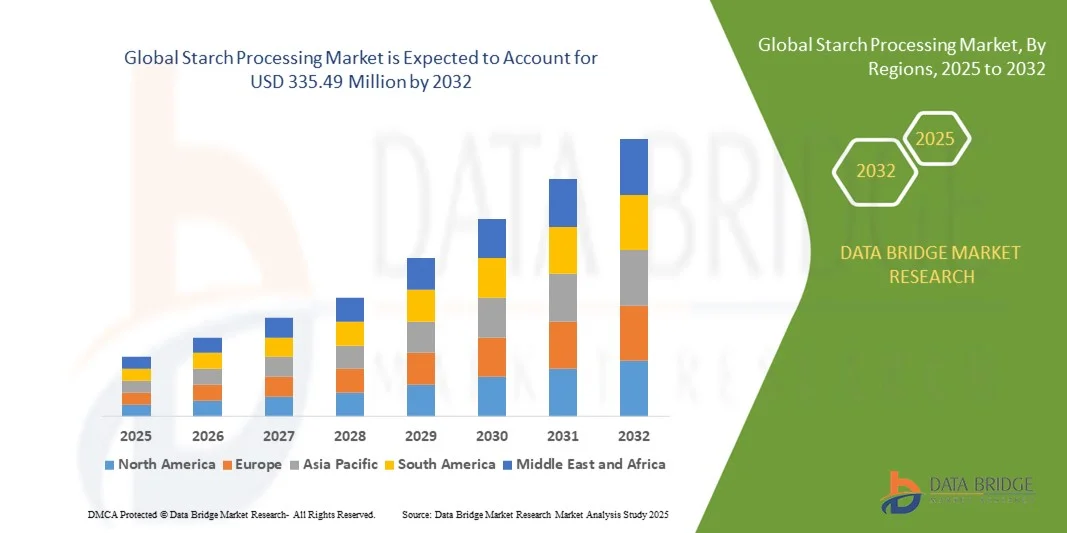
- The global starch processing market size was valued at USD 143.5 million in 2024 and is expected to reach USD 335.49 million by 2032, at a CAGR of 11.20% during the forecast period
- Major factors that are expected to boost the growth of the starch processing market in the forecast period are the usage of industrial starches from paper and packaging and other industrial sectors. Furthermore, the rise in the need corn starch mainly in the paper and textile industries is further anticipated to propel the growth of the starch processing market
- Moreover, the speedy increase in the food processing industry and rise in the demand for starch-based adhesives in the industrial products is further estimated to cushion the growth of the starch processing market
What are the Major Takeaways of Starch Processing Market?
- The need of large-scale financial expenses for the maintenance and establishment of starch processing equipment and services is further projected to impede the growth of the starch processing market in the timeline period
- In addition, the functions of starch in the food industry that are largely utilized as a thickener, binder, emulsifying agent and stabilizer will further provide potential opportunities for the growth of the starch processing market in the coming years. However, the utilization of polymers in adhesives might further challenge the growth of the starch processing market in the near future
- The Asia-Pacific region dominated the starch processing market with the largest revenue share of 39.5% in 2024, driven by rapid urbanization, rising disposable incomes, and expanding industrial and food processing sectors
- The North America starch processing market is poised to grow at the fastest CAGR of 8.64% during the forecast period of 2025 to 2032, driven by rising demand for convenience foods, expanding food processing infrastructure, and growing awareness of functional starches in food, feed, and industrial applications
- The extraction segment dominated the market with a revenue share of 38.5% in 2024, driven by its critical role in obtaining high-quality starch from raw materials efficiently
Report Scope and Starch Processing Market Segmentation
|
Attributes |
Starch Processing Key Market Insights |
|
Segments Covered |
|
|
Countries Covered |
North America
Europe
Asia-Pacific
Middle East and Africa
South America
|
|
Key Market Players |
|
|
Market Opportunities |
|
|
Value Added Data Infosets |
In addition to the insights on market scenarios such as market value, growth rate, segmentation, geographical coverage, and major players, the market reports curated by the Data Bridge Market Research also include in-depth expert analysis, pricing analysis, brand share analysis, consumer survey, demography analysis, supply chain analysis, value chain analysis, raw material/consumables overview, vendor selection criteria, PESTLE Analysis, Porter Analysis, and regulatory framework. |
What is the Key Trend in the Starch Processing Market?
Adoption of Automation and AI-Driven Process Optimization
- A prominent trend in the global starch processing market is the increasing integration of automation and artificial intelligence (AI) in process optimization. Modern starch processing plants are leveraging AI-driven control systems to enhance operational efficiency, reduce waste, and improve product consistency
- For instance, companies such as GEA Group and Alfa Laval are introducing AI-enabled monitoring systems that optimize extraction, drying, and blending processes in real time, improving yield and minimizing energy consumption
- AI-based predictive maintenance is being implemented to forecast equipment failures, reduce downtime, and maintain consistent starch quality across production lines. Advanced sensors allow precise monitoring of moisture, temperature, and particle size, enhancing overall process reliability
- The growing use of digital twins and AI analytics enables centralized control over multiple processing lines, allowing plant managers to adjust parameters remotely and achieve uniform output
- This trend towards smart, automated, and highly efficient starch processing operations is reshaping expectations for productivity and sustainability in the food, beverage, and industrial applications sectors
- The demand for AI-integrated, automated starch processing systems is expanding rapidly as producers prioritize cost efficiency, quality, and scalable operations
What are the Key Drivers of Starch Processing Market?
- Rising demand for processed starch in food, beverage, pharmaceutical, and industrial applications is driving market growth. Companies are increasingly seeking higher throughput and consistent product quality, necessitating advanced processing technologies
- In January 2025, Novozymes launched enzyme-assisted starch processing solutions that improve extraction efficiency and reduce environmental footprint, exemplifying innovations that drive industry expansion
- Growth in the global convenience food and beverage sector is boosting demand for modified starches with specific functional properties, encouraging investment in automated, AI-assisted processing systems
- Energy efficiency and sustainability requirements are promoting adoption of smart processing technologies that reduce water and energy consumption while maintaining product quality
- The need for process standardization and traceability, especially in pharmaceuticals and food-grade starch, encourages companies to implement automated monitoring and control solutions
- Increasing regulatory emphasis on food safety and quality standards further accelerates adoption of modern, AI-driven starch processing technologies
Which Factor is Challenging the Growth of the Starch Processing Market?
- High initial investment costs for automation, AI integration, and advanced processing equipment pose a significant barrier, especially for small and medium-scale manufacturers.
- Complex implementation requirements and the need for skilled personnel to operate AI-driven systems can limit adoption in regions with limited technical expertise
- Integration with legacy equipment is often challenging, requiring additional retrofitting or redesign of production lines, increasing operational costs
- Cybersecurity and data privacy concerns in AI-enabled processing systems can discourage adoption, as sensitive production data could be vulnerable to breaches or manipulation.
- Despite long-term efficiency gains, the perceived high capital expenditure for AI-driven starch processing systems may deter smaller producers, particularly in developing regions
- Addressing these challenges through cost-effective automation solutions, workforce training, and secure digital infrastructure is essential to ensure broader adoption and sustained market growth
How is the Starch Processing Market Segmented?
The market is segmented on the basis of methods, type, source, form, and application.
- By Methods
On the basis of methods, the starch processing market is segmented into extraction, separation, processing, and drying. The extraction segment dominated the market with a revenue share of 38.5% in 2024, driven by its critical role in obtaining high-quality starch from raw materials efficiently. Modern extraction technologies, such as enzyme-assisted and wet milling methods, improve yield and reduce energy consumption.
The drying segment is anticipated to witness the fastest CAGR of 22% from 2025 to 2032, as advanced drying systems, including flash and spray dryers, are increasingly adopted to enhance powder quality, shelf life, and solubility. Drying innovations also reduce moisture-related microbial growth, ensuring safer storage and transportation. The adoption of automated, AI-assisted drying and extraction methods is accelerating globally, particularly in large-scale food, beverage, and industrial starch production, enhancing operational efficiency and sustainability while minimizing production losses.
- By Type
On the basis of type, the starch processing market is segmented into native starch, starch derivatives, and sweeteners. The native starch segment held the largest market revenue share of 42% in 2024, owing to its wide application in food, pharmaceutical, and industrial sectors, along with its low processing requirements. Native starch is valued for its thickening, gelling, and stabilizing properties in various applications.
The starch derivatives segment is expected to register the fastest CAGR of 23% from 2025 to 2032, driven by increasing demand for modified starches such as maltodextrin, high-fructose corn syrup, and dextrins. These derivatives offer tailored functional properties for food texture, shelf life, and industrial applications such as adhesives and paper coatings. The growing focus on functional and value-added starch products for convenience foods and industrial applications is further fueling this segment’s rapid expansion.
- By Source
On the basis of source, the starch processing market is segmented into corn, wheat, cassava, potato, and others. The corn segment dominated the market with a revenue share of 45% in 2024, attributed to high availability, cost-effectiveness, and versatility across food, feed, and industrial applications. Corn-based starch is widely used in sweeteners, snacks, and bio-based polymers.
The cassava segment is anticipated to witness the fastest CAGR of 21.5% from 2025 to 2032, driven by increasing cultivation in Asia-Pacific countries and rising demand for gluten-free and non-GMO starch sources. Cassava’s adaptability to tropical climates and its use in both food and industrial products, such as biodegradable packaging and ethanol production, further support its rapid growth. Rising export potential from key cassava-producing countries is also contributing to wider market penetration.
- By Form
On the basis of form, the starch processing market is segmented into solid and liquid. The solid segment held the largest market revenue share of 53% in 2024, due to its long shelf life, ease of transport, and broad use in industrial, food, and pharmaceutical applications. Solid starch powders are preferred for processed foods, bakery items, and paper coatings.
The liquid segment is expected to witness the fastest CAGR of 22.5% from 2025 to 2032, driven by growing adoption of starch syrups, liquid starch derivatives, and functional liquids in beverages, sauces, and industrial adhesives. Liquid forms allow precise blending, faster dissolution, and consistent quality, making them ideal for large-scale manufacturing processes. The rising demand for ready-to-use liquid starch solutions is fueling rapid segmental growth globally.
- By Application
On the basis of application, the starch processing market is segmented into food, feed, paper industry, and pharmaceutical. The food segment dominated the market with a revenue share of 48% in 2024, driven by growing consumption of processed foods, convenience meals, and functional food products containing starch or its derivatives. Starch enhances texture, stability, and nutritional content in baked goods, snacks, and dairy products.
The feed segment is expected to witness the fastest CAGR of 23% from 2025 to 2032, supported by increasing livestock production and the need for energy-rich, digestible feed formulations. Feed-grade starch improves gut health and energy density in animal diets. Rising awareness about quality feed ingredients and adoption of enzymatic and processed starch in livestock diets are driving this segment’s rapid expansion.
Which Region Holds the Largest Share of the Starch Processing Market?
- The Asia-Pacific region dominated the starch processing market with the largest revenue share of 39.5% in 2024, driven by rapid urbanization, rising disposable incomes, and expanding industrial and food processing sectors
- Consumers and manufacturers in the region increasingly prioritize high-quality, cost-effective, and sustainable starch products, supporting widespread adoption across food, feed, pharmaceutical, and paper industries
- This growth is further aided by government initiatives promoting agricultural modernization, technological adoption in food processing, and increasing investment in manufacturing infrastructure, establishing Asia-Pacific as the global leader in starch production and processing
China Starch Processing Market Insight
The China starch processing market captured the largest revenue share of 46% in 2024 within Asia-Pacific, fueled by its expanding middle class, strong domestic food and beverage industry, and growing demand for processed and convenience foods. Industrial adoption across paper, pharmaceutical, and feed applications is also driving growth. The country’s focus on smart agriculture and modern processing technologies enhances production efficiency and product quality. In addition, the presence of large domestic manufacturers and ongoing infrastructure investments further support market expansion, solidifying China’s dominance in the regional starch processing landscape.
Japan Starch Processing Market Insight
The Japan starch processing market is witnessing steady growth due to the country’s high-tech food processing culture, aging population, and focus on sustainable production methods. Adoption is driven by demand for value-added starch products, functional ingredients, and convenience foods. Integration of advanced processing technologies, automation, and R&D initiatives to improve yield and product quality is fueling growth. The Japanese government’s support for sustainable industrial practices and increasing consumer preference for clean-label and functional food ingredients are further strengthening market demand in both industrial and commercial applications.
Europe Starch Processing Market Insight
The Europe starch processing market is projected to expand at a significant CAGR during the forecast period, primarily driven by demand for functional starch derivatives, regulatory support for sustainable food ingredients, and the growth of processed and convenience foods. Urbanization and industrial adoption are fostering the uptake of high-quality starch across food, feed, and pharmaceutical applications. Countries such as Germany, France, and the U.K. are witnessing growth in starch-based product innovations, including modified starches for energy-efficient industrial processes, healthier food formulations, and biodegradable packaging, positioning Europe as a major market globally.
Germany Starch Processing Market Insight
The Germany starch processing market is expected to grow at a considerable CAGR, fueled by the demand for eco-friendly and technologically advanced starch products. Emphasis on innovation, sustainability, and food safety regulations drives adoption across food, feed, and pharmaceutical industries. Integration of automated processing, quality control technologies, and energy-efficient operations enhances productivity and product reliability. The increasing interest in modified starches and functional ingredients for processed foods and industrial applications, combined with Germany’s strong manufacturing base, ensures sustained market expansion in the region.
Which Region is the Fastest Growing Region in the Starch Processing Market?
The North America starch processing market is poised to grow at the fastest CAGR of 8.64% during the forecast period of 2025 to 2032, driven by rising demand for convenience foods, expanding food processing infrastructure, and growing awareness of functional starches in food, feed, and industrial applications. The region’s technologically advanced processing plants, increasing adoption of automation, and rising focus on clean-label and specialty starch products are fueling market growth. In addition, the growing integration of R&D initiatives for value-added starch derivatives and supportive policies for sustainable food processing further enhance North America’s position as the fastest-growing regional market.
U.S. Starch Processing Market Insight
The U.S. starch processing market captured the largest revenue share of 80% in North America in 2024, fueled by the increasing consumption of processed foods, adoption of functional starch ingredients, and industrial applications in feed, paper, and pharmaceuticals. Rising investments in high-tech processing plants, automated production lines, and research into starch-based innovations are supporting growth. Consumer preference for gluten-free, clean-label, and specialty starch products is driving demand in food and beverage applications, while industrial users increasingly seek customized starch solutions for adhesives, packaging, and other manufacturing processes, reinforcing the U.S. as the growth leader in North America.
Which are the Top Companies in Starch Processing Market?
The starch processing industry is primarily led by well-established companies, including:
- MICROTEC ENGINEERING GROUP PTY LTD (Australia)
- Elomatic (Finland)
- G Larsson Starch Technology AB (Sweden)
- ALFA LAVAL (Sweden)
- Novozymes (Denmark)
- DuPont (U.S.)
- SiccaDania (Denmark)
- Henan Doing Mechanical Equipment Co., Ltd (China)
- INNER MONGOLIA BOSIDA TECHNOLOGY CO., LTD (China)
- Sino-Food Machinery Co, Ltd. (China)
- Royal Dahlman (Sweden)
- ABC Machinery (Netherlands)
- Hosokawa Micron B.V. (Netherlands)
- GEA Group Aktiengesellschaft (Germany)
- AB Enzymes (Germany)
- Thai German Processing Co.,Ltd. (Thailand)
- SSP Pvt Limited (India)
- YSM Biotech International (India)
- Advanced Enzyme Technologies (India)
- ten Brink Engineering & Consulting GmbH & Co. KG (Germany)
- Eclipse Magnetics (U.K.)
What are the Recent Developments in Global Starch Processing Market?
- In July 2025, Brenntag Specialties and Royal Avebe expanded their starch distribution partnership into the U.S., introducing Dutch potato starches and derivatives to North American food and nutrition markets for the first time. The collaboration focuses on segments such as bakery, dairy, meat alternatives, and confectionery. This expansion marks a major step toward strengthening both companies’ global distribution networks and enhancing access to innovative starch solutions across North America
- In December 2024, Tate & Lyle announced a strategic partnership with BioHarvest Sciences to develop next-generation plant-based ingredient molecules through botanical synthesis technology. The collaboration initially focuses on creating advanced botanical sweetening ingredients, with potential extensions into broader plant-based product categories. This partnership underscores Tate & Lyle’s commitment to innovation and sustainability in developing healthier and more natural food ingredients
- In November 2024, Tate & Lyle completed its USD 1.8 billion combination with CP Kelco, forming a global specialty food and beverage solutions company with over 5,000 employees across 75 locations in 39 countries. The merger significantly enhances Tate & Lyle’s capabilities in pectin, specialty gums, and hydrocolloids, complementing its existing starch portfolio. This strategic move strengthens its leadership in the specialty ingredients sector and broadens its global product offerings
- In August 2024, Al Ghurair Foods initiated the construction of an advanced corn starch manufacturing plant in the Khalifa Economic Zones, Abu Dhabi. This cutting-edge facility represents a regional milestone in boosting local food production capabilities and aligns with the U.A.E.’s National Strategy for Food Security. The project emphasizes the nation’s drive for self-sufficiency and sustainable food supply chain development, reinforcing Al Ghurair Foods’ leadership in regional food innovation
- In July 2024, Cryopak expanded its Atlanta facility by establishing a high-volume, low-cost starch manufacturing department. This addition enables the company to produce starch as a new, sustainable insulation substrate alongside its existing PUR, paper, cotton, fiber, and EPS materials. The introduction of this starch-based technology marks a breakthrough in cost-effective and scalable sustainability solutions, positioning Cryopak at the forefront of eco-friendly material innovation

- Interactive Data Analysis Dashboard
- Company Analysis Dashboard for high growth potential opportunities
- Research Analyst Access for customization & queries
- Competitor Analysis with Interactive dashboard
- Latest News, Updates & Trend analysis
- Harness the Power of Benchmark Analysis for Comprehensive Competitor Tracking
Table of Content
1 INTRODUCTION
1.1 OBJECTIVES OF THE STUDY
1.2 MARKET DEFINITION
1.3 OVERVIEW OF GLOBAL STARCH PROCESSING MARKET
1.4 CURRENCY AND PRICING
1.5 LIMITATION
1.6 MARKETS COVERED
2 MARKET SEGMENTATION
2.1 KEY TAKEAWAYS
2.2 ARRIVING AT THE GLOBAL STARCH PROCESSING MARKET SIZE
2.2.1 VENDOR POSITIONING GRID
2.2.2 TECHNOLOGY LIFE LINE CURVE
2.2.3 MARKET GUIDE
2.2.4 COMPANY POSITIONING GRID
2.2.4.1. KEY PLAYERS
2.2.4.2. DISRUPTORS
2.2.4.3. NICHE PLAYERS
2.2.4.4. PROSPECT LEADERS
2.2.5 COMPANY MARKET SHARE ANALYSIS
2.2.6 MULTIVARIATE MODELLING
2.2.7 DEMAND AND SUPPLY-SIDE VARIABLES
2.2.8 TOP TO BOTTOM ANALYSIS
2.2.9 STANDARDS OF MEASUREMENT
2.2.10 VENDOR SHARE ANALYSIS
2.2.11 DATA POINTS FROM KEY PRIMARY INTERVIEWS
2.2.12 DATA POINTS FROM KEY SECONDARY DATABASES
2.3 GLOBAL STARCH PROCESSING MARKET : RESEARCH SNAPSHOT
2.4 ASSUMPTIONS
3 MARKET OVERVIEW
3.1 DRIVERS
3.2 RESTRAINTS
3.3 OPPORTUNITIES
3.4 CHALLENGES
4 EXECUTIVE SUMMARY
5 PREMIUM INSIGHTS
5.1 EXPORT AND IMPORT TRADE ANALYSIS
5.2 VALUE CHAIN ANALYSIS
5.3 SUPPLY CHAIN ANALYSIS
5.4 FACTORS INFLUENCING PURCHASING DECISION OF END USERS
5.5 GROWTH STRATEGIES ADOPTED BY KEY MARKET PLAYERS
5.6 INDUSTRY TRENDS AND FUTURE PERSPECTIVE
5.7 TECHNOLOGICAL ADAVANCEMENT
6 REGULATORY FRAMEWORK AND GUIDELINES
7 GLOBAL STARCH PROCESSING MARKET, BY TYPE OF STARCH, 2022-2031, USD MILLION
7.1 OVERVIEW
7.2 NATIVE STARCH
7.3 MODIFIED STARCH
7.3.1 MODIFIED STARCH, BY TYPE
7.3.1.1. OXIDIZED STARCH
7.3.1.2. DEXTRINIZED STARCH
7.3.1.3. CROSSLINKED STARCH
7.3.1.3.1. ACETYLATED STARCH
7.3.1.3.2. PHOSPHATE MONOESTER STARCH
7.3.1.4. PREGELATINIZED STARCH
7.3.1.5. ACID THINNED STARCH
7.3.1.6. STARCH ETHER
7.3.1.7. STARCH ESTER
7.3.1.8. ETHYLATED STARCH
7.3.1.9. CATIONIC STARCH
7.3.1.10. ACID MODIFIED STARCH
7.3.1.11. ACETYLATED STARCH
7.3.1.12. OTHERS
7.4 SWEETENERS
7.5 STARCH DERIVATIVES
7.5.1 STARCH OLIGOSACCHARIDE DERIVATIVES, BY TYPE
7.5.2 XYLO-OLIGOSACCHARIDE
7.5.3 FRUCTO-OLIGOSACCHARIDE
7.5.4 OTHERS
7.6 OTHERS
8 GLOBAL STARCH PROCESSING MARKET, BY SOURCE, 2022-2031, USD MILLION
8.1 OVERVIEW
8.2 CORN
8.3 WHEAT
8.4 BARLEY
8.5 POTATO
8.6 RICE
8.7 CASSAVA/TAPIOCA
8.8 OTHERS
9 GLOBAL STARCH PROCESSING MARKET, BY METHOD, 2022-2031, USD MILLION
9.1 OVERVIEW
9.2 EXTRACTION
9.3 SEPARATION
9.4 PROCESSING
9.5 DRYING
10 GLOBAL STARCH PROCESSING MARKET, BY FORM, BY METHOD, 2022-2031, USD MILLION
10.1 OVERVIEW
10.2 DRY
10.3 LIQUID
11 GLOBAL STARCH PROCESSING MARKET, BY APPLICATION, BY METHOD, 2022-2031, USD MILLION
11.1 OVERVIEW
11.2 FOOD
11.3 FEED
11.4 PAPER INDUSTRY
11.5 PHARMACEUTICAL
11.6 OTHERS
12 GLOBAL STARCH PROCESSING MARKET, BY DISTRIBUTION CHANNEL, BY METHOD, 2022-2031, USD MILLION
12.1 OVERVIEW
12.2 DIRECT
12.3 INDIRECT
13 GLOBAL STARCH PROCESSING MARKET , BY GEOGRAPHY, BY METHOD, 2022-2031, USD MILLION
13.1 OVERVIEW (ALL SEGMENTATION PROVIDED ABOVE IS REPRESNTED IN THIS CHAPTER BY COUNTRY)
13.2 NORTH AMERICA
13.2.1 U.S.
13.2.2 CANADA
13.2.3 MEXICO
13.3 EUROPE
13.3.1 GERMANY
13.3.2 U.K.
13.3.3 ITALY
13.3.4 FRANCE
13.3.5 SPAIN
13.3.6 SWITZERLAND
13.3.7 NETHERLANDS
13.3.8 BELGIUM
13.3.9 RUSSIA
13.3.10 TURKEY
13.3.11 REST OF EUROPE
13.4 ASIA-PACIFIC
13.4.1 JAPAN
13.4.2 CHINA
13.4.3 SOUTH KOREA
13.4.4 INDIA
13.4.5 AUSTRALIA
13.4.6 SINGAPORE
13.4.7 THAILAND
13.4.8 INDONESIA
13.4.9 MALAYSIA
13.4.10 PHILIPPINES
13.4.11 REST OF ASIA-PACIFIC
13.5 SOUTH AMERICA
13.5.1 BRAZIL
13.5.2 ARGENTINA
13.5.3 REST OF SOUTH AMERICA
13.6 MIDDLE EAST AND AFRICA
13.6.1 SOUTH AFRICA
13.6.2 UAE
13.6.3 SAUDI ARABIA
13.6.4 KUWAIT
13.6.5 REST OF MIDDLE EAST AND AFRICA
14 GLOBAL STARCH PROCESSING MARKET , COMPANY LANDSCAPE
14.1 COMPANY SHARE ANALYSIS: GLOBAL
14.2 COMPANY SHARE ANALYSIS: NORTH AMERICA
14.3 COMPANY SHARE ANALYSIS: EUROPE
14.4 COMPANY SHARE ANALYSIS: ASIA-PACIFIC
14.5 MERGERS & ACQUISITIONS
14.6 NEW PRODUCT DEVELOPMENT & APPROVALS
14.7 EXPANSIONS & PARTNERSHIP
14.8 REGULATORY CHANGES
14.9
15 GLOBAL STARCH PROCESSING MARKET , SWOT & DBMR ANALYSIS
16 GLOBAL STARCH PROCESSING MARKET , COMPANY PROFILES
(SWOT AND DBMR ANALYSIS OF TOP COMPANIES WILL BE PROVIDED)
16.1 MICROTEC ENGINEERING GROUP PTY LTD
16.1.1 COMPANY OVERVIEW
16.1.2 REVENUE ANALYSIS
16.1.3 PRODUCT PORTFOLIO
16.1.4 RECENT DEVELOPMENTS
16.2 FMN PLC
16.2.1 COMPANY OVERVIEW
16.2.2 REVENUE ANALYSIS
16.2.3 PRODUCT PORTFOLIO
16.2.4 RECENT DEVELOPMENTS
16.3 MATNA FOODS LTD
16.3.1 COMPANY OVERVIEW
16.3.2 REVENUE ANALYSIS
16.3.3 PRODUCT PORTFOLIO
16.3.4 RECENT DEVELOPMENTS
16.4 ELOMATIC
16.4.1 COMPANY OVERVIEW
16.4.2 REVENUE ANALYSIS
16.4.3 PRODUCT PORTFOLIO
16.4.4 RECENT DEVELOPMENTS
16.5 CREST AGRO PRODUCTS FARMS
16.5.1 COMPANY OVERVIEW
16.5.2 REVENUE ANALYSIS
16.5.3 PRODUCT PORTFOLIO
16.5.4 RECENT DEVELOPMENTS
16.6 GREENHILLS FARMSTEAD
16.6.1 COMPANY OVERVIEW
16.6.2 REVENUE ANALYSIS
16.6.3 PRODUCT PORTFOLIO
16.6.4 RECENT DEVELOPMENTS
16.7 EKCEL FARMS LIMITED
16.7.1 COMPANY OVERVIEW
16.7.2 REVENUE ANALYSIS
16.7.3 PRODUCT PORTFOLIO
16.7.4 RECENT DEVELOPMENTS
16.8 ALFA LAVAL
16.8.1 COMPANY OVERVIEW
16.8.2 REVENUE ANALYSIS
16.8.3 PRODUCT PORTFOLIO
16.8.4 RECENT DEVELOPMENTS
16.9 ACSMIN NIG
16.9.1 COMPANY OVERVIEW
16.9.2 REVENUE ANALYSIS
16.9.3 PRODUCT PORTFOLIO
16.9.4 RECENT DEVELOPMENTS
16.1 GIVANAS GROUP
16.10.1 COMPANY OVERVIEW
16.10.2 REVENUE ANALYSIS
16.10.3 PRODUCT PORTFOLIO
16.10.4 RECENT DEVELOPMENTS
16.11 GREENTECH INDUSTRIES LTD
16.11.1 COMPANY OVERVIEW
16.11.2 REVENUE ANALYSIS
16.11.3 PRODUCT PORTFOLIO
16.11.4 RECENT DEVELOPMENTS
16.12 IFGREEN INDUSTRIES
16.12.1 COMPANY OVERVIEW
16.12.2 REVENUE ANALYSIS
16.12.3 PRODUCT PORTFOLIO
16.12.4 RECENT DEVELOPMENTS
16.13 NIJI GROUP
16.13.1 COMPANY OVERVIEW
16.13.2 REVENUE ANALYSIS
16.13.3 PRODUCT PORTFOLIO
16.13.4 RECENT DEVELOPMENTS
16.14 NSMFOODSLIMITED
16.14.1 COMPANY OVERVIEW
16.14.2 REVENUE ANALYSIS
16.14.3 PRODUCT PORTFOLIO
16.14.4 RECENT DEVELOPMENTS
16.15 OLO INDUSTRIES LIMITED
16.15.1 COMPANY OVERVIEW
16.15.2 REVENUE ANALYSIS
16.15.3 PRODUCT PORTFOLIO
16.15.4 RECENT DEVELOPMENTS
16.16 ORIENT GLOBAL MANUFACTURING
16.16.1 COMPANY OVERVIEW
16.16.2 REVENUE ANALYSIS
16.16.3 PRODUCT PORTFOLIO
16.16.4 RECENT DEVELOPMENTS
16.17 CARGILL,INCORPORATED
16.17.1 COMPANY OVERVIEW
16.17.2 REVENUE ANALYSIS
16.17.3 PRODUCT PORTFOLIO
16.17.4 RECENT DEVELOPMENTS
16.18 ADM
16.18.1 COMPANY OVERVIEW
16.18.2 REVENUE ANALYSIS
16.18.3 PRODUCT PORTFOLIO
16.18.4 RECENT DEVELOPMENTS
16.19 INGREDION, INCORPORATED
16.19.1 COMPANY OVERVIEW
16.19.2 REVENUE ANALYSIS
16.19.3 PRODUCT PORTFOLIO
16.19.4 RECENT DEVELOPMENTS
16.2 TATE AND LYLE
16.20.1 COMPANY OVERVIEW
16.20.2 REVENUE ANALYSIS
16.20.3 PRODUCT PORTFOLIO
16.20.4 RECENT DEVELOPMENTS
16.21 AGRANA BETEILIGUNGS-AG
16.21.1 COMPANY OVERVIEW
16.21.2 REVENUE ANALYSIS
16.21.3 PRODUCT PORTFOLIO
16.21.4 RECENT DEVELOPMENTS
16.22 HL AGRO PRODUCTS PVT. LTD.
16.22.1 COMPANY OVERVIEW
16.22.2 REVENUE ANALYSIS
16.22.3 PRODUCT PORTFOLIO
16.22.4 RECENT DEVELOPMENTS
16.23 SPAC STARCH PRODUCTS (INDIA) PRIVATE LIMITED
16.23.1 COMPANY OVERVIEW
16.23.2 REVENUE ANALYSIS
16.23.3 PRODUCT PORTFOLIO
16.23.4 RECENT DEVELOPMENTS
16.24 TEREOS
16.24.1 COMPANY OVERVIEW
16.24.2 REVENUE ANALYSIS
16.24.3 PRODUCT PORTFOLIO
16.24.4 RECENT DEVELOPMENTS
16.25 MANILDRA GROUP
16.25.1 COMPANY OVERVIEW
16.25.2 REVENUE ANALYSIS
16.25.3 PRODUCT PORTFOLIO
16.25.4 RECENT DEVELOPMENTS
16.26 MGP
16.26.1 COMPANY OVERVIEW
16.26.2 REVENUE ANALYSIS
16.26.3 PRODUCT PORTFOLIO
16.26.4 RECENT DEVELOPMENTS
16.27 GULSHAN POLYOLS LTD
16.27.1 COMPANY OVERVIEW
16.27.2 REVENUE ANALYSIS
16.27.3 PRODUCT PORTFOLIO
16.27.4 RECENT DEVELOPMENTS
16.28 ROQUETTE FRÈRES
16.28.1 COMPANY OVERVIEW
16.28.2 REVENUE ANALYSIS
16.28.3 PRODUCT PORTFOLIO
16.28.4 RECENT DEVELOPMENTS
16.29 THAI FLOUR INDUSTRY CO., LTD
16.29.1 COMPANY OVERVIEW
16.29.2 REVENUE ANALYSIS
16.29.3 PRODUCT PORTFOLIO
16.29.4 RECENT DEVELOPMENTS
16.3 AMYLCO LLC
16.30.1 COMPANY OVERVIEW
16.30.2 REVENUE ANALYSIS
16.30.3 PRODUCT PORTFOLIO
16.30.4 RECENT DEVELOPMENTS
16.31 SPAC STARCH PRODUCTS (INDIA) LTD.
16.31.1 COMPANY OVERVIEW
16.31.2 REVENUE ANALYSIS
16.31.3 PRODUCT PORTFOLIO
16.31.4 RECENT DEVELOPMENTS
16.32 ALTIA INDUSTRIAL SERVICES
16.32.1 COMPANY OVERVIEW
16.32.2 REVENUE ANALYSIS
16.32.3 PRODUCT PORTFOLIO
16.32.4 RECENT DEVELOPMENTS
16.33 STARPRO
16.33.1 COMPANY OVERVIEW
16.33.2 REVENUE ANALYSIS
16.33.3 PRODUCT PORTFOLIO
16.33.4 RECENT DEVELOPMENTS
16.34 STARCH ASIA
16.34.1 COMPANY OVERVIEW
16.34.2 REVENUE ANALYSIS
16.34.3 PRODUCT PORTFOLIO
16.34.4 RECENT DEVELOPMENTS
16.35 ASIA MODIFIED STARCH CO., LTD.
16.35.1 COMPANY OVERVIEW
16.35.2 REVENUE ANALYSIS
16.35.3 PRODUCT PORTFOLIO
16.35.4 RECENT DEVELOPMENTS
16.36 NOVIDON NETHERLANDS
16.36.1 COMPANY OVERVIEW
16.36.2 REVENUE ANALYSIS
16.36.3 PRODUCT PORTFOLIO
16.36.4 RECENT DEVELOPMENTS
16.37 SÜDZUCKER AG
16.37.1 COMPANY OVERVIEW
16.37.2 REVENUE ANALYSIS
16.37.3 PRODUCT PORTFOLIO
16.37.4 RECENT DEVELOPMENTS
*NOTE: THE COMPANIES PROFILED IS NOT EXHAUSTIVE LIST AND IS AS PER OUR PREVIOUS CLIENT REQUIREMENT. WE PROFILE MORE THAN 100 COMPANIES IN OUR STUDY AND HENCE THE LIST OF COMPANIES CAN BE MODIFIED OR REPLACED ON REQUEST
17 RELATED REPORTS
18 QUESTIONNAIRE
19 ABOUT DATA BRIDGE MARKET RESEARCH

Global Starch Processing Market, Supply Chain Analysis and Ecosystem Framework
To support market growth and help clients navigate the impact of geopolitical shifts, DBMR has integrated in-depth supply chain analysis into its Global Starch Processing Market research reports. This addition empowers clients to respond effectively to global changes affecting their industries. The supply chain analysis section includes detailed insights such as Global Starch Processing Market consumption and production by country, price trend analysis, the impact of tariffs and geopolitical developments, and import and export trends by country and HSN code. It also highlights major suppliers with data on production capacity and company profiles, as well as key importers and exporters. In addition to research, DBMR offers specialized supply chain consulting services backed by over a decade of experience, providing solutions like supplier discovery, supplier risk assessment, price trend analysis, impact evaluation of inflation and trade route changes, and comprehensive market trend analysis.
Data collection and base year analysis are done using data collection modules with large sample sizes. The stage includes obtaining market information or related data through various sources and strategies. It includes examining and planning all the data acquired from the past in advance. It likewise envelops the examination of information inconsistencies seen across different information sources. The market data is analysed and estimated using market statistical and coherent models. Also, market share analysis and key trend analysis are the major success factors in the market report. To know more, please request an analyst call or drop down your inquiry.
The key research methodology used by DBMR research team is data triangulation which involves data mining, analysis of the impact of data variables on the market and primary (industry expert) validation. Data models include Vendor Positioning Grid, Market Time Line Analysis, Market Overview and Guide, Company Positioning Grid, Patent Analysis, Pricing Analysis, Company Market Share Analysis, Standards of Measurement, Global versus Regional and Vendor Share Analysis. To know more about the research methodology, drop in an inquiry to speak to our industry experts.
Data Bridge Market Research is a leader in advanced formative research. We take pride in servicing our existing and new customers with data and analysis that match and suits their goal. The report can be customized to include price trend analysis of target brands understanding the market for additional countries (ask for the list of countries), clinical trial results data, literature review, refurbished market and product base analysis. Market analysis of target competitors can be analyzed from technology-based analysis to market portfolio strategies. We can add as many competitors that you require data about in the format and data style you are looking for. Our team of analysts can also provide you data in crude raw excel files pivot tables (Fact book) or can assist you in creating presentations from the data sets available in the report.













