What is the Starter Feed Market Size and Growth Rate?
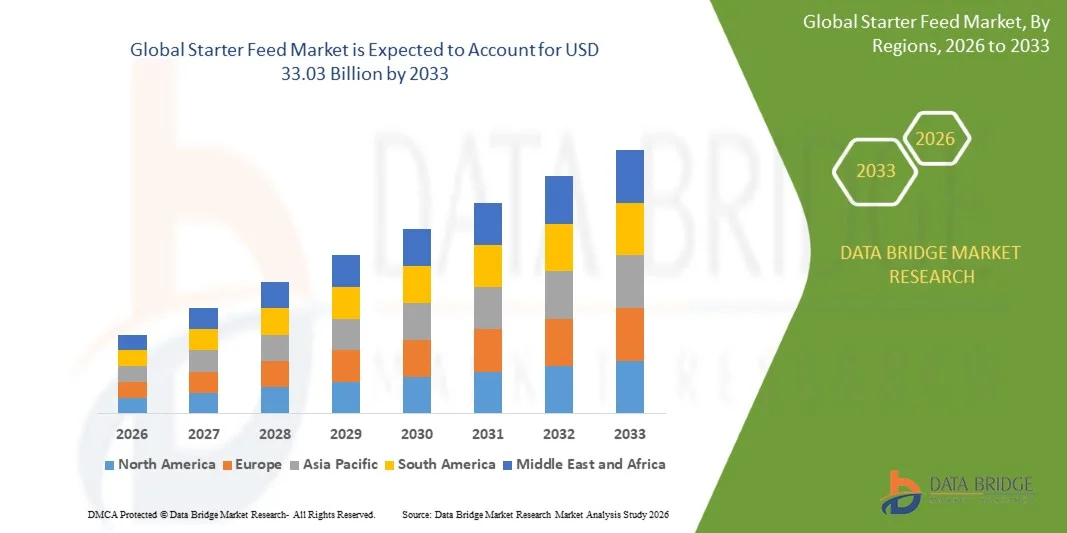
- As per Data Bridge Market Research analysis, the starter feed market was valued at USD 21.36 billion in 2025 and is projected to reach USD 33.03 billion by 2033, growing at a CAGR of 5.60% from 2026 to 2033.
- The market is experiencing consistent growth driven by rising demand for high-quality animal nutrition, increasing livestock and poultry production, and growing adoption of scientifically formulated starter feeds to support early-stage animal growth and productivity.
- The increasing focus on improving feed efficiency and animal health, combined with rising commercial livestock farming and growing demand for animal-based protein, is compelling farmers, feed manufacturers, and livestock producers to adopt specialized starter feed solutions. Nutrient-rich and performance-oriented starter feeds are increasingly replacing conventional feeding practices, offering improved growth, better feed conversion, and enhanced livestock productivity.
Market Size & Forecast
- Global Market Value (2025): USD 21.36 Billion
- Expected Market Value (2033): USD 33.03 Billion
- Forecast CAGR (2026–2033): 5.60%
- Leading Region in 2025: North America
- Fastest Growing Region: Asia Pacific
What are the Major Takeaways of the Starter Feed Market?
- North America dominated the starter feed market with the largest revenue share of 35.0% in 2025, supported by advanced livestock farming practices, high adoption of formulated animal feed, established feed manufacturing infrastructure, and strong demand for high-quality nutritional products.
- Asia-Pacific is expected to be the fastest-growing region at a CAGR of 9.0% from 2026 to 2033, fueled by expanding commercial livestock farming, rising meat consumption, and increasing adoption of formulated animal nutrition in China and India.
- The non-medicated segment led the market with a 58% share in 2025, driven by its broad application across poultry, swine, ruminants, and other livestock
- medicated are the fastest-growing type, projected to register a CAGR of 7.0%, reflecting the surge in emphasis on disease prevention and animal health management.
- The corn segment dominated the ingredient category with a 35% revenue share in 2025, led by its high energy content, digestibility, availability, and extensive use in commercial feed formulations.
- Poultry accounted for 40% of the market share in 2025, preferred by its ability to support rapid growth, efficient feed conversion, and healthy development during the early stages of production.
- The crumbles segment is the fastest-growing form category, with a CAGR of 7.2%, driven by increasing adoption in young poultry and other early-growth applications.
Report Scope and Starter Feed Market Segmentation
|
Attributes |
Starter Feed Key Market Insights |
|
Segments Covered |
|
|
Countries Covered |
North America
Europe
Asia-Pacific
Middle East and Africa
South America
|
|
Key Market Players |
|
|
Market Opportunities |
|
|
Value Added Data Infosets |
In addition to the insights on market scenarios such as market value, growth rate, segmentation, geographical coverage, and major players, the market reports curated by the Data Bridge Market Research also include import export analysis, production capacity overview, production consumption analysis, price trend analysis, climate change scenario, supply chain analysis, value chain analysis, raw material/consumables overview, vendor selection criteria, PESTLE Analysis, Porter Analysis, and regulatory framework. |
What is the Key Trend in the Starter Feed Market?
- Starter feed manufacturers are increasingly shifting toward functional and precision nutrition, incorporating probiotics, enzymes, phytogenics, amino acids, and other targeted additives to improve gut health, nutrient absorption, immunity, and feed efficiency during the critical early growth stage.
- For instance, in April 2025, Cargill launched Biostrong Dual in Brazil, combining postbiotics and essential oil compounds to accelerate gut microbiota maturation, improve nutrient digestibility, and enhance feed conversion and growth performance in poultry, particularly during the critical early-life stage.
- Advanced micro-pellet and precision-feed technologies are enabling manufacturers to deliver more accurately sized particles and species-specific nutrient profiles for young animals, improving nutrient availability and early-stage survival.
- Aquaculture producers are increasingly adopting specialized starter feeds, particularly micro-pellets, to improve survival rates and nutrient utilization during larval and fry stages as commercial aquaculture expands.
- For instance, in March 2025, Cargill presented new research showing that mycotoxin-contaminated poultry feed can disrupt beneficial gut bacteria, while its anti-mycotoxin solution helped support healthy microbiota development, highlighting the growing focus on functional feed solutions for animal health and performance.
- As livestock and aquaculture producers increasingly prioritize animal health, feed efficiency, and sustainable production, demand for functional, species-specific, and precision-formulated starter feeds is expected to accelerate, reinforcing early-stage nutrition as a key area of innovation
What are the Key Drivers of the Starter Feed Market?
- The rapid expansion of commercial livestock and poultry production has significantly increased demand for nutritionally balanced starter feeds capable of supporting early growth, improving feed conversion, and reducing mortality among young animals.
- For instance, in September 2025, De Heus opened a USD 17 million animal feed factory in Rajpura, Punjab, with an installed capacity of 180,000 metric tons annually and separate production lines for cattle, buffalo, poultry, and pig feed, reflecting increasing investment in India’s expanding commercial livestock sector.
- Rising global consumption of animal-based protein, including meat, milk, eggs, and aquaculture products, is encouraging producers to adopt specialized starter diets that improve animal productivity and shorten production cycles.
- Growing awareness of feed efficiency, animal health, and nutritional management is encouraging producers to replace conventional feeding practices with scientifically formulated starter feeds containing optimized proteins, minerals, vitamins, and functional additives.
- For instance, in July 2025, Wayne-Sanderson Farms opened a USD 43 million feed mill in Danville, Arkansas, designed to produce more than 8,500 tons of feed per week and support 130 family-farm partners, demonstrating continued investment in large-scale poultry production and feed manufacturing capacity
- With commercial livestock production continuing to intensify and producers seeking higher productivity from young animals, demand for specialized starter nutrition will remain an important driver of market expansion across poultry, swine, livestock, and aquaculture.
Which Factors are Challenging the Growth of the Starter Feed Market?
- Starter feed manufacturers face significant cost pressures because formulations depend heavily on commodities such as corn, soybean meal, fishmeal, vitamins, and other protein and energy ingredients, whose prices can fluctuate substantially.
- For instance, in September 2026, Indian feed producers faced rising maize and soybean meal costs, with broiler feed containing approximately 55–65% maize and 25–30% soybean meal, increasing production costs and putting upward pressure on poultry prices.
- These input-cost fluctuations can increase finished-feed prices, particularly affecting small and medium-sized livestock producers that operate with limited margins and have less purchasing power.
- Regulatory requirements surrounding feed safety, medicated feeds, antimicrobial use, labeling, and manufacturing practices can further increase compliance costs for feed manufacturers and restrict the use of certain formulations.
- For instance, in July 2025, Reuters reported that China’s soybean processors were facing high import costs and weak margins amid a domestic soymeal glut, while trade barriers and shifting soybean supplies created additional uncertainty for animal-feed producers and soybean markets.
- The combination of volatile raw-material prices, stringent feed-safety requirements, and increasing regulatory scrutiny of medicated and antimicrobial feeds can raise production costs and limit affordability, particularly in price-sensitive and emerging markets.
How is the Starter Feed Market Segmented?
The starter feed market is segmented on the basis of type, ingredient, livestock, form, and nature.
- By Type
On the basis of type, the starter feed market is segmented into medicated and non-medicated. The non-medicated segment dominated the market with 58% share in 2025, owing to its broad application across poultry, swine, ruminants, and other livestock. Non-medicated formulations provide essential nutrients without therapeutic antimicrobial compounds, making them suitable for routine early-stage nutrition. Growing emphasis on preventive animal-health management is encouraging producers to use nutritionally balanced feeds supported by probiotics, enzymes, amino acids, and other functional ingredients. Increasing restrictions on routine antimicrobial use are further strengthening demand for non-medicated alternatives. The segment is also supported by growing consumer preference for animal products produced with reduced antibiotic inputs. Its broad applicability and compatibility with modern feed-management practices are expected to maintain its leading position.
The medicated segment is projected to register the fastest growth at 7% CAGR during the forecast period, driven by increasing emphasis on disease prevention and animal health management. Medicated starter feeds are used to provide targeted support against specific health challenges affecting young animals during their early development stages. Young livestock and poultry are particularly susceptible to infectious diseases, increasing the need for effective preventive feeding strategies. The growing scale of intensive livestock production is further increasing demand for specialized animal-health solutions. Producers are increasingly focusing on reducing mortality, improving growth performance, and maintaining herd and flock health. Rising awareness regarding biosecurity and disease-control practices is also supporting adoption.
- By Ingredient
On the basis of ingredient, the starter feed market is segmented into wheat, corn, soybean, oats, barley, and other ingredients. The corn segment dominated the market with 35% share in 2025, owing to its high energy content, digestibility, availability, and extensive use in commercial feed formulations. Corn provides readily available carbohydrates that support rapid growth during the starter phase. Its established global supply chain makes it a preferred energy ingredient for poultry, swine, and other livestock diets. Corn is frequently combined with soybean meal and other protein ingredients to produce nutritionally balanced starter formulations. Large-scale commercial feed manufacturers also benefit from established processing and storage infrastructure for corn.
The soybean segment is expected to register the fastest growth at 5.2% CAGR during forecast period, supported by increasing demand for high-quality protein in starter diets. Soybean meal provides concentrated protein and a favorable amino-acid profile required for muscle development and early-stage animal growth. Its widespread application across poultry, swine, aquaculture, and other livestock systems strengthens its growth potential. Feed manufacturers are increasingly optimizing soybean-based formulations to improve digestibility and feed conversion. Rising global demand for meat, eggs, dairy, and aquaculture products is encouraging greater utilization of protein-rich feed ingredients
- By Livestock
On the basis of livestock, the starter feed market is segmented into ruminants, swine, poultry, aquatic, equine, and other animals. The poultry segment dominated the market with an 40% share in 2025, supported by the large global scale of commercial poultry production. Starter feed is particularly important for poultry because rapid early growth requires highly digestible and nutrient-dense nutrition. Commercial producers use specialized starter formulations to improve weight gain, feed conversion, flock uniformity, and early immune development. Rising consumption of chicken meat and eggs is encouraging expansion of intensive poultry production. Increasing adoption of scientifically formulated diets is further strengthening demand for specialized poultry starter feeds.
The aquatic segment is projected to register the fastest growth at 8.0% CAGR during forecast period, driven by continued expansion of commercial aquaculture and rising demand for fish and shrimp. Young aquatic species require specialized diets because their digestive systems and feeding capabilities are still developing. Manufacturers are increasingly producing micro-pellets and species-specific formulations to improve feed intake, nutrient utilization, and survival. Improvements in feed stability and nutrient delivery are helping reduce waste in intensive aquaculture systems. Growing hatchery activity is creating additional demand for specialized starter nutrition.
- By Form
On the basis of form, the starter feed market is segmented into pellets, crumbles, and other forms. The pellets segment dominated the market with 49% share in 2025, owing to uniform nutrient distribution, reduced feed wastage, convenient handling, and efficient storage. Pelletized feed allows producers to deliver consistent quantities of nutrients in every feeding. Its compatibility with automated feeding systems makes it particularly attractive to large commercial livestock operations. Pellets also reduce ingredient separation compared with loose feed mixtures. Their broad applicability across poultry, swine, ruminants, and aquaculture further supports market penetration. Established pellet-production infrastructure and continued investments in feed-processing technology are expected to preserve their leading position.
The crumbles segment is projected to register the fastest growth at 7.2% CAGR during forecast period, driven by increasing adoption in young poultry and other early-growth applications. Crumbled feed provides smaller particles that are easier for chicks and young animals to consume. The format supports early feed intake and can contribute to more uniform growth during the starter period. Feed manufacturers are increasingly optimizing crumble size and texture according to animal age and nutritional requirements. Rising commercial poultry production is creating additional demand for specialized starter formulations. Advances in feed-processing technologies are also improving crumble quality and consistency.
- By Nature
On the basis of nature, the starter feed market is segmented into organic and conventional. The conventional segment dominated the market with 75% share in 2025, supported by its broader availability, lower production costs, established supply chains, and extensive adoption across commercial livestock operations. Conventional starter feeds can incorporate a wide range of grains, protein meals, vitamins, minerals, enzymes, and other nutritional additives. Large-scale producers generally favor these formulations because they can be manufactured consistently at high volumes. Established availability of corn, wheat, soybean, and other conventional ingredients further supports the segment. Conventional feed also provides producers with greater flexibility in optimizing nutrient composition according to species and production stage.
The organic segment is projected to register the fastest growth at 6% CAGR during forecast period, driven by rising consumer interest in organic animal products and increasing preference for natural production systems. Organic starter feeds are formulated using ingredients that comply with applicable organic production standards. Demand is particularly strong in premium poultry, dairy, meat, and specialty livestock markets where organic certification can command higher product value. Growing awareness of antibiotic reduction, sustainable agriculture, and traceability is supporting producer interest in organic feed systems. Feed manufacturers are expanding their availability of certified organic grains, protein ingredients, and functional additives.
Which Region Holds the Largest Share of the Starter Feed Market?
- North America dominated the starter feed market with the largest revenue share of 35.0% in 2025, supported by advanced livestock farming practices, high adoption of formulated animal feed, established feed manufacturing infrastructure, and strong demand for high-quality nutritional products.
- The region also benefits from the presence of major feed manufacturers, advanced feed-processing technologies, and increasing adoption of specialized starter formulations for poultry, swine, and other livestock. Rising emphasis on animal health, feed efficiency, and high-quality nutrition, along with strong commercial farming practices, continues to strengthen North America’s leadership position in the global starter feed market.
U.S. Starter Feed Market Insight
The U.S. starter feed market is witnessing strong growth due to rising demand for high-quality animal nutrition, expanding commercial livestock and poultry production, and increasing adoption of specialized feeding programs. The country’s mature animal husbandry industry, along with the presence of major feed manufacturers and advanced feed-processing facilities, is driving demand across poultry, swine, dairy, and other livestock applications. In addition, growing emphasis on animal health, feed efficiency, and early-stage growth performance is accelerating the adoption of nutritionally balanced starter feed across commercial farming operations.
Asia-Pacific Starter Feed Market Insight
The Asia-Pacific starter feed market is expected to witness rapid growth, driven by expanding livestock and poultry production, rising meat and dairy consumption, and increasing investments in commercial animal farming across countries such as China, India, and Japan. Growing awareness regarding balanced animal nutrition, increasing adoption of formulated feed, and rising demand for efficient livestock production are supporting regional market expansion. In addition, the growing aquaculture industry, expansion of feed manufacturing infrastructure, and increasing focus on improving animal health and productivity are accelerating starter feed adoption across the region.
Japan Starter Feed Market Insight
The Japan starter feed market is witnessing consistent growth due to rising investments in advanced animal nutrition, livestock productivity, and efficient feeding technologies. Poultry, swine, and dairy producers are increasingly adopting specialized starter formulations to support healthy early-stage development, improve feed efficiency, and enhance animal performance. Moreover, increasing emphasis on animal health, feed quality, sustainable livestock production, and the integration of functional ingredients such as probiotics and enzymes are further contributing to market growth.
China Starter Feed Market Insight
The China starter feed market is growing rapidly, driven by expanding commercial livestock and poultry production, increasing demand for animal protein, and rising investments in modern feed manufacturing infrastructure. Growing adoption of nutritionally balanced and specialized starter formulations across poultry, swine, and aquaculture sectors is significantly boosting market demand. In addition, rising awareness regarding feed efficiency, animal health, disease prevention, and advanced feed formulation technologies is strengthening China's position as one of the fastest-growing markets for starter feed globally.
U.K. Starter Feed Market Insight
The U.K. starter feed market is experiencing steady growth, supported by rising adoption of specialized nutrition programs across poultry, livestock, and dairy production. Increasing investments in feed quality, animal health, and sustainable farming practices are contributing to market expansion. Furthermore, growing demand for functional ingredients, including probiotics, enzymes, amino acids, and other nutritional additives, is improving starter-feed performance and supporting efficient early-stage animal development, positioning the U.K. as an important market for advanced animal nutrition solutions.
Germany Starter Feed Market Insight
The Germany starter feed market is expanding steadily due to the country’s strong livestock production base, advanced animal nutrition capabilities, and increasing adoption of specialized feed formulations. Poultry, swine, and dairy producers are increasingly utilizing starter feeds to improve early growth, feed conversion, and overall animal health. Continuous advancements in feed formulation, increasing use of functional ingredients, and strong emphasis on sustainable livestock production and feed quality are further driving market growth in Germany.
Which are the Top Companies in Starter Feed Market?
The starter feed industry is primarily led by well-established companies, including:
- Cargill Incorporated (U.S.)
- ADM (U.S.)
- BASF SE (Germany)
- Evonik Industries AG (Germany)
- Charoen Pokphand Foods Public Company Limited (Thailand)
- Roquette Frères (France)
- Alltech (U.S.)
- Godrej Agrovet Limited (India)
- Associated British Foods plc (U.K.)
- Devenish Nutrition Limited (U.K.)
- De Heus Animal Nutrition B.V. (Netherlands)
- ForFarmers N.V. (Netherlands)
- Land O'Lakes, Inc. (U.S.)
- Kent Nutrition Group, Inc. (U.S.)
- The Scoular Company (U.S.)
- Tyson Foods, Inc. (U.S.)
- JAPFA Ltd. (Singapore)
- Guangdong Haid Group Co., Ltd. (China)
- New Hope Group (China)
- Wen's Food Group Co., Ltd. (China)
What are Latest Developments in Starter Feed Market?
- In May 2024, Cargill UK launched its Neopigg Shield range of piglet starter-feed diets, designed to support gut health, immunity, and disease resistance in piglets during the post-weaning period. The formulations were tailored to UK production systems and developed for the transition toward zinc-free feeding. Cargill reported that trials across commercial UK herds demonstrated improved piglet performance compared with zinc-oxide-based feeding programs.
- In March 2023, IFF launched Axtra PRIME in the United States, an optimized enzyme blend designed specifically to address key challenges in piglet production. The solution was developed to improve nutrient digestion and gut health while supporting piglet performance during the critical early-life feeding period. IFF highlighted the importance of targeted nutrition from an early age for successful swine production, making the launch relevant to the development of advanced starter-feed formulations.
- In January 2022, BASF expanded production capacity at its Ludwigshafen, Germany, enzyme plant to increase the availability of feed enzymes, including the recently launched Natupulse TS. The expansion increased production capability for enzymes used to improve feed-nutrient utilization and support more efficient animal protein production. Natupulse TS was particularly relevant to poultry and pig nutrition because its mannanase activity helps improve nutrient digestibility and feed efficiency.
- In December 2021, BASF launched Natupulse TS, a new mannanase enzyme for animal feed, designed to break down β-mannans and improve nutrient digestibility. The enzyme was developed to reduce digesta viscosity and improve the utilization of nutrients in animal diets, including poultry feed containing soybean meal. Its introduction supported the development of more efficient and sustainable feed formulations for growing animals.
- In October 2021, BioMar introduced a smaller 0.35-mm pellet size for its INICIO Plus starter feed, specifically designed for the first feeding of fry across several fish species. The smaller pellets were formulated to meet the nutritional requirements of very young fish while providing improved feeding performance, lower dust generation, and reduced feed waste. The product incorporated functional ingredients including probiotics and yeast fractions to support early growth and fry robustness

- Interactive Data Analysis Dashboard
- Company Analysis Dashboard for high growth potential opportunities
- Research Analyst Access for customization & queries
- Competitor Analysis with Interactive dashboard
- Latest News, Updates & Trend analysis
- Harness the Power of Benchmark Analysis for Comprehensive Competitor Tracking
Data collection and base year analysis are done using data collection modules with large sample sizes. The stage includes obtaining market information or related data through various sources and strategies. It includes examining and planning all the data acquired from the past in advance. It likewise envelops the examination of information inconsistencies seen across different information sources. The market data is analysed and estimated using market statistical and coherent models. Also, market share analysis and key trend analysis are the major success factors in the market report. To know more, please request an analyst call or drop down your inquiry.
The key research methodology used by DBMR research team is data triangulation which involves data mining, analysis of the impact of data variables on the market and primary (industry expert) validation. Data models include Vendor Positioning Grid, Market Time Line Analysis, Market Overview and Guide, Company Positioning Grid, Patent Analysis, Pricing Analysis, Company Market Share Analysis, Standards of Measurement, Global versus Regional and Vendor Share Analysis. To know more about the research methodology, drop in an inquiry to speak to our industry experts.
Data Bridge Market Research is a leader in advanced formative research. We take pride in servicing our existing and new customers with data and analysis that match and suits their goal. The report can be customized to include price trend analysis of target brands understanding the market for additional countries (ask for the list of countries), clinical trial results data, literature review, refurbished market and product base analysis. Market analysis of target competitors can be analyzed from technology-based analysis to market portfolio strategies. We can add as many competitors that you require data about in the format and data style you are looking for. Our team of analysts can also provide you data in crude raw excel files pivot tables (Fact book) or can assist you in creating presentations from the data sets available in the report.