


What is the Steel Piston Market Size and Growth Rate?
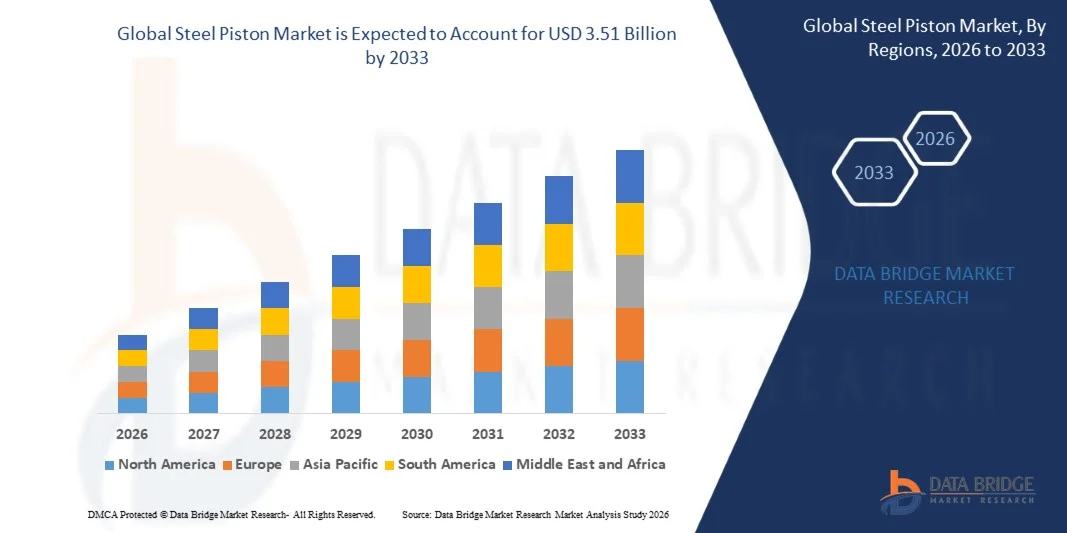
- As per Data Bridge Market Research analysis, the global Steel Piston market was valued at USD 2.55 Billion in 2025 and is projected to reach USD 3.51 Billion by 2033, growing at a CAGR of 4.10% from 2026 to 2033.
- The market is witnessing growth driven by the expansion of the global automotive industry, increasing demand for durable engine components, rising production of passenger and commercial vehicles, and growing adoption of steel pistons in high-performance and heavy-duty engines. Steel pistons offer high strength, durability, and heat resistance, making them suitable for engines operating under high pressure and temperature conditions.
- Advancements in piston manufacturing technologies, development of advanced thermal and oil-shedding coatings, increasing adoption in light and heavy commercial vehicles, and growing demand for high-performance and alternative-fuel engines are creating further growth opportunities. In addition, the focus on improving engine efficiency and reducing emissions is supporting the development of advanced steel piston designs and materials for modern internal combustion engines.
Market Size & Forecast
- Market Value (2025): USD 2.55 Billion
- Expected Market Value (2033): USD 3.51 Billion
- Forecast CAGR (2026–2033): 4.10%
- Leading Region in 2025: Asia Pacific
- Fastest Growing Region: North America
What are the Major Takeaways of the Steel Piston Market?
- Asia-Pacific dominated the global Steel Piston Market, accounting for a 42.75% market share in 2025, supported by the region's large automotive manufacturing base, high production of commercial vehicles, established component manufacturing ecosystem, and strong demand for durable engine components.
- North America is expected to be the fastest-growing region in the global Steel Piston Market with CAGR of 7.7% of 2026 to 2033, supported by increasing demand for high-performance engines, commercial vehicles, advanced engine components, and alternate-fuel applications.
- The Piston Head segment represented the leading component category, accounting for a 48.60% market share in 2025, supported by its direct exposure to combustion pressure and high temperatures and its importance in maintaining engine durability and performance.
- Thermal Barriers represented the leading coating type expected to register a CAGR of 4.90% from 2026 to 2033, driven by increasing requirements for thermal management, reduced heat transfer, improved piston durability, and enhanced engine efficiency.
- Passenger Cars represented the leading vehicle type, accounting for a 54.80% market share in 2025, supported by high global passenger vehicle production, continued use of internal combustion engines, increasing demand for fuel-efficient powertrains, and adoption of advanced piston technologies.
- Diesel represented the leading fuel type, accounting for a 51.40% market share in 2025, supported by the extensive use of diesel engines in high commercial vehicles, heavy-duty applications, construction equipment, and other applications requiring high durability and thermal resistance.
Report Scope Steel Piston Market Segmentation
|
Attributes |
Steel Piston Market Key Market Insights |
|
Segments Covered |
|
|
Countries Covered |
North America
Europe
Asia-Pacific
Middle East and Africa
South America
|
|
Key Market Players |
|
|
Market Opportunities |
|
|
Value Added Data Infosets |
In addition to the market insights such as market value, growth rate, market segments, geographical coverage, market players, and market scenario, the market report curated by the Data Bridge Market Research team includes in-depth expert analysis, import/export analysis, pricing analysis, production consumption analysis, and pestle analysis. |
What is the Key Trend in the Steel Piston Market?
- Increasing adoption of advanced steel piston technologies for high-performance, high-temperature, and alternative-fuel engines is emerging as a key trend in the global steel piston market. Manufacturers are developing steel piston designs with enhanced heat resistance, durability, optimized cooling, and lower friction to support increasingly demanding engine operating conditions. The trend is particularly relevant to diesel engines, commercial vehicles, heavy-duty applications, and emerging hydrogen and renewable-fuel powertrains.
- The trend is being reinforced by increasing requirements for engine efficiency, emission reduction, higher combustion pressures, and improved durability. Advanced coatings, including thermal-barrier, dry-film lubricant, and oil-shedding coatings, are being incorporated into piston systems to improve thermal management, reduce friction, and extend component life.
- For instance, in October 2025, MAHLE highlighted the continued role of piston technology in hydrogen and renewable-fuel engines through its updated piston-themed installation at its Stuttgart headquarters. The company stated that advanced hydrogen engines continue to rely on pistons as central engine components, particularly for large-engine applications such as power generation and marine propulsion.
- Advanced forging and selective hardening are also being used to reduce weight while maintaining the strength and thermal performance required for demanding applications. The trend is particularly relevant to commercial vehicles, heavy-duty engines, and alternative-fuel powertrains, where high combustion pressures and operating temperatures require piston materials with strong mechanical and thermal properties.
What are the Key Drivers of the Steel Piston Market?
- Increasing demand for high-strength and high-temperature-resistant engine components is emerging as a key driver of the global steel piston market. Modern diesel and high-performance internal combustion engines are operating at higher cylinder pressures and temperatures, increasing the need for piston materials that can withstand severe mechanical and thermal loads.
- Steel pistons offer higher strength, durability, and lower thermal expansion compared with conventional aluminum pistons, supporting their adoption in heavy-duty commercial vehicles, passenger vehicles, and high-output engine applications. MAHLE states that steel piston applications can experience ignition pressures of up to 300 bar, making high-strength steel designs increasingly important for advanced engines.
- The trend is being reinforced by increasing requirements for fuel efficiency, lower friction, reduced emissions, and longer engine service life. Steel pistons enable compact designs and can reduce friction-related losses because of their lower thermal expansion, while their high structural strength allows engines to operate under higher combustion pressures. These characteristics are supporting the use of steel piston technologies as engine manufacturers seek to improve efficiency while meeting increasingly stringent emissions requirements.
- For instance, in April 2026, Cummins inc. Received publication of a U.S. patent application for h11 and h13 steel piston technology, covering the use of these high-temperature-resistant steel alloys in piston crowns and skirts. The technology is designed to improve elevated-temperature oxidation resistance and durability in high-power-density internal combustion engines. The development highlights ongoing industry efforts to improve steel piston performance under increasingly severe thermal conditions.
- Advancements in piston coatings and cooling technologies are further supporting market growth. Steel pistons are increasingly combined with graphite, anti-friction, thermal-barrier, and other surface treatments to improve running-in performance, reduce friction and wear, and manage heat. MAHLE'S 2025 technical documentation states.
Which Factors are Challenging the Growth of the Steel Piston Market?
- Increasing raw material price volatility and manufacturing costs are emerging as key challenges in the global steel piston market. Steel pistons require high-strength steel and specialized alloy materials, while forging, friction welding, laser welding, precision machining, and coating processes can increase production costs compared with conventional piston materials. Fluctuations in steel prices and supply conditions can further pressure manufacturers' margins.
- Weight reduction remains a significant technical challenge because steel has a higher density than aluminum. Although steel provides high strength, durability, and resistance to high combustion pressures, its higher density can increase piston weight and affect engine efficiency.
- Increasing emission requirements and the transition toward vehicle electrification are creating long-term challenges for the steel piston industry. Manufacturers are required to improve piston efficiency, reduce friction, manage higher combustion temperatures, and support cleaner internal combustion engines.
- For instance, in January 2025, research published in scientific reports focused on the lightweight design of steel pistons for diesel engines based on thermo-mechanical characteristics. The study highlighted the need to reduce piston weight while maintaining adequate mechanical strength and thermal performance, demonstrating the continuing engineering challenge associated with the higher density of steel.
- These conditions can affect the cost and availability of steel inputs used in piston manufacturing while increasing pressure on automotive component manufacturers to reduce the environmental footprint of their supply chains.
How is the Steel Piston Market Segmented?
The market is segmented on the basis of component, coating type, vehicle type, fuel type, and shape.
- By Component
On the basis of component, the global steel piston market is segmented into piston head, piston ring, and piston pin. The piston head segment is expected to represent a leading component category, accounting for a 48.60% market share in 2025, supported by its critical role in withstanding combustion pressure and high temperatures. The segment is also supported by increasing demand for forged and lightweight steel piston heads in high-performance and heavy-duty engines.
The piston pin segment is expected to witness significant growth during the forecast period, growing at a CAGR of 4.70% from 2026 to 2033, supported by increasing demand for durable engine components, higher engine operating pressures, and growing adoption of advanced piston designs. The Steel Piston Market sources confirm Piston Head, Piston Ring, and Piston Pin as the major component categories.
- By Coating Type
On the basis of coating type, the global steel piston market is segmented into dry film lubricant, thermal barriers, and oil shedding coatings. The thermal barriers segment is expected to account for a leading 43.20% market share in 2025, supported by the increasing need for improved thermal protection, heat management, and durability under high combustion temperatures. Advanced coating technologies are increasingly being used to enhance piston performance in demanding engine applications.
The dry film lubricant segment is expected to register a CAGR of 4.90% from 2026 to 2033, driven by increasing focus on friction reduction, improved fuel efficiency, reduced wear, and longer component life. Thermal barriers, dry film lubricants, and oil-shedding coatings are specifically identified as the major coating categories in the Steel Piston Market.
- By Vehicle Type
On the basis of vehicle type, the global steel piston market is segmented into passenger cars, light commercial vehicle (LCV), and high commercial vehicle (HCV). the passenger cars segment is expected to account for a 54.80% market share in 2025, supported by the large global installed base of internal combustion engine passenger vehicles and continued demand for gasoline and hybrid powertrains incorporating combustion engines.
The high commercial vehicle (HCV) segment is expected to witness a significant CAGR of 4.80% from 2026 to 2033, supported by increasing demand for heavy-duty engines, commercial transportation, logistics, construction, and long-distance freight operations. Steel pistons are particularly relevant to heavy-duty applications because of their strength, durability, and ability to withstand high combustion pressures and temperatures.
- By Fuel Type
On the basis of fuel type, the global steel piston market is segmented into Gasoline, Diesel, and Alternate Fuel. The Diesel segment is expected to represent a leading fuel category, accounting for a 51.40% market share in 2025, supported by the continued use of high-pressure diesel engines in commercial vehicles, heavy-duty trucks, construction equipment, and other demanding applications.
The Alternate Fuel segment is expected to grow at a CAGR of 5.10% from 2026 to 2033, supported by increasing adoption of CNG, LPG, ethanol blends, biodiesel, and other alternative fuels in internal combustion engines. The development of pistons capable of operating under different combustion conditions is expected to create additional demand for advanced steel piston technologies.
- By Shape
On the basis of shape, the global steel piston market is segmented into flat-top piston, bowl piston, and dome piston. The bowl piston segment is expected to account for a 46.30% market share in 2025, supported by its application in diesel and direct-injection engines, where piston bowl geometry contributes to combustion control, fuel-air mixing, and engine performance.
The bowl piston segment is also expected to grow at a CAGR of 4.90% from 2026 to 2033, driven by continued development of direct-injection and high-pressure combustion technologies. The bowl-shaped pistons are important in GDI engine applications because their geometry can support turbulence, fuel atomization, and airflow during combustion.
Which Region Holds the Largest Share of the Steel Piston Market?
- Asia-Pacific dominated the global steel piston market in 2025, accounting for a 42.75% market share, supported by the region's large automotive manufacturing base, expanding production of passenger and commercial vehicles, growing demand for diesel and high-performance engines, and the presence of major steel piston manufacturers across countries such as China, India, Japan, South Korea, and Taiwan. The region's established automotive component supply chains and increasing investments in advanced engine technologies further support demand for steel pistons.
- North America is expected to grow at a CAGR of 7.7% from 2026 to 2033, supported by increasing vehicle production, expansion of commercial transportation, growing demand for high-performance and heavy-duty engines, and continued use of internal combustion engines across automotive and industrial applications. Increasing investments in advanced piston manufacturing, thermal-management technologies, and alternative-fuel engine systems are also expected to support regional market development.
U.S. Steel Piston Market Insight
The U.S. Steel piston market is supported by the country’s established automotive manufacturing base, strong demand for passenger vehicles, pickup trucks, and commercial vehicles, and continued use of internal combustion and hybrid powertrains. Demand for durable steel pistons is further supported by turbocharged and high-performance engines that require greater thermal resistance and strength. In addition, replacement demand from the aging vehicle fleet and advancements in piston coatings and lightweight steel designs are supporting market opportunities. However, increasing vehicle electrification and changing powertrain technologies are expected to influence long-term demand for conventional piston components.
Europe Steel Piston Market Insight
The Europe steel piston market is witnessing steady growth, supported by the region’s established automotive manufacturing industry, strong presence of premium and commercial vehicle manufacturers, and increasing demand for durable and high-performance engine components. Countries such as Germany, France, Italy, the U.K., and Spain contribute significantly to regional demand through their automotive and industrial manufacturing bases. Increasing focus on fuel efficiency, emission reduction, lightweight engine components, and advanced thermal-management technologies is encouraging the development of innovative steel piston designs. In addition, continued demand for internal combustion engines in commercial and hybrid vehicles is supporting market opportunities across Europe.
U.K. Steel Piston Market Insight
The U.K. steel piston market is supported by an established automotive manufacturing and aftermarket ecosystem, with demand for steel pistons sustained by vehicle maintenance, engine servicing, and replacement applications. The U.K. automotive industry produced more than 717,000 cars and 47,000 commercial vehicles in 2025, supporting demand for engine components and related supply chains. However, gradual vehicle electrification is expected to moderate long-term demand for conventional piston-based powertrains. The U.K. automotive sector continued its transition toward electric and electrified vehicles, while aftermarket and remanufacturing activities provided ongoing opportunities for piston manufacturers.
Germany Steel Piston Market Insight
The Germany steel piston market is supported by the country’s strong automotive manufacturing base, established engine-component industry, and demand for high-performance and heavy-duty engine technologies. Germany recorded new passenger-car registrations, while domestic passenger-car production increased, supporting demand for advanced engine components. However, the transition toward electric mobility and declining automotive industrial production present challenges for conventional piston demand.
Asia-Pacific Steel Piston Market Insight
The Asia-pacific steel piston market is witnessing steady growth, supported by the region’s strong automotive manufacturing base, expanding commercial vehicle production, and continued demand for high-performance internal combustion engines. Countries such as China, India, Japan, and south Korea are major contributors due to established automotive component industries and increasing investments in advanced engine technologies. Rising demand for fuel-efficient and durable engine components, growth in logistics and transportation, and development of heavy-duty vehicles are further supporting market expansion. In addition, advancements in lightweight steel pistons, thermal-management technologies, and alternative-fuel engines are creating opportunities for manufacturers across the region.
Japan Steel Piston Market Insight
The Japan steel piston market is supported by the country's advanced automotive manufacturing industry, strong presence of automotive component manufacturers, and continued development of high-efficiency internal combustion engines. Demand for steel pistons is being supported by applications in passenger cars, commercial vehicles, and high-performance engine systems, particularly where durability, thermal resistance, and high-pressure performance are required. Increasing investments in lightweight piston designs, advanced coatings, and thermal-management technologies are further supporting market development. In addition, Japan's focus on fuel efficiency, lower emissions, and advanced powertrain technologies is encouraging innovation in high-performance piston systems.
China Steel Piston Market Insight
The China steel piston market is witnessing steady growth, supported by the country's large automotive manufacturing base, extensive commercial vehicle production, and established automotive component supply chain. Increasing demand for high-strength and durable engine components is supporting the adoption of steel pistons in passenger cars, commercial vehicles, and heavy-duty applications. The expansion of manufacturing activities and continued development of high-efficiency internal combustion engines are further supporting market opportunities. In addition, investments in advanced piston designs, thermal management, lightweight steel technologies, and alternative-fuel engines are expected to create new growth opportunities for steel piston manufacturers in China.
Which are the Top Companies in Steel Piston Market?
The Steel Piston market industry is primarily led by well-established companies, including:
- Federal-Morgul Corporationv (U.S.)
- Mahle GmbH (Germany)
- Shriram Pistons & Rings Ltd. (India)
- Aisin Corporation (Japan)
- Rheinmetall AGv (Germany)
- Ming Shun Industrial Co., Ltd (China)
- Elgin Industries (U.S.)
- SAMKRG (India)
- PIERBURG, S.A. (Germany)
- Abilities India Pistons & Rings Ltd. (India)
- Paramount Pistonts (india)
- Arias Pistons (U.S.)
- Burgess-Norton (U.S.)
- Ross Racing Pistons (U.S.)
What are Latest Developments in Steel Piston Market?
- In April 2026, Shriram Pistons & Rings Limited announced the transfer of its long-standing license agreements with Kolbenschmidt Pistons Germany to Kolbenschmidt Pistons Management GmbH following a strategic restructuring. The agreements cover the use of know-how, patents, and trademarks for manufacturing and selling pistons for internal combustion engines. The collaboration has been in place for more than six decades and provides Shriram access to piston manufacturing technologies and technical know-how.
- In September 2025, Aisin Corporation continued development of steel piston technologies for hydrogen internal combustion engines. Industry reporting indicates that Aisin developed stainless-steel piston variants for hydrogen engines, where the higher combustion temperature of hydrogen creates greater requirements for ring-groove durability and thermal resistance. This development highlights opportunities for steel piston technologies in alternative-fuel powertrains.
- In September 2025, Tenneco continued advancing its Monosteel 4 friction-welded one-piece steel piston technology for large-bore engines. The technology is designed for commercial-vehicle and heavy-duty diesel applications and supports piston diameters of up to 220 mm. The development reflects continued demand for durable steel piston solutions capable of operating under high combustion loads.
- In September2026, KS Kolbenschmidt Pistons, part of the Rheinmetall Automotive business, continued expanding steel piston applications for heavy-duty engines and emerging hydrogen internal combustion engine programs. Industry reports indicate that Rheinmetall expanded steel piston production capacity in Germany and worked on supply programs for heavy-duty hydrogen ICE prototypes, supporting the use of steel piston systems in future lower-carbon combustion applications.
- In September 2025, Hitachi Astemo continued supplying and developing piston solutions for automotive engine applications, including steel-material technologies for OEM programs. Its piston activities cover engine applications requiring high durability and performance, supporting continued demand for advanced piston materials as manufacturers seek improved efficiency and emissions performance.

- Interactive Data Analysis Dashboard
- Company Analysis Dashboard for high growth potential opportunities
- Research Analyst Access for customization & queries
- Competitor Analysis with Interactive dashboard
- Latest News, Updates & Trend analysis
- Harness the Power of Benchmark Analysis for Comprehensive Competitor Tracking
Data collection and base year analysis are done using data collection modules with large sample sizes. The stage includes obtaining market information or related data through various sources and strategies. It includes examining and planning all the data acquired from the past in advance. It likewise envelops the examination of information inconsistencies seen across different information sources. The market data is analysed and estimated using market statistical and coherent models. Also, market share analysis and key trend analysis are the major success factors in the market report. To know more, please request an analyst call or drop down your inquiry.
The key research methodology used by DBMR research team is data triangulation which involves data mining, analysis of the impact of data variables on the market and primary (industry expert) validation. Data models include Vendor Positioning Grid, Market Time Line Analysis, Market Overview and Guide, Company Positioning Grid, Patent Analysis, Pricing Analysis, Company Market Share Analysis, Standards of Measurement, Global versus Regional and Vendor Share Analysis. To know more about the research methodology, drop in an inquiry to speak to our industry experts.
Data Bridge Market Research is a leader in advanced formative research. We take pride in servicing our existing and new customers with data and analysis that match and suits their goal. The report can be customized to include price trend analysis of target brands understanding the market for additional countries (ask for the list of countries), clinical trial results data, literature review, refurbished market and product base analysis. Market analysis of target competitors can be analyzed from technology-based analysis to market portfolio strategies. We can add as many competitors that you require data about in the format and data style you are looking for. Our team of analysts can also provide you data in crude raw excel files pivot tables (Fact book) or can assist you in creating presentations from the data sets available in the report.













