


Stereotactic Radiosurgery (SRS) Market Size
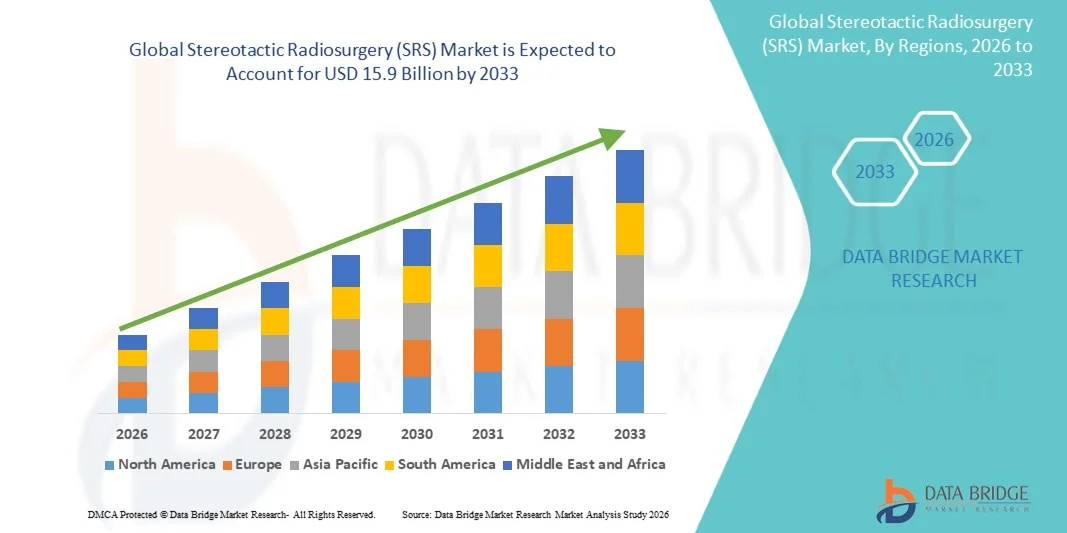
- The global stereotactic radiosurgery (SRS) market size was valued at USD 8.6 billion in 2025and is expected to reach USD 15.9 billion by 2033, at a CAGR of 8.1% during the forecast period
- Growth is driven by increasing prevalence of neurological disorders and cancer cases requiring non-invasive treatment options
- Rising adoption of precision radiotherapy technologies across developed and emerging healthcare systems is accelerating market expansion
Stereotactic Radiosurgery (SRS) Market Analysis
- Stereotactic radiosurgery (SRS) is a highly precise, non-invasive radiation therapy used primarily for treating brain tumors and neurological conditions, offering advantages such as minimal recovery time, high accuracy, and reduced complications
- The demand for SRS is increasing due to the rising burden of cancer, particularly brain metastases, and the growing preference for minimally invasive treatment options
- Advancements in imaging technologies, AI-assisted treatment planning, and real-time tumor tracking are enhancing treatment outcomes and expanding clinical applications
- North America dominated the SRS market with the largest revenue share of 38.2% in 2025, supported by advanced healthcare infrastructure, high adoption of innovative technologies, and strong presence of key market players
- Asia-Pacific is expected to be the fastest-growing region due to increasing healthcare investments, rising cancer incidence, and improving access to advanced treatment technologies
- The LINAC-based SRS segment dominated the market with a share of 42.5% in 2025, driven by its versatility, cost-effectiveness, and widespread adoption in hospitals.
Report Scope and Stereotactic Radiosurgery (SRS) Market Segmentation
|
Attributes |
Stereotactic Radiosurgery (SRS) Key Market Insights |
|
Segments Covered |
|
|
Countries Covered |
North America · U.S. · Canada · Mexico Europe · Germany · France · U.K. · Netherlands · Switzerland · Belgium · Russia · Italy · Spain · Turkey · Rest of Europe Asia-Pacific · China · Japan · India · South Korea · Singapore · Malaysia · Australia · Thailand · Indonesia · Philippines · Rest of Asia-Pacific Middle East and Africa · Saudi Arabia · U.A.E. · South Africa · Egypt · Israel · Rest of Middle East and Africa South America · Brazil · Argentina · Rest of South America |
|
Key Market Players |
· Elekta AB (Sweden) · Varian Medical Systems, Inc. (U.S.) · Accuray Incorporated (U.S.) · Siemens Healthineers AG (Germany) · Brainlab AG (Germany) · ViewRay, Inc. (U.S.) · Hitachi Ltd. (Japan) · Mitsubishi Electric Corporation (Japan) · IBA Worldwide (Belgium) · Canon Medical Systems Corporation (Japan) · GE HealthCare (U.S.) · Panacea Medical Technologies (India) · Mevion Medical Systems (U.S.) · Sumitomo Heavy Industries Ltd. (Japan) · Nordion Inc. (Canada) · Advanced Oncotherapy plc (U.K.) · RaySearch Laboratories AB (Sweden) · CIVCO Radiotherapy (U.S.) · ProTom International (U.S.) · Shinva Medical Instrument Co., Ltd. (China) |
|
Market Opportunities |
· Increasing demand for non-invasive cancer treatment solutions · Expansion of radiotherapy infrastructure in emerging economies · Integration of AI and image-guided technologies in SRS systems |
|
Value Added Data Infosets |
In addition to the insights on market scenarios such as market value, growth rate, segmentation, geographical coverage, and major players, the market reports curated by the Data Bridge Market Research also include in-depth expert analysis, patient epidemiology, pipeline analysis, pricing analysis, and regulatory framework. |
Stereotactic Radiosurgery (SRS) Market Trends
“Growing Adoption of Precision, Image-Guided, and Non-Invasive Treatment Technologies”
- A significant and accelerating trend in the global stereotactic radiosurgery (SRS) market is the growing shift toward highly precise, image-guided, and non-invasive radiation therapies that enhance treatment accuracy while minimizing damage to surrounding healthy tissues across multiple clinical applications
- For instance, companies such as Elekta AB and Accuray Incorporated are increasingly developing advanced SRS systems integrated with real-time imaging and robotic-assisted technologies to improve tumor targeting and treatment efficiency
- Technological advancements in imaging, treatment planning software, and radiation delivery systems are enabling the development of SRS solutions with improved precision, dose accuracy, and adaptability across a wide range of neurological and oncological applications
- The increasing adoption of minimally invasive treatment procedures and outpatient radiosurgery is supporting the demand for SRS systems that enhance patient safety, reduce hospitalization time, and improve clinical outcomes
- This trend toward high-precision and patient-centric treatment solutions is reshaping industry expectations for clinical effectiveness, regulatory compliance, and treatment standardization across healthcare systems
- The demand for advanced SRS systems with improved automation, AI integration, and workflow efficiency is growing rapidly across both developed and emerging economies, driven by increasing cancer incidence and healthcare modernization initiatives
- Increasing adoption of personalized and targeted radiation therapies is gaining traction due to rising demand for effective, low-risk treatment alternatives to conventional surgical procedures
Stereotactic Radiosurgery (SRS) Market Dynamics
Driver
“Rising Demand for Minimally Invasive and High-Precision Cancer Treatment”
- The increasing demand for non-invasive and highly accurate treatment solutions, coupled with the rising prevalence of brain tumors and neurological disorders, is a major driver fueling the growth of the stereotactic radiosurgery (SRS) market globally
- For instance, healthcare systems in regions such as Europe and North America are increasingly adopting advanced radiotherapy technologies to improve treatment outcomes and reduce surgical risks
- As healthcare providers focus more on improving patient outcomes and reducing recovery time, SRS systems offer high precision, minimal complications, and enhanced treatment efficiency compared to conventional surgical approaches
- Furthermore, the growing shift toward outpatient care and advanced oncology treatment methods, supported by rising healthcare expenditure and technological innovation, is increasing the adoption of SRS across healthcare facilities
- The versatility of SRS across applications such as brain tumors, metastatic cancers, and neurological disorders, along with its ability to deliver targeted radiation, is driving widespread adoption
- Expanding healthcare infrastructure and rising investments in oncology treatment centers in emerging economies are further supporting market expansion
- Government initiatives and funding programs promoting advanced cancer treatment technologies are accelerating investments and adoption of SRS systems globally
Restraint/Challenge
“High Cost of Equipment and Limited Accessibility”
- Challenges related to the higher cost of stereotactic radiosurgery (SRS) compared to paraffin Challenges related to the high cost of SRS systems and treatment procedures pose significant barriers to large-scale adoption, particularly in cost-sensitive and developing regions
- For instance, installation and maintenance of advanced systems such as Gamma Knife and proton therapy equipment require substantial capital investment and specialized infrastructure
- Addressing these challenges through technological innovation, cost optimization, and increased public-private partnerships is critical for enhancing accessibility and market penetration
- While demand for advanced treatment solutions is increasing, limited availability of skilled professionals and technical expertise may restrict adoption in certain regions
- Overcoming these challenges through training programs, automation, and improved system usability will be essential for long-term market growth, while infrastructure limitations can impact treatment availability
- Stringent regulatory requirements and long approval timelines can also increase compliance costs and complexity for manufacturers, potentially affecting product commercialization and adoption rates
Stereotactic Radiosurgery (SRS) Market Scope
The market is segmented on the basis of technology, application, end user, component, and treatment type.
- By Technology
On the basis of technology, the global stereotactic radiosurgery (SRS) market is segmented into Gamma Knife, Linear Accelerator (LINAC), Proton Beam Therapy, CyberKnife, and others. The Linear Accelerator (LINAC) segment dominated the market with the largest revenue share of approximately 42.5% in 2025, driven by its widespread adoption across hospitals and cancer treatment centers due to its versatility, cost-effectiveness, and ability to treat both intracranial and extracranial tumors. LINAC systems are widely preferred due to their integration with advanced imaging technologies and flexibility in delivering fractionated treatments. Continuous advancements in treatment planning software and imaging capabilities are further strengthening segment dominance globally.
The Proton Beam Therapy segment is expected to witness the fastest growth during the forecast period, fueled by increasing demand for highly precise radiation therapy with minimal damage to surrounding healthy tissues. Its growing adoption in complex tumor treatments, especially pediatric cancers, is driving demand. Technological advancements and increasing investments in proton therapy centers are enhancing accessibility and expanding its clinical applications, further accelerating segment growth globally.
- By Application
On the basis of application, the market is segmented into brain tumors, metastatic tumors, arteriovenous malformations (AVMs), trigeminal neuralgia, functional disorders, and others. The brain tumors segment dominated the market with the largest revenue share in 2025, driven by the high prevalence of primary brain tumors and the effectiveness of SRS in delivering targeted, non-invasive treatment. SRS is widely used in treating benign and malignant brain tumors due to its precision and reduced recovery time. Increasing awareness and early diagnosis are further supporting segment growth globally.
The metastatic tumors segment is expected to witness the fastest growth during the forecast period, fueled by the rising incidence of cancer metastasis to the brain. Increasing use of SRS as a preferred treatment option for multiple metastases due to its ability to deliver focused radiation is driving adoption. Advancements in imaging and treatment planning technologies are further enhancing treatment outcomes and supporting segment growth.
- By End User
On the basis of end user, the market is segmented into hospitals, specialty clinics, ambulatory surgical centers, and cancer research institutes. The hospitals segment dominated the market with the largest revenue share in 2025, driven by the availability of advanced infrastructure, skilled professionals, and integrated oncology treatment facilities. Hospitals are the primary centers for SRS procedures due to their ability to handle complex cases and provide comprehensive care. Increasing investments in hospital-based radiotherapy units are further strengthening segment dominance globally.
The ambulatory surgical centers segment is expected to witness the fastest growth during the forecast period, fueled by the growing trend toward outpatient procedures and cost-effective treatment options. These centers offer reduced hospital stays and faster treatment turnaround, making them increasingly attractive for patients. Technological advancements enabling compact and efficient SRS systems are further supporting segment growth.
- By Component
On the basis of component, the market is segmented into equipment, software, and services. The equipment segment dominated the market with the largest revenue share in 2025, driven by the high cost of SRS systems such as Gamma Knife and LINAC machines. Increasing installation of advanced radiotherapy systems in hospitals and cancer centers is contributing to segment growth. Continuous innovation in hardware design and radiation delivery systems is further strengthening segment dominance globally.
The software segment is expected to witness the fastest growth during the forecast period, fueled by increasing adoption of AI-based treatment planning and imaging solutions. Software plays a critical role in enhancing precision, workflow efficiency, and treatment outcomes. Advancements in automation and real-time data integration are further accelerating segment growth globally.
- By Treatment Type
On the basis of treatment type, the market is segmented into single session radiosurgery and fractionated radiosurgery. The single session radiosurgery segment dominated the market with the largest revenue share in 2025, driven by its convenience, high precision, and effectiveness in treating small to medium-sized tumors in a single procedure. It reduces hospital visits and improves patient compliance, making it widely preferred across healthcare settings.
The fractionated radiosurgery segment is expected to witness the fastest growth during the forecast period, fueled by its increasing use in treating larger or more complex tumors where gradual radiation delivery is required. It allows better preservation of surrounding healthy tissues and reduces side effects. Advancements in treatment planning and imaging technologies are further supporting segment growth globally.
Stereotactic Radiosurgery (SRS) Market Regional Analysis
- North America dominated the stereotactic radiosurgery (SRS) market with the largest revenue share of 38.2% in 2025, supported by advanced healthcare infrastructure, high adoption of precision radiotherapy technologies, and strong presence of leading market players across the U.S. and Canada. The region benefits from early adoption of advanced treatment systems such as Gamma Knife, CyberKnife, and LINAC-based radiosurgery, along with strong clinical expertise and research capabilities
- Healthcare providers and end-use industries in the region place significant emphasis on integrating advanced imaging technologies, AI-based treatment planning systems, and high-precision radiation delivery solutions, leading to widespread utilization of SRS technologies across hospitals and specialized cancer centers across both public and private healthcare systems
- This strong market position is further supported by favorable reimbursement frameworks, high healthcare expenditure, and increasing prevalence of brain tumors and metastatic cancers, along with continuous technological advancements, establishing SRS as a critical component in modern cancer treatment frameworks across developed economies
U.S. Stereotactic Radiosurgery (SRS) Market Insight
The U.S. stereotactic radiosurgery (SRS) market captured the largest revenue share of 78.4% in 2025 within North America, driven by high adoption of advanced radiotherapy systems, strong presence of key market players, and well-established healthcare infrastructure. Healthcare providers increasingly prioritize precision-based and minimally invasive treatment solutions to improve patient outcomes. The growing prevalence of neurological disorders and cancer cases, along with favorable reimbursement frameworks and strong clinical research ecosystem, continues to propel market growth. Moreover, continuous technological advancements and integration of AI-based treatment planning systems significantly contribute to sustained market expansion
Europe Stereotactic Radiosurgery (SRS) Market Insight
The Europe stereotactic radiosurgery (SRS) market is projected to expand at a steady CAGR throughout the forecast period, primarily driven by increasing adoption of precision oncology, strong healthcare systems, and rising demand for advanced radiotherapy treatments. Healthcare providers across Europe emphasize early diagnosis and high-quality treatment solutions, fostering consistent adoption of SRS technologies across hospitals and specialized cancer centers. Growth is supported by regulatory frameworks, technological advancements, and increasing investments in radiotherapy infrastructure
U.K. Stereotactic Radiosurgery (SRS) Market Insight
The U.K. stereotactic radiosurgery (SRS) market is anticipated to grow at a notable CAGR during the forecast period, supported by increasing adoption of advanced cancer treatment technologies and strong public healthcare system capabilities. Rising focus on reducing invasive surgical procedures and improving patient outcomes through minimally invasive treatment options is driving demand for SRS systems. In addition, expanding investments in oncology care and radiotherapy infrastructure enhance market growth across the country
Germany Stereotactic Radiosurgery (SRS) Market Insight
The Germany stereotactic radiosurgery (SRS) market is expected to expand at a considerable CAGR during the forecast period, driven by strong focus on technological innovation and advanced healthcare delivery systems. Germany’s leadership in medical technology and emphasis on precision treatment solutions support the adoption of advanced SRS systems across hospitals and specialized oncology centers. Continuous advancements in imaging and radiation delivery technologies are further enhancing treatment efficiency and expanding application scope
Asia-Pacific Stereotactic Radiosurgery (SRS) Market Insight
The Asia-Pacific stereotactic radiosurgery (SRS) market is poised to grow at the fastest CAGR during the forecast period of 2026 to 2033, driven by increasing cancer incidence, improving healthcare infrastructure, and rising investments in oncology treatment technologies. Countries such as China, India, and Japan play a key role in the expansion of advanced radiotherapy technologies. Rising awareness regarding minimally invasive treatment options and increasing availability of modern healthcare facilities are accelerating market growth across the region
Japan Stereotactic Radiosurgery (SRS) Market Insight
The Japan stereotactic radiosurgery (SRS) market is gaining momentum due to increasing focus on advanced medical technologies and precision oncology treatments. The country’s early adoption of innovative radiotherapy systems and strong emphasis on high-quality healthcare services are driving demand. Integration of advanced imaging systems and continuous innovation in treatment planning are further enhancing clinical outcomes and expanding application scope
India Stereotactic Radiosurgery (SRS) Market Insight
The India stereotactic radiosurgery (SRS) market accounted for a significant revenue share in Asia-Pacific in 2025, attributed to increasing cancer burden, expanding healthcare infrastructure, and rising adoption of advanced treatment technologies. Growing awareness regarding non-invasive treatment options and improving access to radiotherapy services are driving adoption. Government initiatives and increasing private sector investments in oncology care are key factors supporting sustained market expansion in India
Stereotactic Radiosurgery (SRS) Market Share
The Stereotactic Radiosurgery (SRS) industry is primarily led by well-established companies, including:
- Elekta AB (Sweden)
- Varian Medical Systems, Inc. (U.S.)
- Accuray Incorporated (U.S.)
- Siemens Healthineers AG (Germany)
- Brainlab AG (Germany)
- IBA Worldwide (Belgium)
- Canon Medical Systems Corporation (Japan)
- GE HealthCare (U.S.)
- Hitachi Ltd. (Japan)
- Mitsubishi Electric Corporation (Japan)
- Mevion Medical Systems (U.S.)
- ViewRay, Inc. (U.S.)
- Panacea Medical Technologies (India)
- Nordion Inc. (Canada)
- RaySearch Laboratories AB (Sweden)
- Advanced Oncotherapy plc (U.K.)
- ProTom International (U.S.)
- Shinva Medical Instrument Co., Ltd. (China)
- Vision RT (U.K.)
- QIAGEN (Netherlands)
What are the Recent Developments in Global Stereotactic Radiosurgery (SRS) Market?
- In September 2025, Accuray Incorporated introduced the Accuray Stellar™ solution, an advanced configuration of its Radixact® treatment delivery system, designed to enhance precision, workflow efficiency, and adaptability in radiotherapy treatments, addressing evolving clinical needs in cancer care
- In December 2025, Elekta AB showcased its Evo AI-powered CT-LINAC system featuring online adaptive radiotherapy capabilities, aimed at improving real-time imaging, treatment accuracy, and personalized cancer therapy outcomes
- In September 2025, ZAP Surgical Systems introduced the ZAP-X® gyroscopic radiosurgery platform capable of delivering radiation beams from thousands of angles, enhancing dose shaping precision while minimizing exposure to surrounding healthy brain tissue
- In January 2025, Accuray Incorporated received regulatory approval in China for its CyberKnife S7 and Radixact SynC systems, expanding access to advanced radiosurgery technologies and strengthening its presence in the Asia-Pacific market
- In September 2025, Elekta AB highlighted advancements in MRI-guided adaptive radiotherapy through its Unity platform, demonstrating improved patient outcomes and enhanced treatment precision in clinical studies

- Interactive Data Analysis Dashboard
- Company Analysis Dashboard for high growth potential opportunities
- Research Analyst Access for customization & queries
- Competitor Analysis with Interactive dashboard
- Latest News, Updates & Trend analysis
- Harness the Power of Benchmark Analysis for Comprehensive Competitor Tracking
Data collection and base year analysis are done using data collection modules with large sample sizes. The stage includes obtaining market information or related data through various sources and strategies. It includes examining and planning all the data acquired from the past in advance. It likewise envelops the examination of information inconsistencies seen across different information sources. The market data is analysed and estimated using market statistical and coherent models. Also, market share analysis and key trend analysis are the major success factors in the market report. To know more, please request an analyst call or drop down your inquiry.
The key research methodology used by DBMR research team is data triangulation which involves data mining, analysis of the impact of data variables on the market and primary (industry expert) validation. Data models include Vendor Positioning Grid, Market Time Line Analysis, Market Overview and Guide, Company Positioning Grid, Patent Analysis, Pricing Analysis, Company Market Share Analysis, Standards of Measurement, Global versus Regional and Vendor Share Analysis. To know more about the research methodology, drop in an inquiry to speak to our industry experts.
Data Bridge Market Research is a leader in advanced formative research. We take pride in servicing our existing and new customers with data and analysis that match and suits their goal. The report can be customized to include price trend analysis of target brands understanding the market for additional countries (ask for the list of countries), clinical trial results data, literature review, refurbished market and product base analysis. Market analysis of target competitors can be analyzed from technology-based analysis to market portfolio strategies. We can add as many competitors that you require data about in the format and data style you are looking for. Our team of analysts can also provide you data in crude raw excel files pivot tables (Fact book) or can assist you in creating presentations from the data sets available in the report.













