


What is the Sterility Indicators Market Size and Growth Rate?
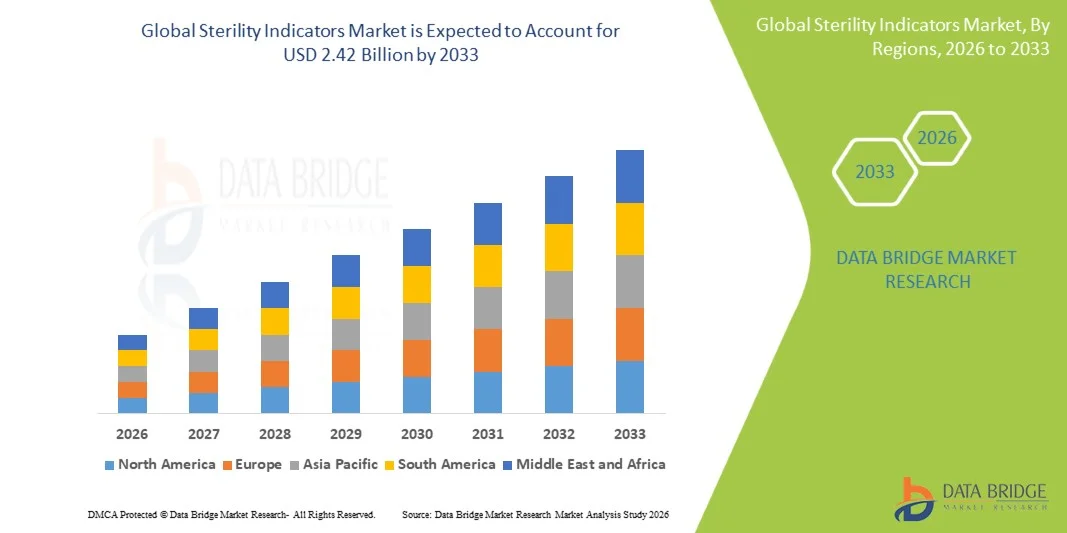
The Sterility Indicators Market was valued at USD 1.15 billion in 2025 and is projected to reach USD 2.42 billion by 2033, growing at a CAGR of 9.80% from 2026 to 2033. The market is witnessing steady growth driven by the rising emphasis on infection control and sterilization validation across healthcare, pharmaceutical manufacturing, and medical device production environments, along with increasing regulatory requirements for ensuring product sterility and patient safety.
The growing volume of surgical procedures globally, expansion of hospital infrastructure, and stringent compliance standards from health authorities are significantly boosting the adoption of biological and chemical sterility indicators. In addition, advancements in rapid sterilization monitoring technologies and increased outsourcing of sterilization services are further supporting market expansion, as healthcare providers and manufacturers prioritize reliable and standardized sterilization assurance processes.
Market Size & Forecast
- Global Market Value (2025): USD 1.15 Billion
- Expected Market Value (2033): USD 2.42 Billion
- Forecast CAGR (2026–2033): 9.80%
- Leading Region in 2025: North America
- Fastest Growing Region: Asia Pacific
What are the Major Takeaways of Sterility Indicators Market?
- North America dominated the Sterility Indicators Market with the largest revenue share of 35.62% in 2025, supported by strong regulatory enforcement, high healthcare expenditure, and widespread adoption of infection prevention protocols in hospitals and pharmaceutical manufacturing facilities.
- The Chemical Indicators segment led the market with a 54.8% share in 2025, driven by their widespread use in routine sterilization monitoring across hospitals, laboratories, and pharmaceutical manufacturing units
- Asia-Pacific is expected to be the fastest-growing region at a CAGR of 7.5% from 2026 to 2033, fueled by expanding healthcare infrastructure, rising surgical volumes, and increasing regulatory focus on sterilization compliance in emerging economies such as China and India.
- Biological Indicators are the fastest-growing type, projected to register a CAGR of 7.1%, reflecting the surge in demand for highly accurate sterility validation in critical healthcare and pharmaceutical applications
- The Heat Sterilization segment dominated the technique category with a 48.6% revenue share in 2025, led by its extensive application in steam autoclaving processes across hospitals, laboratories, and pharmaceutical facilities.
- Steam Sterilization accounted for 42.9% of the market, preferred by its widespread use in hospitals and clinical laboratories for sterilizing surgical instruments and reusable medical devices
- The Hydrogen Peroxide Sterilization segment is the fastest-growing software category, with a CAGR of 7.4%, driven by rising demand for low-temperature and environmentally safe sterilization methods.
Report Scope and Sterility Indicators Market Segmentation
|
Attributes |
Sterility Indicators Key Market Insights |
|
Segments Covered |
|
|
Countries Covered |
North America
Europe
Asia-Pacific · China
Middle East and Africa
South America
|
|
Key Market Players |
|
|
Market Opportunities |
|
|
Value Added Data Infosets |
In addition to the insights on market scenarios such as market value, growth rate, segmentation, geographical coverage, and major players, the market reports curated by the Data Bridge Market Research also include in-depth expert analysis, patient epidemiology, pipeline analysis, pricing analysis, and regulatory framework. |
What is the Key Trend in the Sterility Indicators Market?
Trend: Growth in Rapid Sterility Validation & Automation in Healthcare Settings
Healthcare and pharmaceutical manufacturers are increasingly shifting toward rapid sterility indicators to reduce turnaround time in sterilization validation and improve workflow efficiency in high-volume hospital and production environments. The integration of automated monitoring systems with digital tracking enables real-time documentation of sterilization cycles and reduces human error in compliance reporting. Hospitals and contract sterilization facilities are adopting smart indicator systems that support traceability, standardized validation, and improved infection control outcomes, while digital technologies enhance reliability across critical care environments. For instance, increasing deployment of rapid read-out biological indicators in large hospital networks illustrates the growing preference for faster, more accurate sterilization assurance methods in modern healthcare systems.
Sterility Indicators Market Dynamics
Key Market Driver: Rising Regulatory Pressure for Infection Control and Sterility Assurance Compliance
The increasing enforcement of stringent sterilization and infection prevention regulations across healthcare, pharmaceutical, and medical device industries is significantly driving demand for reliable sterility indicators. Regulatory bodies are mandating stricter validation protocols for sterilization processes to minimize healthcare-associated infections and ensure patient safety in clinical environments. Manufacturers are integrating biological and chemical indicators into routine sterilization workflows to meet global compliance standards and maintain quality assurance across production and hospital operations. For instance, expanded adoption of ISO-compliant sterilization monitoring protocols in pharmaceutical manufacturing facilities highlights the growing impact of regulatory frameworks on market growth.
Key Restraint/Challenge: High Cost and Complexity of Advanced Sterility Validation Systems
A major restraint in the Sterility Indicators Market is the relatively high cost and operational complexity associated with advanced biological indicator systems and automated validation platforms. Small and mid-sized healthcare facilities often face budget constraints that limit adoption of high-precision sterility monitoring solutions requiring specialized storage, incubation, and interpretation systems. In addition, training requirements and workflow integration challenges increase operational burden, particularly in resource-limited settings and developing healthcare infrastructures. For instance, limited deployment of fully automated biological indicator systems in smaller regional hospitals reflects the financial and technical barriers restricting broader market penetration.
Key Market Opportunity: Expansion of Rapid, Digital, and Point-of-Use Sterility Monitoring Solutions
The increasing shift toward rapid, digital, and point-of-use sterility monitoring presents a major growth opportunity in the Sterility Indicators Market as healthcare systems prioritize faster sterilization validation and improved operational efficiency. Integration of smart indicators with digital tracking platforms and automated incubators is enabling real-time decision-making, reducing instrument downtime, and improving compliance accuracy in high-throughput clinical and pharmaceutical environments. Growing demand for decentralized testing solutions in hospitals, outpatient surgical centers, and contract sterilization facilities is further accelerating adoption of user-friendly, scalable indicator systems. For instance, rising implementation of rapid biological indicator readers integrated with hospital sterilization workflows reflects the growing transition toward faster and more connected sterility assurance ecosystems.
How is the Sterility Indicators Market Segmented?
The sterility indicators market is segmented on the basis of type, technique, application, and end-user.
- By Type
On the basis of type, the Sterility Indicators Market is segmented into chemical indicators and biological indicators. The Chemical Indicators segment dominated the market with a 54.8% share in 2025, owing to their widespread use in routine sterilization monitoring across hospitals, laboratories, and pharmaceutical manufacturing units. These indicators are preferred due to their low cost, quick visual interpretation, and ease of integration into sterilization workflows. They are compatible with multiple sterilization techniques such as steam, EtO, and dry heat, making them highly versatile. Their simplicity allows widespread adoption even in resource-constrained healthcare facilities. Increasing focus on operational efficiency and compliance monitoring further supports their dominance. However, they cannot confirm actual microbial kill, limiting their use in critical validation processes.
The Biological Indicators segment is expected to witness the fastest growth at a CAGR of 7.1% from 2026 to 2033, driven by rising demand for highly accurate sterility validation in critical healthcare and pharmaceutical applications. These indicators use highly resistant bacterial spores to directly verify sterilization effectiveness, making them the most reliable method for sterility assurance. Increasing regulatory requirements for validated sterilization processes in medical device and injectable drug manufacturing are boosting adoption. Growing concerns regarding hospital-acquired infections are further accelerating usage. Advancements in rapid biological indicator systems are significantly reducing incubation times and improving workflow efficiency. Expanding pharmaceutical production in emerging economies is also supporting strong market growth.
- By Technique
On the basis of technique, the market is segmented into heat, low temperature, filtration, radiation, and liquid sterilization methods. The Heat Sterilization segment dominated the market with a 48.6% share in 2025, driven by its extensive application in steam autoclaving processes across hospitals, laboratories, and pharmaceutical facilities. It remains the most widely adopted sterilization technique due to its high reliability, cost-effectiveness, and strong validation framework. Chemical and biological indicators are extensively designed to support heat-based sterilization monitoring, reinforcing its leadership position. Standardized global protocols for autoclave validation further strengthen adoption. High efficiency and suitability for reusable medical instruments contribute to its dominance. However, its inability to sterilize heat-sensitive equipment limits its applicability in advanced medical technologies.
The Low Temperature Sterilization segment is expected to witness the fastest growth at a CAGR of 7.3% from 2026 to 2033, driven by increasing demand for sterilization of heat- and moisture-sensitive medical devices. Technologies such as hydrogen peroxide plasma and ethylene oxide sterilization are increasingly being adopted in hospitals and manufacturing facilities. The rising use of complex surgical instruments and minimally invasive devices is boosting demand. Pharmaceutical and biotechnology industries are expanding low-temperature sterilization for biologics and drug delivery systems. Regulatory emphasis on safe and residue-free sterilization methods is further supporting growth. Expanding healthcare infrastructure in emerging economies is accelerating adoption.
- By Application
On the basis of application, the market is segmented into steam sterilization, ethylene oxide (EtO) sterilization, hydrogen peroxide sterilization, dry heat sterilization, and radiation sterilization. The Steam Sterilization segment dominated the market with a 42.9% share in 2025, driven by its widespread use in hospitals and clinical laboratories for sterilizing surgical instruments and reusable medical devices. It is highly reliable, cost-efficient, and widely standardized across global healthcare systems. Strong compatibility with both chemical and biological indicators reinforces its dominant position. Short cycle times and high sterilization efficiency make it ideal for high-volume healthcare environments. Continuous expansion of hospital infrastructure further supports demand. However, its limitation to heat- and moisture-resistant materials restricts broader application.
The Hydrogen Peroxide Sterilization segment is expected to witness the fastest growth at a CAGR of 7.4% from 2026 to 2033, driven by rising demand for low-temperature and environmentally safe sterilization methods. It is widely used for complex and heat-sensitive medical devices, particularly in surgical and diagnostic applications. Increasing adoption in hospital sterilization departments and pharmaceutical cleanrooms is boosting growth. Technological advancements in vaporized hydrogen peroxide systems are improving cycle efficiency and reliability. Regulatory preference for residue-free sterilization methods is further accelerating adoption. Growing minimally invasive surgical procedures are also contributing to strong demand growth.
- By End-User
On the basis of end-user, the market is segmented into hospitals, pharmaceutical companies, medical device companies, clinical laboratories/research centers, and others. The Hospitals segment dominated the market with a 46.1% share in 2025, driven by high surgical volumes, strict infection prevention protocols, and continuous sterilization monitoring requirements. Hospitals extensively use both chemical and biological indicators to ensure compliance with global sterility standards. Increasing focus on reducing hospital-acquired infections is further strengthening adoption. Large-scale sterilization cycles across surgical and diagnostic departments reinforce market dominance. Regulatory mandates for infection control programs also support widespread usage. However, budget constraints in smaller healthcare facilities can limit adoption of advanced biological systems.
The Pharmaceutical Companies segment is expected to witness the fastest growth at a CAGR of 7.6% from 2026 to 2033, driven by increasing demand for sterile drug manufacturing, biologics, and injectable formulations. Strict regulatory frameworks governing GMP compliance are significantly boosting adoption of sterility indicators. Expansion of biopharmaceutical production and contract manufacturing organizations is accelerating demand. Rising vaccine production and injectable drug pipelines are further strengthening growth. Increasing focus on contamination-free production environments is supporting widespread use of biological indicators. Continuous investment in advanced manufacturing infrastructure is sustaining long-term expansion.
Sterility Indicators Market Regional Analysis
North America dominated the Sterility Indicators Market with the largest revenue share of 35.62% in 2025, supported by strong regulatory enforcement, high healthcare expenditure, and widespread adoption of infection prevention protocols in hospitals and pharmaceutical manufacturing facilities. The region also benefits from a strong presence of leading medical device and pharmaceutical manufacturers, well-established hospital infrastructure, and high awareness regarding hospital-acquired infection prevention. Increasing adoption of biological indicators for critical sterilization processes and growing demand for GMP-compliant pharmaceutical manufacturing further strengthen North America’s leadership position in the global market.
U.S. Sterility Indicators Market Insight
The U.S. sterility indicators market is witnessing strong growth due to stringent FDA and CDC sterilization guidelines, high surgical volumes, and widespread adoption of infection prevention protocols across healthcare and pharmaceutical industries. The country’s advanced hospital infrastructure and strong presence of leading medical device and biopharmaceutical companies are driving consistent demand for chemical and biological indicators. Increasing focus on reducing hospital-acquired infections and ensuring GMP-compliant sterile drug manufacturing is further supporting market expansion. In addition, growing adoption of rapid biological indicators and automated sterilization monitoring systems across hospitals and cleanroom facilities continues to strengthen market growth in the U.S.
Europe Sterility Indicators Market Insight
The Europe sterility indicators market remains a major contributor to global revenue, driven by strict EU sterilization validation standards, strong regulatory oversight, and high adoption of advanced infection control practices. The region’s well-established healthcare systems and strong pharmaceutical manufacturing base are supporting widespread use of sterility indicators across hospitals and production facilities. Increasing investments in sterile processing technologies and growing emphasis on patient safety are accelerating market expansion. In addition, rising adoption of biological indicators for critical sterilization applications and continuous improvements in hospital sterilization workflows are reinforcing Europe’s strong market position.
U.K. Sterility Indicators Market Insight
The U.K. sterility indicators market is experiencing steady growth, supported by robust NHS infection control policies, rising surgical procedures, and increasing adoption of standardized sterilization validation practices. Hospitals and laboratories are increasingly using chemical and biological indicators to ensure compliance with strict sterilization protocols. Growing demand for cost-effective and reliable sterility assurance solutions is further contributing to market expansion. Moreover, integration of digital tracking systems and automated sterilization monitoring technologies is improving efficiency and reinforcing the adoption of advanced sterility indicators across healthcare facilities in the U.K.
Germany Sterility Indicators Market Insight
The Germany sterility indicators market is expanding steadily due to its strong pharmaceutical manufacturing base, advanced medical device industry, and strict compliance with EU sterilization standards. Hospitals and production facilities are increasingly relying on biological and chemical indicators for accurate validation of sterilization processes. Continuous investments in high-quality healthcare infrastructure and strong emphasis on patient safety are driving demand. In addition, growing adoption of rapid sterility testing solutions and technologically advanced sterilization monitoring systems is further supporting market growth across Germany’s healthcare and life sciences sectors.
Asia-Pacific Sterility Indicators Market Insight
The Asia-Pacific sterility indicators market is expected to witness rapid growth, driven by expanding healthcare infrastructure, rising surgical volumes, and increasing pharmaceutical manufacturing activities across countries such as China, India, and Japan. Growing awareness regarding infection control and sterilization validation is supporting widespread adoption of chemical and biological indicators. Increasing investments in hospital modernization and regulatory strengthening in emerging economies are further boosting demand. In addition, rising production of medical devices and biologics, along with cost-effective sterilization solutions, is accelerating regional market expansion.
Japan Sterility Indicators Market Insight
The Japan sterility indicators market is witnessing consistent growth due to advanced healthcare systems, strong pharmaceutical innovation, and strict sterilization compliance standards. Hospitals and medical device manufacturers are increasingly adopting high-precision biological indicators for critical sterilization validation processes. The country’s focus on high-quality healthcare delivery and patient safety is driving steady demand. Moreover, integration of automated sterilization monitoring systems and increasing use of rapid indicator technologies are further contributing to market growth across Japan’s healthcare and life sciences industries.
China Sterility Indicators Market Insight
The China sterility indicators market is growing rapidly, driven by expanding healthcare infrastructure, rising surgical procedures, and strong government focus on infection control and medical safety standards. Increasing pharmaceutical production, particularly in biologics and injectable drugs, is significantly boosting demand for sterility indicators. Adoption of advanced sterilization validation systems in hospitals and manufacturing facilities is accelerating market growth. In addition, rising investments in healthcare modernization and growing awareness of hospital-acquired infection prevention are positioning China as one of the fastest-growing markets globally.
Which are the Top Companies in Sterility Indicators Market?
The sterility indicators industry is primarily led by well-established companies, including:
- 3M (U.S.)
- STERIS plc (U.S.)
- Getinge AB (Sweden)
- Mesa Laboratories, Inc. (U.S.)
- Advanced Sterilization Products Services Inc. (U.S.)
- MATACHANA Group (Spain)
- Terragene S.A. (Argentina)
- Andersen Products, Inc. (U.S.)
- Propper Manufacturing Co., Inc. (U.S.)
- Tuttnauer USA Co. Ltd. (Israel)
- Ecolab Inc. (U.S.)
- Merck KGaA (Germany)
- Sartorius AG (Germany)
- Belimed AG (Switzerland)
- Steelco S.p.A. (Italy)
- BGS Beta-Gamma-Service GmbH & Co. KG (Germany)
- Systec GmbH (Germany)
- GKE-GmbH (Germany)
- Laboratory Instrumentation Supplies Inc. (U.S.)
- SPSmedical Supply Corp. (U.S.)
What are Latest Developments in Sterility Indicators Market?
- In August 2025, Advanced Sterilization Products (ASP) launched the BIOTRACE™ Instant Read Steam Biological Indicator System, a next-generation solution designed to deliver sterilization verification in just 7 seconds, significantly improving turnaround time in sterile processing departments. The system enhances workflow efficiency through real-time biological monitoring, digital tracking, and automated reporting capabilities, strengthening compliance and patient safety in healthcare facilities. This innovation reflects the industry’s growing shift toward rapid sterility assurance technologies in hospital environments
- In June 2025, Solventum introduced the Attest Super Rapid VH₂O₂ Clear Challenge Pack, a combined biological and chemical indicator system designed for vaporized hydrogen peroxide sterilization validation. The solution integrates dual indicator functionality into a single-use format, improving efficiency, simplifying workflows, and enhancing reliability in sterilization monitoring processes. It is widely targeted at hospitals and medical device manufacturers to ensure faster and more accurate validation of low-temperature sterilization cycles
- In April 2024, 3M completed the spin-off of its healthcare division, forming Solventum Corporation as an independent entity focused on infection prevention and sterilization solutions. This strategic restructuring allowed greater focus on sterility indicators, sterilization monitoring, and infection control technologies across healthcare and pharmaceutical industries. The move strengthened innovation capabilities and sharpened competitive positioning in the global sterility assurance market
- In April 2024, MATACHANA introduced a new sustainable chemical indicator format designed to reduce environmental impact while maintaining high accuracy in sterilization monitoring. The innovation focuses on improving material efficiency and supporting eco-friendly sterilization validation practices in hospitals and laboratories. This development aligns with the growing global emphasis on sustainability and green healthcare operations in sterility assurance processes
- In October 2023, Mesa Laboratories expanded its sterility validation capabilities through the acquisition of GKE-GmbH’s sterilization indicators business along with its accredited testing laboratory SAL GmbH. This acquisition strengthened Mesa’s portfolio in both biological and chemical indicators while expanding its global presence in sterility assurance technologies. It also enhanced its ability to offer advanced rapid-read biological indicator solutions and regulatory-compliant testing services

- Interactive Data Analysis Dashboard
- Company Analysis Dashboard for high growth potential opportunities
- Research Analyst Access for customization & queries
- Competitor Analysis with Interactive dashboard
- Latest News, Updates & Trend analysis
- Harness the Power of Benchmark Analysis for Comprehensive Competitor Tracking
Data collection and base year analysis are done using data collection modules with large sample sizes. The stage includes obtaining market information or related data through various sources and strategies. It includes examining and planning all the data acquired from the past in advance. It likewise envelops the examination of information inconsistencies seen across different information sources. The market data is analysed and estimated using market statistical and coherent models. Also, market share analysis and key trend analysis are the major success factors in the market report. To know more, please request an analyst call or drop down your inquiry.
The key research methodology used by DBMR research team is data triangulation which involves data mining, analysis of the impact of data variables on the market and primary (industry expert) validation. Data models include Vendor Positioning Grid, Market Time Line Analysis, Market Overview and Guide, Company Positioning Grid, Patent Analysis, Pricing Analysis, Company Market Share Analysis, Standards of Measurement, Global versus Regional and Vendor Share Analysis. To know more about the research methodology, drop in an inquiry to speak to our industry experts.
Data Bridge Market Research is a leader in advanced formative research. We take pride in servicing our existing and new customers with data and analysis that match and suits their goal. The report can be customized to include price trend analysis of target brands understanding the market for additional countries (ask for the list of countries), clinical trial results data, literature review, refurbished market and product base analysis. Market analysis of target competitors can be analyzed from technology-based analysis to market portfolio strategies. We can add as many competitors that you require data about in the format and data style you are looking for. Our team of analysts can also provide you data in crude raw excel files pivot tables (Fact book) or can assist you in creating presentations from the data sets available in the report.













