What is the Stick Packaging Market Size and Growth Rate?
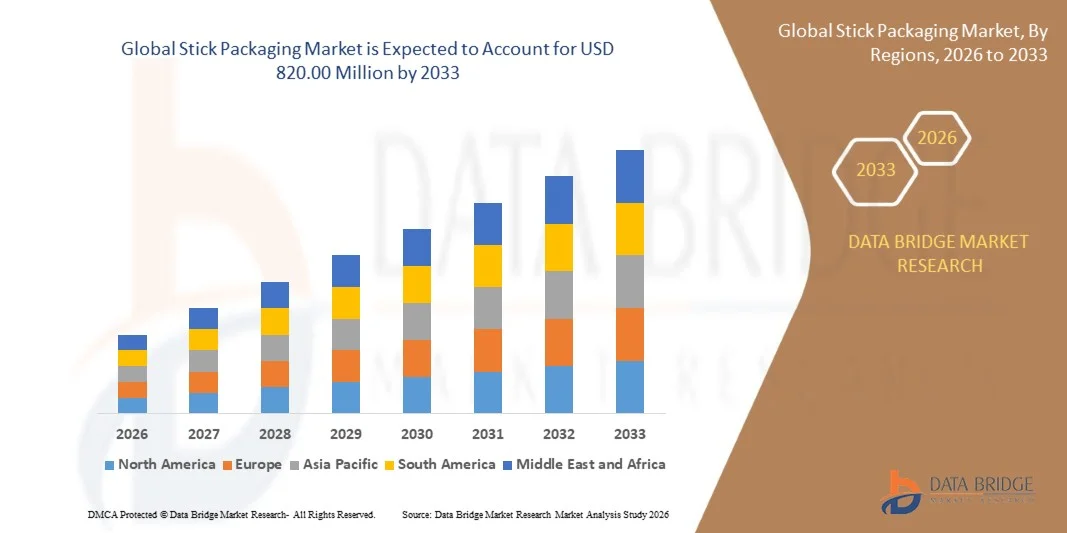
- As per Data Bridge Market Research analysis, the stick packaging market was valued at USD 500.00 million in 2025 and is projected to reach USD 820.00 million by 2033, growing at a CAGR of 6.50% from 2026 to 2033.
- The market is experiencing consistent growth driven by rising demand for convenient and portable packaging solutions, increasing adoption of single-use formats, and expanding applications across food and beverages, pharmaceuticals, nutraceuticals, cosmetics, and personal care products.
- The growing consumer preference for lightweight, portion-controlled, and easy-to-carry packaging, combined with increasing demand for efficient product dispensing and extended shelf-life solutions, is compelling manufacturers to adopt stick packaging formats. Powder, liquid, and tablet products are increasingly being packaged in stick formats, offering convenience, reduced material usage, and improved product protection across various end-use industries.
Market Size & Forecast
- Global Market Value (2025): USD 500.00 Million
- Expected Market Value (2033): USD 820.00 Million
- Forecast CAGR (2026–2033): 6.50%
- Leading Region in 2025: North America
- Fastest Growing Region: Asia Pacific
What are the Major Takeaways of the Stick Packaging Market?
- North America dominated the stick packaging market with the largest revenue share of 32% in 2025, supported by strong demand for convenient single-serve formats, premium nutritional supplements, functional beverages, and over-the-counter medications.
- Asia-Pacific is expected to be the fastest-growing region at a CAGR of 7.2% from 2026 to 2033, fueled by expanding food and beverage consumption, growing pharmaceutical and nutraceutical industries, increasing urbanization, and rising adoption of convenient single-serve packaging formats across China, India, Japan, and Southeast Asia.
- The polyester segment led the market with a 34.78% share in 2025, driven by its excellent barrier properties, high tensile strength, dimensional stability, and versatility in multilayer packaging structures.
- Polypropylene (BOPP) are the fastest-growing material type, projected to register a CAGR of 6.7%, reflecting the surge in strong mechanical performance, moisture resistance, clarity, lightweight characteristics, and suitability for high-speed packaging operations.
- The powder segment dominated the filing type category with a 42.34% revenue share in 2025, led by extensive adoption of stick packs for instant beverages, coffee, nutritional supplements, pharmaceutical formulations, sugar, and other powdered products.
- Food and beverages accounted for 41% of the market share in 2025, preferred by widespread use of stick packs for instant coffee, powdered drink mixes, sugar, sweeteners, sauces, and nutritional beverages.
- The nutraceuticals segment is the fastest-growing application category, with a CAGR of 6.4%, driven by increasing demand for convenient nutritional supplements, functional powders, hydration products, vitamins, and wellness formulations.
Report Scope and Stick Packaging Market Segmentation
|
Attributes |
Stick Packaging Key Market Insights |
|
Segments Covered |
|
|
Countries Covered |
North America
Europe
Asia-Pacific
Middle East and Africa
South America
|
|
Key Market Players |
|
|
Market Opportunities |
|
|
Value Added Data Infosets |
In addition to the insights on market scenarios such as market value, growth rate, segmentation, geographical coverage, and major players, the market reports curated by the Data Bridge Market Research also include import export analysis, production capacity overview, production consumption analysis, price trend analysis, climate change scenario, supply chain analysis, value chain analysis, raw material/consumables overview, vendor selection criteria, PESTLE Analysis, Porter Analysis, and regulatory framework. |
What is the Key Trend in the Stick Packaging Market?
- Sustainable and recyclable stick packaging is becoming a key trend as packaging manufacturers increasingly develop mono-material, paper-based, and recyclable structures that maintain the barrier properties required for food, beverage, pharmaceutical, and nutraceutical products.
- For instance, in March 2024, Taghleef Industries introduced a PP-based mono-material solution for coffee stick packs, designed to improve recyclability while maintaining high-barrier performance and compatibility with high-speed filling lines.
- Mono-material structures enable manufacturers to simplify packaging construction while maintaining protection against moisture, oxygen, and other contaminants.
- Packaging companies are increasingly combining recyclability with lightweight construction to reduce material consumption, transportation impacts, and packaging waste without compromising product protection.
- For instance, in May 2025, Taghleef Industries, Gerosa Group, and Universal Pack developed a recyclable stick-pack solution for supplements to address the recycling challenges associated with conventional multilayer laminates used for OTC products.
- As brands face growing sustainability expectations and consumers increasingly prefer environmentally responsible packaging, recyclable and resource-efficient stick-pack formats are expected to gain wider adoption, reinforcing sustainable packaging as a core development direction in the market.
What are the Key Drivers of the Stick Packaging Market?
- The rising consumer preference for convenient, portable, single-serve, and portion-controlled products has significantly increased demand for stick packaging across food and beverages, pharmaceuticals, nutraceuticals, and personal care applications.
- For instance, in February 2025, Berry Global introduced smaller 15 ml, 20 ml, and 25 ml stick and refill formats for cosmetics, lip care, multi-use cosmetics, and sun care, highlighting growing demand for convenient, portable packaging in personal-care applications.
- Stick packs provide accurate dosing, lightweight construction, easy portability, and reduced product wastage, making them particularly suitable for consumers seeking convenient products for work, travel, and on-the-go consumption.
- For instance, in May 2025, Continental Coffee launched its Lemon Iced Tea Premix in a 140 g stick-pack format containing 14 individual 10 g sticks across India, targeting consumers seeking convenient, easy-to-prepare beverage formats for home and on-the-go consumption.
- With food, beverage, pharmaceutical, nutraceutical, and personal care manufacturers increasingly prioritizing compact and convenient single-dose formats, stick packaging will remain an important packaging solution for improving portability, portion control, and consumer convenience.
What Factors are Challenging the Growth of the Stick Packaging Market?
- The recycling complexity associated with multilayer materials remains a significant challenge for stick packaging because conventional structures often combine different substrates to achieve the barrier, sealing, and mechanical properties required for product protection.
- For instance, in April 2025, an article publishing in Macromolecular Materials and Engineering reported that multilayer barrier films are significantly more difficult to recycle than single-layer films because of their complex chemical composition and strong interlayer adhesion, creating a major recycling barrier for flexible packaging format
- These multilayer structures can be difficult to separate and recycle through conventional recycling systems, increasing waste-management challenges and creating pressure on manufacturers to develop alternative material structures.
- The environmental concerns associated with single-use and multilayer stick packaging are encouraging brands and converters to invest in mono-material and recyclable alternatives, which can require new materials, machinery adjustments, and validation of barrier and sealing performance.
- For instance, in June 2025, an article published in Experimental Mechanics found that multilayer packaging is a major portion of non-recyclable flexible packaging, with conventional multilayer structures limiting effective recycling because different layers are difficult to separate using existing recycling systems.
- The need to balance recyclability, product protection, machinability, cost, and shelf life continues to challenge manufacturers, particularly where high-barrier multilayer structures remain technically advantageous for sensitive food, beverage, pharmaceutical, and nutraceutical products.
How is the Stick Packaging Market Segmented?
The stick packaging market is segmented on the basis of material type, filling type, capacity, and application.
- By Material Type
On the basis of material type, the stick packaging market is segmented into polyester, biaxially oriented polypropylene (BOPP), paper, aluminum, metallized polyester, polyethylene, polypropylene, and others. The polyester segment dominated the market with a 34.78% share in 2025, owing to its excellent barrier properties, high tensile strength, dimensional stability, and versatility in multilayer packaging structures. Polyester is widely used for food, beverage, pharmaceutical, nutraceutical, and personal care stick packs. Its resistance to moisture, oxygen, and mechanical damage helps preserve product quality during storage and transportation. The material also provides good printability, enabling manufacturers to achieve high-quality graphics and branding. Its compatibility with high-speed packaging operations further supports its widespread use.
The polypropylene (BOPP) segment is projected to register the fastest growth at CAGR of 6.7% from 2026 to 2033, supported by its strong mechanical performance, moisture resistance, clarity, lightweight characteristics, and suitability for high-speed packaging operations. BOPP films are increasingly used for instant coffee, powdered beverages, sugar, nutritional supplements, and other products requiring reliable packaging protection. Their excellent printability also enables attractive graphics and improved shelf appeal. The material can be incorporated into multilayer structures to provide the required combination of barrier and sealing performance. Growing demand for lightweight packaging is further supporting adoption across consumer applications.
- By Filling Type
On the basis of filling type, the stick packaging market is segmented into powder, liquid, and tablets. The powder segment dominated the market with an estimated 42.34% share in 2025, driven by extensive adoption of stick packs for instant beverages, coffee, nutritional supplements, pharmaceutical formulations, sugar, and other powdered products. Powder products are particularly compatible with narrow stick formats because they can be accurately portioned into individual doses. Stick packaging also helps protect powdered products against moisture and contamination. Manufacturers benefit from efficient high-speed filling and sealing operations for powder applications. Growing consumption of instant beverages and nutritional products is further supporting demand.
The liquid segment is projected to register the fastest growth at CAGR of 6.3% from 2026 to 2033, supported by increasing adoption of single-use liquid formats across beverages, pharmaceuticals, nutraceuticals, cosmetics, and personal care. Liquid stick packs provide convenient dispensing while minimizing product exposure and spillage. Advances in sealing technologies are improving package integrity and supporting wider use of liquid formulations. Their compact design also makes them suitable for portable and on-the-go consumption. Pharmaceutical and nutraceutical manufacturers are increasingly using single-dose formats where controlled dispensing is important. Rising demand for functional beverages and liquid supplements is creating additional applications.
- By Capacity
On the basis of capacity, the stick packaging market is segmented into 0–5 ml, 5–10 ml, 10–15 ml, 15–20 ml, and 20 ml and above. The 5–10 ml segment dominated the market in 2025 with an estimated 30% share, supported by its suitability for single-serve products across food, beverages, nutraceuticals, cosmetics, and pharmaceutical applications. This capacity provides an effective balance between portability and product quantity. It is widely suitable for instant beverages, nutritional powders, liquid supplements, and personal-care formulations. The format enables manufacturers to control material consumption while maintaining convenient product delivery. Compatibility with automated filling and sealing machinery further supports production efficiency.
The 10–15 ml segment is projected to register the fastest growth at CAGR of 6.8% from 2026 to 2033, driven by increasing demand for slightly larger single-use portions across beverages, nutritional supplements, cosmetics, and personal-care products. The capacity provides additional product volume while retaining the portability associated with stick packaging. It is particularly suitable for liquid formulations and products requiring a larger individual serving. Growing demand for functional beverages and wellness products is expanding its application base. Improved filling technologies are enabling manufacturers to achieve accurate dosing across liquid and powder formulations. Increasing consumer preference for convenient products that can be consumed outside the home is also supporting demand.
- By Application
On the basis of application, the stick packaging market is segmented into food and beverages, pharmaceuticals, consumer goods, nutraceuticals, cosmetics and personal care, industrial, and others. The food and beverages segment dominated the market with an estimated 41% share in 2025, supported by widespread use of stick packs for instant coffee, powdered drink mixes, sugar, sweeteners, sauces, and nutritional beverages. Stick formats provide convenient portion control and easy transportation for food and beverage products. Their lightweight construction also supports efficient storage and distribution. Increasing consumer preference for single-serve and on-the-go products is further driving adoption. Stick packaging can also provide protection against moisture, oxygen, and other environmental factors that can affect product quality.
The nutraceuticals segment is projected to register the fastest growth at CAGR of 6.4% from 2026 to 2033, driven by increasing demand for convenient nutritional supplements, functional powders, hydration products, vitamins, and wellness formulations. Stick packs provide precise single-dose delivery and are easy to carry, store, and consume. The format is particularly suitable for powdered supplements that need protection from moisture and contamination. Growing consumer interest in health and wellness is encouraging brands to introduce portable supplement formats. E-commerce and direct-to-consumer distribution are also increasing demand for lightweight and space-efficient packaging. Manufacturers are increasingly combining high-barrier materials with convenient stick formats to improve product stability.
Which Region Holds the Largest Share of the Stick Packaging Market?
- North America dominated the stick packaging market with the largest revenue share of 32% in 2025, supported by strong demand for convenient single-serve formats, premium nutritional supplements, functional beverages, and over-the-counter medications.
- The region also benefits from increasing consumer preference for portable and portion-controlled formats, advanced packaging manufacturing capabilities, and growing adoption of stick packs across nutraceuticals, personal care, and consumer goods applications. Rising focus on sustainable materials and recyclable packaging solutions further strengthens North America's leadership position in the global market.
U.S. Stick Packaging Market Insight
The U.S. stick packaging market is witnessing strong growth due to rising demand for convenient single-serve packaging across food and beverage, pharmaceutical, and nutraceutical applications. The country’s mature packaging industry, along with increasing adoption of lightweight, portable, and portion-controlled formats, is driving demand across consumer and commercial applications. In addition, growing preference for on-the-go consumption and precise product dispensing is accelerating stick packaging adoption across food, beverage, pharmaceutical, and personal care sectors.
Asia-Pacific Stick Packaging Market Insight
The Asia-Pacific stick packaging market is expected to witness rapid growth, driven by expanding food and beverage consumption, rising pharmaceutical production, and increasing demand for convenient single-serve packaging across countries such as China, India, and Japan. Growing urbanization, changing consumer lifestyles, and rising adoption of portable and portion-controlled packaging solutions are supporting regional market expansion. In addition, the strong flexible packaging manufacturing base and increasing focus on recyclable packaging materials are accelerating stick packaging adoption across food, nutraceutical, personal care, and consumer goods sectors.
Japan Stick Packaging Market Insight
The Japan stick packaging market is witnessing consistent growth due to rising demand for convenient packaging formats, advanced food and beverage products, and pharmaceutical applications. Packaging manufacturers and consumer brands are increasingly adopting flexible and single-serve formats to improve portability, convenience, and product protection. Moreover, increasing integration of flexible packaging technologies and the country’s focus on efficient packaging solutions are further contributing to market growth in Japan.
China Stick Packaging Market Insight
The China stick packaging market is growing rapidly, driven by expanding consumer goods manufacturing, rising demand for packaged foods and beverages, and increasing adoption of convenient single-serve packaging formats. Growing utilization of flexible packaging across food, nutraceutical, personal care, and consumer applications is significantly boosting market demand. In addition, rising investments in flexible packaging production, increasing adoption of recyclable film structures, and rapid technological advancements are positioning China as one of the fastest-growing markets for stick packaging globally.
U.K. Stick Packaging Market Insight
The U.K. stick packaging market is experiencing steady growth, supported by rising adoption of single-serve packaging technologies across food and beverage, pharmaceutical, and personal care applications. Increasing demand for lightweight, portable, and convenient packaging solutions and growing investments in flexible packaging infrastructure are contributing to market growth. Furthermore, increasing focus on sustainable packaging materials and recyclable flexible structures is improving packaging efficiency and supporting continued stick packaging adoption in the U.K.
Germany Stick Packaging Market Insight
The Germany stick packaging market is expanding steadily due to the country’s strong packaging manufacturing base, advanced flexible packaging capabilities, and increasing demand for convenient single-serve formats. Food and beverage companies, pharmaceutical manufacturers, and consumer brands are increasingly utilizing flexible packaging solutions to improve portability, product protection, and consumer convenience. Continuous advancements in sustainable packaging materials, recyclable structures, and flexible packaging technologies, along with strong environmental focus, are further driving market growth in Germany.
Which are the Top Companies in Stick Packaging Market?
The stick packaging industry is primarily led by well-established companies, including:
- Amcor plc (Switzerland)
- Mondi plc (U.K.)
- Constantia Flexibles GmbH (Austria)
- Coveris GmbH (Austria)
- Huhtamäki Oyj (Finland)
- ProAmpac Holdings Inc. (U.S.)
- Sonoco Products Company (U.S.)
- Winpak Ltd. (Canada)
- TC Transcontinental Inc. (Canada)
- Glenroy, Inc. (U.S.)
- Sealed Air (U.S.)
- IMA S.p.A. (Italy)
- Universal Pack S.p.A. (Italy)
- OMAG S.p.A. (Italy)
- VOLPAK S.A.U. (Spain)
- Syntegon Technology GmbH (Germany)
- Mespack S.L. (Spain)
- ULMA Packaging, S. Coop. (Spain)
- Viking Masek (U.S.)
- Triangle Package Machinery Company (U.S.)
What are Latest Developments in Stick Packaging Market?
- In February 2025, Amcor announced the expansion of its Exclusive Stick and Refill packaging range with three smaller sizes designed for personal care applications. The new formats were developed for face colour cosmetics, lip care, multi-use cosmetics, and sun care, while maintaining the range’s circular-design principles focused on reducing waste, product reuse, and recyclability. This development strengthens the use of compact stick packaging for convenient and refillable personal care products.
- In March 2024, Taghleef Industries introduced a PP-based mono-material solution specifically designed for coffee stick packs. The solution was developed to improve recyclability while maintaining the machinability and barrier performance required to protect coffee from moisture, oxygen, and other contaminants. The development highlights the growing shift toward recyclable mono-material structures in single-serve stick packaging.
- In February 2023, Enflex, part of Volpak, launched the PHS Series of flexible packaging machines for the pharmaceutical and healthcare industries, with a particular focus on stick-pack formats. The equipment was designed for single-use and single-dose applications and incorporated multiple-lane configurations, compact machinery, and digital control features. The launch strengthened stick-pack production capabilities for pharmaceutical and healthcare packaging applications.
- In June 2022, Quadpack launched its Multi Stick packaging solution for solid cosmetic formulations as part of its PCR packaging collection. The recyclable PP stick was designed for applications including sunscreen, deodorants, solid skincare, makeup, and fragrance, and incorporated post-consumer recycled material. The development demonstrated the increasing integration of recycled and recyclable materials into stick-format packaging for the beauty and personal care industry.
- In September 2021, Berry expanded its mono-material stick packaging offering by introducing a double-wall cap for its Exclusive 75ml Mono-material Stick. The single-material construction was designed to simplify recycling, while post-consumer recycled plastic was available for the outer cap. The packaging was positioned for deodorants, solid perfumes, face care products, sunscreens, and other personal care applications, supporting the industry's move toward more recyclable stick

- Interactive Data Analysis Dashboard
- Company Analysis Dashboard for high growth potential opportunities
- Research Analyst Access for customization & queries
- Competitor Analysis with Interactive dashboard
- Latest News, Updates & Trend analysis
- Harness the Power of Benchmark Analysis for Comprehensive Competitor Tracking
Global Stick Packaging Market, Supply Chain Analysis and Ecosystem Framework
To support market growth and help clients navigate the impact of geopolitical shifts, DBMR has integrated in-depth supply chain analysis into its Global Stick Packaging Market research reports. This addition empowers clients to respond effectively to global changes affecting their industries. The supply chain analysis section includes detailed insights such as Global Stick Packaging Market consumption and production by country, price trend analysis, the impact of tariffs and geopolitical developments, and import and export trends by country and HSN code. It also highlights major suppliers with data on production capacity and company profiles, as well as key importers and exporters. In addition to research, DBMR offers specialized supply chain consulting services backed by over a decade of experience, providing solutions like supplier discovery, supplier risk assessment, price trend analysis, impact evaluation of inflation and trade route changes, and comprehensive market trend analysis.
Data collection and base year analysis are done using data collection modules with large sample sizes. The stage includes obtaining market information or related data through various sources and strategies. It includes examining and planning all the data acquired from the past in advance. It likewise envelops the examination of information inconsistencies seen across different information sources. The market data is analysed and estimated using market statistical and coherent models. Also, market share analysis and key trend analysis are the major success factors in the market report. To know more, please request an analyst call or drop down your inquiry.
The key research methodology used by DBMR research team is data triangulation which involves data mining, analysis of the impact of data variables on the market and primary (industry expert) validation. Data models include Vendor Positioning Grid, Market Time Line Analysis, Market Overview and Guide, Company Positioning Grid, Patent Analysis, Pricing Analysis, Company Market Share Analysis, Standards of Measurement, Global versus Regional and Vendor Share Analysis. To know more about the research methodology, drop in an inquiry to speak to our industry experts.
Data Bridge Market Research is a leader in advanced formative research. We take pride in servicing our existing and new customers with data and analysis that match and suits their goal. The report can be customized to include price trend analysis of target brands understanding the market for additional countries (ask for the list of countries), clinical trial results data, literature review, refurbished market and product base analysis. Market analysis of target competitors can be analyzed from technology-based analysis to market portfolio strategies. We can add as many competitors that you require data about in the format and data style you are looking for. Our team of analysts can also provide you data in crude raw excel files pivot tables (Fact book) or can assist you in creating presentations from the data sets available in the report.