


Stress Monitoring Wearables Market Size
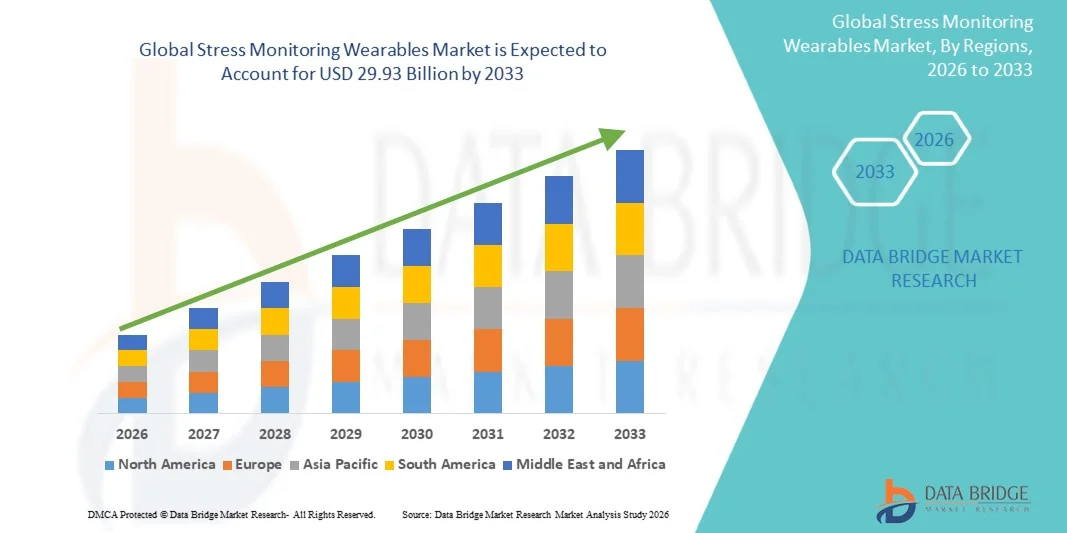
- The global stress monitoring wearables market size was valued at USD 5.64 billion in 2025and is expected to reach USD 29.93 billion by 2033, at a CAGR of 23.20% during the forecast period
- Market growth is primarily driven by the rising prevalence of stress, anxiety, and lifestyle-related disorders, increasing awareness of mental health management, and growing adoption of digital health and continuous biometric monitoring solutions across consumer and clinical settings
- In addition, rapid advancements in biosensors, AI-powered emotion detection algorithms, and integration of stress analytics into mainstream wearable ecosystems are significantly strengthening adoption across both wellness and healthcare applications
Stress Monitoring Wearables Market Analysis
- Stress monitoring wearables, which use physiological indicators such as heart rate variability (HRV), electrodermal activity (EDA), sleep patterns, and respiration tracking, are becoming key tools for real-time mental wellness assessment and preventive healthcare
- The increasing demand for these devices is driven by growing mental health awareness, rising work-related stress, sedentary lifestyles, and expanding adoption of personalized health tracking solutions across developed and emerging economies
- North America dominated the stress monitoring wearables market in 2025, accounting for the largest revenue share of 38.6%, supported by high consumer adoption of advanced wearables, strong digital health infrastructure, and widespread corporate wellness program integration
- Asia-Pacific is expected to be the fastest growing region during the forecast period, registering a CAGR of 11.3%, driven by rapid urbanization, increasing smartphone penetration, rising healthcare awareness, and expanding wearable manufacturing ecosystem
- Smartwatches with stress tracking capabilities dominated the product segment in 2025, owing to their multifunctionality, ease of use, and strong ecosystem integration with health apps and cloud-based analytics platforms
Report Scope and Stress Monitoring Wearables Market Segmentation
|
Attributes |
Stress Monitoring Wearables Key Market Insights |
|
Segments Covered |
|
|
Countries Covered |
North America · U.S. · Canada · Mexico Europe · Germany · France · U.K. · Netherlands · Switzerland · Belgium · Russia · Italy · Spain · Turkey · Rest of Europe Asia-Pacific · China · Japan · India · South Korea · Singapore · Malaysia · Australia · Thailand · Indonesia · Philippines · Rest of Asia-Pacific Middle East and Africa · Saudi Arabia · U.A.E. · South Africa · Egypt · Israel · Rest of Middle East and Africa South America · Brazil · Argentina · Rest of South America |
|
Key Market Players |
|
|
Market Opportunities |
· Expansion of AI-powered mental health analytics and predictive stress detection · Increasing adoption of smart rings and non-invasive biosensor wearable |
|
Value Added Data Infosets |
In addition to the insights on market scenarios such as market value, growth rate, segmentation, geographical coverage, and major players, the market reports curated by the Data Bridge Market Research also include in-depth expert analysis, patient epidemiology, pipeline analysis, pricing analysis, and regulatory framework |
Stress Monitoring Wearables Market Trends
“Shift Toward AI-Driven, Continuous Mental Health Monitoring and Personalized Wellness”
- A major trend in the market is the rapid adoption of AI-enabled wearables capable of continuously monitoring stress levels and providing real-time wellness feedback to users
- For instance, advanced smartwatches and smart rings now integrate HRV-based stress scoring, guided breathing exercises, and adaptive alerts to help users manage emotional well-being proactively
- Increasing integration of wearable data with mobile health apps and cloud platforms enables personalized stress insights and long-term behavioral tracking
- Growing demand for discreet, non-invasive devices such as smart rings and biosensor patches is reshaping user preferences toward comfort and continuous monitoring
- Corporate wellness programs are increasingly adopting wearable-based stress analytics to improve employee productivity, reduce burnout, and enhance workplace mental health initiatives
- The convergence of mental health tracking with sleep monitoring and fitness analytics is creating a unified digital wellness ecosystem across consumer and clinical applications
Stress Monitoring Wearables Market Dynamics
Driver
“Rising Mental Health Awareness and Demand for Preventive Wellness Solutions”
- Increasing global awareness of mental health conditions such as stress, anxiety, and burnout is significantly driving adoption of stress monitoring wearables
- For instance, consumers are increasingly using smartwatches and smart rings to track physiological stress signals and adopt early intervention strategies such as breathing exercises and lifestyle modifications
- Growing emphasis on preventive healthcare and self-managed wellness is encouraging continuous biometric monitoring outside clinical environments
- Rising corporate adoption of employee wellness programs is further accelerating deployment of wearable stress tracking solutions
- Advancements in AI, machine learning, and biosensor technologies are improving accuracy and usability of stress detection systems
- Expanding integration with telehealth platforms is enabling remote mental health monitoring and personalized care delivery
Restraint/Challenge
“Data Privacy Concerns and Accuracy Limitations in Stress Detection”
- Concerns related to data privacy, security, and ethical use of sensitive mental health information remain a key challenge for widespread adoption
- Inconsistent accuracy of stress detection algorithms due to variability in individual physiology and external environmental factors can limit reliability
- High cost of advanced wearables with multi-sensor capabilities may restrict adoption in price-sensitive markets
- Lack of standardized clinical validation for stress metrics limits integration into formal healthcare systems in some regions
- Over-reliance on wearable data without professional medical interpretation may lead to misinterpretation of mental health conditions
- Addressing these challenges through improved sensor accuracy, regulatory frameworks, and secure data handling systems will be critical for market expansion
Stress Monitoring Wearables Market Scope
The market is segmented on the basis of product type, application, and end user.
- By Product Type
On the basis of product type, the global stress monitoring wearables market is segmented into smartwatches with stress tracking, fitness bands/activity trackers, smart rings, wearable patches (biosensor patches), smart clothing (e-textiles), and others. The smartwatches with stress tracking segment dominated the market with the largest revenue share of 52.3% in 2025, driven by their multifunctionality, high consumer adoption, and integration of advanced biometric sensors such as heart rate variability (HRV), sleep tracking, and electrodermal activity (EDA). These devices are widely preferred due to their seamless integration with mobile ecosystems, real-time stress analytics, and user-friendly interfaces. Strong brand presence from leading wearable manufacturers and continuous software upgrades further reinforce segment dominance.
The smart rings segment is expected to witness the fastest growth during the forecast period, fueled by rising demand for discreet, lightweight, and non-intrusive wellness monitoring devices. Smart rings offer continuous stress tracking, sleep monitoring, and recovery insights with improved comfort and longer battery life compared to traditional wearables. Increasing adoption among health-conscious consumers and growing interest in minimalist wearable technology are accelerating segment expansion globally.
- By Application
On the basis of application, the market is segmented into personal wellness & lifestyle management, mental health monitoring/clinical support, corporate & workplace wellness programs, fitness & sports performance optimization, sleep tracking & recovery monitoring, and healthcare & telehealth integration. The personal wellness & lifestyle management segment accounted for the largest market revenue share in 2025, driven by increasing consumer awareness of stress-related health risks and rising adoption of self-monitoring health technologies. Consumers are increasingly using wearables to track stress levels, manage lifestyle habits, and improve emotional well-being.
The corporate & workplace wellness programs segment is anticipated to register the fastest growth over the forecast period, owing to rising concerns about employee burnout, productivity loss, and mental health challenges in high-stress work environments. Organizations are increasingly deploying wearable-based wellness solutions to monitor employee stress levels, promote healthier work habits, and support preventive mental health interventions. Integration of wearable data into HR analytics platforms is further accelerating adoption in enterprise settings.
- By End User
On the basis of end user, the market is segmented into individual consumers, healthcare providers/hospitals, corporates/enterprises, fitness & sports organizations, and research institutions. The individual consumers segment dominated the market in 2025, supported by widespread adoption of consumer-grade wearables, increasing health consciousness, and growing interest in real-time stress and wellness tracking. Easy availability of affordable devices and integration with smartphone applications have significantly boosted consumer adoption.
The corporates/enterprises segment is expected to witness the fastest growth during the forecast period, driven by increasing investment in employee wellness programs and rising awareness of mental health in workplace environments. Companies are increasingly leveraging wearable-based stress monitoring tools to reduce burnout, improve productivity, and enhance workforce well-being. The shift toward data-driven HR wellness strategies is further supporting segment growth.
Stress Monitoring Wearables Market Regional Analysis
- North America dominated the stress monitoring wearables market with the largest revenue share of 38.6% in 2025, supported by high consumer adoption of advanced wearable devices, strong digital health infrastructure, and widespread integration of corporate wellness programs
- The region benefits from high awareness of mental health, strong penetration of premium wearable brands, and early adoption of AI-powered health tracking technologies, making stress monitoring wearables a key component of preventive healthcare and lifestyle management
- This strong market position is further supported by high disposable income, advanced healthcare ecosystems, and increasing collaboration between technology companies and healthcare providers, establishing wearables as essential tools for continuous stress and wellness monitoring
U.S. Stress Monitoring Wearables Market Insight
The U.S. stress monitoring wearables market captured the largest revenue share in North America in 2025, driven by high prevalence of stress-related disorders, strong consumer adoption of smart wearables, and advanced digital health integration. Increasing use of smartwatches, smart rings, and biosensor-enabled devices for stress and sleep tracking is significantly supporting market growth. The expansion of telehealth services and corporate wellness initiatives further accelerates adoption. Additionally, strong presence of leading wearable technology companies and continuous innovation in AI-driven health analytics contribute to sustained market expansion.
Europe Stress Monitoring Wearables Market Insight
The Europe stress monitoring wearables market is projected to expand at a steady CAGR during the forecast period, driven by rising awareness of mental health, increasing work-related stress, and strong regulatory support for digital health solutions. Governments across the region are promoting preventive healthcare initiatives, encouraging adoption of wearable-based wellness monitoring. Growing integration of stress tracking features in consumer electronics and increasing adoption in workplace wellness programs are further supporting market growth.
U.K. Stress Monitoring Wearables Market Insight
The U.K. stress monitoring wearables market is anticipated to grow at a notable CAGR during the forecast period, supported by rising mental health awareness and strong adoption of digital wellness solutions. Increasing workplace stress levels and national focus on mental health improvement programs are driving demand for wearable stress tracking devices. The presence of advanced healthcare infrastructure and widespread availability of connected health technologies further enhances market growth.
Germany Stress Monitoring Wearables Market Insight
The Germany stress monitoring wearables market is expected to expand at a considerable CAGR during the forecast period, driven by strong focus on preventive healthcare and high adoption of advanced wearable technologies. Increasing awareness of stress-related health risks and integration of wearable data into clinical and wellness applications are supporting growth. Germany’s emphasis on innovation and precision health solutions is fostering adoption of AI-enabled stress monitoring devices.
Asia-Pacific Stress Monitoring Wearables Market Insight
The Asia-Pacific stress monitoring wearables market is poised to grow at the fastest CAGR during 2026 to 2033, driven by rapid urbanization, increasing smartphone penetration, rising mental health awareness, and expanding wearable manufacturing ecosystem. Growing middle-class populations and increasing adoption of digital wellness solutions are significantly boosting demand. Government initiatives promoting digital health and rising corporate wellness adoption further support regional expansion.
Japan Stress Monitoring Wearables Market Insight
The Japan stress monitoring wearables market is gaining momentum due to the country’s aging population, high work-related stress levels, and strong adoption of advanced health technologies. Increasing use of compact wearables such as smart rings and wrist-based devices for continuous stress and sleep monitoring is supporting growth. Japan’s focus on precision healthcare and preventive wellness is further driving adoption of AI-enabled wearable solutions.
India Stress Monitoring Wearables Market Insight
The India stress monitoring wearables market accounted for the largest revenue share in Asia-Pacific in 2025, driven by rising stress levels due to urban lifestyles, increasing smartphone penetration, and growing awareness of mental health. Expanding middle-class population and rapid adoption of affordable fitness bands and smartwatches are fueling market growth. Strong domestic manufacturing ecosystem and increasing availability of low-cost wearable devices are further accelerating adoption across both urban and semi-urban populations.
Stress Monitoring Wearables Market Share
The Stress monitoring wearables industry is primarily led by well-established companies, including:
- Apple Inc. (U.S.)
- Google (Fitbit) (U.S.)
- Samsung Electronics (South Korea)
- Garmin Ltd. (U.S.)
- WHOOP Inc. (U.S.)
- Oura Health Ltd. (Finland)
- Huawei Technologies Co. Ltd. (China)
- Xiaomi Corporation (China)
- Polar Electro Oy (Finland)
- Biobeat Technologies (Israel)
- Empatica Inc. (U.S.)
- Amazfit (Zepp Health) (China)
- Withings (France)
- Muse (InteraXon Inc.) (Canada)
- Hexoskin (Canada)
What are the Recent Developments in Global Stress Monitoring Wearables Market?
- In October 2025, Oura Health introduced a major app redesign featuring an advanced “Cumulative Stress” tracking capability, enabling users to monitor long-term stress accumulation through HRV, sleep, and biometric indicators, strengthening its position in AI-driven mental wellness monitoring
- In May 2026, Google (Fitbit) launched Fitbit Air, a screenless wearable focused on continuous stress, recovery, and sleep tracking using HRV-based analytics and AI-powered insights, expanding its presence in the next-generation minimalist wearable segment
- In May 2025, WHOOP introduced upgraded WHOOP 5.0 and WHOOP MG wearables with enhanced stress monitoring, recovery scoring, and advanced cardiovascular insights, strengthening its leadership in performance and stress analytics wearables
- In June 2025, Empatica launched EmbraceMini, a compact clinical-grade wearable designed for precise physiological and behavioral monitoring, supporting advanced stress analysis in clinical trials and healthcare research applications

- Interactive Data Analysis Dashboard
- Company Analysis Dashboard for high growth potential opportunities
- Research Analyst Access for customization & queries
- Competitor Analysis with Interactive dashboard
- Latest News, Updates & Trend analysis
- Harness the Power of Benchmark Analysis for Comprehensive Competitor Tracking
Data collection and base year analysis are done using data collection modules with large sample sizes. The stage includes obtaining market information or related data through various sources and strategies. It includes examining and planning all the data acquired from the past in advance. It likewise envelops the examination of information inconsistencies seen across different information sources. The market data is analysed and estimated using market statistical and coherent models. Also, market share analysis and key trend analysis are the major success factors in the market report. To know more, please request an analyst call or drop down your inquiry.
The key research methodology used by DBMR research team is data triangulation which involves data mining, analysis of the impact of data variables on the market and primary (industry expert) validation. Data models include Vendor Positioning Grid, Market Time Line Analysis, Market Overview and Guide, Company Positioning Grid, Patent Analysis, Pricing Analysis, Company Market Share Analysis, Standards of Measurement, Global versus Regional and Vendor Share Analysis. To know more about the research methodology, drop in an inquiry to speak to our industry experts.
Data Bridge Market Research is a leader in advanced formative research. We take pride in servicing our existing and new customers with data and analysis that match and suits their goal. The report can be customized to include price trend analysis of target brands understanding the market for additional countries (ask for the list of countries), clinical trial results data, literature review, refurbished market and product base analysis. Market analysis of target competitors can be analyzed from technology-based analysis to market portfolio strategies. We can add as many competitors that you require data about in the format and data style you are looking for. Our team of analysts can also provide you data in crude raw excel files pivot tables (Fact book) or can assist you in creating presentations from the data sets available in the report.













