


What is the Stretchers Market Size and Overview?
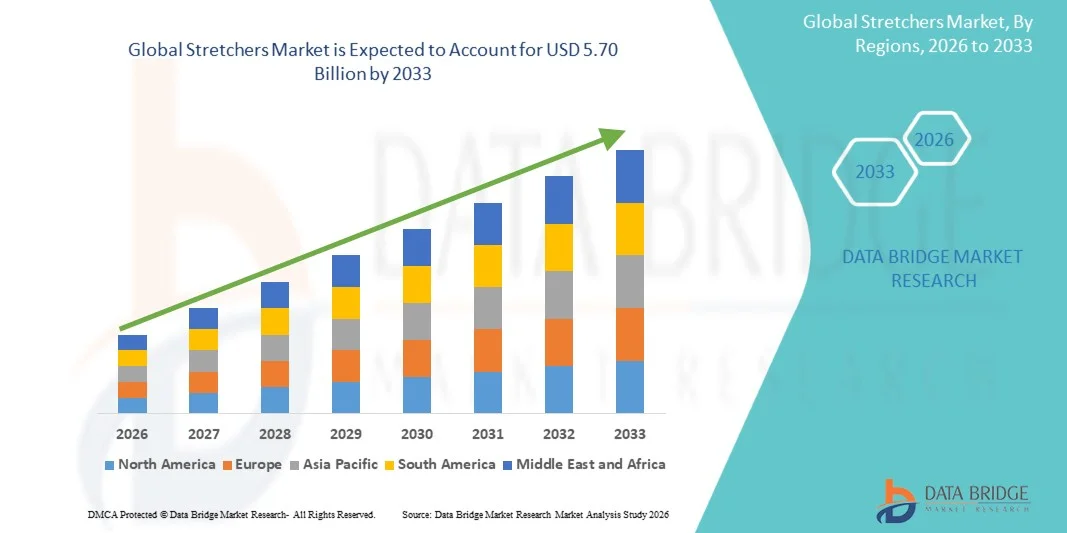
As per Data Bridge Market Research analysis The Stretchers Market was valued at USD 3.50 billion in 2025 and is projected to reach USD 5.70 billion by 2033, growing at a CAGR of 6.30% from 2026 to 2033. The Stretchers Market is experiencing consistent growth driven by rising demand for emergency medical transportation, increasing healthcare infrastructure development, and growing adoption of advanced patient handling equipment across hospitals, ambulatory surgical centers, and emergency care facilities. Rapid advancements in stretcher design, including powered mobility systems, lightweight materials, and improved patient safety features, are further supporting market expansion globally.
The increasing incidence of road accidents, trauma injuries, chronic diseases, and emergency hospital admissions worldwide, combined with growing investments in healthcare and emergency response systems, is compelling hospitals, ambulance services, and military medical units to adopt advanced stretcher solutions. Powered stretchers, bariatric stretchers, and hydraulic transport systems are increasingly replacing conventional patient transport equipment in many healthcare settings, offering improved patient comfort, enhanced caregiver safety, efficient mobility, and reduced risk of handling injuries during emergency and critical care transportation.
Market Size & Forecast
- Global Market Value (2025): USD 3.50 Billion
- Expected Market Value (2033): USD 5.70 Billion
- Forecast CAGR (2026–2033): 6.30%
- Leading Region in 2025: Europe
- Fastest Growing Region: Asia-Pacific
What are the Major Takeaways of Stretchers Market?
-
North America dominated the Stretchers Market with the largest revenue share in 2025, supported by advanced healthcare infrastructure, high emergency care expenditure, increasing adoption of technologically advanced patient transport equipment, and strong presence of leading medical device manufacturers.
- The Non-Motorized Stretchers segment dominated the market with a share of 61.27% in 2025 owing to their affordability, simple operation, and widespread use across hospitals, clinics, and ambulance services globally
- Asia-Pacific is expected to be the fastest-growing region at a CAGR from 2026 to 2033, fueled by expanding healthcare infrastructure, rising emergency medical service adoption, growing road accident cases, and increasing healthcare investments across China, India, and Japan.
- The Motorized Stretchers segment is projected to register the fastest growth, reflecting increasing demand for advanced patient handling systems that reduce caregiver injuries, improve mobility efficiency, and enhance patient safety during transportation.
- The Emergency and Transport Stretchers segment dominates the application category with the largest revenue share in 2025, led by rising emergency admissions, trauma incidents, and increasing demand for rapid patient transfer solutions across hospitals and ambulance services.
- Hospital and Clinic accounts for the largest share of the end-use category, supported by growing patient admissions, increasing surgical procedures, and rising investments in advanced healthcare transportation equipment.
- Ambulance Facilities are expected to witness significant growth during the forecast period, driven by increasing adoption of powered and lightweight stretchers for emergency medical response and patient mobility applications.
- The Non-Motorized Stretchers segment continues to maintain a strong market presence due to lower costs, easy handling, widespread availability, and extensive adoption across developing healthcare systems and small medical facilities globally.
Report Scope and Stretchers Market Segmentation
Attributes |
Stretchers Key Market Insights |
|
Segments Covered |
· By Product: Fixed Stretchers, Adjustable Stretchers, and Stretcher Chairs
|
|
Countries Covered |
North America · U.S. · Canada · Mexico Europe · Germany · France · U.K. · Netherlands · Switzerland · Belgium · Russia · Italy · Spain · Turkey · Rest of Europe Asia-Pacific · China · Japan · India · South Korea · Singapore · Malaysia · Australia · Thailand · Indonesia · Philippines · Rest of Asia-Pacific Middle East and Africa · Saudi Arabia · U.A.E. · South Africa · Egypt · Israel · Rest of Middle East and Africa South America · Brazil · Argentina · Rest of South America |
|
Key Market Players |
• Stryker Corporation (U.S.) |
|
Market Opportunities |
· Rising emergency medical cases, road accidents, and trauma-related hospital admissions · Increasing adoption of motorized and powered stretchers to reduce caregiver injuries · Expanding healthcare infrastructure investments |
|
Value Added Data Infosets |
In addition to the insights on market scenarios such as market value, growth rate, segmentation, geographical coverage, and major players, the market reports curated by the Data Bridge Market Research also include in-depth expert analysis, geographically represented company-wise production and capacity, network layouts of distributors and partners, detailed and updated price trend analysis and deficit analysis of supply chain and demand. |
What is the Key Trend in the Stretchers Market?
Trend: Rising Adoption of Advanced Emergency Patient Handling and Mobility Solutions
Hospitals, ambulance facilities, and emergency care providers are increasingly adopting advanced stretcher systems to improve patient transportation efficiency, enhance caregiver safety, and reduce handling-related injuries. Rising global emergency admissions, trauma cases, chronic disease prevalence, and surgical procedures are significantly increasing demand for technologically advanced stretchers across healthcare facilities. Healthcare providers are increasingly integrating motorized stretchers, hydraulic lift systems, lightweight materials, and bariatric transport solutions to improve operational efficiency and patient comfort. In addition, growing investments in emergency medical services (EMS), hospital infrastructure modernization, and patient safety initiatives are accelerating the adoption of advanced stretcher technologies globally. Expanding ambulance networks and increasing focus on rapid emergency response capabilities are further supporting market growth across developed and emerging healthcare markets.
Stretchers Market Dynamics
Key Market Driver: Increasing Emergency Care Demand and Growing Healthcare Infrastructure Investments
The rising incidence of road accidents, trauma injuries, cardiovascular diseases, and emergency hospital admissions is a major driver of the Stretchers Market. According to global health organizations, millions of patients require emergency transportation and critical care handling services annually, significantly increasing the demand for efficient patient mobility equipment. Hospitals and ambulance service providers are increasingly adopting advanced stretchers to improve patient transfer safety, reduce manual lifting risks, and optimize emergency response operations. Companies such as Stryker Corporation, Hill-Rom Holdings, and Ferno-Washington are continuously expanding their patient transport equipment portfolios with powered and ergonomic stretcher systems. In addition, increasing government investments in healthcare infrastructure, emergency response systems, and ambulance modernization programs are further accelerating market growth globally.
Key Restraint/Challenge: High Cost of Advanced Motorized Stretchers and Maintenance Requirements
A significant restraint in the Stretchers Market is the high cost associated with advanced motorized stretcher systems and specialized patient transport equipment. Modern stretchers equipped with powered lifting systems, electronic controls, hydraulic mechanisms, and advanced safety features require substantial capital investment and ongoing maintenance expenses. Smaller hospitals, rural healthcare centers, and low-budget ambulance providers often face financial constraints in adopting technologically advanced stretcher systems. In addition, maintenance requirements, battery replacement costs, staff training needs, and equipment servicing complexities further increase operational expenses. Strict regulatory standards related to patient safety, infection control, and medical device certification also create compliance challenges for manufacturers and healthcare providers. These factors collectively limit widespread adoption of advanced stretcher technologies, particularly across developing healthcare markets.
Key Market Opportunity: Integration of Smart Technologies and Powered Mobility Systems
The integration of smart technologies, powered mobility systems, and ergonomic patient handling solutions presents a major growth opportunity in the Stretchers Market. Manufacturers are increasingly developing motorized stretchers with electronic height adjustment, automated loading systems, real-time monitoring sensors, and improved maneuverability features to enhance patient care and caregiver efficiency. Advanced stretcher systems integrated with ambulance automation technologies are improving emergency transportation workflows and reducing physical strain on healthcare workers. In addition, increasing adoption of bariatric stretchers, radiology-compatible stretchers, and multifunctional transport systems is expanding product demand across specialized healthcare applications. Growing investments in digital healthcare infrastructure and emergency medical technology modernization are expected to create significant opportunities for innovation and market expansion globally.
How is the Stretchers Market Segmented?
The Stretchers market is segmented on the basis of product, technology, application, and end-use.
By Product
On the basis of product, the Stretchers Market is segmented into fixed stretchers, adjustable stretchers, and stretcher chairs. The Fixed Stretchers segment dominated the market with a share of 44.38% in 2025 due to its extensive adoption across hospitals, trauma centers, emergency departments, and ambulance facilities for safe patient transportation and emergency response applications. Fixed stretchers are widely preferred because of their durable construction, ease of handling, lower maintenance requirements, and cost-effectiveness compared to advanced adjustable systems. In addition, increasing emergency admissions, rising road accidents, and growing surgical procedures globally are significantly supporting segment growth. Hospitals and emergency medical service providers rely heavily on fixed stretchers for rapid patient mobility during critical care situations. The segment also benefits from increasing healthcare infrastructure expansion in developing economies and rising investments in emergency care systems. Furthermore, the availability of lightweight aluminum-based fixed stretchers with enhanced patient safety features such as side rails and locking mechanisms is improving operational efficiency for healthcare professionals. Growing demand for reliable transport equipment in military and disaster response operations is further reinforcing the segment’s leading position in the global market.
The Adjustable Stretchers segment is expected to witness the fastest CAGR of 7.4% from 2026 to 2033, driven by increasing demand for advanced patient handling solutions with enhanced comfort, flexibility, and ergonomic support. Adjustable stretchers are increasingly being adopted in hospitals, ambulatory surgical centers, and trauma care units due to their ability to improve patient positioning during transport and treatment procedures. These stretchers support height adjustment, backrest positioning, and hydraulic or electric lifting mechanisms, significantly reducing physical strain on healthcare workers. Rising investments in technologically advanced hospital infrastructure and increasing focus on patient-centric healthcare delivery are accelerating segment adoption globally. In addition, the growing prevalence of chronic diseases, obesity-related complications, and geriatric populations requiring long-term mobility assistance is contributing to demand growth. Manufacturers are increasingly introducing powered adjustable stretchers with integrated monitoring systems and advanced safety controls to improve emergency response efficiency. Expanding healthcare expenditure and modernization of ambulance fleets across emerging markets are further expected to drive rapid segment expansion during the forecast period.
By Technology
On the basis of technology, the Stretchers Market is segmented into non-motorized stretchers and motorized stretchers. The Non-Motorized Stretchers segment dominated the market with a share of 61.27% in 2025 owing to their affordability, simple operation, and widespread use across hospitals, clinics, and ambulance services globally. These stretchers are extensively utilized in emergency care and patient transportation due to their lightweight structure, portability, and low maintenance costs. Healthcare facilities in developing economies particularly prefer non-motorized stretchers because of budget limitations and easy deployment in high-volume healthcare settings. In addition, increasing emergency medical cases, rising accident rates, and growing hospital admissions are driving steady demand for conventional stretcher systems. The segment also benefits from strong adoption in military medical units, disaster relief operations, and temporary healthcare facilities. Manufacturers continue to improve durability, maneuverability, and infection-control materials in non-motorized designs, enhancing operational performance. Furthermore, the availability of foldable and compact stretcher models suitable for emergency rescue applications further strengthens the segment’s dominant market position globally.
The Motorized Stretchers segment is projected to register the fastest CAGR of 7.8% from 2026 to 2033, driven by increasing demand for advanced patient transportation systems that reduce caregiver injuries and improve operational efficiency. Motorized stretchers incorporate battery-powered lifting, automatic loading systems, and advanced mobility controls, enabling safer and smoother patient handling in emergency situations. Rising awareness regarding workplace safety among healthcare professionals and increasing incidence of musculoskeletal injuries among ambulance staff are significantly supporting segment growth. Hospitals and emergency medical service providers are increasingly investing in powered stretchers to improve patient comfort and reduce manual lifting requirements. In addition, technological advancements such as integrated patient monitoring systems, electronic braking mechanisms, and hydraulic elevation systems are enhancing adoption across critical care environments. Expanding ambulance modernization programs and growing healthcare spending in developed countries are also accelerating market penetration. Furthermore, rising geriatric populations and increasing demand for efficient bariatric patient transport solutions are expected to create substantial opportunities for motorized stretcher manufacturers globally.
By Application
On the basis of application, the Stretchers Market is segmented into emergency and transport stretchers, pediatric stretchers, radiology stretchers, bariatric stretchers, procedural stretchers, and OB/GYN stretchers. The Emergency and Transport Stretchers segment dominated the market with a share of 39.84% in 2025 due to the increasing volume of emergency medical services, trauma care cases, and patient transportation requirements worldwide. Hospitals, ambulances, military medical units, and disaster management organizations extensively utilize emergency stretchers for rapid patient movement and stabilization during critical situations. Rising road accidents, cardiovascular emergencies, and natural disasters are significantly increasing demand for reliable emergency transport equipment. In addition, growing investments in ambulance infrastructure and emergency response systems across developed and emerging economies are strengthening segment growth. The segment also benefits from increasing adoption of lightweight, foldable, and high-durability stretcher designs equipped with advanced patient restraint systems. Continuous advancements in shock absorption technology and mobility features are improving patient safety and caregiver convenience. Furthermore, expanding healthcare access in rural and remote regions is driving higher procurement of transport stretchers by public healthcare agencies globally.
The Bariatric Stretchers segment is expected to witness the fastest CAGR of 7.6% from 2026 to 2033, driven by the increasing prevalence of obesity and rising demand for specialized patient handling equipment. Bariatric stretchers are specifically designed to support higher weight capacities while ensuring patient safety, comfort, and mobility efficiency. Healthcare providers are increasingly investing in bariatric transport systems due to the growing number of obese patients requiring emergency care, surgical procedures, and long-term hospitalization. In addition, rising awareness regarding caregiver safety and prevention of handling-related injuries is accelerating adoption of advanced bariatric stretcher systems with powered lifting and mobility assistance features. Manufacturers are introducing reinforced frames, wider patient surfaces, and hydraulic positioning systems to improve operational functionality. Increasing healthcare expenditure and expanding hospital infrastructure are further supporting segment growth globally. Moreover, growing focus on inclusive healthcare services and specialized obesity treatment centers is expected to drive rapid adoption of bariatric stretchers during the forecast period.
By End-Use
On the basis of end-use, the Stretchers Market is segmented into hospitals & clinics and ambulance facilities. The Hospitals & Clinics segment dominated the market with a share of 68.91% in 2025 due to the high volume of patient admissions, emergency treatments, surgical procedures, and inpatient care services performed globally. Hospitals extensively utilize stretchers across emergency rooms, intensive care units, radiology departments, surgical wards, and outpatient facilities for efficient patient transportation and treatment support. Rising healthcare infrastructure investments, increasing chronic disease prevalence, and growing geriatric populations are significantly contributing to segment expansion. In addition, the increasing number of multispecialty hospitals and ambulatory care centers worldwide is accelerating demand for technologically advanced stretcher systems. Healthcare providers are increasingly adopting ergonomic and motorized stretchers to improve workflow efficiency, patient safety, and caregiver comfort. Furthermore, rising focus on infection prevention, patient comfort, and emergency preparedness is driving procurement of advanced stretcher technologies. Strong government funding for hospital modernization and healthcare capacity expansion is further reinforcing the dominant position of this segment in the global market.
The Ambulance Facilities segment is anticipated to witness the fastest CAGR of 7.3% from 2026 to 2033, driven by increasing emergency medical response requirements and expanding ambulance infrastructure globally. Rising incidence of road traffic accidents, cardiac emergencies, and disaster-related injuries is significantly increasing demand for advanced ambulance stretcher systems. Ambulance service providers are increasingly adopting lightweight, motorized, and automatic loading stretchers to improve emergency response efficiency and reduce manual handling injuries among paramedics. In addition, growing government investments in pre-hospital emergency care systems and rising awareness regarding rapid trauma response are accelerating segment growth. Technological advancements such as powered loading mechanisms, integrated patient monitoring systems, and enhanced mobility controls are improving operational performance in ambulance environments. Expanding healthcare access in rural and underserved areas is also increasing procurement of ambulance stretchers worldwide. Furthermore, increasing partnerships between healthcare organizations and emergency transport service providers are expected to create significant growth opportunities for stretcher manufacturers during the forecast period.
Stretchers Market Regional Analysis
North America dominated the Stretchers market and accounted for the largest revenue share in 2025, supported by advanced healthcare infrastructure, high emergency care expenditure, and increasing adoption of technologically advanced patient transport equipment across hospitals, trauma centers, and ambulance facilities. The region also benefits from the strong presence of leading medical device manufacturers, rising healthcare modernization initiatives, and growing demand for motorized and bariatric stretchers for emergency and critical care applications. Increasing focus on patient safety, rapid emergency response systems, and ergonomic healthcare equipment continues to strengthen North America’s leadership position in the global market.
U.S. Stretchers Market Insight
The U.S. Stretchers market is witnessing strong growth due to rising emergency hospital admissions, increasing road accidents, and growing investments in advanced emergency medical services infrastructure. Hospitals and ambulance providers are increasingly adopting motorized stretchers, powered patient transport systems, and advanced bariatric stretchers to improve operational efficiency and reduce caregiver injuries. In addition, increasing healthcare expenditure, strong adoption of technologically advanced medical devices, and growing focus on patient comfort and safety are accelerating market expansion across the country.
Europe Stretchers Market Insight
The Europe Stretchers market remains a major contributor to global revenue, driven by strong healthcare infrastructure, increasing adoption of advanced patient handling systems, and rising government investments in emergency medical services. The widespread use of technologically advanced stretchers across hospitals, trauma centers, and ambulance fleets is supporting market growth throughout the region. Increasing aging population, rising prevalence of chronic diseases, and growing demand for efficient patient transportation systems continue to strengthen stretcher adoption across Europe.
U.K. Stretchers Market Insight
The U.K. Stretchers market is experiencing steady growth, supported by rising investments in hospital modernization, expanding ambulance services, and increasing demand for ergonomic patient transportation solutions. Healthcare facilities are increasingly adopting motorized and adjustable stretchers to improve emergency response efficiency and enhance patient care quality. Furthermore, growing focus on reducing manual handling injuries among healthcare professionals and increasing adoption of technologically advanced medical transport systems are contributing to sustained market growth in the U.K.
Germany Stretchers Market Insight
The Germany Stretchers market is expanding steadily due to the country’s advanced healthcare infrastructure, strong medical device manufacturing industry, and increasing adoption of technologically advanced patient handling equipment. Hospitals and emergency medical service providers are increasingly utilizing motorized stretchers, radiology stretchers, and bariatric transport systems to improve patient mobility and healthcare efficiency. Continuous investments in healthcare modernization, emergency preparedness, and patient safety initiatives are further driving market growth across Germany.
Asia-Pacific Stretchers Market Insight
The Asia-Pacific Stretchers market is expected to witness rapid growth, driven by expanding healthcare infrastructure, increasing healthcare expenditure, and rising demand for emergency medical services across countries such as China, India, and Japan. Growing road accident cases, increasing hospital admissions, and rising awareness regarding patient safety and emergency care are significantly supporting market expansion. In addition, growing investments in ambulance modernization programs and rapid development of healthcare facilities are accelerating stretcher adoption throughout the region.
Japan Stretchers Market Insight
The Japan Stretchers market is witnessing consistent growth due to rising healthcare investments, growing geriatric population, and increasing demand for advanced patient transportation systems. Hospitals and emergency medical facilities are increasingly adopting motorized and adjustable stretchers to improve patient comfort, caregiver safety, and operational efficiency. Moreover, increasing focus on healthcare automation, advanced emergency response systems, and high-quality patient care solutions is further contributing to market growth in Japan.
China Stretchers Market Insight
The China Stretchers market is growing rapidly, driven by expanding healthcare infrastructure, increasing emergency medical service adoption, and rising government investments in hospital development projects. Growing urbanization, rising road traffic accidents, and increasing patient volumes are significantly boosting demand for advanced stretcher systems across hospitals and ambulance facilities. In addition, rising adoption of motorized patient transport equipment and increasing focus on improving emergency healthcare accessibility are positioning China as one of the fastest-growing markets for stretchers globally.
Stretchers Market Share
The Stretchers industry is primarily led by well-established companies, including:
- Stryker Corporation (U.S.)
- Hill-Rom Holdings, Inc. (U.S.)
- Ferno-Washington, Inc. (U.S.)
- Paramount Bed Holdings Co., Ltd. (Japan)
- Arjo AB (Sweden)
- GF Health Products, Inc. (U.S.)
- Gendron, Inc. (U.S.)
- MAC Medical, Inc. (U.S.)
- Medline Industries, LP (U.S.)
- ROYAX, s.r.o. (Slovakia)
- Narang Medical Limited (India)
- Zhangjiagang Xiehe Medical Apparatus & Instruments Co., Ltd. (China)
- Jiangsu Saikang Medical Equipment Co., Ltd. (China)
- Hebei Pukang Medical Instruments Co., Ltd. (China)
- Favero Health Projects S.p.A. (Italy)
- Malvestio S.p.A. (Italy)
- PROMOTAL (France)
- Anetic Aid Ltd. (U.K.)
- GPC Medical Ltd. (India)
- Drive DeVilbiss Healthcare (U.S.)
- Besco Medical Limited (Hong Kong)
- Bristol Maid Hospital Metalcraft Ltd. (U.K.)
- Hausted Patient Handling Systems (U.S.)
- ME.BER. Srl (Italy)
- Pedigo Products, Inc. (U.S.)
- Savion Industries (Israel)
- PVS SpA (Italy)
- Schmitz u. Söhne GmbH & Co. KG (Germany)
- Midmark Corporation (U.S.)
- TransMotion Medical, Inc. (U.S.)
Latest Developments in Stretchers Market
- In September 2025, Moog Inc. has unveiled its latest motion systems all electric E60 Series and the electro pneumatic P60 Series, setting a new benchmark for simulation across aviation, land, and maritime training with support for up to 14,000 kg loads and high fidelity motion for Level D flight simulators and other professional uses. The upgraded platforms deliver enhanced reliability, compact design and sustained operational uptime, reflecting modernized electronics and sustainable operation. These new systems strengthen Moog’s market leadership in simulation motion technology by boosting performance, energy efficiency, and usability
- In January 2025, Exail Technologies has acquired Leukos, a French photonics specialist known for pulsed micro lasers, supercontinuum laser sources, ultrafast lasers, and simulation-enabled optical systems, strengthening its technological and industrial capabilities in advanced laser and simulation technologies. The deal integrates Leukos’s expertise with Exail’s photonics, optical, and simulation platforms, broadening product offerings for applications in biophotonics, microelectronics, and high-fidelity training simulations. This strategic acquisition accelerates Exail’s innovation in high-tech technologies, creating synergies that expand its reach in scientific, industrial, and simulation applications while reinforcing its position as a leading advanced-technology provider
- In November 2025, IPG Automotive launched CarMaker 15.0, the latest version of its driving simulation software used for virtual vehicle development. The new release improves simulation accuracy by integrating virtual electronic control units (vECUs), allowing engineers to test software and vehicle systems at earlier development stages. It also includes enhanced sensor models and improved endurance testing capabilities for ADAS and autonomous vehicles. This development strengthens IPG Automotive’s position in the driving simulator market, as CarMaker enables automotive manufacturers to perform complex vehicle tests in a virtual driving environment instead of physical road testing.
- In November 2024, IPG Automotive released CarMaker 14.0, introducing new simulation capabilities including advanced sensor models and more realistic virtual environments. The update allows developers to simulate complex traffic scenarios involving pedestrians, vehicles, and different weather conditions. These features help automotive companies test ADAS and autonomous driving systems more efficiently in driving simulators, reducing development time and cost. The upgrade also expanded simulation capabilities for heavy-duty vehicles using the TruckMaker platform.
- In June 2023, IPG Automotive participated in the UNICARagil research project, collaborating with universities and industry partners to develop automated vehicle architectures. The company contributed its CarMaker driving simulation platform to support simulation and validation of automated driving systems in Software-in-the-Loop (SIL) and Hardware-in-the-Loop (HIL) environments. This collaboration demonstrates the application of Stretchers in research and development of autonomous mobility solutions

- Interactive Data Analysis Dashboard
- Company Analysis Dashboard for high growth potential opportunities
- Research Analyst Access for customization & queries
- Competitor Analysis with Interactive dashboard
- Latest News, Updates & Trend analysis
- Harness the Power of Benchmark Analysis for Comprehensive Competitor Tracking
Data collection and base year analysis are done using data collection modules with large sample sizes. The stage includes obtaining market information or related data through various sources and strategies. It includes examining and planning all the data acquired from the past in advance. It likewise envelops the examination of information inconsistencies seen across different information sources. The market data is analysed and estimated using market statistical and coherent models. Also, market share analysis and key trend analysis are the major success factors in the market report. To know more, please request an analyst call or drop down your inquiry.
The key research methodology used by DBMR research team is data triangulation which involves data mining, analysis of the impact of data variables on the market and primary (industry expert) validation. Data models include Vendor Positioning Grid, Market Time Line Analysis, Market Overview and Guide, Company Positioning Grid, Patent Analysis, Pricing Analysis, Company Market Share Analysis, Standards of Measurement, Global versus Regional and Vendor Share Analysis. To know more about the research methodology, drop in an inquiry to speak to our industry experts.
Data Bridge Market Research is a leader in advanced formative research. We take pride in servicing our existing and new customers with data and analysis that match and suits their goal. The report can be customized to include price trend analysis of target brands understanding the market for additional countries (ask for the list of countries), clinical trial results data, literature review, refurbished market and product base analysis. Market analysis of target competitors can be analyzed from technology-based analysis to market portfolio strategies. We can add as many competitors that you require data about in the format and data style you are looking for. Our team of analysts can also provide you data in crude raw excel files pivot tables (Fact book) or can assist you in creating presentations from the data sets available in the report.













