What is the Stringing Machines Market Size and Overview ?
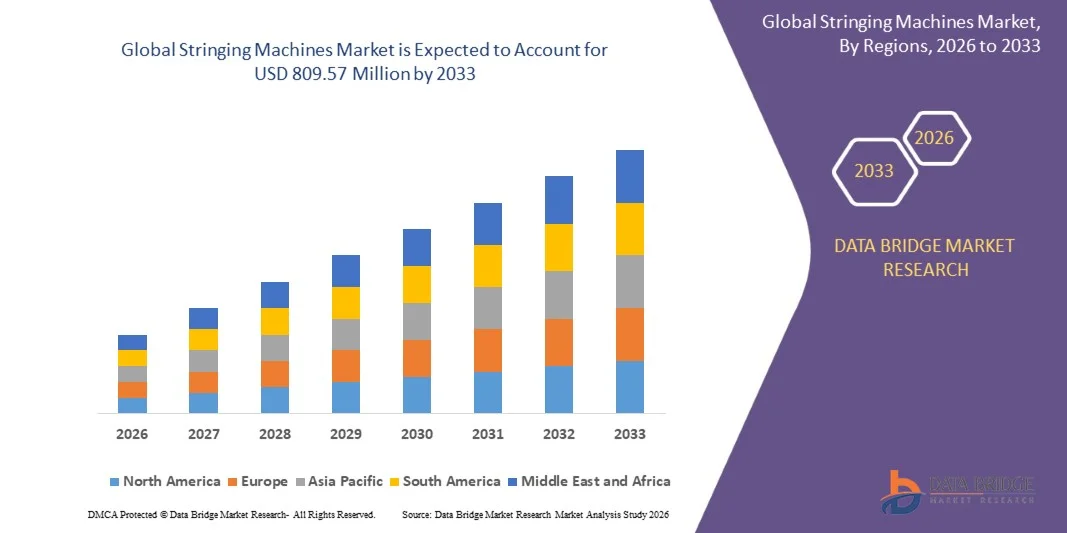
As per Data Bridge Market Research Analysis the Stringing Machines Market was valued at USD 452.24 Million in 2025 and is projected to reach USD 809.57 Million by 2033, growing at a CAGR of 7.55% from 2026 to 2033. The market is experiencing consistent growth driven by rising investments in power transmission and distribution infrastructure, increasing deployment of high-voltage and ultra-high-voltage transmission networks, and growing demand for efficient conductor installation solutions. Rapid modernization of aging grid systems and expansion of renewable energy integration projects are further supporting market growth across developed and emerging economies.
The increasing global focus on grid reliability, electrification of rural and industrial regions, and large-scale renewable energy evacuation projects is accelerating adoption of advanced stringing machines. Utilities and EPC contractors are increasingly shifting toward automated, electronically controllable, and high-precision stringing systems to improve installation efficiency, safety, and operational accuracy. In addition, government-backed transmission expansion programs and cross-border interconnection projects are strengthening demand for modern stringing equipment, supporting long-term market expansion.
Market Size & Forecast
- Global Market Value (2025): USD 452.24 Million
- Expected Market Value (2033): USD 809.57 Million
- Forecast CAGR (2026–2033): 7.55%
- Leading Region in 2025: North America
- Fastest Growing Region: Asia-Pacific
What are the Major Takeaways of Stringing Machines Market ?
- North America dominated the Stringing Machines Market with the largest revenue share of 40% in 2025, supported by extensive investments in high voltage transmission infrastructure upgrades and strong adoption of advanced power grid modernization projects
- The mechanical segment led the market with a 57.1% share in 2025, driven by its widespread use in conventional transmission line installation projects where simplicity and ruggedness are critical
- Asia-Pacific is expected to be the fastest-growing region at a CAGR of 7% from 2026 to 2033, fueled by rapid urbanization, massive expansion of power transmission networks, and increasing investments in renewable energy infrastructure. Countries such as China, India, Japan, and South Korea are heavily investing in high voltage
- Electronically controllable is the fastest-growing product type, projected to register a CAGR of 14.1% from 2026 to 2033, supported by increasing demand for automated and digitally controlled transmission installation systems
- The medium segment dominated the price type category with a 46.8% revenue share in 2025, led by balanced adoption across industrial and utility-scale applications where cost efficiency and performance reliability are both critical
- Commercial accounted for 68.4% of the market in 2025, preferred by large-scale deployment across utility companies, EPC contractors, and infrastructure developers involved in transmission network expansion
- The electronically controllable segment is the fastest-growing product type category, with a CAGR of 12.6% from 2026 to 2033, driven by rising demand for precision-controlled and automated stringing operations in high-voltage networks
Report Scope and Stringing Machines Market Segmentation
|
Attributes |
Stringing Machines Key Market Insights |
|
Segments Covered |
|
|
Countries Covered |
North America · U.S. · Canada · Mexico Europe · Germany · France · U.K. · Netherlands · Switzerland · Belgium · Russia · Italy · Spain · Turkey · Rest of Europe Asia-Pacific · China · Japan · India · South Korea · Singapore · Malaysia · Australia · Thailand · Indonesia · Philippines · Rest of Asia-Pacific Middle East and Africa · Saudi Arabia · U.A.E. · South Africa · Egypt · Israel · Rest of Middle East and Africa South America · Brazil · Argentina · Rest of South America |
|
Key Market Players |
· YONEX Co., Ltd. (Japan) · GAMMA Sports (U.S.) · W & D Strings (U.S.) · Holabird Sports (U.S.) · Pro’s Pro Versand GmbH (Germany) · Eagnas (Taiwan) · Dongguan Siboasi Sports Goods Technology Co., Ltd (China) · Ashaway Line & Twine Mfg. Co. (U.S.) · Alpha Racquet Sports (U.S.) · Tecnifibre (France) · Stringway (Netherlands) · Limited Cambria (U.S.) · Aro Granite Industries Ltd. (India) · Asian Granito India Limited (India) · STRASSER Steine GmbH (Austria) · Wilsonart LLC. (U.S.) · ARISTECH SURFACES LLC (U.S.) |
|
Market Opportunities |
· Expansion of Ultra-High-Voltage Transmission Networks in Emerging Economies · Growing Renewable Energy Integration Requiring Long-Distance Transmission · Rising Demand for Rental and Leasing-Based Stringing Equipment Models |
|
Value Added Data Infosets |
In addition to the insights on market scenarios such as market value, growth rate, segmentation, geographical coverage, and major players, the market reports curated by the Data Bridge Market Research also include in-depth expert analysis, pricing analysis, brand share analysis, consumer survey, demography analysis, supply chain analysis, value chain analysis, raw material/consumables overview, vendor selection criteria, PESTLE Analysis, Porter Analysis, and regulatory framework. |
What is the Key Trend in the Stringing Machines Market ?
Trend: Rising Adoption of Automated and Electronic Stringing Machines in Transmission Projects
The Stringing Machines Market is witnessing a strong shift toward automated and electronically controlled systems to improve precision, safety, and installation efficiency in high-voltage transmission projects. Utilities and EPC contractors are increasingly replacing conventional mechanical equipment with advanced digital stringing machines capable of real-time tension control and monitoring. This trend is further supported by large-scale grid modernization programs and renewable energy evacuation projects requiring high-accuracy conductor installation.
Companies such as Tesmec S.p.A. are actively expanding their portfolio of digital and electric stringing systems, including IoT-enabled solutions that support smarter and more efficient transmission line construction.
Stringing Machines Market Dynamics
Key Market Driver: Increasing Investment in Transmission Infrastructure and Grid Modernization
Rising global investment in transmission network expansion and grid modernization is a major driver for the Stringing Machines market, as utilities upgrade aging infrastructure and build new high-voltage corridors. Governments and power utilities are focusing on strengthening grid reliability and integrating renewable energy sources such as wind and solar into national transmission systems. This is significantly increasing demand for high-performance stringing machines capable of handling complex and large-scale installations.
For instance, TenneT (Germany-Netherlands transmission operator) has been heavily investing in offshore wind grid connections in the North Sea, driving demand for advanced stringing and cable installation equipment across Europe.
Key Restraint/Challenge: High Equipment Cost and Maintenance Complexity
A key challenge in the Stringing Machines market is the high initial cost and maintenance complexity associated with advanced automated and electronically controlled equipment. These machines require specialized components, skilled operators, and regular servicing, which increases overall operational expenditure for contractors and utilities. Smaller contractors often face difficulty in adopting such high-cost equipment despite its efficiency benefits.
For instance, the deployment of advanced stringing systems by major manufacturers such as Condux Tesmec in large transmission projects highlights the significant capital investment required for procurement, logistics, and maintenance support infrastructure.
Key Market Opportunity: Rising Demand for Rental and Leasing-Based Stringing Equipment Models
The growing preference for rental and leasing-based equipment models is creating strong opportunities in the Stringing Machines market, particularly among small and mid-sized contractors involved in transmission projects. This model reduces upfront capital burden while enabling access to advanced, high-performance stringing machines for short-term or project-based requirements. It also improves equipment utilization rates and supports flexible deployment across multiple regions.
Companies such as Nesco Rentals (partnering with Condux Tesmec in North America) are expanding rental availability of stringing and tensioning equipment, enabling wider adoption of advanced technologies across utility and EPC project segments.
How is the Stringing Machines Market Segmented ?
The stringing machines market is segmented on the basis of price type, sales channel, product type, technology, and end-user.
- By Price Type
On the basis of price type, the Stringing Machines Market is segmented into high, medium, and low categories. The Medium price segment dominated the market with the largest share of 46.8% in 2025, driven by balanced adoption across industrial and utility-scale applications where cost efficiency and performance reliability are both critical. These machines offer optimal durability, precision control, and operational efficiency, making them suitable for large transmission and distribution projects. Growing infrastructure upgrades across emerging economies further support sustained demand. Strong preference from contractors for standardized equipment reinforces segment leadership.
The High price segment is projected to register the fastest growth at a CAGR of 11.9% from 2026 to 2033, driven by increasing deployment of advanced automated stringing systems in high-voltage and ultra-high-voltage transmission projects. These systems offer enhanced safety, real-time monitoring, and precision tension control, reducing operational risks. Rising investments in smart grid infrastructure and cross-border transmission networks are accelerating adoption. Utility operators in developed regions are prioritizing high-performance equipment to improve efficiency and reduce downtime. Continuous technological innovation further strengthens segment expansion.
- By Sales Channel
On the basis of sales channel, the Stringing Machines Market is segmented into third party online channel, direct to customer online channel, and local distributors. The Local Distributors segment dominated the market with a share of 52.3% in 2025, supported by strong regional supply networks and the need for after-sales service in complex infrastructure equipment. Contractors and utilities prefer distributor-led procurement due to faster delivery and on-site technical support. Established relationships with construction firms enhance procurement consistency. Wide penetration across developing regions reinforces dominance. Strong logistical capabilities further sustain segment leadership.
The Direct to Customer Online Channel segment is projected to register the fastest growth at a CAGR of 13.4% from 2026 to 2033, driven by increasing digital procurement adoption among utility companies and EPC contractors. Online direct sales platforms enable better pricing transparency and faster quotation-to-order cycles. Integration of technical specification tools and virtual product configuration is improving buyer confidence. Rising digitization of industrial procurement processes is accelerating shift toward direct channels. Expanding e-commerce infrastructure for heavy equipment further supports segment growth.
- By Product Type
On the basis of product type, the Stringing Machines Market is segmented into mechanical and electronically controllable systems. The Mechanical segment dominated the market with a share of 57.1% in 2025, driven by its widespread use in conventional transmission line installation projects where simplicity and ruggedness are critical. These systems require lower maintenance and perform reliably in harsh field conditions. Lower initial investment costs make them suitable for small and medium contractors. Strong presence in developing regions supports continued demand. Proven operational stability reinforces segment leadership.
The Electronically Controllable segment is projected to register the fastest growth at a CAGR of 12.6% from 2026 to 2033, driven by rising demand for precision-controlled and automated stringing operations in high-voltage networks. These systems enable real-time load monitoring, automated tension adjustment, and enhanced safety features. Increasing integration with digital grid management systems is improving operational efficiency. Utilities are adopting advanced equipment to reduce manual intervention and improve installation accuracy. Rapid modernization of transmission infrastructure further accelerates adoption.
- By Technology
On the basis of technology, the Stringing Machines Market is segmented into drop weight stringing machines, crank stringing machines, and electronic stringing machines. The Crank Stringing Machines segment dominated the market with a share of 41.9% in 2025, driven by its extensive use in conventional transmission line projects requiring consistent pulling force and mechanical reliability. These systems are widely preferred due to their durability and ease of maintenance in remote project locations. Strong adoption in utility-scale installations supports segment leadership. Established operational familiarity among contractors enhances usage. Cost-effective performance strengthens market position.
The Electronic Stringing Machines segment is projected to register the fastest growth at a CAGR of 14.1% from 2026 to 2033, driven by increasing demand for automated and digitally controlled transmission installation systems. These machines provide higher accuracy in tension control and reduce risks of conductor damage during installation. Integration with smart monitoring systems improves operational safety and efficiency. Expanding high-voltage grid projects and renewable energy transmission corridors are accelerating adoption. Continuous advancements in automation technologies further support rapid growth.
- By End-User
On the basis of end-user, the Stringing Machines Market is segmented into individual and commercial categories. The Commercial segment dominated the market with a share of 68.4% in 2025, driven by large-scale deployment across utility companies, EPC contractors, and infrastructure developers involved in transmission network expansion. These organizations require high-capacity machines for continuous and large-volume operations. Strong investments in power grid modernization projects further support demand. Increasing cross-border interconnection projects enhance usage intensity. Established procurement cycles reinforce segment dominance.
The Individual segment is projected to register the fastest growth at a CAGR of 10.8% from 2026 to 2033, driven by rising participation of small contractors and independent operators in regional transmission and distribution projects. Growing availability of rental and leasing models is improving access to advanced stringing equipment. Increasing decentralization of infrastructure development is supporting adoption among smaller players. Expansion of rural electrification projects is further contributing to demand. Gradual technology penetration into smaller enterprises accelerates segment growth.
Which Region Holds the Largest Share of the Stringing Machines Market ?
North America dominated the stringing machines market and accounted for the largest revenue share of 40% in 2025, driven by extensive investments in high voltage transmission infrastructure upgrades and strong adoption of advanced power grid modernization projects. The region benefits from a highly developed utility ecosystem, widespread deployment of automated stringing technologies, and strong presence of leading transmission equipment manufacturers. Increasing replacement and refurbishment of aging grid infrastructure across the U.S. and Canada is further supporting market expansion. In addition, rising integration of renewable energy sources into national grids is accelerating demand for efficient and high precision stringing machines, reinforcing North America’s leadership position in the global market.
U.S. Stringing Machines Market Insight
The U.S. Stringing Machines market is witnessing strong growth driven by large scale grid modernization initiatives, increasing investment in ultra high voltage transmission lines, and rising demand for efficient installation of renewable energy corridors. Utilities and EPC contractors are rapidly adopting electronically controlled and automated stringing systems to improve installation accuracy and reduce operational risks. Strong government support for infrastructure resilience and clean energy transition is further accelerating deployment. In addition, growing cross state transmission projects and expansion of wind and solar integration networks are significantly boosting demand for advanced stringing equipment across the country.
Canada Stringing Machines Market Insight
The Canada Stringing Machines market is experiencing steady growth supported by expansion of long distance transmission networks and increasing investments in hydroelectric and renewable energy integration projects. The country’s challenging terrain and vast geography are driving demand for durable and high performance stringing machines capable of operating in remote environments. Utilities are increasingly adopting mechanized and electronically controllable systems to improve installation efficiency and reduce labor dependency. In addition, ongoing grid interconnection projects between provinces are further supporting market expansion across Canada.
Europe Stringing Machines Market Insight
The Europe Stringing Machines market is expanding steadily due to strong investments in cross border power transmission projects, growing renewable energy integration, and continuous modernization of aging grid infrastructure. The region benefits from a highly regulated energy framework that promotes efficient and low loss transmission systems. Utilities and contractors across the power sector are increasingly adopting automated stringing machines to enhance operational precision and safety. Rising focus on offshore wind integration and interconnection of national grids is further driving demand for advanced stringing equipment across Europe.
U.K. Stringing Machines Market Insight
The U.K. Stringing Machines market is growing steadily, driven by strong investments in offshore wind transmission networks and national grid reinforcement projects. Increasing electrification initiatives and rising demand for reliable power distribution infrastructure are supporting adoption of advanced stringing technologies. Utilities are focusing on reducing installation time and improving safety through automated and electronically controlled systems. In addition, expansion of renewable energy corridors connecting offshore wind farms to mainland grids is significantly boosting market growth in the U.K.
Germany Stringing Machines Market Insight
The Germany Stringing Machines market is expanding due to rapid energy transition initiatives, strong emphasis on renewable integration, and large scale grid expansion projects. The country’s focus on strengthening transmission infrastructure to support wind and solar energy deployment is driving demand for high precision stringing machines. Utilities and EPC contractors are increasingly investing in automated systems to improve efficiency and reduce installation errors. In addition, Germany’s leadership in engineering innovation and smart grid development is further supporting adoption of advanced stringing technologies.
Asia-Pacific Stringing Machines Market Insight
The Asia-Pacific Stringing Machines market is expected to register the fastest growth with a CAGR of 7% from 2026 to 2033, driven by rapid urbanization, massive expansion of power transmission networks, and increasing investments in renewable energy infrastructure. Countries such as China, India, Japan, and South Korea are heavily investing in high voltage transmission corridors to support rising electricity demand. Growing electrification of rural areas and large scale grid modernization projects are further boosting demand for advanced stringing machines. In addition, increasing adoption of automated and electronically controlled equipment is accelerating regional market expansion.
Japan Stringing Machines Market Insight
The Japan Stringing Machines market is witnessing steady growth supported by strong focus on infrastructure resilience, advanced grid modernization, and increasing integration of renewable energy sources. Utilities are adopting high precision stringing systems to ensure efficient installation in densely populated and technically complex environments. The country’s emphasis on automation and robotics is further encouraging adoption of electronically controlled stringing machines. In addition, ongoing upgrades to transmission networks to support offshore wind and clean energy projects are strengthening market demand in Japan.
China Stringing Machines Market Insight
The China Stringing Machines market is growing rapidly due to massive investments in ultra high voltage transmission networks, rapid expansion of renewable energy capacity, and strong government support for grid infrastructure development. Utilities are increasingly deploying advanced automated stringing systems to handle large scale transmission projects efficiently. The presence of strong domestic manufacturing capabilities is further supporting cost effective equipment availability. In addition, growing interprovincial transmission projects and integration of wind and solar power into the national grid are significantly driving market growth in China.
Which are the Top Companies in Stringing Machines Market ?
The stringing machines industry is primarily led by well-established companies, including:
- YONEX Co., Ltd. (Japan)
- GAMMA Sports (U.S.)
- W & D Strings (U.S.)
- Holabird Sports (U.S.)
- Pro’s Pro Versand GmbH (Germany)
- Eagnas (Taiwan)
- Dongguan Siboasi Sports Goods Technology Co., Ltd (China)
- Ashaway Line & Twine Mfg. Co. (U.S.)
- Alpha Racquet Sports (U.S.)
- Tecnifibre (France)
- Stringway (Netherlands)
- Limited Cambria (U.S.)
- Aro Granite Industries Ltd. (India)
- Asian Granito India Limited (India)
- STRASSER Steine GmbH (Austria)
- Wilsonart LLC. (U.S.)
- ARISTECH SURFACES LLC (U.S.)
What are Latest Developments in Stringing Machines Market ?
- In May 2025, Condux Tesmec expanded its puller and puller-tensioner equipment portfolio, strengthening its position in the Stringing Machines Market by addressing rising demand for efficient and safer transmission line installation solutions. This development is increasing the availability of advanced electric and high-performance stringing systems used in overhead transmission projects, improving operational speed and installation precision. It is also enhancing contractor access to modern equipment through improved product offerings and service flexibility. The expansion is supporting faster execution of grid modernization and renewable integration projects across major regions, reinforcing technology-driven growth in the market
- In October 2025, Tesmec reported continued growth in its digital and automated stringing equipment segment, reflecting stronger adoption of advanced transmission installation technologies across global infrastructure projects. This development is driving market transformation by increasing demand for digitally enabled stringing machines that enhance safety, monitoring, and conductor control during installation. It is also supporting utilities in managing complex high-voltage and renewable energy transmission networks more efficiently. The shift toward automated systems is accelerating the replacement of conventional mechanical equipment, reinforcing modernization trends across the Stringing Machines Market
- In July 2024, Condux Tesmec showcased its next-generation electric puller and tensioner systems at major industry platforms, highlighting a strong shift toward low-emission stringing technologies. This development is influencing the market by promoting adoption of electric alternatives to traditional hydraulic machines, particularly in regions with strict environmental and operational regulations. It is also improving awareness among utilities and EPC contractors regarding energy-efficient and quieter installation equipment. The introduction of these systems is supporting sustainable transmission construction practices and accelerating the transition toward cleaner infrastructure development
- In March 2024, Condux Tesmec launched its PE1250 all-electric puller and PES500 electric puller-tensioner systems, marking a significant step toward full electrification of stringing machine operations. This development is impacting the market by reducing reliance on hydraulic systems and improving operational safety, efficiency, and maintenance requirements in transmission projects. It is also enabling faster deployment in both urban and remote environments due to improved mobility and ease of operation. The integration of electric systems is accelerating the shift toward sustainable and high-precision transmission line installation technologies globally
- In February 2024, Tesmec introduced its digital “Teo” ecosystem for stringing operations, enabling real-time monitoring, remote control, and fleet management of stringing machines across project sites. This development is transforming the market by integrating IoT and digital technologies into traditional stringing operations, improving efficiency, coordination, and equipment utilization. It is also helping utilities and contractors reduce downtime and enhance operational planning across large-scale transmission projects. The adoption of connected platforms is driving the evolution toward smart, data-driven stringing machine ecosystems in the global market

- Interactive Data Analysis Dashboard
- Company Analysis Dashboard for high growth potential opportunities
- Research Analyst Access for customization & queries
- Competitor Analysis with Interactive dashboard
- Latest News, Updates & Trend analysis
- Harness the Power of Benchmark Analysis for Comprehensive Competitor Tracking
Data collection and base year analysis are done using data collection modules with large sample sizes. The stage includes obtaining market information or related data through various sources and strategies. It includes examining and planning all the data acquired from the past in advance. It likewise envelops the examination of information inconsistencies seen across different information sources. The market data is analysed and estimated using market statistical and coherent models. Also, market share analysis and key trend analysis are the major success factors in the market report. To know more, please request an analyst call or drop down your inquiry.
The key research methodology used by DBMR research team is data triangulation which involves data mining, analysis of the impact of data variables on the market and primary (industry expert) validation. Data models include Vendor Positioning Grid, Market Time Line Analysis, Market Overview and Guide, Company Positioning Grid, Patent Analysis, Pricing Analysis, Company Market Share Analysis, Standards of Measurement, Global versus Regional and Vendor Share Analysis. To know more about the research methodology, drop in an inquiry to speak to our industry experts.
Data Bridge Market Research is a leader in advanced formative research. We take pride in servicing our existing and new customers with data and analysis that match and suits their goal. The report can be customized to include price trend analysis of target brands understanding the market for additional countries (ask for the list of countries), clinical trial results data, literature review, refurbished market and product base analysis. Market analysis of target competitors can be analyzed from technology-based analysis to market portfolio strategies. We can add as many competitors that you require data about in the format and data style you are looking for. Our team of analysts can also provide you data in crude raw excel files pivot tables (Fact book) or can assist you in creating presentations from the data sets available in the report.