


Stroke Management Market Size
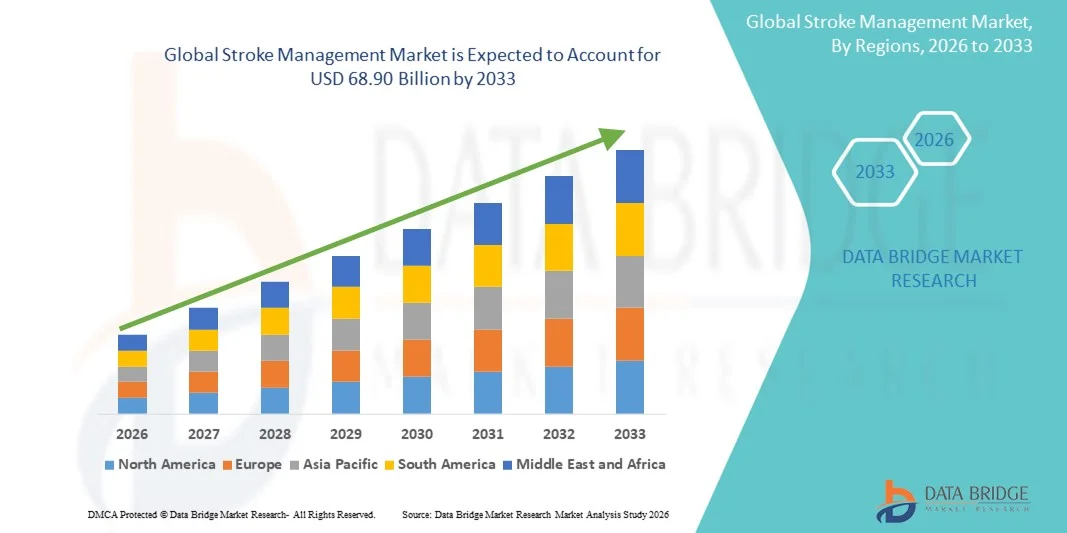
- The global stroke management market size was valued at USD 40.77 billion in 2025 and is expected to reach USD 68.90 billion by 2033, at a CAGR of 6.78% during the forecast period
- The market growth is largely fueled by the increasing prevalence of stroke cases globally, coupled with advancements in stroke diagnosis, monitoring, and rehabilitation technologies, leading to improved patient outcomes and reduced long-term healthcare costs
- Furthermore, rising awareness among healthcare providers and patients about the benefits of timely stroke management, along with the integration of digital health solutions and telemedicine for remote monitoring, is accelerating the uptake of Stroke Management solutions, thereby significantly boosting the industry's growth
Stroke Management Market Analysis
- Stroke management solutions, encompassing acute care devices, rehabilitation equipment, and digital monitoring platforms, are increasingly vital components of modern healthcare systems in both hospital and home care settings due to their ability to improve patient outcomes, enable timely interventions, and support long-term recovery
- The escalating demand for stroke management solutions is primarily fueled by the rising global prevalence of stroke, increasing geriatric population, and growing adoption of telemedicine and AI-driven diagnostic and monitoring tools
- North America dominated the stroke management market with the largest revenue share of approximately 38.5% in 2025, characterized by a strong healthcare infrastructure, high R&D investments, widespread adoption of advanced medical technologies, and a robust presence of key market players, with the U.S. driving substantial growth through innovative stroke care solutions and integrated monitoring platforms
- Asia-Pacific is expected to be the fastest-growing region in the stroke management market during the forecast period, registering an estimated CAGR of 9.2%, due to increasing healthcare expenditure, expanding hospital networks, rising awareness of stroke prevention and management, and growing adoption of telehealth solutions in countries such as China and India
- The ischemic stroke segment accounted for the largest market revenue share of around 64.1% in 2025, driven by its high global incidence and the critical need for timely intervention
Report Scope and Stroke Management Market Segmentation
|
Attributes |
Stroke Management Key Market Insights |
|
Segments Covered |
|
|
Countries Covered |
North America
Europe
Asia-Pacific
Middle East and Africa
South America
|
|
Key Market Players |
• Medtronic (Ireland) |
|
Market Opportunities |
|
|
Value Added Data Infosets |
In addition to the insights on market scenarios such as market value, growth rate, segmentation, geographical coverage, and major players, the market reports curated by the Data Bridge Market Research also include in-depth expert analysis, patient epidemiology, pipeline analysis, pricing analysis, and regulatory framework. |
Stroke Management Market Trends
Increasing Adoption of Advanced Stroke Care Solutions
- A significant and accelerating trend in the global Stroke Management market is the growing adoption of advanced diagnostic, monitoring, and treatment solutions in hospitals, rehabilitation centers, and home care settings
- Healthcare providers are increasingly integrating evidence-based therapies, minimally invasive interventions, and comprehensive post-stroke rehabilitation programs to improve patient outcomes and reduce long-term disability
- For instance, in 2024, leading hospitals in Europe and North America adopted continuous hemodynamic and neurological monitoring systems to assess stroke severity in real-time, enabling faster clinical decision-making
- Similarly, rehabilitation centers in Asia-Pacific have begun implementing structured therapy protocols, combining physical therapy, speech therapy, and cognitive rehabilitation to enhance recovery rates
- Furthermore, there is a growing focus on preventive stroke care and early intervention, with healthcare systems worldwide promoting awareness campaigns and screening programs to identify high-risk individuals
- This trend is driving the adoption of advanced stroke management solutions, including thrombolytic therapy, neuroimaging tools, and wearable monitoring devices
- Overall, the market is witnessing a shift towards integrated care models that emphasize rapid diagnosis, individualized treatment, and comprehensive post-stroke rehabilitation, reflecting a broader global commitment to improving stroke patient outcomes
Stroke Management Market Dynamics
Driver
Rising Prevalence of Stroke and Associated Risk Factors
- The global Stroke Management market is strongly driven by the increasing prevalence of stroke and associated risk factors such as hypertension, diabetes, obesity, and cardiovascular diseases
- According to global health reports, stroke remains a leading cause of disability and mortality, particularly among aging populations in Europe, North America, and Asia-Pacific
- For instance, in 2025, healthcare facilities in India and China reported a substantial rise in stroke incidents due to lifestyle-related risk factors, prompting increased investment in stroke care infrastructure and training for medical professionals
- Furthermore, the growing awareness of the importance of early intervention and rapid treatment is fueling demand for advanced diagnostic imaging, telemedicine-based monitoring, and rehabilitation programs
- The expansion of stroke care centers, coupled with government initiatives to improve access to quality care, especially in developing regions, continues to boost market growth
- In addition, the focus on reducing post-stroke complications and improving quality of life is encouraging hospitals and clinics worldwide to adopt comprehensive stroke management protocols
Restraint/Challenge
High Treatment Costs and Limited Access in Emerging Regions
- Despite strong demand, the Stroke Management market faces challenges related to the high cost of advanced treatments, diagnostic procedures, and rehabilitation programs
- In many developing regions, access to state-of-the-art stroke care remains limited due to insufficient healthcare infrastructure and budgetary constraints
- For instance, rural healthcare facilities in Africa and parts of Southeast Asia often rely on basic diagnostic tools and lack specialized rehabilitation services, hindering the adoption of comprehensive stroke management solutions
- Furthermore, the cost of therapies such as mechanical thrombectomy, neuroprotective medications, and continuous monitoring systems can be prohibitive for patients without insurance coverage, creating disparities in access to care
- Addressing these challenges requires increased government investment, cost-effective stroke care technologies, and broader awareness programs to improve early detection and management
- Expanding telemedicine and remote monitoring solutions, along with international collaborations to provide training and resources, will be essential to overcome these barriers and support sustained market growth globally
Stroke Management Market Scope
The market is segmented on the basis of type, application, and end user.
- By Type
On the basis of type, the Stroke Management market is segmented into therapeutics and diagnostics. The therapeutics segment dominated the largest market revenue share of approximately 58.4% in 2025, driven by the growing prevalence of stroke worldwide and increased adoption of advanced treatment options such as thrombolytic therapy, neuroprotective drugs, and minimally invasive interventions. Rising awareness about timely stroke management and favorable reimbursement policies in developed regions further support the dominance of therapeutics. Large-scale clinical trials, increasing R&D investments by pharmaceutical companies, and technological innovations in treatment delivery contribute to higher adoption. Hospitals and specialized stroke centers are increasingly investing in therapeutics to improve patient outcomes. The segment’s leadership is reinforced by continuous product launches and expanding global distribution networks.
The diagnostics segment is anticipated to witness the fastest CAGR of around 12.8% from 2026 to 2033, driven by advancements in imaging technologies such as CT, MRI, and perfusion scans, along with the development of portable diagnostic devices. Rapid diagnostics enable early detection of ischemic and hemorrhagic strokes, improving clinical outcomes. Rising investments in point-of-care diagnostic solutions, increasing demand in emerging markets, and the integration of AI-assisted imaging tools are accelerating growth. Improved accessibility in ambulatory and outpatient settings also boosts the adoption of diagnostic solutions. Increasing prevalence of stroke risk factors such as hypertension and diabetes fuels the need for enhanced diagnostic services, supporting strong CAGR growth.
- By Application
On the basis of application, the Stroke Management market is segmented into ischemic, hemorrhagic, and transient ischemic attack (TIA). The ischemic stroke segment accounted for the largest market revenue share of around 64.1% in 2025, driven by its high global incidence and the critical need for timely intervention. Therapeutic advancements such as mechanical thrombectomy, clot retrieval devices, and thrombolytic agents have strengthened the segment. Hospitals and specialized stroke centers are focusing on early intervention and post-stroke care, increasing adoption. Government initiatives promoting stroke awareness, combined with robust reimbursement frameworks, further enhance market dominance. The segment benefits from large patient populations, advanced clinical guidelines, and continuous R&D investment in treatment options.
The hemorrhagic stroke segment is expected to witness the fastest CAGR of approximately 11.9% from 2026 to 2033, fueled by the rising adoption of advanced surgical interventions, minimally invasive procedures, and hemostatic therapies. Improved imaging and monitoring tools aid early diagnosis and effective management. Expansion of stroke care infrastructure in emerging economies and increased awareness about hemorrhagic stroke management are contributing to rapid growth. Technological innovation, increasing patient awareness, and growing focus on preventive care strategies are also accelerating adoption. The segment shows strong growth potential due to unmet clinical needs and evolving treatment modalities.
- By End User
On the basis of end user, the Stroke Management market is segmented into hospitals, ambulatory surgery centers (ASCs), diagnostics centers, and others. The hospitals segment dominated the market with a revenue share of approximately 72.3% in 2025, driven by their capability to provide comprehensive stroke care, including acute treatment, diagnostics, and rehabilitation. Hospitals benefit from well-established infrastructure, specialized stroke units, and skilled medical professionals, enabling high adoption of both therapeutics and diagnostics. Large-scale investments in stroke management programs and partnerships with device manufacturers further reinforce the dominance of hospitals in this segment.
The ambulatory surgery centers (ASCs) segment is anticipated to witness the fastest CAGR of around 13.5% from 2026 to 2033, driven by the rising demand for outpatient stroke care services, cost-effective procedures, and minimally invasive interventions. Increasing patient preference for quick recovery and home-based rehabilitation services contributes to ASC adoption. Expansion of specialized stroke care units in ASCs, advancements in portable diagnostic technologies, and rising awareness about early stroke interventions are boosting growth. The segment also benefits from supportive reimbursement policies and healthcare infrastructure development in emerging regions.
Stroke Management Market Regional Analysis
- North America dominated the stroke management market with the largest revenue share of approximately 38.5% in 2025, supported by a well-established healthcare infrastructure, high per-capita healthcare expenditure, and widespread availability of advanced diagnostic and therapeutic technologies
- The region benefits from strong R&D investments, early adoption of innovative stroke care solutions, and the presence of leading pharmaceutical and medical device companies
- In addition, favorable reimbursement policies and growing emphasis on rapid diagnosis, post-stroke rehabilitation, and integrated care pathways continue to strengthen market growth across hospitals and specialized stroke centers
U.S. Stroke Management Market Insight
The U.S. stroke management market accounted for the largest share within North America in 2025, driven by increasing stroke incidence, high adoption of advanced imaging and monitoring technologies, and strong government and private initiatives focused on improving stroke outcomes. The growing use of tele-stroke programs, AI-enabled diagnostics, and minimally invasive treatment approaches is enhancing clinical efficiency. Moreover, extensive clinical research activity and continuous product innovation are further accelerating market expansion in the country.
Europe Stroke Management Market Insight
The Europe stroke management market is projected to expand at a steady CAGR during the forecast period, supported by rising awareness of stroke prevention, favorable government healthcare policies, and increasing investments in neurological care. European countries are focusing on improving emergency response systems, expanding specialized stroke units, and adopting advanced rehabilitation solutions, which is contributing to sustained market growth across the region.
U.K. Stroke Management Market Insight
The U.K. stroke management market is expected to grow at a noteworthy CAGR, driven by increasing healthcare funding, strong national stroke strategies, and rising adoption of digital health and telemedicine platforms. The country’s focus on early diagnosis, timely intervention, and long-term rehabilitation services is supporting the demand for comprehensive stroke management solutions across public and private healthcare facilities.
Germany Stroke Management Market Insight
Germany’s stroke management market is anticipated to grow at a considerable pace during the forecast period, supported by a robust healthcare system, high utilization of advanced medical technologies, and strong emphasis on clinical excellence. The presence of leading medical device manufacturers and increasing investments in neurological research are further enhancing the adoption of innovative stroke management solutions in hospitals and rehabilitation centers.
Asia-Pacific Stroke Management Market Insight
The Asia-Pacific stroke management market is expected to register the fastest CAGR of around 9.2% during the forecast period, driven by rising healthcare expenditure, expanding hospital infrastructure, and increasing awareness regarding stroke prevention and treatment. Growing adoption of telehealth platforms, improving access to advanced diagnostic tools, and government initiatives aimed at strengthening neurological care are significantly contributing to market growth across the region.
Japan Stroke Management Market Insight
The Japan stroke management market is gaining steady traction due to the country’s aging population, high prevalence of cerebrovascular diseases, and advanced healthcare infrastructure. Strong focus on early diagnosis, rehabilitation technologies, and long-term patient care is driving demand for comprehensive stroke management solutions in both hospital and home-based care settings.
China Stroke Management Market Insight
China stroke management market accounted for the largest revenue share in the Asia-Pacific Stroke Management market in 2025, supported by rapid expansion of healthcare infrastructure, increasing adoption of telemedicine, and rising government investments in stroke care programs. Growing awareness of stroke risks, improving access to advanced treatment options, and expansion of specialized stroke centers are key factors fueling market growth in the country.
Stroke Management Market Share
The Stroke Management industry is primarily led by well-established companies, including:
• Medtronic (Ireland)
• Stryker Corporation (U.S.)
• Johnson & Johnson (U.S.)
• Penumbra Inc. (U.S.)
• Abbott (U.S.)
• Boston Scientific Corporation (U.S.)
• B. Braun SE (Germany)
• Siemens Healthineers (Germany)
• GE HealthCare (U.S.)
• Philips Healthcare (Netherlands)
• Terumo Corporation (Japan)
• Bayer AG (Germany)
• Boehringer Ingelheim (Germany)
• Pfizer Inc. (U.S.)
• F. Hoffmann-La Roche Ltd. (Switzerland)
• AstraZeneca (U.K.)
• Merck & Co., Inc. (U.S.)
• Sanofi (France)
Latest Developments in Global Stroke Management Market
- In September 2025, the global stroke diagnostic and therapeutic market was reported to be growing rapidly as AI-powered imaging and advanced therapies expanded adoption, with the market size projected at USD ~42.07 billion in 2025 and expected to reach USD 83.91 billion by 2034, reflecting strong investment and innovation in stroke care solutions. This growth was attributed to rising stroke incidence, increased awareness, and enhancements in AI diagnostics and interventional devices that improve speed and accuracy of stroke care decisions
- In September 2025, all 107 stroke centres in England were equipped with a revolutionary AI CT scanning tool deployed through the NHS, enabling rapid analysis of brain scans within one minute to identify stroke type and severity and significantly reducing time to treatment and improving recovery rates. This technology was showcased at the European Society of Cardiology congress, with early results showing that faster decision-making led to marked improvements in functional recovery for many stroke patients
- In October 2025, AI-enabled scan systems were increasingly adopted in hospitals in Chennai, India, to accelerate stroke diagnosis by automatically highlighting problem areas on brain CT scans within minutes, helping clinicians initiate thrombolysis or thrombectomy treatments faster. Local reporting emphasized that this adoption significantly shortened diagnosis time from around 30 minutes to under 10 minutes in many cases, accelerating lifesaving intervention
- In December 2025, India’s AIIMS New Delhi announced the successful clinical trial results of an indigenous stent-retriever device (“Supernova”), demonstrating efficacy in treating large vessel occlusion strokes with outcomes comparable to global standards and low complication rates, marking a major milestone for domestic stroke intervention technology and expanding access to affordable stroke care in resource-limited settings

- Interactive Data Analysis Dashboard
- Company Analysis Dashboard for high growth potential opportunities
- Research Analyst Access for customization & queries
- Competitor Analysis with Interactive dashboard
- Latest News, Updates & Trend analysis
- Harness the Power of Benchmark Analysis for Comprehensive Competitor Tracking
Data collection and base year analysis are done using data collection modules with large sample sizes. The stage includes obtaining market information or related data through various sources and strategies. It includes examining and planning all the data acquired from the past in advance. It likewise envelops the examination of information inconsistencies seen across different information sources. The market data is analysed and estimated using market statistical and coherent models. Also, market share analysis and key trend analysis are the major success factors in the market report. To know more, please request an analyst call or drop down your inquiry.
The key research methodology used by DBMR research team is data triangulation which involves data mining, analysis of the impact of data variables on the market and primary (industry expert) validation. Data models include Vendor Positioning Grid, Market Time Line Analysis, Market Overview and Guide, Company Positioning Grid, Patent Analysis, Pricing Analysis, Company Market Share Analysis, Standards of Measurement, Global versus Regional and Vendor Share Analysis. To know more about the research methodology, drop in an inquiry to speak to our industry experts.
Data Bridge Market Research is a leader in advanced formative research. We take pride in servicing our existing and new customers with data and analysis that match and suits their goal. The report can be customized to include price trend analysis of target brands understanding the market for additional countries (ask for the list of countries), clinical trial results data, literature review, refurbished market and product base analysis. Market analysis of target competitors can be analyzed from technology-based analysis to market portfolio strategies. We can add as many competitors that you require data about in the format and data style you are looking for. Our team of analysts can also provide you data in crude raw excel files pivot tables (Fact book) or can assist you in creating presentations from the data sets available in the report.













