


Structural Core Market Overview
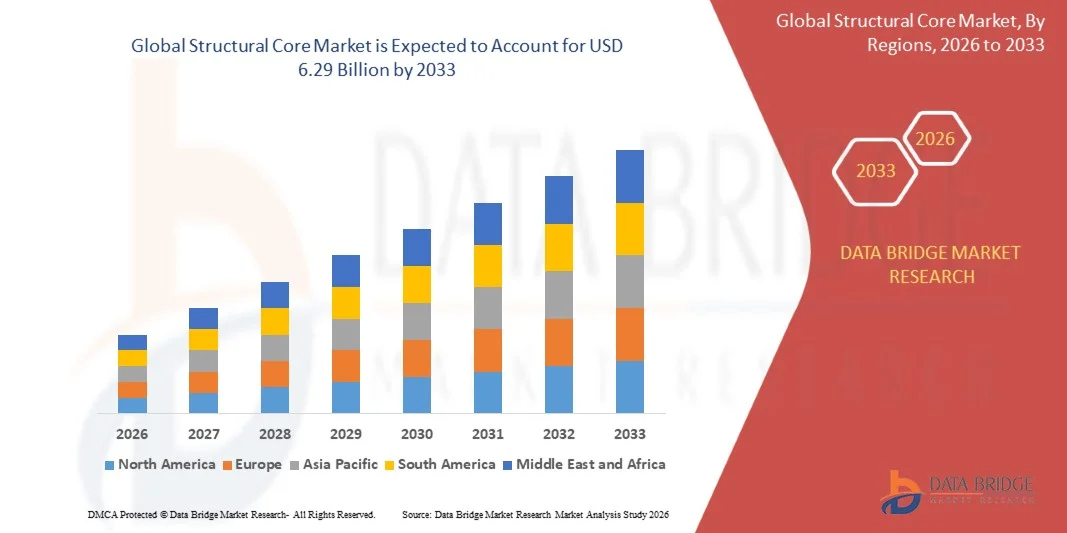
As per Data Bridge Market Research analysis, the structural core market was valued at USD 3.23 billion in 2025 and is projected to reach USD 6.29 billion by 2033, growing at a CAGR of 8.70% from 2026 to 2033. The market is experiencing consistent growth driven by increasing demand for lightweight, high-strength composite materials across wind energy, aerospace, marine, transportation, and construction industries. The growing emphasis on fuel efficiency, renewable energy infrastructure, and advanced composite manufacturing continues to support market expansion.
The rising adoption of wind turbine blades, lightweight aircraft components, and high-performance automotive structures is accelerating the use of structural core materials such as foam, honeycomb, and balsa. In addition, continuous innovations in composite technologies, coupled with increasing investments in sustainable and energy-efficient manufacturing, are encouraging manufacturers to adopt advanced structural core solutions that offer superior stiffness, durability, impact resistance, and weight reduction across multiple end-use industries.
Market Size & Forecast
- Global Market Value (2025): USD 3.23 Billion
- Expected Market Value (2033): USD 6.29 Billion
- Forecast CAGR (2026–2033): 8.70%
- Leading Region in 2025: North America
- Fastest Growing Region: Asia Pacific
Key Market Trends & Insights
- North America dominated the structural core market with a revenue share of 36.9% in 2025, supported by strong demand from the aerospace, wind energy, marine, and transportation industries, along with the presence of major composite material manufacturers
- The foam segment led the market with a 55.60% share in 2025, driven by its lightweight properties, high strength-to-weight ratio, durability, and extensive adoption across wind energy, aerospace, marine, transportation, and construction applications
- Asia-Pacific is expected to be the fastest-growing region, registering a CAGR of 7.4% from 2026 to 2033, fueled by increasing renewable energy investments, rapid industrialization, and rising adoption of lightweight composite materials in transportation and infrastructure applications
- Honeycomb are the fastest-growing type, projected to register a CAGR of 7.8%, reflecting the surge in demand for high-performance lightweight structures in aerospace, defense, and advanced transportation applications
- The glass fiber reinforced polymer (GFRP) segment dominated the outer skin category with a 60.65% revenue share in 2025, led by its cost-effectiveness, high mechanical strength, corrosion resistance, and widespread utilization in wind energy, marine, construction, and transportation applications
- Wind energy accounted for 35.40% of the market, preferred by increasing global wind turbine installations and rising demand for lightweight composite turbine blades
- The carbon fiber reinforced polymer (CFRP) segment is the fastest-growing outer skin category, with a CAGR of 8.9%, driven by rising demand for ultra-lightweight and high-strength composite structures
Report Scope and Structural Core Market Segmentation
|
Attributes |
Structural Core Key Market Insights |
|
Segments Covered |
|
|
Countries Covered |
North America
Europe
Asia-Pacific
Middle East and Africa
South America
|
|
Key Market Players |
|
|
Market Opportunities |
|
|
Value Added Data Infosets |
In addition to the insights on market scenarios such as market value, growth rate, segmentation, geographical coverage, and major players, the market reports curated by the Data Bridge Market Research also include import export analysis, production capacity overview, production consumption analysis, price trend analysis, climate change scenario, supply chain analysis, value chain analysis, raw material/consumables overview, vendor selection criteria, PESTLE Analysis, Porter Analysis, and regulatory framework. |
Structural Core Market Trends
Trend: Rising Adoption of Recyclable and Sustainable Core Materials
Manufacturers across the composites industry are increasingly adopting recyclable structural core materials to meet sustainability targets, reduce lifecycle emissions, and comply with evolving environmental regulations. Polyethylene terephthalate (PET) foam cores and bio-based core solutions are gaining traction in wind energy, transportation, marine, and construction applications due to their recyclability, lightweight properties, and compatibility with advanced composite manufacturing processes. The transition toward circular economy practices is encouraging material suppliers to develop next-generation core technologies that deliver high mechanical performance while improving environmental credentials throughout the product lifecycle. For instance, in January 2025, Gurit announced a long-term supply agreement with Genesis Products to supply Kerdyn® PET structural foam core, manufactured from up to 100% recycled PET, for office and commercial interior applications in North America. The agreement demonstrates the growing commercial adoption of sustainable structural core materials across new end-use industries beyond wind energy.
This development highlights the increasing industry focus on recyclable materials as a key growth trend in the structural core market.
Structural Core Market Dynamics
Key Market Driver: Growing Demand for Lightweight Materials in Wind Energy and Transportation
The increasing demand for lightweight, high-strength composite structures in wind energy, aerospace, marine, and transportation industries is driving substantial growth in the structural core market. Structural core materials improve stiffness-to-weight performance, enhance energy efficiency, and reduce overall component weight without compromising mechanical strength. As wind turbine blades become larger and transportation manufacturers pursue lightweighting strategies to improve fuel economy and reduce emissions, demand for advanced foam, honeycomb, and balsa core materials continues to accelerate across global markets. For instance, in January 2025, Gurit announced that demand from Western wind blade manufacturers strengthened during 2024 and highlighted the introduction of its OptiCore technology to optimize turbine blade design while reducing blade weight and cost. The company also expanded commercialization of its PET structural foam core through a long-term supply agreement, demonstrating continued demand for advanced structural core materials in wind energy applications.
Rising deployment of lightweight composite structures across wind energy and transportation sectors continues to serve as a primary growth engine for the structural core market.
Key Restraint/Challenge: Volatility in Raw Material Prices and Manufacturing Costs
A significant challenge in the structural core market is the fluctuation in raw material prices associated with polymer foams, resins, balsa wood, and specialty composite inputs. Manufacturers face ongoing pressure from supply chain disruptions, energy cost variations, and feedstock price volatility, which can affect production economics and profit margins. The challenge is particularly pronounced for industries operating under long-term supply contracts where sudden cost increases are difficult to pass on to customers, creating uncertainty in procurement and manufacturing planning. For instance, in 2025, TPI Composites reported that wind blade manufacturers remain exposed to supply chain risks due to dependence on critical raw materials, including fiberglass, carbon fiber, resins, foam core, and balsa wood. The company highlighted that fluctuations in commodity, energy, and logistics costs, along with supplier concentration risks, can impact manufacturing operations and cost stability. This demonstrates how raw material price volatility and supply chain uncertainty continue to challenge structural core material manufacturers and composite producers.
Persistent raw material price volatility remains a key operational challenge that can influence profitability, pricing strategies, and long-term investment decisions across the structural core value chain.
Key Market Opportunity: Expansion of Offshore Wind Energy and Next-Generation Composite Applications
The rapid expansion of offshore wind energy projects and advanced composite applications presents a significant opportunity for structural core material manufacturers. Larger turbine blades, floating offshore platforms, and next-generation transportation systems require lightweight materials with superior fatigue resistance and structural integrity. Advancements in foam core technologies, recyclable materials, and high-performance sandwich composites are enabling suppliers to address evolving industry requirements while expanding into new high-growth application areas. For instance, in September 2024, WindEurope reported that Europe added 6.4 GW of new wind capacity in the first half of 2024, including 1.1 GW of offshore wind capacity, while turbine orders increased year-on-year. The continued expansion of offshore wind projects and demand for larger turbines is driving the need for advanced composite structures, creating growth opportunities for structural core material suppliers serving renewable energy applications.
Increasing investment in offshore wind energy and advanced composite engineering is expected to create substantial long-term growth opportunities for structural core material manufacturers globally.
Structural Core Market Scope
The structural core market is segmented on the basis of type, outer skin, and end-user.
- By Type
On the basis of type, the structural core market is segmented into foam, honeycomb, and balsa. The foam segment dominated the structural core market with an estimated share of 55.60% in 2025, owing to its lightweight properties, high strength-to-weight ratio, durability, and extensive adoption across wind energy, aerospace, marine, transportation, and construction applications. Foam core materials, including PET, PVC, and SAN foams, are widely used in composite sandwich structures to improve stiffness while reducing overall component weight. These materials provide excellent moisture resistance, impact performance, and compatibility with advanced composite manufacturing processes. Growing demand for lightweight wind turbine blades and transportation components is significantly supporting foam core adoption. Increasing preference for recyclable PET foam solutions is further strengthening segment growth due to rising sustainability requirements. Their cost-effectiveness, processing flexibility, and balanced mechanical performance continue to make foam the leading structural core material globally.
The honeycomb segment is projected to register the fastest growth at a CAGR of 7.8% from 2026 to 2033, driven by increasing demand for high-performance lightweight structures in aerospace, defense, and advanced transportation applications. Honeycomb cores provide exceptional stiffness-to-weight performance and are extensively used in aircraft panels, interiors, and structural components. Increasing aircraft production, fleet modernization, and weight reduction initiatives are accelerating adoption of honeycomb materials. Advancements in aluminum, aramid, and thermoplastic honeycomb technologies are expanding application opportunities. Growing investments in next-generation aircraft and defense platforms are further supporting demand. The segment is expected to gain traction due to increasing requirements for materials offering superior strength, durability, and fuel efficiency benefits.
- By Outer Skin
On the basis of outer skin, the structural core market is segmented into glass fiber reinforced polymer (GFRP), carbon fiber reinforced polymer (CFRP), nylon fiber reinforced polymer (NFRP), and others. The glass fiber reinforced polymer (GFRP) segment dominated the market with an estimated share of 60.65% in 2025, supported by its cost-effectiveness, high mechanical strength, corrosion resistance, and widespread utilization in wind energy, marine, construction, and transportation applications. GFRP composites offer a favorable balance between performance and manufacturing cost compared with other advanced composite materials. Increasing wind turbine installations have significantly contributed to demand for GFRP-based composite structures, particularly turbine blades. These materials provide excellent fatigue resistance and long service life for large-scale structural applications. Growing infrastructure development and marine composite adoption are further supporting segment expansion. Established manufacturing capabilities and supply chains continue to maintain GFRP as the dominant outer skin material category.
The carbon fiber reinforced polymer (CFRP) segment is expected to be the fastest-growing outer skin material, expanding at a CAGR of 8.9% from 2026 to 2033, driven by rising demand for ultra-lightweight and high-strength composite structures. CFRP provides superior stiffness, strength, and weight reduction capabilities compared with conventional composite materials. Increasing aircraft lightweighting programs and electric vehicle development are accelerating CFRP adoption. Automotive manufacturers are increasingly integrating carbon fiber composites to improve efficiency and performance. Continuous improvements in carbon fiber production technologies are helping reduce costs and expand application areas. Growing demand for advanced aerospace, defense, and high-performance transportation structures is expected to support rapid CFRP growth during the forecast period.
- By End-user
On the basis of end-user, the structural core market is segmented into aerospace, wind energy, marine, transportation, and construction. The wind energy segment dominated the market with an estimated share of 35.40% in 2025, driven by increasing global wind turbine installations and rising demand for lightweight composite turbine blades. Structural core materials are extensively used in wind blades to improve stiffness, reduce weight, and enhance structural performance. The development of larger and longer turbine blades is increasing the requirement for advanced foam, honeycomb, and balsa core materials. Growing renewable energy investments are creating strong demand for composite material solutions. Manufacturers are increasingly adopting PET foam and recyclable core materials to meet sustainability requirements. Expansion of offshore wind projects and next-generation turbine designs is further strengthening the segment’s leading position in the structural core market.
The aerospace segment is projected to register the fastest growth at a CAGR of 7.8% from 2026 to 2033, supported by increasing aircraft production, lightweighting initiatives, and rising adoption of advanced composite materials. Structural core materials are widely used in aircraft interiors, fuselage components, flooring systems, and sandwich panels to reduce weight while maintaining structural integrity. Growing commercial aviation demand and defense modernization programs are increasing the requirement for high-performance composite materials. Aerospace manufacturers are increasingly adopting honeycomb and foam core technologies for improved fuel efficiency and durability. Expansion of electric and hybrid aircraft development is further creating new opportunities for advanced structural materials. Continuous innovation in aerospace composite manufacturing is expected to accelerate segment growth over the forecast period.
Structural Core Market Regional Analysis
North America dominated the structural core market with a revenue share of 36.9% in 2025, supported by strong demand from the aerospace, wind energy, marine, and transportation industries, along with the presence of major composite material manufacturers. The region benefits from the presence of established composite material manufacturers, growing adoption of lightweight structural materials, and increasing investments in renewable energy infrastructure. Expanding wind turbine blade production, aircraft lightweighting programs, and advanced manufacturing technologies are accelerating structural core material adoption. Growing focus on fuel efficiency, emission reduction, and high-performance composite structures continues to strengthen North America's leading position in the global market
U.S. Structural Core Market Insight
The U.S. structural core market is witnessing strong growth due to rising demand for lightweight composite materials across aerospace, wind energy, marine, and transportation industries. The country’s established aerospace manufacturing base, expanding renewable energy sector, and increasing adoption of advanced composite structures are driving demand for foam, honeycomb, and balsa core materials. In addition, growing investments in wind turbine blade manufacturing and aircraft lightweighting programs are accelerating structural core adoption across industrial applications. According to the U.S. Department of Energy (DOE) Land-Based Wind Market Report 2024, the United States installed 6.5 GW of new land-based wind capacity in 2023, supporting continued demand for composite wind turbine components, including structural core materials used in lightweight blade manufacturing.
Europe Structural Core Market Insight
The Europe structural core market remains a major contributor to global revenue, driven by strong renewable energy investments, advanced aerospace manufacturing capabilities, and increasing adoption of lightweight composite materials. The widespread use of structural core materials in wind turbine blades, aircraft components, and marine structures is supporting market expansion across the region. Increasing focus on sustainable composite solutions, recyclable PET foam technologies, and offshore wind development continues to enhance structural core material demand throughout Europe. According to WindEurope’s Wind Energy in Europe: 2023 Statistics and the Outlook for 2024–2030, Europe installed 18.3 GW of new wind capacity in 2023, including record offshore wind additions of 3.8 GW, supporting continued demand for advanced composite turbine blades and structural core materials used in lightweight wind energy structures.
U.K. Structural Core Market Insight
The U.K. structural core market is experiencing steady growth, supported by increasing offshore wind investments, aerospace composite manufacturing, and demand for lightweight structural materials. Growing deployment of offshore wind farms and development of advanced turbine technologies are contributing to increased utilization of foam and balsa core materials in blade manufacturing. Furthermore, the expansion of sustainable composite solutions and government initiatives supporting renewable energy infrastructure are strengthening market opportunities. According to RenewableUK’s Offshore Wind Industrial Growth Plan (2024), the U.K. offshore wind sector has a significant project pipeline and requires expanded supply chain capacity to support future deployment. This continued offshore wind development is creating long-term opportunities for composite material suppliers, including manufacturers of structural core materials used in turbine blades and lightweight components.
Germany Structural Core Market Insight
The Germany structural core market is expanding steadily due to the country’s strong automotive, aerospace, and renewable energy industries, along with increasing adoption of advanced composite materials. German manufacturers are increasingly utilizing structural core solutions for lightweight vehicle components, wind turbine blades, aircraft structures, and industrial applications. Continuous advancements in recyclable composite technologies and strong investment in wind energy infrastructure are further driving market growth. According to the German Wind Energy Association (BWE), Germany remains one of Europe’s largest wind energy markets, with installed onshore wind capacity reaching 63.46 GW in 2024 and continued expansion of wind installations supporting demand for composite blade materials and structural core solutions used in turbine manufacturing.
Asia-Pacific Structural Core Market Insight
The Asia-Pacific structural core market is expected to witness rapid growth, driven by increasing renewable energy installations, expanding aerospace production, and rising adoption of lightweight composite materials across transportation and infrastructure sectors. Growing investments in wind energy projects, electric vehicles, and advanced manufacturing capabilities across China, India, and Japan are supporting regional demand. In addition, increasing focus on recyclable core materials and composite technologies is accelerating adoption across industrial applications. According to the Global Wind Energy Council, Asia-Pacific accounted for the largest share of new global wind installations in 2023, with China leading global wind capacity additions, supporting demand for structural core materials used in turbine blades.
Japan Structural Core Market Insight
The Japan structural core market is witnessing consistent growth due to rising adoption of lightweight composite materials in aerospace, automotive, marine, and renewable energy applications. Japanese manufacturers are increasingly investing in advanced composite technologies to improve energy efficiency, reduce vehicle weight, and enhance structural performance. The country’s strong aerospace manufacturing capabilities and focus on next-generation mobility solutions are supporting demand for high-performance core materials. According to the Agency for Natural Resources and Energy (ANRE), Ministry of Economy, Trade and Industry (METI), Japan has set offshore wind development targets of 10 GW by 2030 and 30–45 GW by 2040, with projects totaling 5.1 GW under development as of 2024. The expansion of offshore wind infrastructure is creating additional opportunities for composite materials, including structural core materials used in lightweight turbine blade structures.
China Structural Core Market Insight
The China structural core market is growing rapidly, driven by the country’s dominant wind energy sector, expanding aerospace industry, and increasing production of lightweight composite components. Strong government support for renewable energy development, large-scale wind turbine manufacturing, and growing adoption of advanced composite materials are significantly boosting market demand. In addition, increasing investments in electric vehicles, transportation infrastructure, and high-performance manufacturing are positioning China as one of the fastest-growing structural core markets globally. According to the National Energy Administration of China (NEA), China’s cumulative installed wind power capacity reached approximately 441 GW by the end of 2023, representing a 20.7% year-on-year increase. The continued expansion of wind power capacity is increasing demand for composite turbine blades and structural core materials used in lightweight wind energy structures.
Structural Core Market Share
The structural core industry is primarily led by well-established companies, including:
- Airex (Switzerland)
- ARMACELL (Luxembourg)
- Gurit Services AG, (Switzerland)
- Diab Group (Sweden)
- Plascore, Inc. (U.S.)
- Hexcel Corporation (U.S.)
- Evonik (Germany)
- TORAY INDUSTRIES, INC. (Japan)
- SABIC (Saudi Arabia)
- Nidaplast (France)
- The Gill Corporation (U.S.)
- EconCore (Belgium)
- Owens Corning (U.S.)
- Dow Inc. (U.S.)
- BASF (Germany)
- Zotefoams plc (U.K.)
- METYX (Turkey)
Latest Developments in Structural Core Market
- In September 2025, Gurit announced a multi-year contract to supply Corecell™ structural foam core materials to the subsea industry, strengthening the company’s position in high-performance composite applications. The agreement supports the expansion of Gurit’s Corecell™ SAN foam core solutions, which are engineered for demanding environments requiring high toughness, impact resistance, and long-term durability. The development also includes expansion of Gurit’s Asia-Pacific operations to support future supply requirements. This strategic move demonstrates increasing demand for advanced structural core materials beyond traditional wind and marine applications
- In May 2025, 3A Composites Core Materials announced that its BALTEK SBC balsa core product line was formally declared FSC™ MIX certified in selected markets, strengthening the sustainability credentials of its structural core portfolio. The certification improves product traceability and enables customers to use verified sustainable sourcing information for their composite applications. BALTEK SBC is a structural balsa core material used in lightweight sandwich structures across wind energy, marine, transportation, and industrial applications. This development highlights the growing importance of sustainable and responsibly sourced core materials in the global structural core market
- In July 2024, 3A Composites Core Materials announced the transition of its BALTEK SB balsa core portfolio toward BALTEK SBC controlled structural balsa core materials, focusing on sustainable sourcing, controlled-origin supply chains, and improved traceability. The updated product portfolio supports composite manufacturers seeking lightweight core solutions with consistent mechanical performance and responsible material sourcing. BALTEK SBC provides high strength-to-weight and stiffness-to-weight ratios for applications such as wind turbine blades, marine structures, transportation, and industrial composites
- In May 2022, 3A Composites Core Materials acquired Solvay’s TegraCore foam technology, expanding its portfolio of advanced structural core materials for lightweight sandwich composite applications. The acquisition strengthened 3A Composites’ capabilities in high-performance foam core solutions designed for aerospace, transportation, marine, and industrial applications. TegraCore technology supports the development of lightweight composite structures with improved processing characteristics and mechanical performance
- In November 2021, ALUULA Composites launched a new class of lightweight soft composite materials developed through a proprietary molecular-level bonding technology. The new material platform was designed to deliver high strength-to-weight performance, improved abrasion resistance, and reduced dependence on heavy adhesive layers compared with conventional laminated composites. The technology was targeted for applications requiring lightweight and durable composite structures across industrial and performance-oriented markets. This launch demonstrated the growing focus on advanced composite material technologies that improve weight efficiency and structural performance

- Interactive Data Analysis Dashboard
- Company Analysis Dashboard for high growth potential opportunities
- Research Analyst Access for customization & queries
- Competitor Analysis with Interactive dashboard
- Latest News, Updates & Trend analysis
- Harness the Power of Benchmark Analysis for Comprehensive Competitor Tracking
Global Structural Core Market, Supply Chain Analysis and Ecosystem Framework
To support market growth and help clients navigate the impact of geopolitical shifts, DBMR has integrated in-depth supply chain analysis into its Global Structural Core Market research reports. This addition empowers clients to respond effectively to global changes affecting their industries. The supply chain analysis section includes detailed insights such as Global Structural Core Market consumption and production by country, price trend analysis, the impact of tariffs and geopolitical developments, and import and export trends by country and HSN code. It also highlights major suppliers with data on production capacity and company profiles, as well as key importers and exporters. In addition to research, DBMR offers specialized supply chain consulting services backed by over a decade of experience, providing solutions like supplier discovery, supplier risk assessment, price trend analysis, impact evaluation of inflation and trade route changes, and comprehensive market trend analysis.
Data collection and base year analysis are done using data collection modules with large sample sizes. The stage includes obtaining market information or related data through various sources and strategies. It includes examining and planning all the data acquired from the past in advance. It likewise envelops the examination of information inconsistencies seen across different information sources. The market data is analysed and estimated using market statistical and coherent models. Also, market share analysis and key trend analysis are the major success factors in the market report. To know more, please request an analyst call or drop down your inquiry.
The key research methodology used by DBMR research team is data triangulation which involves data mining, analysis of the impact of data variables on the market and primary (industry expert) validation. Data models include Vendor Positioning Grid, Market Time Line Analysis, Market Overview and Guide, Company Positioning Grid, Patent Analysis, Pricing Analysis, Company Market Share Analysis, Standards of Measurement, Global versus Regional and Vendor Share Analysis. To know more about the research methodology, drop in an inquiry to speak to our industry experts.
Data Bridge Market Research is a leader in advanced formative research. We take pride in servicing our existing and new customers with data and analysis that match and suits their goal. The report can be customized to include price trend analysis of target brands understanding the market for additional countries (ask for the list of countries), clinical trial results data, literature review, refurbished market and product base analysis. Market analysis of target competitors can be analyzed from technology-based analysis to market portfolio strategies. We can add as many competitors that you require data about in the format and data style you are looking for. Our team of analysts can also provide you data in crude raw excel files pivot tables (Fact book) or can assist you in creating presentations from the data sets available in the report.













