


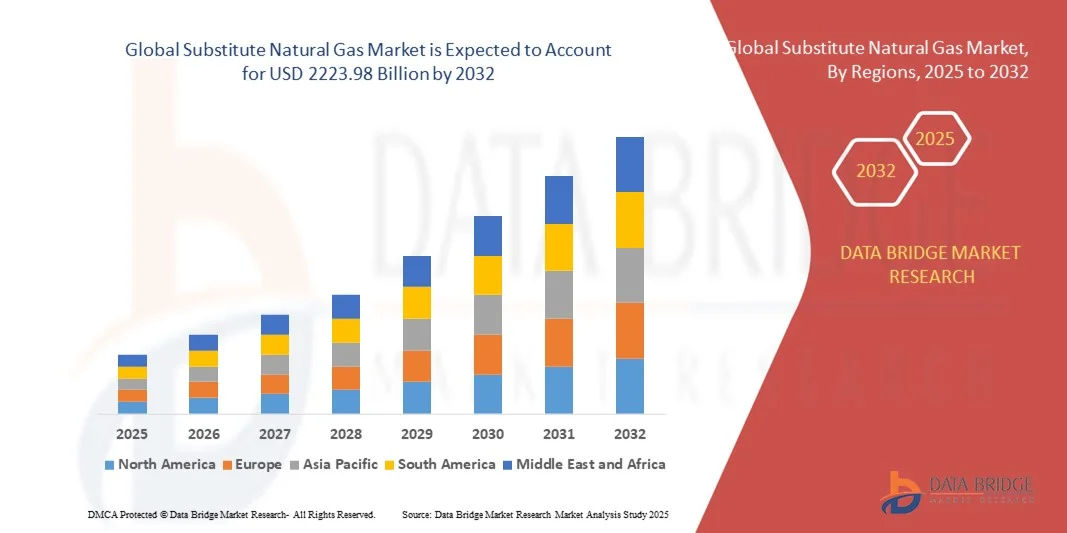
Global Substitute Natural Gas Market Size
- The global Substitute Natural Gas (SNG) market size was valued at USD 1210.49billion in 2024 and is projected to reach USD 2223.98billion by 2032, growing at a CAGR of 7.90% during the forecast period.
- The market growth is primarily driven by increasing global energy demand, volatility in natural gas prices, and the need for cleaner energy alternatives to reduce greenhouse gas emissions across industrial and power generation sectors.
- Additionally, supportive government policies, rising investments in renewable and synthetic gas technologies, and the shift toward energy diversification are propelling the adoption and expansion of the SNG market globally.
Global Substitute Natural Gas Market Analysis
- The Global Substitute Natural Gas (SNG) market is gaining traction as a reliable and cleaner alternative to conventional natural gas, playing a crucial role in energy diversification and emission reduction strategies, particularly in regions seeking to lower dependence on fossil fuels and enhance energy security.
- The rising demand for SNG is primarily driven by increasing environmental regulations, growing energy consumption, the volatility of natural gas prices, and the push for decarbonization across industrial, residential, and transportation sectors.
- Asia-Pacific Dominated the global SNG market with the largest revenue share of 38.5%in 2024, fueled by strong government initiatives in China and India to reduce coal usage, expand renewable energy integration, and invest in synthetic gas infrastructure to meet surging urban energy needs.
- North America is expected to witness significant growth in the SNG market during the forecast period due to advancements in gasification technologies, robust pipeline networks, and rising investment in renewable natural gas (RNG) production, especially in the U.S. and Canada.
- The coal segment dominated the market with the largest revenue share of 46.5% in 2024, primarily due to the extensive availability of coal reserves and established coal gasification technologies, especially in countries like China and India
Report Scope and Global Substitute Natural Gas Market Segmentation
|
Attributes |
Substitute Natural Gas Key Market Insights |
|
Segments Covered |
|
|
Countries Covered |
North America
Europe
Asia-Pacific
Middle East and Africa
South America
|
|
Key Market Players |
|
|
Market Opportunities |
|
|
Value Added Data Infosets |
In addition to the insights on market scenarios such as market value, growth rate, segmentation, geographical coverage, and major players, the market reports curated by the Data Bridge Market Research also include import export analysis, production capacity overview, production consumption analysis, price trend analysis, climate change scenario, supply chain analysis, value chain analysis, raw material/consumables overview, vendor selection criteria, PESTLE Analysis, Porter Analysis, and regulatory framework. |
Global Substitute Natural Gas Market Trends
Technological Advancements Driving Efficiency and Sustainability
- A significant and accelerating trend in the global Substitute Natural Gas (SNG) market is the integration of advanced technologies such as artificial intelligence (AI), carbon capture and storage (CCS), and renewable energy inputs into SNG production processes. This convergence is enhancing process efficiency, reducing emissions, and improving the overall economic viability of synthetic gas solutions across industries.
- For Instance, AI-driven monitoring and control systems are being implemented in gasification and methanation units to optimize reaction conditions, predict maintenance needs, and reduce energy consumption. Companies like Siemens Energy are deploying digital twin technology in SNG plants to simulate real-time operations and improve decision-making.
- Carbon capture integration plays a pivotal role in making SNG a low-carbon alternative to conventional natural gas. Technologies developed by companies such as Shell and TotalEnergies are enabling the capture and storage of CO₂ emissions generated during coal or biomass gasification, significantly lowering the environmental footprint of SNG facilities.
- Additionally, the use of renewable electricity (such as solar or wind) to power electrolysis for green hydrogen production is reshaping the SNG value chain. This hydrogen is then combined with captured CO₂ to synthesize methane, forming a carbon-neutral or even carbon-negative fuel. This method is gaining traction in regions with strong renewable capacity and climate targets, such as Europe and parts of North America.
- This technological evolution is also enabling decentralized and modular SNG production units, making it feasible for industrial parks, urban centers, and even remote locations to generate clean gas locally. Such flexibility is attracting utilities and governments looking to decarbonize their gas grids and reduce reliance on imported fossil fuels.
- The rising integration of AI, CCS, and renewable hydrogen into the SNG production ecosystem reflects a broader shift toward cleaner, smarter, and more resilient energy systems. As climate policies tighten and energy security concerns rise, these innovations are expected to play a central role in shaping the future of the global SNG market.
Global Substitute Natural Gas Market Dynamics
Driver
Growing Need Due to Energy Security and Environmental Regulations
- The increasing global emphasis on energy security and climate change mitigation is a significant driver of the growing demand for Substitute Natural Gas (SNG), particularly in countries aiming to diversify energy sources and reduce reliance on conventional fossil fuels.
- For instance, in March 2024, TotalEnergies SE announced its expansion of SNG production capacity through a new biomass-to-gas plant in France, part of its strategy to supply cleaner, domestically sourced energy while meeting EU decarbonization targets. Such strategic developments underscore the growing role of SNG in national energy portfolios.
- SNG offers a reliable and cleaner-burning alternative to natural gas, making it attractive for countries with limited natural gas reserves but abundant feedstock such as coal, biomass, or waste. Governments in Asia and Europe are increasingly supporting SNG infrastructure as part of long-term energy transition plans.
- Furthermore, as industries and utilities face stricter emissions targets, SNG—particularly when produced using renewable hydrogen and carbon capture—presents an appealing pathway to maintain gas use while significantly reducing carbon intensity. This is especially relevant in power generation, district heating, and heavy industrial applications.
- The rising demand is also fueled by the versatility of SNG in existing gas infrastructure. Its chemical compatibility with natural gas allows it to be injected directly into pipelines, enabling countries to decarbonize without overhauling existing systems. This makes SNG an effective transitional solution for achieving net-zero goals while ensuring energy reliability.
Restraint/Challenge
High Production Costs and Limited Economic Viability Without Policy Support
- The high capital and operational costs associated with Substitute Natural Gas (SNG) production remain a significant challenge to widespread market adoption, particularly in regions without strong policy incentives or subsidies. The complex processes involved—such as gasification, methanation, and carbon capture—require advanced infrastructure and significant energy input, which can lead to higher costs compared to conventional natural gas.
- For instance, large-scale coal-to-SNG plants, such as those in China, have faced scrutiny due to their high cost per energy unit and environmental concerns, especially in the absence of carbon pricing mechanisms or emissions trading schemes to offset these impacts.
- The economic feasibility of SNG also depends heavily on feedstock availability and cost. While coal and biomass are widely used, their extraction, transportation, and preparation can add logistical complexity and cost. Moreover, green SNG production using renewable hydrogen and captured CO₂ is still in its early stages and remains more expensive than fossil-based alternatives.
- Additionally, the lack of global standardization, underdeveloped infrastructure for renewable gas injection, and uncertainties around long-term demand projections hinder investment confidence. As a result, many private-sector players are hesitant to fund SNG projects without clear government backing or guaranteed off-take agreements.
- While technological advancements and economies of scale are gradually improving cost competitiveness, the SNG market will require sustained policy support—such as tax incentives, renewable gas mandates, and R&D funding—to overcome economic barriers and scale production. Strategic partnerships and public-private collaboration will also be crucial for ensuring long-term viability and accelerating adoption across industrial and energy sectors.
Global Substitute Natural Gas Market Scope
The market is segmented on the basis of source, application, technology.
- By Source
On the basis of source, the global substitute natural gas market is segmented into coal, biomass, waste, and others. The coal segment dominated the market with the largest revenue share of 46.5% in 2024, primarily due to the extensive availability of coal reserves and established coal gasification technologies, especially in countries like China and India. Coal-based SNG remains a cost-effective solution for regions focused on energy security and industrial usage.
The biomass segment is expected to witness the fastest CAGR of 22.3% from 2025 to 2032, driven by rising environmental concerns, government incentives for renewable energy, and increasing investments in sustainable gas production technologies. Biomass offers a carbon-neutral alternative, leveraging agricultural and forestry residues, and is gaining momentum in Europe and North America as part of the global energy transition.
- By Application
On the basis of application, the substitute natural gas market is segmented into residential, commercial, industrial, and transportation. The industrial segment held the largest market revenue share of 39.8% in 2024, fueled by demand for cleaner fuel alternatives in manufacturing, chemical processing, and power generation industries where natural gas is used as a primary feedstock or energy source. SNG provides a low-carbon, reliable energy source to meet stringent emissions regulations.
The transportation segment is anticipated to record the fastest CAGR of 24.1% from 2025 to 2032, driven by increased adoption of compressed natural gas (CNG) vehicles and public transit fleets seeking cleaner fuel options. Policy support for decarbonizing transportation and investments in fueling infrastructure further propel growth in this segment.
Global Substitute Natural Gas Market Regional Analysis
- Asia Pacific dominated the global substitute natural gas market with the largest revenue share of 38.5% in 2024, driven by strong government initiatives promoting clean energy and decarbonization efforts across multiple sectors.
- The region’s abundant feedstock availability, advanced technological infrastructure, and significant investments in renewable energy projects support the rapid adoption of substitute natural gas, particularly in industrial and transportation applications.
- Additionally, rising environmental regulations and policies encouraging the use of low-carbon fuels, combined with growing demand for energy security and diversification, have positioned North America as a key market for SNG solutions in both commercial and residential sectors.
U.S. Substitute Natural Gas Market Insight
The U.S. substitute natural gas market captured the largest revenue share of 42% in 2024, driven by strong federal and state policies aimed at reducing carbon emissions and boosting clean energy alternatives. Increasing investments in gasification and methanation technologies, along with a robust pipeline infrastructure, support the growing demand from industrial, residential, and transportation sectors. The U.S. also benefits from abundant feedstock availability, such as coal and biomass, facilitating diverse SNG production pathways. Additionally, rising adoption of renewable natural gas (RNG) and power-to-gas projects, coupled with increasing emphasis on energy security and diversification, are further propelling market expansion.
Europe Substitute Natural Gas Market Insight
Europe’s substitute natural gas market is projected to witness a substantial CAGR during the forecast period, primarily driven by stringent environmental regulations, carbon neutrality goals, and increasing investments in green gas projects. The region’s focus on decarbonizing industrial processes and expanding the use of biomethane supports market growth. Countries like Germany and the Netherlands are at the forefront of advancing methanation technologies and integrating SNG into existing gas grids. The rising adoption of renewable energy and hydrogen blending initiatives further enhances the substitute natural gas market in Europe across residential, commercial, and transportation applications.
Germany Substitute Natural Gas Market Insight
Germany’s substitute natural gas market is expected to grow at a significant CAGR, fueled by the country’s strong commitment to the Energiewende (energy transition) and aggressive targets to reduce greenhouse gas emissions. The development of innovative gasification and methanation projects, combined with a robust renewable hydrogen infrastructure, positions Germany as a leader in synthetic methane production. Industrial sectors, including chemicals and manufacturing, along with residential heating and transportation, are major consumers of SNG. The government’s support through subsidies and research grants is accelerating the commercialization of substitute natural gas technologies.
Asia-Pacific Substitute Natural Gas Market Insight
The Asia-Pacific substitute natural gas market is poised to record the fastest CAGR of 25.4% from 2025 to 2032, driven by rapid urbanization, industrialization, and increasing energy demand in countries such as China, India, Japan, and South Korea. The region’s abundant coal reserves and growing biomass resources provide diverse feedstock options for SNG production. Government initiatives promoting cleaner fuels, energy diversification, and reduction of air pollution are propelling the uptake of substitute natural gas in power generation, industrial applications, and transportation. Additionally, technological advancements and increasing investments from both domestic and international players are expanding the market’s reach.
China Substitute Natural Gas Market Insight
China dominated the Asia-Pacific substitute natural gas market with the largest revenue share of 45% in 2024, fueled by the country’s vast coal reserves, increasing focus on energy security, and aggressive policies aimed at reducing coal consumption in favor of cleaner alternatives. China’s commitment to carbon neutrality by 2060 has accelerated investments in coal gasification and biomethane projects. Urbanization and industrial growth are driving demand for substitute natural gas across various sectors, including residential heating, industrial processing, and transportation. The government’s support for innovation, coupled with strong domestic manufacturing capabilities, is expected to sustain market growth.
Japan Substitute Natural Gas Market Insight
Japan’s substitute natural gas market is gaining momentum due to the country’s energy import dependency and its strong focus on renewable energy integration and energy security. The market is supported by increasing investments in power-to-gas methanation technology, aimed at producing synthetic methane using surplus renewable electricity and captured CO₂. Residential and industrial sectors are progressively adopting SNG as a cleaner fuel alternative. Additionally, Japan’s aging population and urban infrastructure modernization are driving demand for reliable and sustainable energy sources, enhancing the market’s growth potential.
Global Substitute Natural Gas Market Share
The Substitute Natural Gas industry is primarily led by well-established companies, including:
- Air Liquide (France)
- Air Products and Chemicals, Inc. (U.S.)
- BASF SE (Germany)
- BP plc (U.K.)
- Chevron Corporation (U.S.)
- China National Petroleum Corporation (CNPC) (China)
- ConocoPhillips (U.S.)
- ExxonMobil Corporation (U.S.)
- Gazprom (Russia)
- Linde plc (Ireland)
- Royal Dutch Shell plc (Netherlands/U.K.)
- Sasol Limited (South Africa)
- Siemens AG (Germany)
- Sinopec Limited (China)
- Southern Company (U.S.)
- Synthesis Energy Systems, Inc. (U.S.)
- TotalEnergies SE (France)
- U-Gas (United States)
- Uniper SE (Germany)
- Yara International ASA (Norway)
What are the Recent Developments in Global Substitute Natural Gas Market?
- In April 2023, Air Liquide, a global leader in industrial gases and energy solutions, announced a strategic project in South Africa to expand its substitute natural gas production capacity. This initiative aims to support the region’s transition to cleaner energy by leveraging advanced gasification and methanation technologies. By tailoring solutions to local feedstock availability and energy needs, Air Liquide is reinforcing its commitment to sustainable development while strengthening its presence in the rapidly growing global Substitute Natural Gas Market.
- In March 2023, Synthesis Energy Systems, Inc., a U.S.-based company specializing in coal gasification, launched an upgraded synthetic natural gas production system designed specifically for industrial clients. The new system focuses on improving efficiency and reducing emissions, enabling industries to meet stricter environmental regulations. This development highlights Synthesis Energy’s dedication to advancing cleaner fuel technologies that support industrial decarbonization and sustainable energy use.
- In March 2023, Honeywell International Inc. successfully implemented a large-scale substitute natural gas project in Bengaluru, India, aimed at enhancing energy security and reducing pollution through coal-to-SNG conversion. This project uses cutting-edge gasification and methanation technology to supply cleaner fuel to urban and industrial consumers, demonstrating Honeywell’s expertise in innovative energy solutions and its role in promoting sustainable urban development.
- In February 2023, TotalEnergies SE formed a strategic partnership with a regional biomass supplier in Europe to develop renewable substitute natural gas through advanced biomethane production processes. This collaboration aims to increase the availability of low-carbon gas options for residential and commercial applications, underscoring TotalEnergies’ commitment to expanding its clean energy portfolio and accelerating the global transition to sustainable gas solutions.
- In January 2023, Shell plc unveiled its new gasification technology platform at an international energy conference, featuring enhanced efficiency and lower emissions for synthetic natural gas production. The platform integrates renewable energy sources with carbon capture technologies, enabling the production of carbon-neutral substitute natural gas. Shell’s innovation marks a significant step towards decarbonizing the gas supply chain and supporting global climate goals.

- Interactive Data Analysis Dashboard
- Company Analysis Dashboard for high growth potential opportunities
- Research Analyst Access for customization & queries
- Competitor Analysis with Interactive dashboard
- Latest News, Updates & Trend analysis
- Harness the Power of Benchmark Analysis for Comprehensive Competitor Tracking
Table of Content
1 INTRODUCTION
1.1 OBJECTIVES OF THE STUDY
1.2 MARKET DEFINITION
1.3 OVERVIEW OF GLOBAL SUBSTITUTE NATURAL GAS MARKET
1.4 CURRENCY AND PRICING
1.5 LIMITATION
1.6 MARKETS COVERED
2 MARKET SEGMENTATION
2.1 KEY TAKEAWAYS
2.2 ARRIVING AT THE GLOBAL SUBSTITUTE NATURAL GAS MARKET SIZE
2.3 VENDOR POSITIONING GRID
2.4 MARKETS COVERED
2.5 GEOGRAPHIC SCOPE
2.6 YEARS CONSIDERED FOR THE STUDY
2.7 RESEARCH METHODOLOGY
2.8 TECHNOLOGY LIFE LINE CURVE
2.9 MULTIVARIATE MODELLING
2.1 PRIMARY INTERVIEWS WITH KEY OPINION LEADERS
2.11 DBMR MARKET POSITION GRID
2.12 MARKET APPLICATION COVERAGE GRID
2.13 DBMR MARKET CHALLENGE MATRIX
2.14 IMPORT AND EXPORT DATA
2.15 SECONDARY SOURCES
2.16 GLOBAL SUBSTITUTE NATURAL GAS MARKET: RESEARCH SNAPSHOT
2.17 ASSUMPTIONS
3 MARKET OVERVIEW
3.1 DRIVERS
3.2 RESTRAINTS
3.3 OPPORTUNITIES
3.4 CHALLENGES
4 EXECUTIVE SUMMARY
5 PREMIUM INSIGHTS
5.1 PRODUCTION CONSUMPTION ANALYSIS
5.2 RAW MATERIAL PRODUCTION COVERAGE
5.3 REGULATION COVERAGE
6 CLIMATE CHANGE SCENARIO
6.1 ENVIRONMENTAL CONCERNS
6.2 INDUSTRY RESPONSE
6.3 GOVERNMENT’S ROLE
6.4 ANALYST RECOMMENDATIONS
7 IMPACT OF COVID-19 PANDEMIC ON GLOBAL SUBSTITUTE NATURAL GAS MARKET
7.1 ANALYSIS ON IMPACT OF COVID-19 ON THE MARKET
7.2 AFTERMATH OF COVID-19 AND GOVERNMENT INITIATIVE TO BOOST THE MARKET
7.3 STRATEGIC DECISIONS FOR MANUFACTUERS AFTER COVID-19 TO GAIN COMPETITIVE MARKET SHARE
7.4 PRICE IMPACT
7.5 IMPACT ON DEMAND
7.6 IMPACT ON SUPPLY CHAIN
7.7 CONCLUSION
8 GLOBAL SUBSTITUTE NATURAL GAS MARKET, BY SOURCE
8.1 OVERVIEW
8.2 COAL
8.3 PETROLEUM COKE
8.4 BIOMASS
8.5 SOLID WASTE
8.6 OIL SHALE/GAS
8.7 BIOFUELS
8.8 OTHERS
9 GLOBAL SUBSTITUTE NATURAL GAS MARKET, BY PROCESS
9.1 OVERVIEW
9.2 FERMENTATION PROCESS
9.3 GAS-CONDITIONING
10 GLOBAL SUBSTITUTE NATURAL GAS MARKET, BY APPLICATION
10.1 OVERVIEW
10.2 TRANSPORTATION
10.2.1 AUTOMOTIVE
10.2.1.1. PASSENGER CARS
10.2.1.2. TWO/ THREE-WHEELERS
10.2.1.3. COMMERCIAL VEHICLES
10.2.2 RAIL
10.2.3 AVIATION
10.2.4 AGRICULTURAL
10.2.5 MARINE
10.2.6 OTHERS
10.3 ENERGY
10.4 ELECTRICITY GENERATION
10.5 RESIDENTIAL HEATING
10.6 INDUSTRIAL
10.7 OTHERS
11 GLOBAL SUBSTITUTE NATURAL GAS MARKET, BY GEOGRAPHY
11.1 GLOBAL SUBSTITUTE NATURAL GAS MARKET, (ALL SEGMENTATION PROVIDED ABOVE IS REPRESENTED IN THIS CHAPTER BY COUNTRY)
11.2 NORTH AMERICA
11.2.1 U.S.
11.2.2 CANADA
11.2.3 MEXICO
11.3 EUROPE
11.3.1 GERMANY
11.3.2 U.K.
11.3.3 ITALY
11.3.4 FRANCE
11.3.5 SPAIN
11.3.6 RUSSIA
11.3.7 SWITZERLAND
11.3.8 TURKEY
11.3.9 BELGIUM
11.3.10 NETHERLANDS
11.3.11 REST OF EUROPE
11.4 ASIA-PACIFIC
11.4.1 JAPAN
11.4.2 CHINA
11.4.3 SOUTH KOREA
11.4.4 INDIA
11.4.5 SINGAPORE
11.4.6 THAILAND
11.4.7 INDONESIA
11.4.8 MALAYSIA
11.4.9 PHILIPPINES
11.4.10 AUSTRALIA & NEW ZEALAND
11.4.11 REST OF ASIA-PACIFIC
11.5 SOUTH AMERICA
11.5.1 BRAZIL
11.5.2 ARGENTINA
11.5.3 REST OF SOUTH AMERICA
11.6 MIDDLE EAST AND AFRICA
11.6.1 SOUTH AFRICA
11.6.2 EGYPT
11.6.3 SAUDI ARABIA
11.6.4 UNITED ARAB EMIRATES
11.6.5 ISRAEL
11.6.6 REST OF MIDDLE EAST AND AFRICA
12 GLOBAL SUBSTITUTE NATURAL GAS MARKET, COMPANY LANDSCAPE
12.1 COMPANY SHARE ANALYSIS: GLOBAL
12.2 COMPANY SHARE ANALYSIS: NORTH AMERICA
12.3 COMPANY SHARE ANALYSIS: EUROPE
12.4 COMPANY SHARE ANALYSIS: ASIA-PACIFIC
12.5 MERGERS AND ACQUISITIONS
12.6 NEW PRODUCT DEVELOPMENT AND APPROVALS
12.7 EXPANSIONS
12.8 PARTNERSHIP AND OTHER STRATEGIC DEVELOPMENTS
13 SWOT AND DATA BRIDGE MARKET RESEARCH ANALYSIS
14 GLOBAL SUBSTITUTE NATURAL GAS MARKET - COMPANY PROFILES
14.1 TRANSTECH ENERGY, LLC
14.1.1 COMPANY SNAPSHOT
14.1.2 REVENUE ANALYSIS
14.1.3 PRODUCT PORTFOLIO
14.1.4 RECENT UPDATES
14.2 NATIONAL GAS COMPANY
14.2.1 COMPANY SNAPSHOT
14.2.2 REVENUE ANALYSIS
14.2.3 PRODUCT PORTFOLIO
14.2.4 RECENT UPDATES
14.3 DAKOTA GASIFICATION COMPANY
14.3.1 COMPANY SNAPSHOT
14.3.2 REVENUE ANALYSIS
14.3.3 PRODUCT PORTFOLIO
14.3.4 RECENT UPDATES
14.4 INDRAPRASTHA GAS LIMITED
14.4.1 COMPANY SNAPSHOT
14.4.2 REVENUE ANALYSIS
14.4.3 PRODUCT PORTFOLIO
14.4.4 RECENT UPDATES
14.5 EXXON MOBIL CORPORATION
14.5.1 COMPANY SNAPSHOT
14.5.2 REVENUE ANALYSIS
14.5.3 PRODUCT PORTFOLIO
14.5.4 RECENT UPDATES
14.6 ENI S.P.A.
14.6.1 COMPANY SNAPSHOT
14.6.2 REVENUE ANALYSIS
14.6.3 PRODUCT PORTFOLIO
14.6.4 RECENT UPDATES
14.7 AIR LIQUIDE
14.7.1 COMPANY SNAPSHOT
14.7.2 REVENUE ANALYSIS
14.7.3 PRODUCT PORTFOLIO
14.7.4 RECENT UPDATES
14.8 MAN ENERGY SOLUTIONS
14.8.1 COMPANY SNAPSHOT
14.8.2 REVENUE ANALYSIS
14.8.3 PRODUCT PORTFOLIO
14.8.4 RECENT UPDATES
14.9 HAWAII GAS
14.9.1 COMPANY SNAPSHOT
14.9.2 REVENUE ANALYSIS
14.9.3 PRODUCT PORTFOLIO
14.9.4 RECENT UPDATES
14.1 BASF SE
14.10.1 COMPANY SNAPSHOT
14.10.2 REVENUE ANALYSIS
14.10.3 PRODUCT PORTFOLIO
14.10.4 RECENT UPDATES
14.11 LINDE PLC
14.11.1 COMPANY SNAPSHOT
14.11.2 REVENUE ANALYSIS
14.11.3 PRODUCT PORTFOLIO
14.11.4 RECENT UPDATES
14.12 AIR PRODUCTS INC.
14.12.1 COMPANY SNAPSHOT
14.12.2 REVENUE ANALYSIS
14.12.3 PRODUCT PORTFOLIO
14.12.4 RECENT UPDATES
14.13 ROCKY MOUNTAIN GTL INC.
14.13.1 COMPANY SNAPSHOT
14.13.2 REVENUE ANALYSIS
14.13.3 PRODUCT PORTFOLIO
14.13.4 RECENT UPDATES
14.14 CHEVRON CORPORATION
14.14.1 COMPANY SNAPSHOT
14.14.2 REVENUE ANALYSIS
14.14.3 PRODUCT PORTFOLIO
14.14.4 RECENT UPDATES
NOTE: THE COMPANIES PROFILED IS NOT EXHAUSTIVE LIST AND IS AS PER OUR PREVIOUS CLIENT REQUIREMENT. WE PROFILE MORE THAN 100 COMPANIES IN OUR STUDY AND HENCE THE LIST OF COMPANIES CAN BE MODIFIED OR REPLACED ON REQUEST
15 RELATED REPORTS
16 QUESTIONNAIRE
17 CONCLUSION
18 ABOUT DATA BRIDGE MARKET RESEARCH

Global Substitute Natural Gas Market, Supply Chain Analysis and Ecosystem Framework
To support market growth and help clients navigate the impact of geopolitical shifts, DBMR has integrated in-depth supply chain analysis into its Global Substitute Natural Gas Market research reports. This addition empowers clients to respond effectively to global changes affecting their industries. The supply chain analysis section includes detailed insights such as Global Substitute Natural Gas Market consumption and production by country, price trend analysis, the impact of tariffs and geopolitical developments, and import and export trends by country and HSN code. It also highlights major suppliers with data on production capacity and company profiles, as well as key importers and exporters. In addition to research, DBMR offers specialized supply chain consulting services backed by over a decade of experience, providing solutions like supplier discovery, supplier risk assessment, price trend analysis, impact evaluation of inflation and trade route changes, and comprehensive market trend analysis.
Data collection and base year analysis are done using data collection modules with large sample sizes. The stage includes obtaining market information or related data through various sources and strategies. It includes examining and planning all the data acquired from the past in advance. It likewise envelops the examination of information inconsistencies seen across different information sources. The market data is analysed and estimated using market statistical and coherent models. Also, market share analysis and key trend analysis are the major success factors in the market report. To know more, please request an analyst call or drop down your inquiry.
The key research methodology used by DBMR research team is data triangulation which involves data mining, analysis of the impact of data variables on the market and primary (industry expert) validation. Data models include Vendor Positioning Grid, Market Time Line Analysis, Market Overview and Guide, Company Positioning Grid, Patent Analysis, Pricing Analysis, Company Market Share Analysis, Standards of Measurement, Global versus Regional and Vendor Share Analysis. To know more about the research methodology, drop in an inquiry to speak to our industry experts.
Data Bridge Market Research is a leader in advanced formative research. We take pride in servicing our existing and new customers with data and analysis that match and suits their goal. The report can be customized to include price trend analysis of target brands understanding the market for additional countries (ask for the list of countries), clinical trial results data, literature review, refurbished market and product base analysis. Market analysis of target competitors can be analyzed from technology-based analysis to market portfolio strategies. We can add as many competitors that you require data about in the format and data style you are looking for. Our team of analysts can also provide you data in crude raw excel files pivot tables (Fact book) or can assist you in creating presentations from the data sets available in the report.













