


What is the Sugar Substitutes in Food Industry Market Size and Growth Rate?
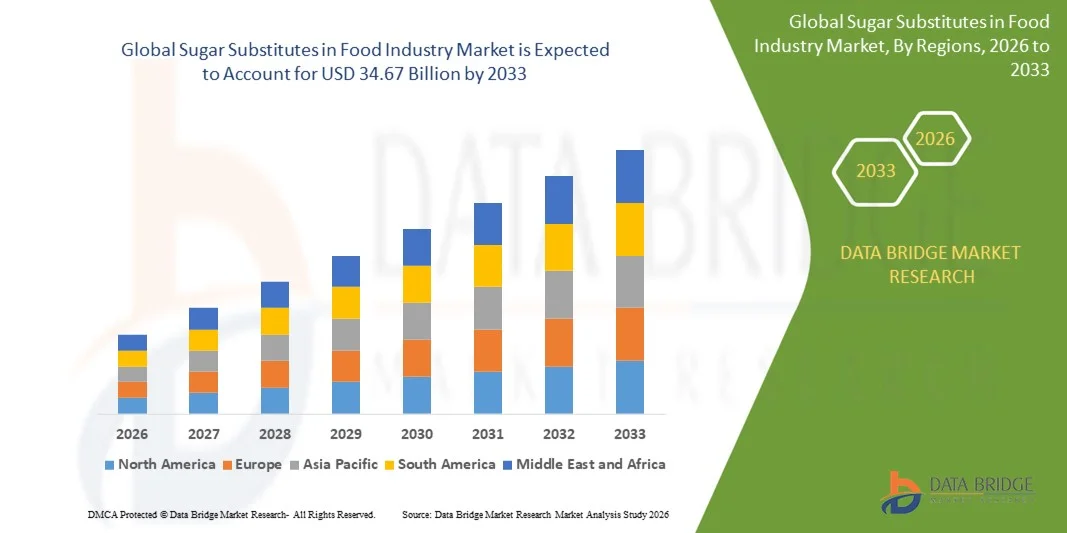
- As per Data Bridge Market Research Analysis the global Sugar Substitutes in Food Industry Market size was valued at USD 24.56 billion in 2025 and is expected to reach USD 34.67 billion by 2033, at a CAGR of 4.40% during the forecast period.
- The market growth is largely driven by increasing health consciousness among consumers and the rising prevalence of diabetes and obesity, prompting a shift toward low-calorie and sugar-free alternatives in food and beverages.
- Furthermore, continuous product innovation, technological advancements in natural and synthetic sweeteners, and growing adoption of clean-label products are encouraging manufacturers to expand their sugar substitute offerings. These converging factors are accelerating the adoption of sugar substitutes across the food industry, thereby significantly boosting the market’s growth.
Market Size & Forecast
- Global Market Value (2025): USD 24.56 Billion
- Expected Market Value (2033): USD 34.67 Billion
- Forecast CAGR (2026–2033): 4.40%
What are the Major Takeaways of Sugar Substitutes in Food Industry Market?
- Sugar substitutes, including natural and artificial sweeteners, are increasingly integral to the modern food and beverage industry due to their ability to provide low-calorie, low-glycemic, and diabetic-friendly alternatives while maintaining taste and texture in various products.
- The escalating demand for sugar substitutes is primarily fueled by rising health awareness, increasing prevalence of diabetes and obesity, and a growing consumer preference for low-calorie and clean-label products.
- North America dominated the Global Sugar Substitutes in Food Industry Market with the largest revenue share of 34.1% in 2025, characterized by high health-conscious consumer adoption, well-established food and beverage manufacturing infrastructure, and a strong presence of key industry players, with the U.S. experiencing substantial growth in sugar substitute consumption across beverages, baked goods, and confectionery, driven by innovations from both multinational companies and startups focusing on natural and plant-based sweeteners.
- Asia-Pacific is expected to be the fastest-growing region in the Global Sugar Substitutes in Food Industry Market during the forecast period due to increasing urbanization, rising disposable incomes, and shifting dietary habits toward healthier alternatives.
- The high-intensity sweeteners segment dominated the market with a revenue share of 46.5% in 2025, driven by their superior sweetness, low-calorie profile, and versatility across beverages, bakery, and confectionery products.
Report Scope and Global Sugar Substitutes in Food Industry Market Segmentation
|
Attributes |
Sugar Substitutes in Food Industry Key Market Insights |
|
Segments Covered |
|
|
Countries Covered |
North America
Europe
Asia-Pacific
Middle East and Africa
South America
|
|
Key Market Players |
|
|
Market Opportunities |
|
|
Value Added Data Infosets |
In addition to the insights on market scenarios such as market value, growth rate, segmentation, geographical coverage, and major players, the market reports curated by the Data Bridge Market Research also include in-depth expert analysis, pricing analysis, brand share analysis, consumer survey, demography analysis, supply chain analysis, value chain analysis, raw material/consumables overview, vendor selection criteria, PESTLE Analysis, Porter Analysis, and regulatory framework. |
What is the Key Trend in the Global Sugar Substitutes in Food Industry Market?
Enhanced Product Innovation Through Natural and Functional Ingredients
- A significant and accelerating trend in the global Sugar Substitutes in Food Industry Market is the growing integration of natural, plant-based, and functional ingredients such as stevia, monk fruit, and allulose. This shift is significantly enhancing product appeal, taste, and health benefits for consumers.
- For instance, several beverage and dairy brands are incorporating stevia and monk fruit blends to reduce sugar content while maintaining sweetness and flavor profiles comparable to traditional sugar. Similarly, baked goods and confectionery companies are experimenting with allulose to provide low-calorie alternatives that replicate the texture and browning properties of sugar.
- Innovations in sugar substitutes enable features such as added nutritional benefits, lower glycemic impact, and cleaner labels, meeting the rising consumer demand for healthier and more transparent products. For example, some functional sweetener blends now include prebiotics to support digestive health while reducing sugar intake.
- The seamless incorporation of these advanced sugar substitutes across various food and beverage categories allows manufacturers to offer healthier alternatives without compromising on taste or quality. This integration supports a broader shift toward functional and clean-label foods, creating more diverse options for health-conscious consumers.
- This trend toward natural, functional, and multi-benefit sugar substitutes is fundamentally reshaping consumer expectations in the food industry. Consequently, companies such as Tate & Lyle and Ingredion are developing innovative sweetener solutions that combine natural origins, zero-calorie profiles, and enhanced functional benefits.
- The demand for sugar substitutes that offer superior taste, health benefits, and functional advantages is growing rapidly across both packaged foods and beverages, as consumers increasingly prioritize health, wellness, and cleaner ingredient profiles.
Global Sugar Substitutes in Food Industry Market Dynamics
Driver
Growing Need Due to Rising Health Awareness and Sugar Reduction Trends
-
The increasing prevalence of lifestyle-related health concerns, including obesity, diabetes, and cardiovascular diseases, coupled with the growing consumer preference for healthier diets, is a significant driver for the heightened demand for sugar substitutes.
- For instance, in 2025, Tate & Lyle launched a new range of natural low-calorie sweeteners aimed at beverages and snacks, addressing both taste retention and sugar reduction targets. Such initiatives by key companies are expected to drive the sugar substitutes market growth during the forecast period.
- As consumers become more health-conscious and seek products that support weight management and blood sugar control, sugar substitutes offer viable alternatives to traditional sugar, providing sweetness without the associated calories or glycemic impact.
- Furthermore, the growing popularity of clean-label products and functional foods is making sugar substitutes an integral ingredient for manufacturers, allowing seamless integration into beverages, bakery, confectionery, and dairy products.
- The convenience of using sugar substitutes that mimic sugar’s taste and texture, combined with the ability to formulate products for diabetic and calorie-conscious consumers, are key factors propelling adoption across both residential consumption and commercial food production. The trend towards reformulated recipes and increasing availability of user-friendly sweetener blends further contributes to market growth.
Restraint/Challenge
Concerns Regarding Regulatory Approvals, Taste, and Cost
- Concerns surrounding regulatory compliance, taste profiles, and the cost of sugar substitutes pose significant challenges to broader market penetration. Some sweeteners require extensive safety evaluations and approval processes, which can delay product launches.
- For instance, certain high-intensity sweeteners have faced regulatory scrutiny in key markets such as the U.S. and EU, making some consumers hesitant to adopt new formulations.
- Addressing these concerns through rigorous testing, transparent labeling, and education about the safety and benefits of approved sugar substitutes is crucial for building consumer trust. Companies such as Cargill and ADM emphasize the natural origins and safety profiles of their products in marketing campaigns to reassure buyers. Additionally, some sugar substitutes, particularly natural ones like stevia or monk fruit, can have higher production costs compared to traditional sugar, which can be a barrier for price-sensitive manufacturers and consumers.
- While prices are gradually becoming more competitive, the perceived premium for certain sugar substitutes can still hinder widespread adoption, especially in emerging markets or for cost-conscious food manufacturers.
- Overcoming these challenges through product innovation, cost optimization, and consumer education on health benefits and safe usage will be vital for sustained market growth.
How is the Global Sugar Substitutes in Food Industry Market Segmented?
Sugar substitutes in food industry market is segmented on the basis of type, application, distribution channel, end use and category.
- By Type
On the basis of type, the market is segmented into high-fructose syrup, high-intensity sweeteners, and low-intensity sweeteners. The high-intensity sweeteners segment dominated the market with a revenue share of 46.5% in 2025, driven by their superior sweetness, low-calorie profile, and versatility across beverages, bakery, and confectionery products. Products such as sucralose, stevia, and aspartame are increasingly used by manufacturers to reduce sugar content without affecting taste.
The low-intensity sweeteners segment is expected to witness the fastest CAGR of 18.7% from 2026 to 2033, fueled by growing consumer preference for natural, plant-based alternatives like monk fruit and allulose. Rising health awareness, clean-label trends, and demand for reduced-calorie products in functional foods and beverages further propel the growth of low-intensity sweeteners in both developed and emerging markets.
- By Application
On the basis of application, the market is segmented into confectionery, bakery, condiments, dairy and frozen yogurt, ice cream, and others. The confectionery segment accounted for the largest market revenue share of 39.8% in 2025, driven by the extensive use of sugar substitutes in chocolates, candies, and chewing gums to reduce sugar content while maintaining desired sweetness.
The dairy and frozen yogurt segment is anticipated to witness the fastest CAGR of 19.3% from 2026 to 2033, due to rising demand for low-sugar, probiotic-enriched yogurts, frozen desserts, and diabetic-friendly dairy products. Increasing consumer inclination toward healthier, functional dairy and frozen offerings supports the adoption of sugar substitutes in this segment across both retail and foodservice channels.
- By Distribution Channel
On the basis of distribution channel, the market is segmented into store-based and non-store-based channels. The store-based segment dominated with a 57.2% revenue share in 2025, attributed to the widespread availability of sugar substitutes in supermarkets, hypermarkets, and specialty stores, providing consumers with convenience and product variety.
The non-store-based segment is expected to witness the fastest CAGR of 17.8% from 2026 to 2033, driven by the rapid growth of e-commerce, online grocery platforms, and direct-to-consumer models. Digital channels allow consumers access to a wider range of natural and specialty sweeteners, doorstep delivery, subscription options, and competitive pricing, supporting adoption in both urban and semi-urban regions globally.
- By End Use
On the basis of end use, the market is segmented into food and beverage manufacturers, tabletop, hospitality, and others. The food and beverage manufacturers segment held the largest revenue share of 52.6% in 2025, driven by large-scale incorporation of sugar substitutes in processed foods, beverages, and functional products to meet consumer demand for healthier alternatives.
The tabletop segment is expected to witness the fastest CAGR of 18.1% from 2026 to 2033, fueled by rising household use of tabletop sugar substitutes and increased adoption in cafés, restaurants, and hospitality for sugar-free options, enhancing convenience and flexibility for end consumers seeking personalized sweetness levels.
- By Category
On the basis of category, the market is segmented into natural and synthetic sugar substitutes. The natural segment dominated with a 48.9% revenue share in 2025, reflecting consumer preference for plant-based, minimally processed ingredients.
The synthetic segment is expected to witness the fastest CAGR of 19.0% from 2026 to 2033, driven by innovations in artificial sweeteners that mimic sugar taste with low-calorie profiles. Growing regulatory support for reduced-sugar products, combined with increasing R&D in synthetic alternatives, is expanding their adoption across processed foods, beverages, and confectionery worldwide.
Which Region Holds the Largest Share of the Global Sugar Substitutes in Food Industry Market?
- North America dominated the Global Sugar Substitutes in Food Industry Market with the largest revenue share of 34.1% in 2025, driven by growing health awareness, increasing incidence of lifestyle diseases such as diabetes and obesity, and a strong preference for low-calorie and natural sweeteners.
- Consumers in the region are increasingly seeking healthier alternatives to traditional sugar in everyday food and beverages, including bakery products, confectionery, dairy, and beverages, fueling demand for both natural and synthetic sugar substitutes.
- This widespread adoption is further supported by high disposable incomes, a well-established food processing industry, and strong regulatory frameworks encouraging reduced sugar content in packaged foods. Additionally, the presence of major food and beverage manufacturers focusing on clean-label and sugar-reduction initiatives has cemented the region as a key market for sugar substitutes across both retail and foodservice sectors.
U.S. Sugar Substitutes Market Insight
The U.S. sugar substitutes market captured the largest revenue share of 38% in 2025 within North America, driven by growing health awareness, rising prevalence of diabetes and obesity, and increasing demand for low-calorie and natural sweeteners. Consumers are actively seeking sugar alternatives for bakery, confectionery, dairy, and beverage applications. The expanding trend of clean-label products and reduced-sugar initiatives by major food and beverage manufacturers further propels market growth. Additionally, rising consumer preference for tabletop sweeteners and ready-to-use sugar substitutes, coupled with robust retail and e-commerce channels, supports widespread adoption.
Europe Sugar Substitutes Market Insight
The Europe sugar substitutes market is projected to expand at a steady CAGR throughout the forecast period, fueled by regulatory initiatives promoting sugar reduction, such as the EU’s voluntary sugar reduction programs. Rising health consciousness and the growing demand for functional foods and beverages are key growth drivers. Countries such as Germany, the U.K., and France are witnessing significant adoption in confectionery, bakery, dairy, and beverage applications, with both natural and synthetic sweeteners gaining traction.
U.K. Sugar Substitutes Market Insight
The U.K. sugar substitutes market is expected to grow at a notable CAGR during the forecast period, driven by increased public awareness of sugar-related health risks and government-backed sugar reduction campaigns. Consumer preference for healthier alternatives in tea, coffee, and bakery products, along with strong retail and online distribution channels, is supporting growth. Additionally, the popularity of low-calorie and functional sweeteners in foodservice and hospitality sectors is further boosting market adoption.
Germany Sugar Substitutes Market Insight
The Germany sugar substitutes market is anticipated to expand at a significant CAGR, fueled by rising health consciousness, stringent food labeling regulations, and increasing demand for low-calorie and natural sweeteners. Growing adoption in bakery, confectionery, and dairy applications, along with strong innovation in functional sweeteners, is driving market growth. Germany’s well-developed food and beverage industry, coupled with consumer preference for eco-friendly and sustainable alternatives, supports widespread adoption.
Asia-Pacific Sugar Substitutes Market Insight
The Asia-Pacific sugar substitutes market is poised to grow at the fastest CAGR of 22% during the forecast period of 2026 to 2032, driven by rapid urbanization, rising disposable incomes, and increasing awareness of lifestyle diseases in countries such as China, India, and Japan. The region’s expanding food processing industry, growing demand for low-calorie and natural sweeteners, and initiatives promoting healthier diets are driving adoption. The availability of affordable sugar substitutes and increasing export-oriented food production further propels market growth.
Japan Sugar Substitutes Market Insight
The Japan sugar substitutes market is witnessing strong growth due to rising health awareness, an aging population, and a high preference for functional and low-calorie sweeteners. Consumers increasingly adopt sugar substitutes in beverages, confectionery, and tabletop applications. Government-led campaigns promoting healthier diets, combined with a technologically advanced food processing industry, are boosting adoption in both retail and foodservice sectors.
China Sugar Substitutes Market Insight
The China sugar substitutes market accounted for the largest market revenue share in Asia-Pacific in 2025, driven by rapid urbanization, increasing health awareness, and the rising prevalence of diabetes and obesity. The country’s growing middle-class population is shifting toward healthier food and beverage options, including bakery, dairy, and confectionery products. Government initiatives promoting reduced-sugar diets and the availability of competitively priced sugar substitutes from domestic manufacturers are key factors driving market growth.
Which are the Top Companies in Global Sugar Substitutes in Food Industry Market?
The Sugar Substitutes in Food Industry is primarily led by well-established companies, including:
• Cargill, Inc. (U.S.)
• Tate & Lyle PLC (U.K.)
• Ingredion Incorporated (U.S.)
• ADM (Archer Daniels Midland Company) (U.S.)
• Roquette Frères (France)
• Sweet Green Fields (Netherlands)
• Mitsubishi Corporation Life Sciences (Japan)
• Kerry Group PLC (Ireland)
• Beneo GmbH (Germany)
• GLG Life Tech Corporation (Canada)
• Südzucker AG (Germany)
• PureCircle (Malaysia)
• NutraSweet Company (U.S.)
• Cosucra Groupe Warcoing (Belgium)
• Rousselot (France)
• Ajinomoto Co., Inc. (Japan)
• Daesang Corporation (South Korea)
• Jungbunzlauer Suisse AG (Switzerland)
• Stevia Corp (U.S.)
• Fujian Sunner Development Co., Ltd. (China)
What are Latest Developments in Global Sugar Substitutes in Food Industry Market?
- In April 2024, Cargill, Inc., a global leader in food and agricultural products, launched a new line of high-intensity natural sweeteners in the U.S. market aimed at providing healthier alternatives for beverages and baked goods. This initiative underscores the company’s commitment to meeting growing consumer demand for low-calorie, clean-label sugar substitutes. By leveraging its global expertise in food innovation and formulation, Cargill is strengthening its position in the expanding sugar substitutes market.
- In March 2024, Tate & Lyle PLC, a leading global supplier of food ingredients, introduced a stevia-based sweetener solution tailored for confectionery and dairy applications in Europe. The new product is designed to reduce sugar content without compromising taste, highlighting Tate & Lyle’s focus on health-driven innovation and supporting the ongoing shift toward reduced-sugar formulations in the food industry.
- In March 2024, Ingredion Incorporated partnered with a major beverage manufacturer in Asia to develop low-calorie syrups for soft drinks and functional beverages. The collaboration aims to provide healthier drink options while maintaining taste and texture, demonstrating Ingredion’s dedication to expanding the adoption of sugar substitutes in emerging markets.
- In February 2024, ADM (Archer Daniels Midland Company) announced a strategic partnership with a leading dairy cooperative in North America to launch natural sweetener solutions for yogurt and ice cream products. This collaboration focuses on reducing added sugars and enhancing nutritional profiles, reflecting ADM’s commitment to innovation and meeting consumer demand for healthier, functional foods.
- In January 2024, Roquette Frères, a global provider of plant-based ingredients, unveiled a new line of high-fructose syrup alternatives at the Food Ingredients Europe (Fi Europe) 2024 event. The product line targets bakery and confectionery applications, offering manufacturers an opportunity to reduce sugar content while maintaining taste and consistency. This launch underscores Roquette’s focus on sustainability and health-conscious product development in the global sugar substitutes market.

- Interactive Data Analysis Dashboard
- Company Analysis Dashboard for high growth potential opportunities
- Research Analyst Access for customization & queries
- Competitor Analysis with Interactive dashboard
- Latest News, Updates & Trend analysis
- Harness the Power of Benchmark Analysis for Comprehensive Competitor Tracking
Global Sugar Substitutes In Food Industry Market, Supply Chain Analysis and Ecosystem Framework
To support market growth and help clients navigate the impact of geopolitical shifts, DBMR has integrated in-depth supply chain analysis into its Global Sugar Substitutes In Food Industry Market research reports. This addition empowers clients to respond effectively to global changes affecting their industries. The supply chain analysis section includes detailed insights such as Global Sugar Substitutes In Food Industry Market consumption and production by country, price trend analysis, the impact of tariffs and geopolitical developments, and import and export trends by country and HSN code. It also highlights major suppliers with data on production capacity and company profiles, as well as key importers and exporters. In addition to research, DBMR offers specialized supply chain consulting services backed by over a decade of experience, providing solutions like supplier discovery, supplier risk assessment, price trend analysis, impact evaluation of inflation and trade route changes, and comprehensive market trend analysis.
Data collection and base year analysis are done using data collection modules with large sample sizes. The stage includes obtaining market information or related data through various sources and strategies. It includes examining and planning all the data acquired from the past in advance. It likewise envelops the examination of information inconsistencies seen across different information sources. The market data is analysed and estimated using market statistical and coherent models. Also, market share analysis and key trend analysis are the major success factors in the market report. To know more, please request an analyst call or drop down your inquiry.
The key research methodology used by DBMR research team is data triangulation which involves data mining, analysis of the impact of data variables on the market and primary (industry expert) validation. Data models include Vendor Positioning Grid, Market Time Line Analysis, Market Overview and Guide, Company Positioning Grid, Patent Analysis, Pricing Analysis, Company Market Share Analysis, Standards of Measurement, Global versus Regional and Vendor Share Analysis. To know more about the research methodology, drop in an inquiry to speak to our industry experts.
Data Bridge Market Research is a leader in advanced formative research. We take pride in servicing our existing and new customers with data and analysis that match and suits their goal. The report can be customized to include price trend analysis of target brands understanding the market for additional countries (ask for the list of countries), clinical trial results data, literature review, refurbished market and product base analysis. Market analysis of target competitors can be analyzed from technology-based analysis to market portfolio strategies. We can add as many competitors that you require data about in the format and data style you are looking for. Our team of analysts can also provide you data in crude raw excel files pivot tables (Fact book) or can assist you in creating presentations from the data sets available in the report.













