Sulfur Fertilizers Market Overview
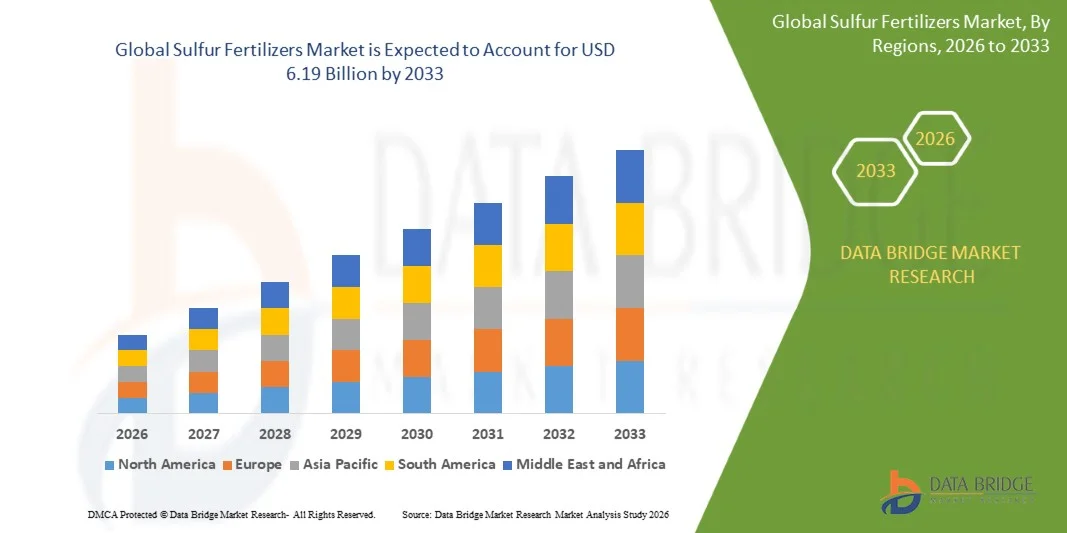
As per Data Bridge Market Research Analysis the sulfur fertilizers market was valued at USD 4.96 billion in 2025 and is projected to reach USD 6.19 billion by 2033, growing at a CAGR of 2.80 % from 2026 to 2033. Market growth is primarily driven by the increasing prevalence of sulfur-deficient soils, rising demand for high-quality agricultural produce, and growing awareness among farmers regarding balanced crop nutrition. The widespread adoption of sulfur-based fertilizers to improve crop yield, nutrient uptake, and overall soil health is further supporting market expansion.
Growing cultivation of sulfur-intensive crops such as oilseeds, pulses, cereals, fruits, and vegetables is creating sustained demand for sulfur fertilizers across major agricultural economies. Increasing emphasis on sustainable farming practices, precision agriculture, and efficient nutrient management is encouraging the use of advanced sulfur fertilizer formulations. Furthermore, supportive government initiatives promoting balanced fertilization, coupled with technological advancements in fertilizer manufacturing and expanding agricultural production in emerging economies, are expected to strengthen market growth throughout the forecast period.
Market Size & Forecast
- Market Value (2025): USD 4.96 Billion
- Expected Market Value (2033): USD 6.19 Billion
- Forecast CAGR (2026–2033): 2.80%
- Leading Region in 2025: Asia-Pacific
- Fastest Growing Region: North America
Key Market Trends & Insights
- Asia-Pacific dominated the sulfur fertilizers market with the largest revenue share of approximately 37.05% in 2025, supported by its extensive agricultural production, widespread sulfur-deficient soils, high fertilizer consumption, and increasing adoption of balanced nutrient management practices across major farming economies such as China and India.
- North America is expected to witness the fastest growth rate from 2026 to 2033, supported by advanced agricultural practices, widespread cultivation of cereals, oilseeds, and pulses, and increasing adoption of balanced crop nutrition strategies.
- The sulphate fertilizers segment held the largest market revenue share of approximately 45.5% in 2025, driven by its rapid sulfur availability and extensive use across cereals, oilseeds, pulses, fruits, and vegetables. Sulphate fertilizers provide sulfur in a readily available form that is immediately absorbed by crops, making them highly effective in correcting sulfur deficiencies, improving protein synthesis, and enhancing nutrient-use efficiency. Their compatibility with conventional fertilizer programs and widespread adoption in intensive farming systems continue to support the segment's market leadership.
- The elemental sulfur fertilizers segment is expected to witness the fastest growth during the forecast period from 2026 to 2033, driven by increasing adoption in long-term soil fertility management, rising demand for sustainable agriculture, and expanding investments in precision farming. Elemental sulfur provides gradual nutrient release through microbial oxidation, ensuring season-long sulfur availability and improved soil health. Meanwhile, the liquid sulfur fertilizers segment is gaining traction due to its compatibility with fertigation and foliar application systems, while the others segment continues to expand through innovative specialty and blended sulfur fertilizer formulations that improve nutrient-use efficiency and crop-specific performance.
- The dry segment held the largest market revenue share in 2025, driven by its widespread adoption in conventional agriculture, ease of storage and transportation, longer shelf life, and cost-effectiveness. Dry sulfur fertilizers, including granular and powdered formulations, are extensively used across cereals, grains, oilseeds, and pulses, providing a reliable and economical solution for correcting sulfur deficiencies. Their compatibility with bulk fertilizer blending and conventional application equipment continues to support the segment's market leadership.
- The liquid segment is expected to witness the fastest growth during the forecast period from 2026 to 2033, driven by the increasing adoption of precision agriculture, fertigation systems, and foliar nutrient application techniques. Liquid sulfur fertilizers provide rapid nutrient availability, uniform application, and improved nutrient-use efficiency, making them well suited for high-value horticultural crops and controlled-environment agriculture. Rising investments in modern irrigation infrastructure and sustainable farming practices are expected to further accelerate the adoption of liquid sulfur fertilizers.
Report Scope and Sulfur Fertilizers Market Segmentation
|
Attributes |
Sulfur Fertilizers Key Market Segments |
|
Segments Covered |
|
|
Countries Covered |
North America
Europe
Asia-Pacific
Middle East and Africa
South America
|
|
Key Market Players |
|
|
Market Opportunities |
|
|
Value Added Data Infosets |
In addition to the insights on market scenarios such as market value, growth rate, segmentation, geographical coverage, and major players, the market reports curated by the Data Bridge Market Research also include import export analysis, production capacity overview, production consumption analysis, price trend analysis, climate change scenario, supply chain analysis, value chain analysis, raw material/consumables overview, vendor selection criteria, PESTLE Analysis, Porter Analysis, and regulatory framework |
Sulfur Fertilizers Market Trends
Trend: Rising Adoption of Sustainable Sulfur-Based Crop Nutrition Solutions
Growing emphasis on sustainable agriculture and balanced crop nutrition is accelerating the adoption of advanced sulfur fertilizers across global farming systems. Increasing sulfur deficiencies in agricultural soils, coupled with the expansion of precision agriculture and regenerative farming practices, are encouraging growers to adopt sulfur-based fertilizers that improve nutrient-use efficiency, enhance crop quality, and support long-term soil health. Manufacturers are also expanding their portfolios with specialty sulfur formulations that reduce nutrient losses and improve fertilizer performance across a wide range of crops.
For instance, in July 2025, ICL Group introduced Sulfurball, a sulfur-based fertilizer featuring a distinctive spherical granule design to improve spreading uniformity, enhance sulfur absorption, and reduce application costs for major crops such as soybeans and corn in Latin America. The product reflects the industry's growing focus on developing innovative sulfur fertilizer solutions that support precision nutrient management and sustainable agricultural productivity.
The growing adoption of sustainable sulfur-based crop nutrition solutions and continued investments in specialty fertilizer innovation are expected to strengthen long-term demand for sulfur fertilizers, supporting improved crop productivity and sustainable agricultural practices worldwide.
Sulfur Fertilizers Market Dynamics
Key Market Driver: Rising Demand for Balanced Crop Nutrition and Season-Long Sulfur Availability
The increasing need for balanced crop nutrition to address widespread sulfur deficiencies and improve agricultural productivity is driving demand for sulfur fertilizers worldwide. Declining atmospheric sulfur deposition, intensive cultivation practices, and the growing adoption of high-yielding crop varieties have significantly increased the requirement for sulfur supplementation across cereals, oilseeds, pulses, fruits, and vegetables. Sulfur plays a vital role in protein synthesis, chlorophyll formation, and nutrient-use efficiency, encouraging farmers to adopt advanced sulfur fertilizer technologies that provide consistent nutrient availability throughout the growing season.
For instance, in January 2024, The Mosaic Company strengthened its MicroEssentials fertilizer portfolio through its proprietary Fusion Technology, which combines nitrogen, phosphorus, and two forms of sulfur (sulfate and elemental sulfur) into a single granule. The technology provides season-long sulfur availability, improves nutrient uptake, and enhances fertilizer-use efficiency, supporting higher crop productivity and balanced crop nutrition.
The growing emphasis on balanced crop nutrition and continuous advancements in sulfur fertilizer technologies are expected to strengthen long-term demand for sulfur fertilizers, supporting sustainable agricultural productivity and improved crop performance.
Key Restraint/Challenge: Rising Sulfur Price Volatility and Inefficient Sulfur Availability
Volatility in sulfur raw material prices and the limited efficiency of conventional sulfur fertilizers are posing significant challenges to market growth. Fluctuations in sulfur supply due to refinery output, geopolitical disruptions, and rising raw material costs continue to increase production expenses for fertilizer manufacturers and create pricing uncertainty for farmers. In addition, sulfate sulfur is highly susceptible to leaching under high-rainfall conditions, reducing nutrient availability during critical crop growth stages and limiting fertilizer-use efficiency in several agricultural regions.
For instance, in January 2026, CF Industries highlighted that fertilizer production costs remain highly dependent on the availability and pricing of key raw materials and energy inputs, with natural gas accounting for more than 70% of the variable cost of ammonia production. The company also noted that geopolitical disruptions and global supply chain constraints continue to influence fertilizer availability and pricing across international markets.
Rising sulfur price volatility and ongoing supply chain uncertainties are expected to remain key challenges for the sulfur fertilizers market, encouraging manufacturers to improve production efficiency, strengthen supply resilience, and develop advanced fertilizer formulations with enhanced nutrient availability.
Key Market Opportunity: Growing Demand for Specialty Sulfur Fertilizers and Precision Nutrient Management
The increasing adoption of specialty fertilizers and precision nutrient management practices is creating significant growth opportunities for the sulfur fertilizers market. Rising demand for high-value crops, growing awareness of balanced crop nutrition, and the expansion of precision agriculture and fertigation technologies are encouraging farmers to adopt advanced sulfur fertilizer solutions that improve nutrient-use efficiency and crop quality. Increasing investments in innovative fertilizer formulations and specialty nutrient manufacturing are further enabling producers to address evolving soil nutrient deficiencies while supporting sustainable agricultural production.
For instance, in March 2025, Coromandel International Limited inaugurated its second Bentonite Sulphur production plant at Visakhapatnam, India, doubling its sulfur fertilizer manufacturing capacity to 50,000 metric tons per annum. The facility utilizes advanced German technology to produce fortified sulfur fertilizers with micronutrients, strengthening the company's specialty nutrient portfolio and supporting the growing demand for sulfur-based crop nutrition solutions.
The growing adoption of specialty sulfur fertilizers and continued investments in precision nutrient management are expected to create substantial growth opportunities for the sulfur fertilizers market, supporting sustainable agricultural productivity and improved crop quality.
Sulfur Fertilizers Market Scope
The sulfur fertilizers market is segmented based on product type, form, crop type, mode of application, and cultivation type.
- • By Product Type
On the basis of product, the sulfur fertilizers market is segmented into sulphate fertilizers, elemental sulfur fertilizers, liquid sulfur fertilizers, and others. The sulphate fertilizers segment held the largest market revenue share of approximately 45.5% in 2025, driven by its rapid sulfur availability and extensive use across cereals, oilseeds, pulses, fruits, and vegetables. Sulphate fertilizers provide sulfur in a readily available form that is immediately absorbed by crops, making them highly effective in correcting sulfur deficiencies, improving protein synthesis, and enhancing nutrient-use efficiency. Their compatibility with conventional fertilizer programs and widespread adoption in intensive farming systems continue to support the segment's market leadership.
The elemental sulfur fertilizers segment is expected to witness the fastest growth during the forecast period from 2026 to 2033, driven by increasing adoption in long-term soil fertility management, rising demand for sustainable agriculture, and expanding investments in precision farming. Elemental sulfur provides gradual nutrient release through microbial oxidation, ensuring season-long sulfur availability and improved soil health. Meanwhile, the liquid sulfur fertilizers segment is gaining traction due to its compatibility with fertigation and foliar application systems, while the others segment continues to expand through innovative specialty and blended sulfur fertilizer formulations that improve nutrient-use efficiency and crop-specific performance.
- By Form
On the basis of form, the sulfur fertilizers market is segmented into dry and liquid. The dry segment held the largest market revenue share in 2025, driven by its widespread adoption in conventional agriculture, ease of storage and transportation, longer shelf life, and cost-effectiveness. Dry sulfur fertilizers, including granular and powdered formulations, are extensively used across cereals, grains, oilseeds, and pulses, providing a reliable and economical solution for correcting sulfur deficiencies. Their compatibility with bulk fertilizer blending and conventional application equipment continues to support the segment's market leadership.
The liquid segment is expected to witness the fastest growth during the forecast period from 2026 to 2033, driven by the increasing adoption of precision agriculture, fertigation systems, and foliar nutrient application techniques. Liquid sulfur fertilizers provide rapid nutrient availability, uniform application, and improved nutrient-use efficiency, making them well suited for high-value horticultural crops and controlled-environment agriculture. Rising investments in modern irrigation infrastructure and sustainable farming practices are expected to further accelerate the adoption of liquid sulfur fertilizers.
- By Crop Type
On the basis of crop type, the sulfur fertilizers market is segmented into cereals and grains, oilseeds and pulses, fruits and vegetables, turf and ornamentals, and other crop types. The cereals and grains segment held the largest market revenue share in 2025, driven by the extensive cultivation of wheat, rice, maize, and barley, along with the increasing need to improve crop yield and grain quality. Sulfur plays a vital role in chlorophyll formation, protein synthesis, and nitrogen-use efficiency, making it an essential nutrient for maximizing cereal productivity. The widespread adoption of sulfur fertilizers in large-scale cereal farming continues to support the segment's market leadership.
The oilseeds and pulses segment are expected to witness the fastest growth during the forecast period from 2026 to 2033, driven by the high sulfur requirements of crops such as soybean, canola, mustard, sunflower, and pulses. Sulfur is essential for improving oil content, protein formation, and overall crop quality, encouraging greater adoption of balanced sulfur fertilization. Meanwhile, the fruits and vegetables segment are expected to grow steadily due to increasing demand for high-quality horticultural produce, while the turf and ornamentals and other crop types segments continue to expand with growing applications in landscaping, ornamental horticulture, plantation crops, forage crops, and other specialty agricultural products.
- By Mode of Application
On the basis of mode of application, the sulfur fertilizers market is segmented into soil, foliar, and fertigation. The soil segment held the largest market revenue share in 2025, driven by its widespread adoption in conventional agriculture and effectiveness in correcting sulfur deficiencies across a broad range of field crops. Soil application ensures sustained nutrient availability by delivering sulfur directly to the root zone, supporting healthy plant growth, improved protein synthesis, and enhanced crop yield. Its compatibility with conventional farming practices and extensive use across cereals, grains, oilseeds, and pulses continue to support the segment's market leadership.
The foliar segment is expected to witness the fastest growth during the forecast period from 2026 to 2033, driven by the increasing adoption of precision agriculture and the need for rapid correction of sulfur deficiencies during critical crop growth stages. Foliar application provides quick nutrient absorption, improving nutrient-use efficiency and crop quality, particularly for high-value horticultural crops. Meanwhile, the fertigation segment is gaining traction due to the expanding use of drip irrigation and other advanced irrigation systems that enable precise nutrient delivery, reduce fertilizer losses, and improve water-use efficiency, supporting sustainable agricultural practices.
- By Cultivation Type
On the basis of cultivation type, the sulfur fertilizers market is segmented into open field and controlled-environment agriculture. The open field segment held the largest market revenue share in 2025, driven by its extensive adoption across large-scale commercial farming operations for cereals, grains, oilseeds, pulses, fruits, and vegetables. Open-field cultivation accounts for the majority of global agricultural land, creating substantial demand for sulfur fertilizers to improve soil fertility, enhance nutrient-use efficiency, and increase crop productivity. The growing prevalence of sulfur-deficient soils and the continued expansion of agricultural activities continue to support the segment's market leadership.
The controlled-environment agriculture segment is expected to witness the fastest growth during the forecast period from 2026 to 2033, driven by increasing investments in greenhouse cultivation, vertical farming, and other protected agriculture systems. These farming methods require precise nutrient management, encouraging the adoption of advanced sulfur fertilizer formulations through fertigation and foliar application. Rising demand for year-round production of high-value fruits, vegetables, and ornamental crops, coupled with the growing adoption of precision agriculture technologies, is expected to further accelerate the growth of the controlled-environment agriculture segment.
Sulfur Fertilizers Market Analysis
Asia-Pacific Sulfur Fertilizers Market Insight
Asia-Pacific dominated the sulfur fertilizers market with the largest revenue share of approximately 37.05% in 2025, supported by its extensive agricultural production, widespread sulfur-deficient soils, high fertilizer consumption, and increasing adoption of balanced nutrient management practices across major farming economies such as China and India. Strong government initiatives promoting agricultural productivity, expanding cultivation of cereals, grains, oilseeds, and pulses, and rising awareness of sulfur's role in improving crop yield and nutrient-use efficiency continue to strengthen regional market growth. Furthermore, increasing investments in precision agriculture, specialty fertilizers, and sustainable farming practices are expected to reinforce Asia-Pacific's market leadership throughout the forecast period.
China Sulfur Fertilizers Market Insight
China dominated the sulfur fertilizers market with the largest revenue share in 2025, supported by its extensive agricultural production, large cultivation area, and increasing adoption of balanced nutrient management practices. The country is witnessing growing demand for sulfur fertilizers due to widespread sulfur-deficient soils, intensive cropping systems, and the need to improve crop yield and quality. China is also one of the world's largest producers and consumers of fertilizers, with sulfur-based fertilizers playing an increasingly important role in enhancing nutrient-use efficiency across cereals, oilseeds, fruits, and vegetables.
Japan Sulfur Fertilizers Market Insight
Japan is expected to witness the fastest growth rate from 2026 to 2033, supported by its advanced agricultural practices, high-value crop cultivation, and strong emphasis on balanced nutrient management. The country is witnessing increasing demand for sulfur fertilizers to improve soil fertility, nutrient-use efficiency, and crop quality, particularly across fruits, vegetables, rice, and other specialty crops. Growing adoption of precision agriculture, controlled-environment farming, and sustainable cultivation techniques is further driving the use of advanced sulfur fertilizer formulations.
North America Sulfur Fertilizers Market Insight
North America is expected to witness the fastest growth rate from 2026 to 2033, supported by advanced agricultural practices, widespread cultivation of cereals, oilseeds, and pulses, and increasing adoption of balanced crop nutrition strategies. Growing awareness of sulfur deficiencies in agricultural soils, coupled with rising demand for high-yield and high-quality crops, is driving the use of sulfur fertilizers across the region. Furthermore, increasing investments in precision agriculture, sustainable farming practices, and advanced fertilizer technologies are expected to support the continued growth of the sulfur fertilizers market in North America throughout the forecast period.
U.S. Sulfur Fertilizers Market Insight
The U.S. is expected to witness the fastest growth rate from 2026 to 2033, driven by its extensive commercial agriculture sector and strong adoption of precision nutrient management practices. Increasing cultivation of corn, soybean, wheat, and other sulfur-responsive crops, along with growing emphasis on improving soil fertility and nutrient-use efficiency, continues to support market growth. Rising investments in specialty fertilizers, precision farming technologies, and sustainable agricultural practices are expected to further strengthen demand for sulfur fertilizers across the country.
Europe Sulfur Fertilizers Market Insight
Europe is expected to witness the fastest growth rate from 2026 to 2033, supported by increasing focus on sustainable agriculture, balanced nutrient management, and efficient fertilizer use. Declining atmospheric sulfur deposition has increased the prevalence of sulfur-deficient soils, encouraging the adoption of sulfur fertilizers across cereals, oilseeds, and horticultural crops. Furthermore, growing investments in precision agriculture, specialty fertilizers, and environmentally sustainable farming practices are expected to support market growth throughout the region.
Germany Sulfur Fertilizers Market Insight
Germany is expected to witness the fastest growth rate from 2026 to 2033, supported by its advanced agricultural sector and strong focus on sustainable crop production. Increasing adoption of precision farming, balanced fertilization practices, and soil health management is driving demand for sulfur fertilizers across cereals, oilseeds, and specialty crops. Continued investments in innovative fertilizer technologies and environmentally responsible farming practices are expected to support steady market growth in Germany during the forecast period.
U.K. Sulfur Fertilizers Market Insight
The U.K. is expected to witness the fastest growth rate from 2026 to 2033, driven by increasing awareness of sulfur deficiencies in agricultural soils and the growing adoption of balanced nutrient management practices. Rising demand for improved crop productivity, coupled with expanding use of precision agriculture and sustainable farming techniques, is supporting the adoption of sulfur fertilizers across cereals, oilseeds, and horticultural crops. Government initiatives promoting efficient fertilizer application and sustainable agriculture are expected to further strengthen market growth throughout the forecast period.
Sulfur Fertilizers Market Share
The sulfur fertilizers market Analysis is primarily led by well-established companies, including:
- Nutrien Ltd. (Canada)
- The Mosaic Company (U.S.)
- ICL Group Ltd. (Israel)
- K+S Aktiengesellschaft (Germany)
- Koch Fertilizer, LLC (U.S.)
- Shell Sulphur Solutions (United Kingdom)
- Sulphur Mills Limited (India)
- Coromandel International Limited (India)
- EuroChem Group AG (Switzerland)
- OCI Global (Netherlands)
- Haifa Group (Israel)
- Deepak Fertilisers and Petrochemicals Corporation Ltd (India)
- Grupa Azoty S.A. (Poland)
- Sinofert Holdings Limited (China)
- Indian Farmers Fertiliser Cooperative Limited (IFFCO) (India)
- National Fertilizers Limited (India)
- Wilbur-Ellis Holdings, Inc. (U.S.)
- Kugler Company (U.S.)
Latest Developments in Sulfur Fertilizers Market
- In July 2025: ICL Group launched Sulfurball, an advanced sulfur-based fertilizer featuring innovative spherical granule technology to improve spreading accuracy, optimize sulfur uptake, and reduce application costs. The product was specifically developed to enhance nutrient efficiency and support productivity across major South American crops, including soybeans and corn.
- In March 2025: Coromandel International Limited commissioned its second Bentonite Sulphur manufacturing facility at Visakhapatnam, India, increasing its annual production capacity to 50,000 metric tons. The expansion strengthens the company's specialty fertilizer portfolio and enhances its ability to meet the growing demand for sulfur-based crop nutrition solutions.
- In November 2024: QatarEnergy signed a 10-year elemental sulfur supply agreement with OCP Nutricrops to supply up to 7.5 million metric tons of sulfur beginning in the third quarter of 2024. The long-term partnership is expected to strengthen global sulfur supply security and support the increasing demand for sulfur fertilizers.
- In May 2025: CF Industries announced a strategic joint venture with JERA Co., Inc. and Mitsui & Co., Ltd. to establish a 1.4 million metric tons per year low-carbon ammonia production facility at the Blue Point Complex in Louisiana. Scheduled to commence commercial operations in 2029, the project is expected to support sustainable fertilizer production and strengthen the supply of sulfur-based agricultural nutrients.
- In March 2025: Ecovyst Inc. entered into an agreement to acquire Cornerstone Chemical Company's sulfuric acid production facility in Waggaman, Louisiana. The acquisition is expected to expand Ecovyst's sulfuric acid manufacturing capacity in North America and enhance its ability to serve the agricultural, industrial, and specialty chemicals sectors through a more resilient supply network.

- Interactive Data Analysis Dashboard
- Company Analysis Dashboard for high growth potential opportunities
- Research Analyst Access for customization & queries
- Competitor Analysis with Interactive dashboard
- Latest News, Updates & Trend analysis
- Harness the Power of Benchmark Analysis for Comprehensive Competitor Tracking
Data collection and base year analysis are done using data collection modules with large sample sizes. The stage includes obtaining market information or related data through various sources and strategies. It includes examining and planning all the data acquired from the past in advance. It likewise envelops the examination of information inconsistencies seen across different information sources. The market data is analysed and estimated using market statistical and coherent models. Also, market share analysis and key trend analysis are the major success factors in the market report. To know more, please request an analyst call or drop down your inquiry.
The key research methodology used by DBMR research team is data triangulation which involves data mining, analysis of the impact of data variables on the market and primary (industry expert) validation. Data models include Vendor Positioning Grid, Market Time Line Analysis, Market Overview and Guide, Company Positioning Grid, Patent Analysis, Pricing Analysis, Company Market Share Analysis, Standards of Measurement, Global versus Regional and Vendor Share Analysis. To know more about the research methodology, drop in an inquiry to speak to our industry experts.
Data Bridge Market Research is a leader in advanced formative research. We take pride in servicing our existing and new customers with data and analysis that match and suits their goal. The report can be customized to include price trend analysis of target brands understanding the market for additional countries (ask for the list of countries), clinical trial results data, literature review, refurbished market and product base analysis. Market analysis of target competitors can be analyzed from technology-based analysis to market portfolio strategies. We can add as many competitors that you require data about in the format and data style you are looking for. Our team of analysts can also provide you data in crude raw excel files pivot tables (Fact book) or can assist you in creating presentations from the data sets available in the report.