


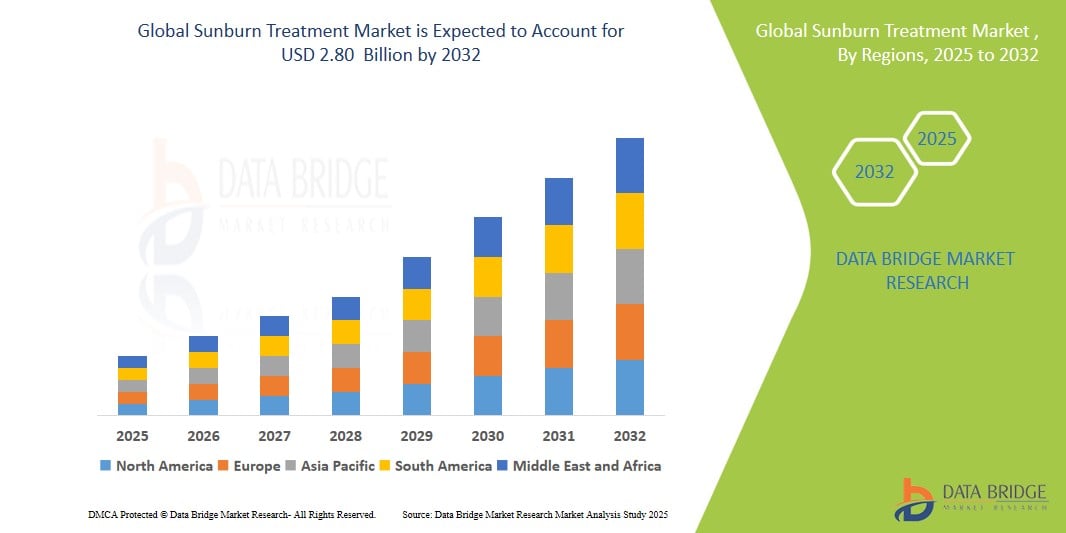
Sunburn Treatment Market Size
- The global sunburn treatment market was valued at USD 1.44 billion in 2024 and is expected to reach USD 2.80 billion by 2032 at a CAGR of 4.05%, during the forecast period
- This growth is driven by factors the increase in the health consciousness among population across the globe
Sunburn Treatment Market Analysis
- Sunburn refers to a type of irritation and skin burning that is caused the over exposure to sun or ultraviolet light Regular exposure to sun or ultraviolet light could heighten the risks of acquiring dark spots, wrinkles, and even skin cancer Redness, painful or itchy skin are the major symptoms of sunburn
- The surge in the prevalence of sunburn and melanoma skin cancer because of depleting stratospheric ozone and harmful sun and heat effects due to certain medications accelerate the market
- The rise in number of online suppliers for the treatment and growth in awareness regarding adverse effects of exposure to ultraviolet (UV) radiation caused by global warming further influence the market
- North America is expected to dominate the sunburn treatment market with a share of 35 8%, owing to a high prevalence of sunburn cases, heightened consumer awareness regarding skin protection, strong sales of over-the-counter (OTC) products, and a well-established pharmaceutical retail infrastructure
- Asia-Pacific is projected to be the fastest growing region in the sunburn treatment market during the forecast period due to increasing disposable incomes, growing awareness of skincare, expansion of retail pharmacies, and rising incidences of sun-related skin conditions due to climate and lifestyle factors
- The moisturizer segment is expected to dominate the market with a market share of 33 2% due to its widespread use in treating mild to moderate sunburns by providing hydration, soothing inflammation, and preventing peeling Despite the availability of more potent anti-inflammatory agents, moisturizers remain the first line of treatment in many cases due to ease of use, affordability, and accessibility
Report Scope and Sunburn Treatment Market Segmentation
|
Attributes |
Sunburn Treatment Key Market Insights |
|
Segments Covered |
|
|
Countries Covered |
North America
Europe
Asia-Pacific
Middle East and Africa
South America
|
|
Key Market Players |
|
|
Market Opportunities |
|
|
Value Added Data Infosets |
In addition to the insights on market scenarios such as market value, growth rate, segmentation, geographical coverage, and major players, the market reports curated by the Data Bridge Market Research also include import export analysis, production capacity overview, production consumption analysis, price trend analysis, climate change scenario, supply chain analysis, value chain analysis, raw material/consumables overview, vendor selection criteria, PESTLE Analysis, Porter Analysis, and regulatory framework |
Sunburn Treatment Market Trends
“Growing Preference for Natural and Organic Formulations”
- One prominent trend in the sunburn treatment market is the increasing consumer shift towards natural and organic products for sunburn relief and skin recovery
- These products, often enriched with ingredients such as aloe vera, chamomile, cucumber extract, and calendula, offer soothing effects without harsh chemical reactions, appealing to the growing segment of health-conscious and eco-conscious consumers
For instance,
- The demand for clean-label skincare and herbal alternatives is driving R&D efforts and pushing manufacturers to expand their product lines with certified organic and cruelty-free formulations
- This trend is transforming the landscape of sunburn treatments, as both pharmaceutical and cosmetic companies increasingly blend therapeutic and cosmetic benefits to improve customer satisfaction and brand loyalty
Sunburn Treatment Market Dynamics
Driver
“Rising Incidence of Sunburn Due to Increased UV Exposure”
- The growing prevalence of sunburn cases worldwide, driven by heightened UV exposure from climate change and increased outdoor activities, is a major factor fueling demand for sunburn treatment products
- With thinning ozone layers and increased global temperatures, individuals are more susceptible to UV radiation, resulting in higher risks of sunburn, particularly among children, outdoor workers, and tourists
- Prolonged sun exposure not only causes sunburn but also contributes to premature aging and skin cancer, further emphasizing the importance of effective sunburn prevention and treatment solutions
- As awareness increases about the damaging effects of UV radiation, there is growing consumer demand for both preventive and post-exposure care, boosting the use of sunscreens, after-sun gels, and hydrating agents
For instance,
- In July 2022, according to the Skin Cancer Foundation, sunburns can increase the risk of developing melanoma, the deadliest form of skin cancer, particularly among individuals with five or more sunburns in their lifetime, making early treatment and care critical
- In December 2021, a report by the CDC highlighted that more than one-third of U.S. adults reported experiencing sunburns annually, underscoring the need for accessible and effective treatment options
- As awareness around the health risks of UV exposure spreads globally, the demand for sunburn treatment products is expected to rise significantly
Opportunity
“Expanding E-Commerce and Digital Marketing Channels”
- The increasing penetration of e-commerce platforms and the rise of direct-to-consumer (DTC) brands present a significant opportunity for sunburn treatment manufacturers to reach a broader and more targeted consumer base
- Online platforms enable easy access to a wide variety of sunburn relief products, allowing consumers to compare formulations, ingredients, and pricing while also benefiting from doorstep delivery and customer reviews
- Therefore, digital marketing strategies, including influencer partnerships, targeted ads, and educational content on social media, are helping brands build consumer trust and increase product visibility
For instance,
- In January 2025, several leading sunburn treatment brands reported double-digit sales growth through e-commerce platforms like Amazon, Nykaa, and Flipkart, attributed to strong online promotional campaigns and seasonal product bundles
- In November 2023, Himalaya Wellness launched a digital-first campaign for its new herbal sunburn cream, reaching over 10 million consumers across Asia-Pacific through YouTube and Instagram marketing
- The digital transformation of the retail landscape allows both established players and startups to scale rapidly, offer personalized product recommendations, and improve consumer engagement
Restraint/Challenge
“Limited Access to Dermatological Products in Rural and Low-Income Regions”
- • One of the major restraints in the sunburn treatment market is the limited accessibility and affordability of high-quality dermatological care products in rural and economically disadvantaged areas
- • Many regions, particularly in developing countries, lack sufficient healthcare infrastructure and retail availability of sunburn relief products, leading to under-treatment or the use of ineffective home remedies
- • Price sensitivity among low-income consumers can deter regular purchases of sunburn gels, lotions, or sprays, particularly if such products are perceived as non-essential or cosmetic rather than therapeutic
For instance,
- In November 2024, according to a report by WHO, over 2 billion people globally lack regular access to essential healthcare products, including dermatological treatments, due to distribution gaps and pricing barriers
- In a 2023 survey by India’s Ministry of Health and Family Welfare, nearly 60% of rural households in sun-intensive states lacked access to sunscreen or after-sun treatments, citing high costs and poor local availability
- • This disparity in access restricts market penetration and limits growth potential, particularly in emerging markets where sunburn incidence is often high but awareness and distribution remain low
Sunburn Treatment Market Scope
The market is segmented on the basis of mechanism of action, drugs, route of administration, end user, and distribution channel.
|
Segmentation |
Sub-Segmentation |
|
By Mechanism of Action |
|
|
By Drugs |
|
|
By Route of Administration |
|
|
By End User |
|
|
By Distribution Channel
|
|
In 2025, the moisturizer segment is projected to dominate the market with the largest share in the mechanism of action segment
The moisturizer segment is expected to dominate the sunburn treatment market with the largest share of 33 2% in 2025 due to its universal applicability across all age groups, minimal side effects, and compatibility with other treatments Its popularity as a first-response remedy to sunburn and continued innovation in product formulations are key contributors to its strong market position
The aloe vera segment is expected to account for the largest share during the forecast period in the drugs segment
In 2025, the aloe vera segment is expected to dominate the market due to its natural anti-inflammatory, soothing, and moisturizing properties, making it a preferred choice for sunburn relief Aloe vera-based products are widely available over-the-counter and are perceived as safe and effective for frequent use Their popularity is also fueled by a growing preference for natural and herbal products among consumers, especially in the skincare segment
Sunburn Treatment Market Regional Analysis
“North America is the Dominant Region in the Sunburn Treatment Market”
-
North America dominates the sunburn treatment market with a market share of 35 8%, driven by a well-established healthcare infrastructure, high awareness regarding sun protection, and the strong presence of leading dermatological product manufacturers
- The U.S. holds a significant share due to increasing incidences of sunburns caused by outdoor recreational activities, rising consumer preference for over-the-counter (OTC) skincare products, and greater emphasis on personal grooming
- The availability of a wide range of sunburn treatment products, including corticosteroids, NSAIDs, moisturizers, and aloe vera-based formulations, along with favorable regulatory support for OTC drugs, further accelerates market growth in this region
- Hence, continuous product innovation, the growing popularity of organic and natural ingredient-based formulations, and high consumer spending on skincare products are contributing to the expansion of the sunburn treatment market across North America
“Asia-Pacific is Projected to Register the Highest Growth Rate”
- The Asia-Pacific region is expected to witness the fastest growth in the sunburn treatment market due to rising awareness about sun damage, increasing disposable income, and expanding urban populations exposed to prolonged sun exposure
- Countries such as India, China, and Japan are emerging as key markets, driven by a growing young population, increasing concern over UV-related skin issues, and heightened demand for skincare solutions
- Japan, known for its innovation in cosmetics and skincare technologies, remains a crucial market with a high consumer preference for multifunctional sunburn and skin repair products
- In India and China, growing awareness campaigns, increasing demand for herbal and Ayurvedic remedies, and the expansion of retail and e-commerce distribution channels are playing a vital role in market development The involvement of domestic and international players offering affordable and effective sunburn relief products continues to boost market penetration
Sunburn Treatment Market Share
The market competitive landscape provides details by competitor Details included are company overview, company financials, revenue generated, market potential, investment in research and development, new market initiatives, global presence, production sites and facilities, production capacities, company strengths and weaknesses, product launch, product width and breadth, application dominance The above data points provided are only related to the companies' focus related to market
The Major Market Leaders Operating in the Market Are:
- Johnson & Johnson (U.S.)
- GlaxoSmithKline plc (U.K.)
- Bayer AG (Germany)
- Sanofi (France)
- Sun Pharmaceutical Industries Ltd (India)
- Cipla Inc (India)
- Reckitt Benckiser Group plc (U.K.)
- Walgreens Boots Alliance, Inc (U.S.)
- Himalaya Wellness (India)
- Beiersdorf AG (Germany)
- Emami Limited (India)
- L’Oréal S A (France)
- Galderma S A (Switzerland)
- Perrigo Company plc (Ireland)
Latest Developments in Global Sunburn Treatment Market
- In January 2025, Johnson & Johnson Consumer Health expanded its Neutrogena line with the launch of a new ultra-cooling sunburn relief gel that combines aloe vera, lidocaine, and panthenol for faster relief and skin recovery, targeting both U.S. and Latin American markets
- In October 2024, Himalaya Wellness announced the global availability of its Herbal Sunburn Relief Cream, containing natural anti-inflammatory and cooling agents like sandalwood and turmeric, catering to the demand for plant-based skincare in Asia and Europe

- Interactive Data Analysis Dashboard
- Company Analysis Dashboard for high growth potential opportunities
- Research Analyst Access for customization & queries
- Competitor Analysis with Interactive dashboard
- Latest News, Updates & Trend analysis
- Harness the Power of Benchmark Analysis for Comprehensive Competitor Tracking
Data collection and base year analysis are done using data collection modules with large sample sizes. The stage includes obtaining market information or related data through various sources and strategies. It includes examining and planning all the data acquired from the past in advance. It likewise envelops the examination of information inconsistencies seen across different information sources. The market data is analysed and estimated using market statistical and coherent models. Also, market share analysis and key trend analysis are the major success factors in the market report. To know more, please request an analyst call or drop down your inquiry.
The key research methodology used by DBMR research team is data triangulation which involves data mining, analysis of the impact of data variables on the market and primary (industry expert) validation. Data models include Vendor Positioning Grid, Market Time Line Analysis, Market Overview and Guide, Company Positioning Grid, Patent Analysis, Pricing Analysis, Company Market Share Analysis, Standards of Measurement, Global versus Regional and Vendor Share Analysis. To know more about the research methodology, drop in an inquiry to speak to our industry experts.
Data Bridge Market Research is a leader in advanced formative research. We take pride in servicing our existing and new customers with data and analysis that match and suits their goal. The report can be customized to include price trend analysis of target brands understanding the market for additional countries (ask for the list of countries), clinical trial results data, literature review, refurbished market and product base analysis. Market analysis of target competitors can be analyzed from technology-based analysis to market portfolio strategies. We can add as many competitors that you require data about in the format and data style you are looking for. Our team of analysts can also provide you data in crude raw excel files pivot tables (Fact book) or can assist you in creating presentations from the data sets available in the report.












