


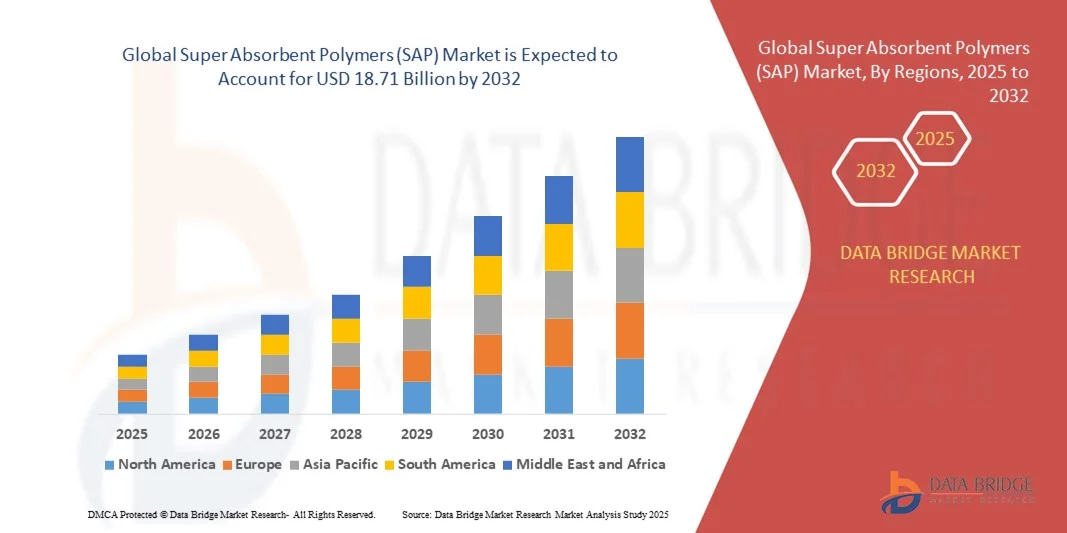
Global Super Absorbent Polymers (SAP) Market Size
- The global super absorbent polymers (SAP) market size was valued at USD 11.19 billion in 2024 and is expected to reach USD 18.71 billion by 2032, growing at a CAGR of 6.63% during the forecast period.
- The market expansion is primarily driven by increasing demand across hygiene products such as baby diapers, adult incontinence items, and feminine hygiene products, coupled with innovations in SAP materials and manufacturing processes.
- Additionally, the rise in agricultural applications and water conservation efforts is further propelling the demand for SAPs, as they offer high water retention capabilities, enhancing soil productivity and efficiency in arid regions.
Global Super Absorbent Polymers (SAP) Market Analysis
- Super Absorbent Polymers (SAP), known for their exceptional liquid absorption and retention capabilities, are essential components in personal hygiene products, agriculture, and medical applications, due to their ability to absorb and retain large volumes of liquid relative to their mass
- The growing demand for SAP is primarily driven by rising global hygiene awareness, an aging population, increasing birth rates in emerging economies, and expanding applications in agriculture and medical sectors
- Asia-Pacific dominated the global super absorbent polymers (SAP) market with the largest revenue share of 34.01% in 2024, supported by high consumption of hygiene products, strong R&D investments, and a robust presence of leading manufacturers focusing on product innovation and sustainability
- North America is expected to be the fastest growing region in the Global Super Absorbent Polymers (SAP) Market during the forecast period due to rapid population growth, increasing disposable incomes, and rising demand for baby diapers and feminine hygiene products
- The Sodium Polyacrylate segment dominated the market with the largest revenue share of 43.2% in 2024, owing to its widespread use in disposable hygiene products such as baby diapers, adult incontinence items, and feminine hygiene pads
Report Scope and Global Super Absorbent Polymers (SAP) Market Segmentation
|
Attributes |
Super Absorbent Polymers (SAP) Key Market Insights |
|
Segments Covered |
|
|
Countries Covered |
North America
Europe
Asia-Pacific
Middle East and Africa
South America
|
|
Key Market Players |
|
|
Market Opportunities |
|
|
Value Added Data Infosets |
In addition to the insights on market scenarios such as market value, growth rate, segmentation, geographical coverage, and major players, the market reports curated by the Data Bridge Market Research also include import export analysis, production capacity overview, production consumption analysis, price trend analysis, climate change scenario, supply chain analysis, value chain analysis, raw material/consumables overview, vendor selection criteria, PESTLE Analysis, Porter Analysis, and regulatory framework. |
Global Super Absorbent Polymers (SAP) Market Trends
Advanced SAPs Driving Performance and Sustainability
- A significant and accelerating trend in the global Super Absorbent Polymers (SAP) Market is the growing focus on developing advanced SAP materials that offer enhanced absorption performance, biodegradability, and sustainability. This shift is largely driven by environmental concerns, regulatory pressures, and increasing consumer demand for eco-friendly hygiene and agricultural products.
- For instance, companies such as Nippon Shokubai and BASF SE are investing in next-generation SAP technologies that reduce environmental impact by using bio-based feedstocks and improving polymer degradability without compromising absorbency. These innovations are especially relevant for disposable hygiene products, which contribute significantly to global plastic waste.
- Advancements in SAP chemistry and polymer design are enabling materials with higher absorbency, faster fluid uptake, and better retention under pressure—critical performance factors in baby diapers, adult incontinence products, and feminine hygiene items. Additionally, tailored SAPs are being developed for specific agricultural needs, such as water retention in drought-prone areas and controlled nutrient release.
- The integration of sustainable practices throughout the SAP value chain—from raw material sourcing to end-of-life product disposal—is becoming central to corporate strategies. Manufacturers are increasingly collaborating with consumer goods companies to deliver products that meet both performance standards and environmental goals.
- This trend is reshaping the competitive landscape, pushing traditional petrochemical-based SAP producers to innovate or transition toward more sustainable solutions. Companies like LG Chem and Evonik are exploring green chemistry approaches and closed-loop production systems to stay ahead of evolving market expectations.
- The demand for high-performance, eco-conscious SAPs is growing rapidly across hygiene, agriculture, and medical sectors, as end-users and regulators alike prioritize sustainability, efficiency, and long-term environmental impact.
Global Super Absorbent Polymers (SAP) Market Dynamics
Driver
Growing Demand Due to Expanding Hygiene Needs and Agricultural Applications
-
The increasing global emphasis on personal hygiene, driven by rising birth rates, aging populations, and improved healthcare awareness, is a key driver behind the growing demand for Super Absorbent Polymers (SAP). Their use in baby diapers, adult incontinence products, and feminine hygiene items continues to expand rapidly, especially in emerging economies where access to hygiene products is improving.
- For instance, in 2024, Nippon Shokubai announced a strategic investment in expanding SAP production facilities in Southeast Asia to meet the surging demand for high-performance absorbent hygiene products in the region. Such expansions are expected to fuel market growth throughout the forecast period.
- Beyond hygiene, SAPs are increasingly used in agriculture due to their water-retention capabilities, helping to improve crop yield and soil quality in drought-prone and arid regions. This is particularly relevant as climate change intensifies water scarcity concerns, prompting governments and farmers to adopt more sustainable water management solutions.
- Furthermore, the shift toward high-efficiency products in the medical and pharmaceutical industries is boosting demand for SAPs in wound care and drug delivery systems, where moisture control is critical.
- The dual benefit of SAPs in enhancing both hygiene and agricultural productivity, combined with ongoing innovation in bio-based and high-performance variants, is positioning SAPs as a vital material in the drive toward sustainable and health-conscious living.
Restraint/Challenge
Environmental Concerns and Raw Material Price Volatility
- A key challenge facing the Super Absorbent Polymers (SAP) Market is growing environmental scrutiny related to the use of non-biodegradable petrochemical-based polymers, especially in disposable hygiene products. The increasing pressure from regulatory authorities and environmentally conscious consumers is pushing the industry to find more sustainable alternatives.
- For instance, landfill waste associated with used diapers and sanitary products has led to mounting criticism of single-use products, compelling manufacturers to invest in research toward bio-based SAPs and compostable absorbent cores. However, these alternatives often come with higher production costs and technical limitations.
- In addition to environmental concerns, price volatility in raw materials such as acrylic acid significantly impacts production costs for SAP manufacturers. Fluctuations in crude oil prices, geopolitical tensions, and supply chain disruptions contribute to uncertainty, making long-term pricing strategies challenging for producers.
- Overcoming these restraints will require intensified innovation in sustainable SAP development, enhanced recycling and disposal methods, and the stabilization of raw material supply chains through diversification and localized sourcing strategies.
- Addressing these challenges is critical for aligning with global sustainability goals and ensuring the long-term viability and acceptance of SAPs across key end-use sectors.
Global Super Absorbent Polymers (SAP) Market Scope
The super absorbent polymers (SAP) market is segmented on the basis of type and application.
- By Type
On the basis of type, the Global Super Absorbent Polymers (SAP) Market is segmented into sodium polyacrylate, polyacrylate/polyacrylamide copolymer, and others. The sodium polyacrylate segment dominated the market with the largest revenue share of 43.2% in 2024, owing to its widespread use in disposable hygiene products such as baby diapers, adult incontinence items, and feminine hygiene pads. Sodium polyacrylate offers excellent liquid absorption and retention capacity, making it the preferred material for manufacturers aiming for high-performance and cost-effective solutions. Its compatibility with current production technologies and regulatory acceptance further solidify its leading market position.
The Polyacrylate/Polyacrylamide Copolymer segment is anticipated to witness the fastest growth rate from 2025 to 2032, driven by increasing adoption in agriculture and industrial applications. These copolymers are known for their water-retention properties and soil conditioning benefits, making them ideal for enhancing crop productivity in arid regions and for applications in civil engineering and waste management.
- By Application
On the basis of application, the Global Super Absorbent Polymers (SAP) Market is segmented into Personal Hygiene, Agriculture, Medical, Industrial, and Others. The Personal Hygiene segment accounted for the largest market revenue share in 2024, fueled by high global demand for baby diapers, feminine hygiene products, and adult incontinence care. Rising awareness about personal hygiene, coupled with aging populations and increasing birth rates, especially in developing countries, is driving consistent demand for SAPs in this segment. Government initiatives promoting hygiene and access to sanitary products further contribute to this segment’s dominance.
The Agriculture segment is expected to record the fastest CAGR from 2025 to 2032, due to increasing focus on sustainable farming and water conservation. SAPs help improve soil moisture retention, reduce irrigation frequency, and enhance crop yields, especially in water-scarce regions. Growing environmental awareness and support from agricultural development programs are driving the adoption of SAPs for large-scale farming, landscaping, and horticulture.
Global Super Absorbent Polymers (SAP) Market Regional Analysis
- Asia Pacific dominated the global super absorbent polymers (SAP) market with the largest revenue share of 34.01% in 2024, driven by strong demand for high-quality hygiene products and advanced agricultural solutions. The region benefits from a well-established personal care industry, high healthcare standards, and increasing demand for baby diapers and adult incontinence products among its aging population.
- Consumers and manufacturers in the region prioritize product performance, safety, and sustainability, leading to significant investments in R&D and innovation for bio-based and high-absorbency SAPs.
- This dominance is further supported by high disposable incomes, strong presence of key industry players such as BASF SE and Evonik Industries, and robust supply chains. Additionally, the use of SAPs in agricultural applications is gaining momentum, particularly in the U.S., where water conservation practices are being adopted to combat drought and climate-related challenges.
U.S. Super Absorbent Polymers (SAP) Market Insight
The U.S. SAP market captured the largest revenue share of 81% in North America in 2024, driven by high demand for personal hygiene products such as baby diapers, adult incontinence items, and feminine hygiene products. The country’s advanced healthcare infrastructure and increasing focus on sanitation and hygiene bolster SAP consumption. Moreover, the rising use of SAPs in agriculture for water retention and soil conditioning supports market growth. Innovation in bio-based and sustainable SAPs further fuels demand as consumers and manufacturers prioritize environmentally friendly solutions.
Europe Super Absorbent Polymers (SAP) Market Insight
The Europe SAP market is projected to grow steadily at a substantial CAGR throughout the forecast period, supported by increasing environmental regulations and heightened awareness of hygiene standards. Demand is driven by personal care, medical applications, and expanding agricultural use due to water conservation efforts. The region’s focus on sustainability promotes the development and adoption of eco-friendly SAP products. Additionally, increasing urbanization and aging populations boost consumption across residential and healthcare sectors.
U.K. Super Absorbent Polymers (SAP) Market Insight
The U.K. SAP market is expected to expand at a notable CAGR during the forecast period, propelled by rising demand in personal hygiene and medical sectors. The increasing elderly population and growing awareness about sanitation and healthcare drive SAP usage. The country’s strong retail and e-commerce infrastructure also facilitates the wide availability of SAP-based products. Moreover, initiatives supporting sustainable agriculture encourage the use of SAPs for improving soil moisture retention.
Germany Super Absorbent Polymers (SAP) Market Insight
Germany’s SAP market is anticipated to grow at a considerable CAGR, driven by stringent regulations on product safety and environmental sustainability. The country’s advanced healthcare system and high demand for personal care products contribute to market expansion. Additionally, Germany’s agricultural sector is adopting SAPs to enhance water efficiency and crop yield. The emphasis on innovation and eco-friendly manufacturing processes aligns with consumer preferences for sustainable and high-performance SAP solutions.
Asia-Pacific Super Absorbent Polymers (SAP) Market Insight
The Asia-Pacific SAP market is poised to register the fastest CAGR of 24% from 2025 to 2032, fueled by rapid urbanization, increasing disposable incomes, and growing awareness of hygiene and agricultural needs in countries such as China, India, and Japan. The expanding middle class and rising healthcare expenditure boost the consumption of personal hygiene and medical SAP products. Government initiatives supporting sustainable agriculture and water conservation further accelerate demand. Additionally, APAC’s emergence as a manufacturing hub for SAP materials enhances accessibility and affordability.
Japan Super Absorbent Polymers (SAP) Market Insight
Japan’s SAP market is gaining traction due to its advanced technological infrastructure and increasing focus on healthcare and elderly care products. The aging population and high standards for personal hygiene drive steady demand for SAPs in diapers and medical applications. Integration of SAPs in innovative healthcare products and growing adoption in agricultural sectors for soil moisture management support market growth. Furthermore, sustainability efforts push the development of biodegradable and environmentally friendly SAP options.
China Super Absorbent Polymers (SAP) Market Insight
China accounted for the largest SAP market revenue share in Asia-Pacific in 2024, supported by rapid urbanization, expanding middle-class population, and increasing healthcare awareness. The country leads in the production and consumption of personal hygiene products incorporating SAPs, including baby diapers and adult incontinence items. The government’s focus on water-saving agricultural practices drives the use of SAPs for enhancing soil moisture retention. Strong domestic manufacturing capabilities and growing investments in R&D contribute to China’s dominant position in the regional SAP market.
Global Super Absorbent Polymers (SAP) Market Share
The Super Absorbent Polymers (SAP) industry is primarily led by well-established companies, including:
- BASF SE (Germany)
- Nippon Shokubai Co., Ltd. (Japan)
- Evonik Industries AG (Germany)
- Sumitomo Seika Chemicals Company, Ltd. (Japan)
- LG Chem Ltd. (South Korea)
- Formosa Plastics Corporation (Taiwan)
- SDP Global Co., Ltd. (Japan)
- Satellite Science & Technology Co., Ltd. (China)
- Yixing Danson Technology (China)
- Kao Corporation (Japan)
- Arkema Group (France)
- Sanyo Chemical Industries, Ltd. (Japan)
- Chemtex Speciality Limited (India)
- Wanhua Chemical Group Co., Ltd. (China)
- Zhejiang Satellite Petrochemical Co., Ltd. (China)
- Shanghai Huayi Group Corporation (China)
- San-Dia Polymers, Ltd. (Japan)
- Quanzhou Banglida Technology Industry Co., Ltd. (China)
- Shandong Nuoer Biological Technology Co., Ltd. (China)
What are the Recent Developments in Global Super Absorbent Polymers (SAP) Market?
- In April 2023, BASF SE, a global leader in chemical solutions, announced the launch of its new high-performance super absorbent polymer designed specifically for hygiene products in the Asia-Pacific region. This strategic move highlights BASF's commitment to meeting the rising demand for advanced SAP materials that offer superior absorption and skin-friendliness. By leveraging its extensive R&D capabilities and global manufacturing network, BASF aims to strengthen its presence in the rapidly expanding SAP market, catering to both consumer and industrial needs.
- In March 2023, Evonik Industries AG introduced its latest SAP product line featuring biodegradable polymers aimed at sustainable hygiene applications. This innovation aligns with the company’s focus on eco-friendly solutions, addressing environmental concerns within the global SAP market. Evonik’s advancement demonstrates its dedication to driving sustainable growth while meeting stringent regulatory standards and consumer expectations in the hygiene and agriculture sectors.
- In March 2023, Nippon Shokubai Co., Ltd. successfully completed the expansion of its SAP production facility in Japan to boost capacity and improve supply chain efficiency. This expansion supports the growing demand for SAP in baby diapers, adult incontinence products, and agricultural use. Nippon Shokubai’s investment highlights the increasing significance of scalable, cost-effective production technologies in maintaining competitive advantage in the global SAP market.
- In February 2023, LG Chem Ltd. formed a strategic partnership with a major global hygiene brand to develop next-generation SAP materials with enhanced absorbency and improved environmental footprint. This collaboration aims to accelerate product innovation and sustainability initiatives within the SAP market. LG Chem’s move underlines the importance of strategic alliances to address evolving market needs and regulatory pressures.
- In January 2023, Sumitomo Seika Chemicals Company, Ltd. unveiled its new SAP technology at the International Absorbent Hygiene Products (IAHP) Conference, featuring enhanced gel strength and quicker absorption rates. The innovation is designed to improve the performance of hygiene products, offering manufacturers greater flexibility in design and functionality. Sumitomo Seika’s introduction of cutting-edge SAP solutions exemplifies its commitment to advancing material science and meeting dynamic consumer demands.

- Interactive Data Analysis Dashboard
- Company Analysis Dashboard for high growth potential opportunities
- Research Analyst Access for customization & queries
- Competitor Analysis with Interactive dashboard
- Latest News, Updates & Trend analysis
- Harness the Power of Benchmark Analysis for Comprehensive Competitor Tracking
Global Super Absorbent Polymers Sap Market, Supply Chain Analysis and Ecosystem Framework
To support market growth and help clients navigate the impact of geopolitical shifts, DBMR has integrated in-depth supply chain analysis into its Global Super Absorbent Polymers Sap Market research reports. This addition empowers clients to respond effectively to global changes affecting their industries. The supply chain analysis section includes detailed insights such as Global Super Absorbent Polymers Sap Market consumption and production by country, price trend analysis, the impact of tariffs and geopolitical developments, and import and export trends by country and HSN code. It also highlights major suppliers with data on production capacity and company profiles, as well as key importers and exporters. In addition to research, DBMR offers specialized supply chain consulting services backed by over a decade of experience, providing solutions like supplier discovery, supplier risk assessment, price trend analysis, impact evaluation of inflation and trade route changes, and comprehensive market trend analysis.
Data collection and base year analysis are done using data collection modules with large sample sizes. The stage includes obtaining market information or related data through various sources and strategies. It includes examining and planning all the data acquired from the past in advance. It likewise envelops the examination of information inconsistencies seen across different information sources. The market data is analysed and estimated using market statistical and coherent models. Also, market share analysis and key trend analysis are the major success factors in the market report. To know more, please request an analyst call or drop down your inquiry.
The key research methodology used by DBMR research team is data triangulation which involves data mining, analysis of the impact of data variables on the market and primary (industry expert) validation. Data models include Vendor Positioning Grid, Market Time Line Analysis, Market Overview and Guide, Company Positioning Grid, Patent Analysis, Pricing Analysis, Company Market Share Analysis, Standards of Measurement, Global versus Regional and Vendor Share Analysis. To know more about the research methodology, drop in an inquiry to speak to our industry experts.
Data Bridge Market Research is a leader in advanced formative research. We take pride in servicing our existing and new customers with data and analysis that match and suits their goal. The report can be customized to include price trend analysis of target brands understanding the market for additional countries (ask for the list of countries), clinical trial results data, literature review, refurbished market and product base analysis. Market analysis of target competitors can be analyzed from technology-based analysis to market portfolio strategies. We can add as many competitors that you require data about in the format and data style you are looking for. Our team of analysts can also provide you data in crude raw excel files pivot tables (Fact book) or can assist you in creating presentations from the data sets available in the report.













