


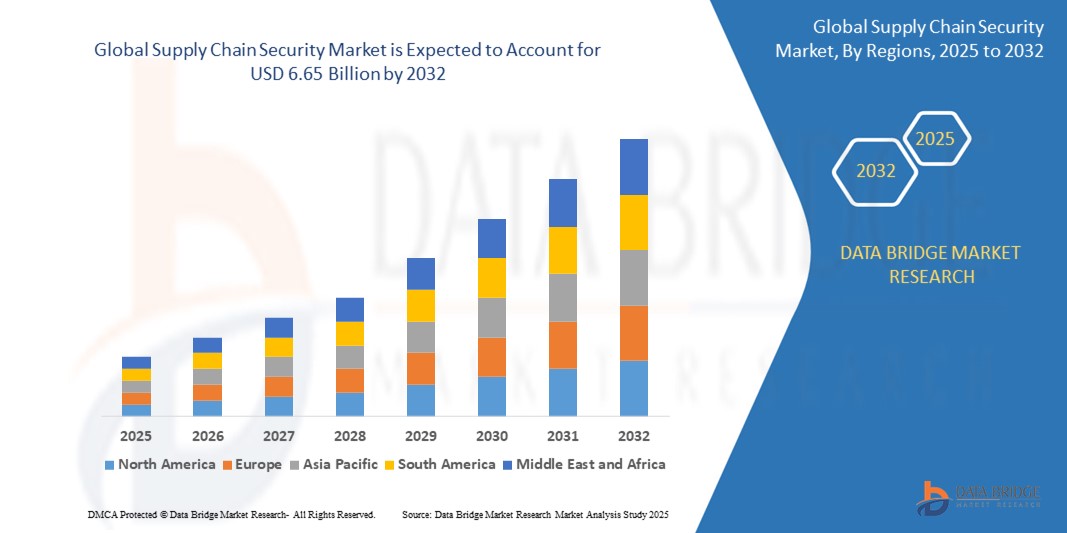
Supply Chain Security Market Size
- The global supply chain security market size was valued at USD 2.67 billion in 2024 and is expected to reach USD 6.65 billion by 2032, at a CAGR of 12.10% during the forecast period
- The market growth is largely fueled by the rising complexity of global supply chains and the increasing threat of cyberattacks, data breaches, and operational disruptions, prompting organizations to invest in robust security technologies across both physical and digital supply chain layers
- Furthermore, growing regulatory pressure for data protection, combined with the demand for real-time visibility, predictive risk analytics, and third-party risk management, is accelerating the adoption of integrated supply chain security solutions, significantly boosting market expansion
Supply Chain Security Market Analysis
- Supply chain security encompasses a range of technologies and services designed to protect logistics networks, digital assets, and physical goods from threats including cyber intrusions, theft, and compliance violations. These solutions integrate IoT, AI, blockchain, and cloud platforms to enhance end-to-end visibility and control across global supply networks
- The escalating demand for supply chain security is primarily driven by the surge in e-commerce, geopolitical disruptions, and digital transformation across industries such as healthcare, manufacturing, and retail, where resilience, traceability, and risk mitigation are critical to operational continuity
- North America dominated the supply chain security market with a share of 34% in 2024, due to stringent regulatory frameworks, advanced digital infrastructure, and a growing focus on cybersecurity across logistics and manufacturing sectors
- Asia-Pacific is expected to be the fastest growing region in the supply chain security market during the forecast period due to rapid industrialization, expanding e-commerce networks, and rising concerns about supply chain vulnerabilities
- Hardware segment dominated the market with a market share of 65% in 2024, due to the widespread deployment of physical security devices such as RFID tags, sensors, GPS trackers, and surveillance systems across supply chain touchpoints. These hardware components are essential for real-time monitoring, asset tracking, tamper detection, and ensuring the physical integrity of goods in transit or storage. Their foundational role in enabling end-to-end visibility and securing physical infrastructure contributes significantly to their continued dominance in the market
Report Scope and Supply Chain Security Market Segmentation
|
Attributes |
Supply Chain Security Key Market Insights |
|
Segments Covered |
|
|
Countries Covered |
North America
Europe
Asia-Pacific
Middle East and Africa
South America
|
|
Key Market Players |
|
|
Market Opportunities |
|
|
Value Added Data Infosets |
In addition to the market insights such as market value, growth rate, market segments, geographical coverage, market players, and market scenario, the market report curated by the Data Bridge Market Research team includes in-depth expert analysis, import/export analysis, pricing analysis, production consumption analysis, and pestle analysis. |
Supply Chain Security Market Trends
“Escalating Cybersecurity Threats and Digital Transformation”
- The market is witnessing a surge in cyberattacks targeting supply chains, with ransomware and AI-powered threats increasingly focused on critical logistics and software nodes
- For instance, companies such as IBM, Cisco, and Oracle are investing in advanced security platforms, AI-driven threat intelligence, and real-time monitoring to protect multi-tiered supply networks from both digital and physical threats
- The adoption of blockchain, IoT devices, and cloud-based solutions is transforming supply chain visibility and traceability, but also introduces new vulnerabilities that require robust security protocols
- Regulatory compliance and ESG requirements are prompting organizations to strengthen supply chain security, with more businesses implementing third-party audits and supplier risk assessments
- Predictive analytics and machine learning are being leveraged for proactive risk management, enabling companies to anticipate and mitigate threats before they disrupt operations
- In conclusion, as supply chains become more interconnected and digitized, security is now a strategic imperative, with organizations prioritizing end-to-end protection and resilience to safeguard business continuity and reputation
Supply Chain Security Market Dynamics
Driver
“Rising Complexity and Digitalization of Supply Chains”
- The market is witnessing a surge in cyberattacks targeting supply chains, with ransomware and AI-powered threats increasingly focused on critical logistics and software nodes
- For instance, companies such as IBM, Cisco, and Oracle are investing in advanced security platforms, AI-driven threat intelligence, and real-time monitoring to protect multi-tiered supply networks from both digital and physical threats
- The adoption of blockchain, IoT devices, and cloud-based solutions is transforming supply chain visibility and traceability, but also introduces new vulnerabilities that require robust security protocols
- Regulatory compliance and ESG requirements are prompting organizations to strengthen supply chain security, with more businesses implementing third-party audits and supplier risk assessments
- Predictive analytics and machine learning are being leveraged for proactive risk management, enabling companies to anticipate and mitigate threats before they disrupt operations
- In conclusion, as supply chains become more interconnected and digitized, security is now a strategic imperative, with organizations prioritizing end-to-end protection and resilience to safeguard business continuity and reputation
Restraint/Challenge
“Evolving Threat Landscape and Resource Constraints”
- The market is witnessing a surge in cyberattacks targeting supply chains, with ransomware and AI-powered threats increasingly focused on critical logistics and software nodes
- For instance, companies such as IBM, Cisco, and Oracle are investing in advanced security platforms, AI-driven threat intelligence, and real-time monitoring to protect multi-tiered supply networks from both digital and physical threats
- The adoption of blockchain, IoT devices, and cloud-based solutions is transforming supply chain visibility and traceability, but also introduces new vulnerabilities that require robust security protocols
- Regulatory compliance and ESG requirements are prompting organizations to strengthen supply chain security, with more businesses implementing third-party audits and supplier risk assessments
- Predictive analytics and machine learning are being leveraged for proactive risk management, enabling companies to anticipate and mitigate threats before they disrupt operations
- In conclusion, as supply chains become more interconnected and digitized, security is now a strategic imperative, with organizations prioritizing end-to-end protection and resilience to safeguard business continuity and reputation
Supply Chain Security Market Scope
The market is segmented on the basis of component, type, enterprise size, and vertical.
- By Component
On the basis of component, the supply chain security market is segmented into hardware, software, and services. The hardware segment dominated the largest market revenue share 65% in 2024, driven by the widespread deployment of physical security devices such as RFID tags, sensors, GPS trackers, and surveillance systems across supply chain touchpoints. These hardware components are essential for real-time monitoring, asset tracking, tamper detection, and ensuring the physical integrity of goods in transit or storage. Their foundational role in enabling end-to-end visibility and securing physical infrastructure contributes significantly to their continued dominance in the market.
The services segment is projected to witness the fastest growth rate from 2025 to 2032, supported by the increasing demand for consulting, implementation, and managed services. Organizations are seeking external expertise to configure and operate comprehensive supply chain security frameworks, especially in light of growing cyber threats and regulatory scrutiny. The surge in outsourcing among companies lacking in-house security capabilities also reinforces the robust outlook for this segment.
- By Type
On the basis of type, the market is segmented into data locality & protection, data visibility & governance, and others. The data visibility & governance segment captured the highest market share in 2024, as businesses emphasize greater transparency, traceability, and accountability throughout the supply chain. Organizations are deploying advanced solutions that provide real-time dashboards, anomaly detection, and compliance tracking to mitigate financial and reputational risks linked to supply chain disruptions.
The data locality & protection segment is expected to exhibit the highest CAGR from 2025 to 2032, driven by increasing regulatory emphasis on data sovereignty and the need to safeguard sensitive logistics and operational data from cyber threats. The proliferation of region-specific data regulations—such as GDPR, HIPAA, and CCPA—is compelling organizations to deploy localized and compliant storage and protection mechanisms, particularly in industries with highly sensitive data such as pharmaceuticals and defense.
- By Enterprise Size
On the basis of enterprise size, the market is divided into small & medium-sized enterprises (SMEs) and large enterprises. The large enterprises segment accounted for the largest revenue share of 53.8% in 2024, primarily due to their broader supply networks and greater financial resources to deploy comprehensive security solutions. These enterprises are early adopters of integrated platforms that unify risk management, asset tracking, and threat intelligence across multi-tiered supply chains.
The SMEs segment is poised to grow at the fastest pace over the forecast period, fueled by increasing awareness of the financial and reputational risks tied to supply chain disruptions. As affordable and scalable cloud-based security tools become more accessible, SMEs are investing in modular solutions that enhance supply chain resilience while aligning with limited budgets and internal IT capabilities.
- By Vertical
On the basis of vertical, the market is segmented into healthcare & pharmaceuticals, retail & e-commerce, automotive, transportation and logistics, manufacturing, and others. The healthcare & pharmaceuticals segment led the market in terms of revenue in 2024, owing to strict regulatory mandates, temperature-sensitive logistics, and the critical need for counterfeit prevention in medicine distribution. Supply chain security is vital in this sector to ensure authenticity, compliance, and uninterrupted delivery of medical goods.
The retail & e-commerce segment is projected to register the highest growth from 2025 to 2032, driven by the rapid rise in cross-border digital commerce and customer expectations for transparent, secure, and traceable deliveries. The proliferation of omnichannel retail, demand for last-mile tracking, and exposure to fraud have all made advanced supply chain security tools a necessity for e-commerce operators seeking to maintain consumer trust and competitive edge.
Supply Chain Security Market Regional Analysis
- North America dominated the supply chain security market with the largest revenue share of 34% in 2024, driven by stringent regulatory frameworks, advanced digital infrastructure, and a growing focus on cybersecurity across logistics and manufacturing sectors
- Enterprises in the region prioritize end-to-end visibility, threat intelligence, and real-time risk assessment, leading to widespread adoption of supply chain security platforms and IoT-based tracking solutions
- The region’s technological maturity, coupled with increasing incidents of cyberattacks on logistics and warehousing operations, is accelerating demand for integrated security solutions in both physical and digital supply chain layers
U.S. Supply Chain Security Market Insight
The U.S. supply chain security market captured the largest revenue share in 2024 within North America, driven by federal initiatives to secure critical infrastructure and national logistics networks. The rising adoption of AI, blockchain, and advanced analytics for real-time shipment monitoring and anomaly detection is fueling market expansion. In addition, increased supply chain disruptions due to geopolitical tensions, natural disasters, and cyber incidents are pushing companies to invest heavily in proactive risk management solutions.
Europe Supply Chain Security Market Insight
The Europe supply chain security market is expected to expand at a steady CAGR during the forecast period, supported by data protection regulations such as GDPR and the emphasis on digital sovereignty. The market is gaining momentum due to increased demand for resilient, transparent, and secure logistics operations across the EU. European firms are integrating blockchain-based solutions and cloud-native platforms to ensure compliance, traceability, and agility in the face of geopolitical instability and supply shocks.
U.K. Supply Chain Security Market Insight
The U.K. market is projected to grow at a notable CAGR, propelled by the country’s post-Brexit emphasis on independent trade resilience and secure cross-border movement of goods. Businesses are actively upgrading their supply chain infrastructures to incorporate smart monitoring tools, predictive analytics, and risk mitigation frameworks. The increased adoption of digitized logistics platforms in sectors such as pharmaceuticals, retail, and automotive is further contributing to market growth.
Germany Supply Chain Security Market Insight
Germany's market is anticipated to expand steadily, driven by its strong manufacturing base and focus on Industry 4.0. The need for enhanced transparency, automation, and data security across production and logistics networks is fostering the adoption of supply chain security technologies. With a preference for high-integrity and compliance-driven solutions, German enterprises are leveraging IoT, AI, and blockchain to modernize risk management in their supply chains.
Asia-Pacific Supply Chain Security Market Insight
The Asia-Pacific market is projected to grow at the fastest CAGR of 13.6% from 2025 to 2032, owing to rapid industrialization, expanding e-commerce networks, and rising concerns about supply chain vulnerabilities. Countries across the region are embracing digital transformation to strengthen logistics integrity and regulatory compliance. The availability of low-cost technologies, government-led initiatives on smart infrastructure, and the surge in cross-border trade are collectively driving market growth.
Japan Supply Chain Security Market Insight
Japan’s market is experiencing steady growth due to the nation’s focus on automation, precision logistics, and disaster preparedness. Enterprises in Japan are increasingly deploying real-time asset tracking, data encryption, and cyber-physical system protection tools to ensure supply chain continuity. The country's advanced technological ecosystem and commitment to operational resilience are key contributors to its expanding security infrastructure.
China Supply Chain Security Market Insight
China accounted for the largest revenue share in the Asia-Pacific market in 2024, driven by its position as a global manufacturing and export powerhouse. Rising trade complexities, regulatory tightening, and increasing reliance on digital logistics platforms are prompting investments in supply chain risk management tools. Domestic technology players are leading innovations in AI-based surveillance, blockchain-enabled product traceability, and secure data exchange systems, reinforcing China’s market dominance.
Supply Chain Security Market Share
The supply chain security industry is primarily led by well-established companies, including:
- Altana (Germany)
- Dickson, Inc. (U.S.)
- ELPRO-BUCHS AG (Switzerland)
- Emerson Electric Co. (U.S.)
- International Business Machines Corporation (U.S.)
- Hanwell Solutions (U.K.)
- Monnit Corporation (U.S.)
- NXP Semiconductors N.V. (Netherlands)
- Oracle Corporation (U.S.)
- ORBCOMM (U.S.)
- Rotronic Instrument Corp. (U.S.)
- SafeTraces (U.S.)
- Sensitech Inc. (U.S.)
- Tagbox Solutions (India)
- Testo SE & Co. KGaA (Germany)
- Eufy Security (China)
- Aqara (China)
- Nuki (Austria)
- Danalock (Denmark)
- Samsung SmartThings (South Korea)
- Honeywell (U.S.)
- Brinks Home (U.S.)
Latest Developments in Global Supply Chain Security Market
- In May 2025, ThingsRecon launched a new supply chain discovery solution and expanded its strategic partnership program for security service providers, aiming to enhance enterprise capabilities in managing external attack surfaces and mitigating supply chain security risks. These initiatives are expected to strengthen the company’s role in advancing proactive threat visibility and third-party risk management across global supply chains
- In June 2023, Emerson Electric Co. introduced its ASCO Series 641, 642, and 643 Aluminum Filter Regulators, aimed at reducing unplanned downtime and improving process efficiency. This launch enhances operational reliability in supply chain-critical industries, thereby strengthening the market’s focus on proactive risk mitigation and process stability
- In May 2023, NXP Semiconductors N.V. launched its i.MX 91 application processor series, offering advanced security features and energy-efficient performance for Linux-based IoT and industrial applications. This innovation supports the growing need for secure, scalable, and intelligent edge devices in supply chain monitoring and control, contributing to market expansion
- In February 2023, ELPRO-BUCHS AG expanded its presence in Asia-Pacific by relocating its sales and service office to a larger facility in Singapore. This strategic move enhances its service capabilities in the region and supports the growing demand for compliant and secure cold chain monitoring solutions, particularly in pharmaceuticals and healthcare logistics
- In June 2022, IBM Corporation acquired Randori, a cybersecurity company, to bolster its hybrid cloud strategy and expand its AI-driven cybersecurity portfolio. This acquisition strengthens IBM’s capabilities in supply chain threat detection and response, reinforcing the market’s shift toward integrated and intelligent security platforms.

- Interactive Data Analysis Dashboard
- Company Analysis Dashboard for high growth potential opportunities
- Research Analyst Access for customization & queries
- Competitor Analysis with Interactive dashboard
- Latest News, Updates & Trend analysis
- Harness the Power of Benchmark Analysis for Comprehensive Competitor Tracking
Data collection and base year analysis are done using data collection modules with large sample sizes. The stage includes obtaining market information or related data through various sources and strategies. It includes examining and planning all the data acquired from the past in advance. It likewise envelops the examination of information inconsistencies seen across different information sources. The market data is analysed and estimated using market statistical and coherent models. Also, market share analysis and key trend analysis are the major success factors in the market report. To know more, please request an analyst call or drop down your inquiry.
The key research methodology used by DBMR research team is data triangulation which involves data mining, analysis of the impact of data variables on the market and primary (industry expert) validation. Data models include Vendor Positioning Grid, Market Time Line Analysis, Market Overview and Guide, Company Positioning Grid, Patent Analysis, Pricing Analysis, Company Market Share Analysis, Standards of Measurement, Global versus Regional and Vendor Share Analysis. To know more about the research methodology, drop in an inquiry to speak to our industry experts.
Data Bridge Market Research is a leader in advanced formative research. We take pride in servicing our existing and new customers with data and analysis that match and suits their goal. The report can be customized to include price trend analysis of target brands understanding the market for additional countries (ask for the list of countries), clinical trial results data, literature review, refurbished market and product base analysis. Market analysis of target competitors can be analyzed from technology-based analysis to market portfolio strategies. We can add as many competitors that you require data about in the format and data style you are looking for. Our team of analysts can also provide you data in crude raw excel files pivot tables (Fact book) or can assist you in creating presentations from the data sets available in the report.













