


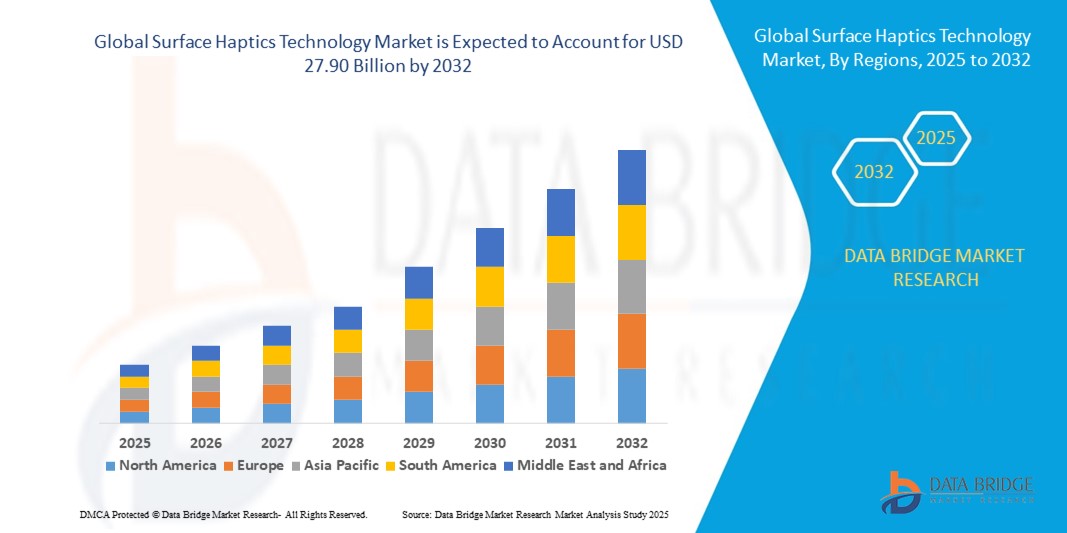
What is the Global Surface Haptics Technology Market Size and Growth Rate?
- The global surface haptics technology market size was valued at USD 9.31 billion in 2024 and is expected to reach USD 27.90 billion by 2032, at a CAGR of 14.70% during the forecast period
- Surface haptics technology is tactile feedback technology that simulates the sense of touch by applying forces, vibrations, or motions to the user's skin
- It enhances user interaction with digital interfaces by providing tactile sensations on flat surfaces such as screens, touchpads, or touchscreens. Surface haptics technology finds applications in various sectors, including consumer electronics, automotive, healthcare, gaming, and others, to improve user experience and usability
What are the Major Takeaways of Surface Haptics Technology Market?
- Surface haptics technology enhances user interaction with digital interfaces by providing tactile sensations and feedback, making interactions more intuitive, engaging, and immersive. In sectors such as consumer electronics, automotive, healthcare, and gaming, where user experience is a key differentiator, surface haptics technology enables the development of innovative and user-friendly products and applications
- As consumer requirement for seamless and intuitive interactions with digital devices continue to rise, the demand for surface haptics technology is expected to grow significantly
- North America dominated the surface haptics technology market with the largest revenue share of 36.41% in 2024, supported by the rising adoption of immersive technologies in consumer electronics, automotive displays, and AR/VR systems
- Asia-Pacific surface haptics technology market is projected to grow at the fastest CAGR of 7.14% from 2025 to 2032, fueled by rapid urbanization, rising disposable incomes, and mass adoption of smartphones and gaming devices
- The Piezoelectric segment dominated the surface haptics technology market with the largest revenue share of 41.5% in 2024, owing to its high precision, durability, and rapid response time
Report Scope and Surface Haptics Technology Market Segmentation
|
Attributes |
Surface Haptics Technology Key Market Insights |
|
Segments Covered |
|
|
Countries Covered |
North America
Europe
Asia-Pacific
Middle East and Africa
South America
|
|
Key Market Players |
|
|
Market Opportunities |
|
|
Value Added Data Infosets |
In addition to the insights on market scenarios such as market value, growth rate, segmentation, geographical coverage, and major players, the market reports curated by the Data Bridge Market Research also include in-depth expert analysis, pricing analysis, brand share analysis, consumer survey, demography analysis, supply chain analysis, value chain analysis, raw material/consumables overview, vendor selection criteria, PESTLE Analysis, Porter Analysis, and regulatory framework. |
What is the Key Trend in the Surface Haptics Technology Market?
Enhanced Realism Through AI and Multisensory Integration
- A significant trend in the global surface haptics technology market is the integration of artificial intelligence (AI) with multisensory feedback, enabling more immersive, realistic, and adaptive user experiences across devices. This shift is especially visible in consumer electronics, gaming, automotive infotainment, and AR/VR applications
- For instance, Ultraleap’s haptic technology combines mid-air tactile feedback with hand-tracking, powered by AI algorithms that adjust intensity and response in real time, creating highly personalized user interactions. Similarly, Immersion Corporation is advancing adaptive haptics for mobile devices and wearables, enhancing realism in touch-based interfaces
- AI-driven haptics can analyze user behavior and optimize tactile responses for different contexts—whether simulating textures in AR shopping, vibrations in automotive dashboards, or responsive feedback in medical simulations. This personalized approach significantly increases usability and engagement
- The seamless blending of touch, sound, and visual cues powered by AI enables next-generation multisensory experiences, which go beyond static feedback, offering intuitive and lifelike interactions across digital environments
- This trend is reshaping expectations in industries such as gaming, automotive, healthcare, and consumer electronics, driving demand for smart, adaptive, and immersive surface haptics solutions
What are the Key Drivers of Surface Haptics Technology Market?
- The rising demand for immersive digital experiences across gaming, AR/VR, and consumer electronics is a key driver propelling the surface haptics technology market forward
- For instance, in September 2023, Immersion Corporation expanded its partnership portfolio to license its haptic technologies to leading OEMs, targeting automotive and gaming applications, underlining the growing industry push for tactile-rich experiences
- The adoption of haptics in automotive displays is growing rapidly, as automakers such as BMW and Tesla incorporate tactile feedback into infotainment systems to improve driver safety and interaction
- Increasing penetration of wearables and foldable devices is further fueling demand for ultra-thin and flexible actuators that deliver lifelike touch sensations without compromising portability
- In addition, haptic-enabled medical training simulators are gaining momentum, offering more precise and realistic touch feedback for surgical training and remote healthcare applications, thus expanding the market scope beyond consumer electronics
Which Factor is Challenging the Growth of the Surface Haptics Technology Market?
- One of the primary challenges is the high cost and complexity of haptic components, which limits large-scale adoption across cost-sensitive markets. Surface haptics technologies require advanced actuators, materials, and integration, making mass production expensive
- For instance, Novasentis Inc. and Precision Microdrives Ltd. continue to face challenges in scaling up production of thin, flexible actuators for next-gen devices due to high R&D and manufacturing costs
- Moreover, achieving consistency and reliability in tactile sensations across different devices remains technically challenging, particularly in applications such as AR/VR and medical simulations
- Concerns about energy efficiency also affect adoption, as continuous haptic feedback can drain device batteries faster, impacting consumer satisfaction in mobile and wearable devices
- While ongoing innovations and material advancements are gradually reducing costs, the market still faces hurdles in terms of affordability, power consumption, and integration challenges, which could slow down mainstream adoption in emerging economies
How is the Surface Haptics Technology Market Segmented?
The market is segmented on the basis of type and application.
- By Type
On the basis of type, the surface haptics technology market is segmented into Piezoelectric, Electrostatic, Electroadhesion, and Tactile Feedback. The Piezoelectric segment dominated the surface haptics technology market with the largest revenue share of 41.5% in 2024, owing to its high precision, durability, and rapid response time. Piezoelectric actuators are widely used in smartphones, laptops, and automotive infotainment systems, delivering crisp haptic feedback for an enhanced user experience. Their compact design and low energy consumption further make them a preferred choice for consumer electronics manufacturers.
The Electrostatic segment is projected to record the fastest CAGR from 2025 to 2032, supported by its ability to simulate diverse tactile sensations without significant mechanical movement. Increasing integration into advanced display technologies, gaming devices, and AR/VR solutions is fueling its adoption. Meanwhile, electroadhesion and tactile feedback solutions are gaining traction in niche applications such as medical training simulators and industrial touch interfaces, strengthening market diversity.
- By Application
On the basis of application, the surface haptics technology market is segmented into Consumer Electronics, Automotive, Healthcare, Gaming, and Others. The Consumer Electronics segment held the largest market revenue share of 46.8% in 2024, driven by the widespread adoption of smartphones, tablets, and wearables with advanced touch-enabled interfaces. Leading consumer electronics brands are investing heavily in haptics integration to deliver immersive user experiences and strengthen customer engagement. Growing demand for high-end devices and the expansion of AR/VR technologies are also boosting this segment.
The Automotive segment is anticipated to witness the fastest CAGR from 2025 to 2032, fueled by the increasing integration of haptic-enabled touchscreens, infotainment systems, and safety applications in vehicles. Automakers are leveraging haptics to minimize driver distraction and enhance interaction with in-car digital systems. In addition, the healthcare and gaming industries are adopting haptics for simulation training, rehabilitation devices, and immersive gaming environments, further diversifying the application landscape of surface haptics technology.
Which Region Holds the Largest Share of the Surface Haptics Technology Market?
- North America dominated the surface haptics technology market with the largest revenue share of 36.41% in 2024, supported by the rising adoption of immersive technologies in consumer electronics, automotive displays, and AR/VR systems
- The region benefits from strong R&D investments, widespread use of smartphones and gaming devices, and the presence of leading haptics innovators integrating advanced touch feedback into devices
- High consumer preference for interactive and realistic digital experiences, coupled with early commercialization of haptics-enabled products, drives widespread adoption across industries
U.S. Surface Haptics Technology Market Insight
The U.S. dominated North America’s revenue share in 2024, propelled by rapid integration of haptics into smartphones, gaming consoles, and automotive infotainment systems. Strong consumer demand for tactile feedback in AR/VR headsets, coupled with significant investments from technology giants, fuels market expansion. In addition, partnerships between device manufacturers and haptic technology providers are boosting commercialization across entertainment, healthcare, and enterprise applications.
Europe Surface Haptics Technology Market Insight
Europe is expected to register steady growth, driven by stringent regulations promoting innovative automotive solutions and increased investment in consumer electronics. Growing demand for energy-efficient and interactive touch solutions in smart devices and the rising popularity of AR/VR-based training platforms are accelerating adoption. European industries, particularly automotive and healthcare, are increasingly adopting haptic interfaces to enhance user experience and safety applications.
U.K. Surface Haptics Technology Market Insight
The U.K. market is projected to expand at a notable CAGR, supported by growing adoption of advanced haptics in gaming, medical training, and smart consumer devices. The presence of companies such as Ultraleap, coupled with strong demand for immersive technology in entertainment and enterprise sectors, strengthens market growth. Increasing investments in AR/VR innovation and digital healthcare further contribute to market expansion.
Germany Surface Haptics Technology Market Insight
Germany is anticipated to grow at a considerable CAGR, driven by its leadership in automotive innovation, robotics, and industrial automation. With emphasis on precision engineering and sustainability, haptic solutions are increasingly integrated into automotive HMIs, factory automation systems, and medical devices. The country’s robust R&D ecosystem and consumer demand for interactive digital experiences are accelerating adoption across both B2B and B2C applications.
Which Region is the Fastest Growing Region in the Surface Haptics Technology Market?
Asia-Pacific surface haptics technology market is projected to grow at the fastest CAGR of 7.14% from 2025 to 2032, fueled by rapid urbanization, rising disposable incomes, and mass adoption of smartphones and gaming devices. Strong government support for digitalization and smart manufacturing, combined with the region’s dominance in consumer electronics production, drives accessibility and affordability of haptic-enabled devices. Expanding demand for immersive experiences in entertainment, education, and healthcare is further boosting the adoption of surface haptics.
Japan Surface Haptics Technology Market Insight
Japan is experiencing strong demand for haptic solutions across gaming, automotive, and robotics. The country’s tech-savvy population and leadership in AR/VR development are driving adoption. In addition, its aging population is increasing demand for user-friendly medical haptic interfaces, making healthcare an emerging growth area.
China Surface Haptics Technology Market Insight
China accounted for the largest revenue share in Asia-Pacific in 2024, supported by its dominance in smartphone, display, and electronics manufacturing. Rapid urbanization, government-backed smart city initiatives, and strong domestic demand for affordable haptics-enabled devices are driving market growth. Local companies are also innovating in automotive and consumer applications, making China a pivotal hub for global Surface Haptics Technology adoption.
Which are the Top Companies in Surface Haptics Technology Market?
The surface haptics technology industry is primarily led by well-established companies, including:
- Ultraleap Limited (U.K.)
- Tanvas Inc. (U.S.)
- Haption S.A. (France)
- Novasentis Inc. (U.S.)
- Redux Labs (U.S.)
- Senseg Ltd. (Finland)
- Bayerische Motoren Werke AG (Germany)
- Immersion Corporation (U.S.)
- 3D Systems Corporation (U.S.)
- Precision Microdrives Ltd. (U.K.)
What are the Recent Developments in Global Surface Haptics Technology Market?
- In October 2023, Boréas Technologies launched HapticStudio, a user-friendly software development kit (SDK) designed to create customized haptic effects on its CapDrive semiconductors. The SDK simplifies development by enabling designers to adjust vibration intensity and response speed without extensive coding. Alongside this, the company introduced the BOS1921, an ultra-low-power piezo driver that enhances HapticStudio’s capabilities. This launch strengthens Boréas’ role in accelerating immersive tactile experiences across consumer electronics
- In March 2023, Haption SA unveiled its latest surface haptics technology platform, featuring advanced tactile feedback capabilities tailored for virtual reality and simulation applications. The solution enables more realistic and interactive user experiences, especially in training and high-fidelity simulations. This launch underscores the company’s commitment to driving innovation in immersive haptic technologies
- In February 2023, Tanvas Inc. introduced a new line of surface haptics controllers designed for seamless integration into smartphones and tablets. These controllers deliver customizable tactile feedback to enhance user interactions and digital touch experiences. This development highlights Tanvas’ focus on bringing next-generation haptic solutions to the consumer electronics sector
- In January 2023, TDK Corporation rolled out the i3 Micro Module, a compact device that combines edge AI and wireless mesh connectivity in a single unit. Developed in partnership with Texas Instruments, it incorporates a 32-bit microcontroller and multiple sensors to enable real-time monitoring and anomaly detection in industrial environments. Its battery-powered design makes it ideal for predictive maintenance, advancing the adoption of smart factories. This innovation reinforces TDK’s role in transforming industrial automation with intelligent sensing solutions

- Interactive Data Analysis Dashboard
- Company Analysis Dashboard for high growth potential opportunities
- Research Analyst Access for customization & queries
- Competitor Analysis with Interactive dashboard
- Latest News, Updates & Trend analysis
- Harness the Power of Benchmark Analysis for Comprehensive Competitor Tracking
Global Surface Haptics Technology Market, Supply Chain Analysis and Ecosystem Framework
To support market growth and help clients navigate the impact of geopolitical shifts, DBMR has integrated in-depth supply chain analysis into its Global Surface Haptics Technology Market research reports. This addition empowers clients to respond effectively to global changes affecting their industries. The supply chain analysis section includes detailed insights such as Global Surface Haptics Technology Market consumption and production by country, price trend analysis, the impact of tariffs and geopolitical developments, and import and export trends by country and HSN code. It also highlights major suppliers with data on production capacity and company profiles, as well as key importers and exporters. In addition to research, DBMR offers specialized supply chain consulting services backed by over a decade of experience, providing solutions like supplier discovery, supplier risk assessment, price trend analysis, impact evaluation of inflation and trade route changes, and comprehensive market trend analysis.
Data collection and base year analysis are done using data collection modules with large sample sizes. The stage includes obtaining market information or related data through various sources and strategies. It includes examining and planning all the data acquired from the past in advance. It likewise envelops the examination of information inconsistencies seen across different information sources. The market data is analysed and estimated using market statistical and coherent models. Also, market share analysis and key trend analysis are the major success factors in the market report. To know more, please request an analyst call or drop down your inquiry.
The key research methodology used by DBMR research team is data triangulation which involves data mining, analysis of the impact of data variables on the market and primary (industry expert) validation. Data models include Vendor Positioning Grid, Market Time Line Analysis, Market Overview and Guide, Company Positioning Grid, Patent Analysis, Pricing Analysis, Company Market Share Analysis, Standards of Measurement, Global versus Regional and Vendor Share Analysis. To know more about the research methodology, drop in an inquiry to speak to our industry experts.
Data Bridge Market Research is a leader in advanced formative research. We take pride in servicing our existing and new customers with data and analysis that match and suits their goal. The report can be customized to include price trend analysis of target brands understanding the market for additional countries (ask for the list of countries), clinical trial results data, literature review, refurbished market and product base analysis. Market analysis of target competitors can be analyzed from technology-based analysis to market portfolio strategies. We can add as many competitors that you require data about in the format and data style you are looking for. Our team of analysts can also provide you data in crude raw excel files pivot tables (Fact book) or can assist you in creating presentations from the data sets available in the report.













