


Surgical Tourniquets Market Size
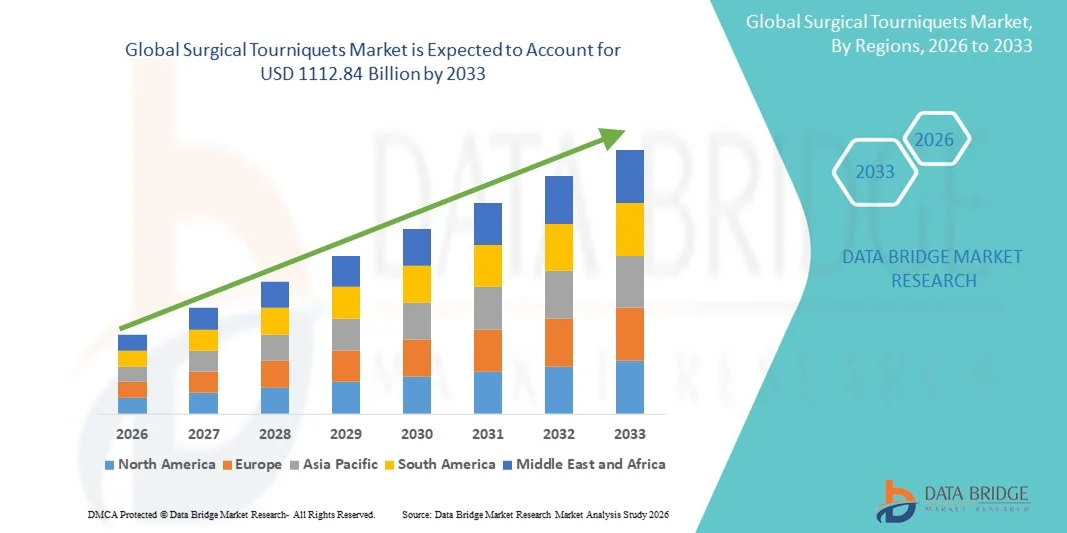
- The global surgical tourniquets market size was valued at USD 573.90 billion in 2025 and is expected to reach USD 1112.84 billion by 2033, at a CAGR of 8.63% during the forecast period
- The market growth is largely fueled by the increasing adoption of advanced surgical technologies and the rising volume of surgical procedures worldwide, leading to greater demand for precise blood flow control and enhanced surgical efficiency in both hospital and ambulatory settings
- Furthermore, growing emphasis on patient safety, improved surgical outcomes, and the integration of digital pressure monitoring systems is establishing surgical tourniquets as an essential tool in modern operating rooms. These converging factors are accelerating the uptake of Surgical Tourniquets solutions, thereby significantly boosting the industry's growth
Surgical Tourniquets Market Analysis
- Surgical tourniquets, essential medical devices used to control blood flow during surgical procedures, are increasingly vital in both hospital and ambulatory settings due to their ability to provide a clear operative field, reduce intraoperative blood loss, and improve surgical precision. The growing focus on patient safety, improved pressure regulation systems, and digital monitoring technologies are enhancing their clinical reliability and adoption
- The escalating demand for surgical tourniquets is primarily driven by the rising volume of orthopedic, trauma, and reconstructive surgeries, growing awareness about infection control, and technological advancements in pneumatic and automatic tourniquet systems
- North America dominated the surgical tourniquets market with the largest revenue share of 41.3% in 2025, characterized by advanced healthcare infrastructure, high surgical procedure volumes, and strong presence of key market players. The U.S. experienced substantial growth in the adoption of advanced pneumatic and electronic tourniquets, driven by increasing orthopedic surgeries, military trauma care applications, and a shift toward reusable and digitally controlled systems
- Asia-Pacific is expected to be the fastest growing region in the surgical tourniquets market during the forecast period, registering a CAGR fueled by rapid healthcare infrastructure development, a growing geriatric population, and rising surgical volumes in countries such as China, India, and Japan. Increasing government investments in hospital modernization and growing access to advanced medical technologies are also propelling regional market growth
- The Lower-Limb Surgery segment held the largest market share of 57.3% in 2025, attributed to the high incidence of orthopedic and trauma procedures involving the knee, ankle, and thigh regions
Report Scope and Surgical Tourniquets Market Segmentation
|
Attributes |
Surgical Tourniquets Key Market Insights |
|
Segments Covered |
|
|
Countries Covered |
North America
Europe
Asia-Pacific
Middle East and Africa
South America
|
|
Key Market Players |
|
|
Market Opportunities |
|
|
Value Added Data Infosets |
In addition to the insights on market scenarios such as market value, growth rate, segmentation, geographical coverage, and major players, the market reports curated by the Data Bridge Market Research also include in-depth expert analysis, patient epidemiology, pipeline analysis, pricing analysis, and regulatory framework. |
Surgical Tourniquets Market Trends
Enhanced Convenience Through AI and Digital Integration
- A significant and accelerating trend in the global surgical tourniquets market is the deepening integration of artificial intelligence (AI), advanced sensors, and digital monitoring systems. These technologies are transforming conventional tourniquet devices into intelligent systems capable of enhancing precision, optimizing pressure control, and improving patient outcomes during surgical procedures
- For instance, Zimmer Biomet’s A.T.S. 4000 Automatic Tourniquet System utilizes advanced microprocessor control to continuously monitor cuff pressure, ensuring precise regulation throughout surgery. This exemplifies the growing emphasis on intelligent automation and real-time patient safety monitoring in surgical environments
- AI integration in modern surgical tourniquets allows continuous feedback from sensors to predict and prevent complications such as nerve damage or ischemia. For example, Ulrich Medical’s Tourniquet 3000 incorporates adaptive control algorithms to automatically adjust cuff pressure according to limb occlusion levels, enhancing both safety and procedural efficiency. Furthermore, digital display systems enable surgeons to monitor key performance metrics with high accuracy, supporting data-driven decision-making during operations
- The seamless integration of these devices with hospital information systems and surgical workflow platforms enables centralized data management and performance tracking. Through digital connectivity, clinicians can record tourniquet use data, analyze outcomes, and ensure compliance with surgical safety standards, fostering a more connected and efficient operating room environment
- This trend toward intelligent, data-supported, and automated tourniquet systems is fundamentally reshaping surgical practices worldwide. Consequently, companies such as Delfi Medical Innovations are focusing on AI-enabled pneumatic tourniquets with wireless monitoring features and auto-regulation capabilities that adjust to the patient’s physiological parameters in real time
- The growing adoption of AI-driven and digitally integrated surgical tourniquets reflects a broader industry shift toward precision medicine and automation in healthcare. Hospitals and surgical centers are increasingly prioritizing systems that reduce manual intervention, enhance safety, and streamline operational workflows
Surgical Tourniquets Market Dynamics
Driver
Rising Surgical Volume and Demand for Precision-Controlled Tourniquet Systems
- The increasing number of orthopedic, trauma, and emergency surgeries globally, along with advancements in minimally invasive procedures, is a major factor driving the growth of the Surgical Tourniquets market. The need for effective blood flow control and improved surgical field visibility continues to elevate the demand for advanced pneumatic and electronic tourniquet system
- For instance, in April 2025, Zimmer Biomet introduced enhancements to its next-generation A.T.S. platform with improved real-time monitoring and automated safety alerts, strengthening its portfolio in precision-driven tourniquet technology. Such strategic innovations by key industry players are expected to drive market expansion over the forecast period
- As surgical caseloads rise due to an aging population and increasing trauma cases, healthcare institutions are focusing on devices that enhance intraoperative safety and minimize complications related to pressure management. Advanced tourniquet systems with accurate pressure sensors, customizable settings, and quick-release features are becoming essential in modern surgical suites
- Furthermore, growing adoption of digital healthcare infrastructure and demand for systems with integrated data logging and compliance tracking capabilities are reinforcing market demand. These systems help hospitals maintain detailed procedural records, ensuring adherence to surgical standards and enhancing postoperative evaluation
- The convenience of automated inflation and deflation mechanisms, along with multi-cuff control options, provides surgeons with greater precision, operational efficiency, and patient comfort. The trend toward compact, portable, and user-friendly tourniquet devices in both hospital and outpatient settings further supports market growth
Restraint/Challenge
Concerns Regarding Pressure-Related Complications and High Equipment Costs
- Despite their importance in surgery, tourniquet devices carry inherent risks related to pressure-induced tissue and nerve injury, which remain a key challenge for the market. Improper application or over-inflation can result in postoperative complications, leading to growing scrutiny around device safety and clinician training
- For instance, reported cases of tourniquet-related nerve palsy in orthopedic surgeries have increased awareness regarding safe operating pressures and duration limits, prompting hospitals to invest in devices with better control mechanisms and safety indicators
- Manufacturers are addressing these concerns by developing systems with automated pressure calibration, limb occlusion pressure (LOP) determination, and real-time monitoring to minimize human error. Companies such as Delfi Medical Innovations emphasize adaptive pressure management and smart safety alerts in their marketing to enhance clinician confidence
- However, the high initial cost of advanced electronic and dual-cuff tourniquet systems compared to traditional pneumatic models remains a barrier to adoption, particularly in developing regions. Smaller hospitals and ambulatory surgical centers often face budget constraints that limit their access to premium-grade devices
- While manufacturers are introducing cost-effective models, the perceived high price of technologically advanced tourniquets can still deter widespread usage, especially in price-sensitive markets. Continuous efforts toward cost optimization, standardization, and improved clinician training will be vital to achieving broader market penetration and sustainable growth
Surgical Tourniquets Market Scope
The market is segmented on the basis of type, application, and end user.
- By Type
On the basis of type, the Surgical Tourniquets market is segmented into Tourniquet Systems, Tourniq uet Cuffs, and Tourniquet Accessories. The Tourniquet Systems segment dominated the market in 2025, accounting for the largest revenue share of 48.6%, primarily driven by the increasing demand for automated, precise, and digitally controlled pneumatic systems in surgical procedures. These systems are widely adopted in orthopedic and trauma surgeries for their ability to regulate cuff pressure accurately, minimizing the risk of tissue and nerve damage. Their integration with digital monitoring units enhances patient safety and procedural efficiency. The growing number of orthopedic surgeries globally and technological advancements such as microprocessor-based control systems further strengthen the dominance of this segment. For instance, leading manufacturers like Zimmer Biomet and Delfi Medical Innovations continue to launch advanced automatic tourniquet systems designed for real-time pressure regulation.
The Tourniquet Cuffs segment is expected to witness the fastest growth rate of 22.4% (CAGR) from 2026 to 2033, driven by rising surgical volumes and increased adoption of disposable cuffs to maintain sterility and prevent cross-contamination. The growing preference for single-use cuffs, especially in hospitals and outpatient centers, aligns with stringent infection control guidelines. Moreover, the availability of ergonomic and limb-specific cuff designs improves patient comfort and procedural accuracy. The trend toward lightweight materials and customizable sizes further contributes to this segment’s rapid expansion in the global market.
- By Application
On the basis of application, the Surgical Tourniquets market is segmented into Lower-Limb Surgery and Upper-Limb Surgery. The Lower-Limb Surgery segment held the largest market share of 57.3% in 2025, attributed to the high incidence of orthopedic and trauma procedures involving the knee, ankle, and thigh regions. Tourniquets play a critical role in establishing a bloodless surgical field during procedures such as total knee arthroplasty, ligament reconstruction, and fracture fixation. The increasing prevalence of sports injuries and road accidents further propels demand. In addition, advanced pneumatic and electronic tourniquet systems designed for precision pressure control during prolonged surgeries enhance patient outcomes and surgical efficiency. The growing number of total joint replacement procedures worldwide continues to sustain this segment’s dominance.
Conversely, the Upper-Limb Surgery segment is projected to record the fastest CAGR of 20.8% from 2026 to 2033, driven by the rising number of hand, wrist, and shoulder surgeries across hospitals and ambulatory surgical centers. Increased preference for minimally invasive upper-extremity procedures, coupled with the availability of anatomically adaptive cuffs, is boosting demand. Moreover, portable tourniquet systems with dual-cuff capabilities offer improved flexibility for smaller anatomical areas, promoting adoption in outpatient orthopedic practices. Enhanced recovery protocols and growing surgical volumes in upper-limb trauma repair are also accelerating this segment’s growth.
- By End User
On the basis of end user, the Surgical Tourniquets market is segmented into Hospitals and Trauma Centres, Ambulatory Surgical Centres, Military, and Others. The Hospitals and Trauma Centres segment dominated the global market with a share of 62.1% in 2025, owing to the increasing number of complex surgical procedures and the availability of advanced infrastructure supporting digital tourniquet systems. Hospitals remain the primary users of pneumatic and electronic tourniquets due to their capability to handle high surgical volumes and critical trauma cases. The continuous demand for technologically advanced systems, along with rising investments in upgrading surgical equipment, has reinforced this segment’s leadership. In addition, large-scale orthopedic units and emergency departments utilize integrated tourniquet systems to ensure precise intraoperative control and enhanced patient safety.
The Military segment is anticipated to witness the fastest CAGR of 21.3% from 2026 to 2033, supported by the rising need for portable and rapid-deployment tourniquet systems in combat and emergency medical situations. Military applications require compact, durable, and high-performance devices for trauma care in field conditions. The increasing adoption of tactical tourniquets by defense forces and humanitarian organizations for emergency hemorrhage control significantly contributes to growth. The ongoing development of lightweight, easy-to-apply tourniquets with automatic inflation technology further accelerates market demand in this sector.
Surgical Tourniquets Market Regional Analysis
- North America dominated the surgical tourniquets market with the largest revenue share of 41.3% in 2025, characterized by advanced healthcare infrastructure, high surgical procedure volumes, and a strong presence of key industry player
- The region’s dominance is supported by widespread adoption of pneumatic and electronic tourniquets in hospitals and trauma centers, along with increasing orthopedic and reconstructive surgeries
- In addition, technological advancements enabling precise pressure control and improved patient safety have further driven the market in the region
U.S. Surgical Tourniquets Market Insight
The U.S. surgical tourniquets market accounted for the largest share in North America in 2025, driven by rising incidences of orthopedic disorders, sports injuries, and trauma cases. The growing preference for automated and digitally controlled tourniquet systems to enhance surgical precision and minimize complications is accelerating market expansion. Moreover, the strong presence of key manufacturers, significant healthcare spending, and robust adoption within military and emergency medical services continue to propel the U.S. market forward.
Europe Surgical Tourniquets Market Insight
The Europe surgical tourniquets market is projected to expand at a steady CAGR throughout the forecast period, primarily due to the growing number of surgical procedures, improved healthcare infrastructure, and increasing adoption of advanced medical devices. Heightened emphasis on patient safety, along with strict regulatory standards, is promoting the use of modern pneumatic and electronic tourniquet systems. Countries such as Germany, the U.K., and France are key contributors to regional growth due to their strong hospital networks and government initiatives supporting healthcare modernization.
U.K. Surgical Tourniquets Market Insight
The U.K. surgical tourniquets market is expected to grow at a noteworthy CAGR during the forecast period, supported by an increasing volume of orthopedic and trauma surgeries and a growing preference for reusable and eco-friendly tourniquet cuffs. The country’s robust healthcare infrastructure, combined with strong investments in surgical technologies and staff training, is fostering market development. Furthermore, the NHS’s emphasis on safe surgical practices and infection control is boosting the adoption of advanced tourniquet systems.
Germany Surgical Tourniquets Market Insight
The Germany surgical tourniquets market is anticipated to witness significant growth driven by the nation’s focus on precision medicine, high surgical standards, and sustainable healthcare practices. German hospitals are rapidly integrating advanced pneumatic and electronic tourniquet systems that offer precise pressure control and lower the risk of nerve damage. The country’s strong manufacturing base and emphasis on technological innovation are further strengthening its market position within Europe.
Asia-Pacific Surgical Tourniquets Market Insight
The Asia-Pacific surgical tourniquets market is expected to register the fastest CAGR from 2026 to 2033, driven by rapid healthcare infrastructure expansion, increasing surgical volumes, and a growing aging population in countries such as China, India, and Japan. Government investments in hospital modernization and the growing adoption of advanced surgical equipment are accelerating market growth. Moreover, the region’s cost-effective manufacturing capabilities and rising awareness about patient safety are expanding the accessibility of high-quality tourniquet systems.
Japan Surgical Tourniquets Market Insight
The Japan surgical tourniquets market is gaining traction due to its technologically advanced healthcare ecosystem, increasing orthopedic and vascular procedures, and demand for precision-driven medical devices. The adoption of automated pneumatic systems that ensure consistent pressure control is becoming widespread across hospitals. Furthermore, Japan’s aging population and focus on surgical accuracy and safety continue to drive the demand for advanced tourniquet solutions.
China Surgical Tourniquets Market Insight
The China surgical tourniquets market accounted for the largest market revenue share in the Asia-Pacific region in 2025, supported by rapid hospital expansion, growing trauma cases, and government initiatives to enhance surgical care. China’s expanding middle-class population and increased healthcare expenditure are further contributing to the adoption of modern pneumatic and disposable tourniquets. In addition, the presence of domestic manufacturers offering affordable, high-quality products is significantly propelling market growth.
Surgical Tourniquets Market Share
The Surgical Tourniquets industry is primarily led by well-established companies, including:
• Zimmer Biomet (U.S.)
• Stryker Corporation (U.S.)
• Delfi Medical Innovations Inc. (Canada)
• VBM Medizintechnik GmbH (Germany)
• Ulrich Medical (Germany)
• Hokanson Inc. (U.S.)
• Anetic Aid Ltd. (U.K.)
• Hemostasis LLC (U.S.)
• DSMAREF Co., Ltd. (South Korea)
• Mectronic Medicale S.r.l. (Italy)
• ATS Medical Inc. (U.S.)
• Sarstedt AG & Co. KG (Germany)
• Medline Industries, LP (U.S.)
• Prescott’s Inc. (U.S.)
• Henvy Medical Equipment Co., Ltd. (China)
• Shanghai Bojin Medical Instrument Co., Ltd. (China)
• Tokyo Boeki Medical System Ltd. (Japan)
• Western Medical Ltd. (U.K.)
• B. Braun Melsungen AG (Germany)
• Vyaire Medical Inc. (U.S.)
Latest Developments in Global Surgical Tourniquets Market
- In May 2021, McEwen & Associates Consulting Ltd. received U.S. FDA 510(k) clearance for its ATS 5000 Automatic Tourniquet System (K202919). This advanced dual-port pneumatic system was designed for precise limb occlusion pressure control during surgical procedures, improving patient safety and optimizing tourniquet inflation management. The clearance marked a major step forward in clinical reliability and the standardization of automated tourniquet technology for operating rooms
- In April 2023, Delfi Medical Innovations Inc., a leading manufacturer of personalized pneumatic tourniquet systems, launched its PTS II (Personalized Tourniquet System). The new model introduced enhanced patient-specific pressure management, improved battery efficiency, integrated cuff testing, and advanced connectivity for operating room digital systems. This launch reinforced Delfi’s commitment to safety, innovation, and precision in modern surgical environments

- Interactive Data Analysis Dashboard
- Company Analysis Dashboard for high growth potential opportunities
- Research Analyst Access for customization & queries
- Competitor Analysis with Interactive dashboard
- Latest News, Updates & Trend analysis
- Harness the Power of Benchmark Analysis for Comprehensive Competitor Tracking
Data collection and base year analysis are done using data collection modules with large sample sizes. The stage includes obtaining market information or related data through various sources and strategies. It includes examining and planning all the data acquired from the past in advance. It likewise envelops the examination of information inconsistencies seen across different information sources. The market data is analysed and estimated using market statistical and coherent models. Also, market share analysis and key trend analysis are the major success factors in the market report. To know more, please request an analyst call or drop down your inquiry.
The key research methodology used by DBMR research team is data triangulation which involves data mining, analysis of the impact of data variables on the market and primary (industry expert) validation. Data models include Vendor Positioning Grid, Market Time Line Analysis, Market Overview and Guide, Company Positioning Grid, Patent Analysis, Pricing Analysis, Company Market Share Analysis, Standards of Measurement, Global versus Regional and Vendor Share Analysis. To know more about the research methodology, drop in an inquiry to speak to our industry experts.
Data Bridge Market Research is a leader in advanced formative research. We take pride in servicing our existing and new customers with data and analysis that match and suits their goal. The report can be customized to include price trend analysis of target brands understanding the market for additional countries (ask for the list of countries), clinical trial results data, literature review, refurbished market and product base analysis. Market analysis of target competitors can be analyzed from technology-based analysis to market portfolio strategies. We can add as many competitors that you require data about in the format and data style you are looking for. Our team of analysts can also provide you data in crude raw excel files pivot tables (Fact book) or can assist you in creating presentations from the data sets available in the report.













