


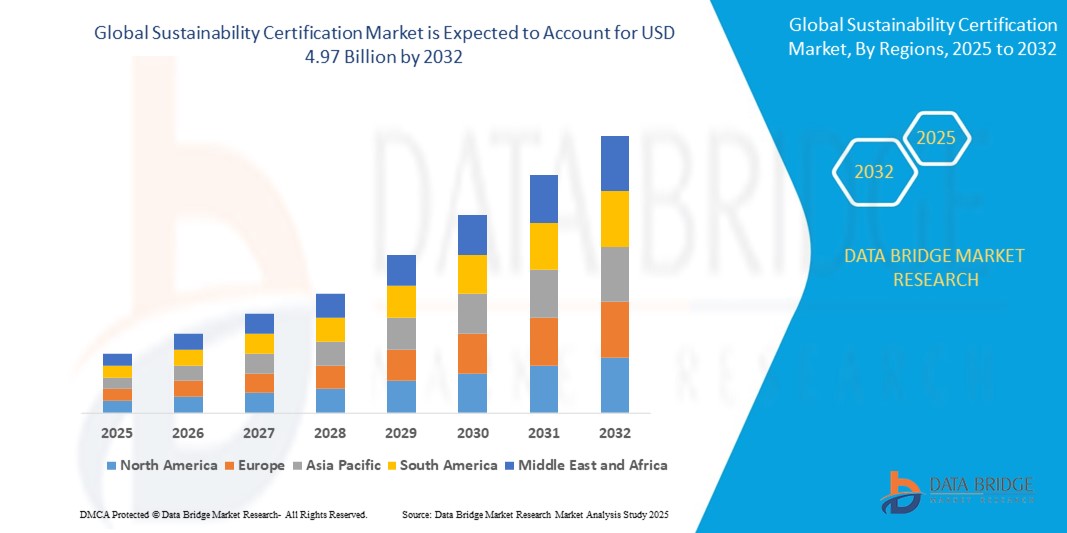
Sustainability Certification Market Size
- The global sustainability certification market size was valued at USD 3.1 billion in 2024 and is expected to reach USD 4.97 billion by 2032, at a CAGR of 6.10% during the forecast period
- The sustainability certification market growth is significantly driven by the increasing emphasis on ESG compliance, regulatory mandates, and corporate commitments to environmental responsibility across sectors such as energy, manufacturing, and construction
- The rising need for third-party validation of sustainability claims, combined with growing investor and consumer demand for transparency in carbon footprints, supply chain practices, and material use, is accelerating market expansion. Increasing adoption of certifications to meet net-zero targets and align with global frameworks such as the UN SDGs and Paris Agreement further propels market growth
Sustainability Certification Market Analysis
- Sustainability certifications are mechanisms used to verify that a specific product, service, or business operates in an environmentally, socially, and economically sustainable manner according to established standards. These certifications are typically granted by third-party organizations after an assessment process to ensure compliance with predefined criteria, such as those related to environmental management, fair trade practices, or sustainable forestry. They serve as a form of assurance and communication of sustainability efforts to consumers and stakeholders
- The expanding adoption of sustainability certifications is primarily attributable to the growing global awareness of environmental and social issues, leading to increased consumer demand for sustainable products and services. In addition, businesses are increasingly seeking certifications to enhance their reputation, gain a competitive advantage by demonstrating their commitment to sustainability, meet investor expectations related to ESG factors, and comply with evolving government regulations and industry standards aimed at promoting sustainable practices
- North America dominates the sustainability certification market with a share of 33.7% in 2024 due to increasing corporate focus on ESG targets and strong consumer demand for sustainable products
- Asia-Pacific is expected to be the fastest growing region in the sustainability certification market during the forecast period due to increasing awareness of environmental issues, rising government initiatives promoting sustainability, and growing demand for certified products from both domestic and international markets.
- Energy segment dominates the market with a market share of 29.5% in 2024 due to rising investments in renewable energy projects and the need to meet decarbonization goals. Certification plays a vital role in validating clean energy claims, ensuring compliance with green energy standards, and attracting sustainability-linked financing. The transition to wind, solar, and hydrogen technologies further fuels demand for certification solutions
Report Scope and Sustainability Certification Market Segmentation
|
Attributes |
Sustainability Certification Key Market Insights |
|
Segments Covered |
|
|
Countries Covered |
North America
Europe
Asia-Pacific
Middle East and Africa
South America
|
|
Key Market Players |
|
|
Market Opportunities |
|
|
Value Added Data Infosets |
In addition to the insights on market scenarios such as market value, growth rate, segmentation, geographical coverage, and major players, the market reports curated by the Data Bridge Market Research also include in-depth expert analysis, geographically represented company-wise production and capacity, network layouts of distributors and partners, detailed and updated price trend analysis and deficit analysis of supply chain and demand. |
Sustainability Certification Market Trends
“Increasing Demand for Certifications”
- A significant and accelerating trend in the sustainability certification market is the increasing demand from businesses across various sectors to obtain credible certifications for their products, services, and operations. This growing adoption is fueled by heightened consumer awareness and preference for sustainable and ethically produced goods, coupled with increasing pressure from investors and regulatory bodies to demonstrate commitment to environmental, social, and governance (ESG) principles
- For instance, major companies in the food industry are increasingly seeking certifications such as Fairtrade and Rainforest Alliance to demonstrate ethical sourcing and sustainable agricultural practices. In the apparel industry, certifications such as the Global Organic Textile Standard (GOTS) are gaining traction
- This heightened demand for certifications enables businesses to build trust with consumers, enhance their brand reputation, differentiate themselves in the market, and potentially gain access to new markets where sustainability standards are a prerequisite. Compared to self-proclaimed sustainability initiatives, third-party certifications provide an independent and verifiable validation of a company's commitment to sustainable practices, offering greater credibility and assurance to stakeholders
- The growing global emphasis on sustainability, the urgent need to address climate change, and the increasing focus on corporate responsibility are further fueling the importance of sustainability certifications as a tangible way for businesses to demonstrate their positive impact and contribution to a more sustainable future
- Organizations are increasingly acknowledging that obtaining relevant certifications is not just a matter of compliance but a strategic imperative for long-term success and stakeholder engagement.
- The demand for robust and recognized sustainability certifications is growing rapidly as more businesses recognize the value and necessity of demonstrating their sustainability efforts through independent verification. This trend is driving significant growth in the sustainability certification market, encouraging both businesses and certification providers to innovate and expand the scope and rigor of sustainability standards and certifications across industries
Sustainability Certification Market Dynamics
Driver
“Rising Consumer Demand for Green Products”
- A significant and growing driver for the sustainability certification market is the increasing consumer demand for green and environmentally friendly products across various industries. This surge in demand is fueled by growing awareness of environmental issues, climate change, and the impact of consumption on the planet, leading consumers to actively seek out and prefer products that are certified as sustainable
- For instance, major companies in the consumer goods sector, such as Unilever, Nestlé, and Procter & Gamble, are increasingly seeking sustainability certifications such as Fair Trade, Rainforest Alliance, and Certified B Corporation for their products to meet the demands of environmentally conscious consumers. Retail giants such as Walmart and IKEA also prioritize sourcing and promoting products with recognized sustainability certifications, signaling to consumers their commitment to environmental stewardship
- As consumers become more informed and concerned about the environmental and social impact of their purchasing decisions, the presence of credible sustainability certifications on products serves as a key differentiator and a signal of trust. This demand encourages more businesses to adopt sustainable practices and seek certification to attract and retain customers who prioritize green products
- The growing emphasis on sustainable lifestyles and the increasing willingness of consumers to pay a premium for eco-friendly and ethically sourced products are further fueling the importance of sustainability certifications as a crucial marketing and credibility tool for businesses. Organizations recognize that aligning with consumer values regarding sustainability is not just an ethical choice but also a significant business opportunity
- The demand for independently verified green products is growing rapidly, encouraging more companies to pursue sustainability certifications to demonstrate their environmental and social responsibility and cater to this expanding consumer segment, ultimately driving the growth and importance of the sustainability certification market
Restraint/Challenge
“Complex Regulatory Landscapes”
- A notable challenge for the sustainability certification market arises from the increasingly complex and often fragmented regulatory landscapes across different regions and industries. Businesses seeking sustainability certifications must navigate a myriad of national and international regulations, each with its own specific requirements, standards, and reporting frameworks, creating a significant hurdle in terms of compliance and cost
- For instance, major companies operating globally need to adhere to different environmental and social regulations in various countries, such as the European Union's environmental directives, the United States' EPA regulations, and regulations in other regions such as Asia-Pacific. While companies such as Unilever, Nestlé, and IKEA aim for global sustainability standards and certifications, they still face the complexity of ensuring compliance with diverse and evolving local regulations that impact their supply chains and product offerings. Certification bodies such as ISO and LEED strive to provide universally recognized standards, but the interpretation and enforcement of these standards can vary depending on local regulations
- Addressing this challenge requires significant resources in terms of legal expertise, compliance teams, and ongoing monitoring of regulatory changes across different markets. The lack of harmonization and the potential for conflicting regulations can make it difficult and expensive for companies to achieve and maintain sustainability certifications on a global scale, potentially hindering market growth and cross-sector penetration, especially for smaller businesses
- Despite the increasing demand for sustainability certifications, the complex web of regulations can be a concern for companies, potentially leading to confusion, increased administrative burden, and higher costs associated with obtaining and maintaining the necessary certifications to operate in different markets. This complexity can also create opportunities for greenwashing if companies selectively adhere to less stringent regulations or certifications
- Overcoming these limitations involves greater harmonization of international sustainability standards and regulations, as well as the development of clearer and more accessible guidance for businesses seeking certifications. Companies also need to invest in robust compliance frameworks and work closely with certification bodies to navigate the complex regulatory landscape effectively and ensure the credibility and value of their sustainability certifications
Sustainability Certification Market Scope
The market is segmented on the basis of focus, application, and vertical.
- By Focus
On the basis of focus, the market is segmented into climate impact, energy efficiency, material sustainability, and supply chain sustainability. The climate impact segment dominates the largest market revenue share in 2024, driven by growing global emphasis on carbon neutrality and the enforcement of international climate agreements. Corporations are increasingly seeking certifications to validate emission reduction efforts and demonstrate alignment with ESG goals. The rise of net-zero pledges and pressure from investors and regulators further propel demand for climate-related certification services.
The supply chain sustainability segment is expected to witness the fastest CAGR from 2025 to 2032, driven by the growing need for transparency and accountability across value chains. Companies are adopting supply chain certifications to mitigate risks, meet procurement standards, and address consumer concerns about ethical sourcing. Enhanced traceability, coupled with digital tools, is also making it easier to certify sustainability at each supply chain tier.
- By Application
On the basis of application, the market is segmented into energy, transportation, and infrastructure. The energy segment dominates the largest market revenue share 29.5% in 2024, driven by rising investments in renewable energy projects and the need to meet decarbonization goals. Certification plays a vital role in validating clean energy claims, ensuring compliance with green energy standards, and attracting sustainability-linked financing. The transition to wind, solar, and hydrogen technologies further fuels demand for certification solutions.
The infrastructure segment is expected to witness the fastest CAGR from 2025 to 2032, driven by the rapid integration of sustainable building standards and green construction practices. As governments and developers adopt eco-friendly infrastructure models, certifications such as LEED and BREEAM gain traction. The push for smart cities and climate-resilient infrastructure also amplifies demand for validated sustainability credentials.
- By Vertical
On the basis of vertical, the market is segmented into industrial, commercial, and residential. The industrial segment dominates the largest market revenue share in 2024, driven by rising regulatory requirements, environmental audits, and stakeholder pressure for sustainable operations. Heavy-emission sectors such as manufacturing, energy, and mining are adopting certifications to manage environmental risks and meet ESG benchmarks. Digital platforms are further enabling efficient certification tracking and compliance reporting.
The commercial segment is expected to witness the fastest CAGR from 2025 to 2032, driven by increasing emphasis on sustainable business practices and green certifications for office spaces and retail buildings. Certifications are being used to boost brand reputation, attract sustainability-minded tenants, and reduce operational costs. The growing adoption of smart, energy-efficient technologies also supports certification uptake in the commercial sector.
Sustainability Certification Market Regional Analysis
- North America dominates the sustainability certification market with the largest revenue share of 33.7% in 2024, driven by increasing corporate focus on ESG targets and strong consumer demand for sustainable products
- The region's stringent environmental regulations and the presence of numerous multinational corporations committed to sustainability initiatives contribute to the high adoption of various certifications
- Consumers in North America increasingly value transparency and independently verified sustainability claims for products and services. This widespread adoption is supported by a mature market with well-established certification bodies and a growing awareness of the importance of environmental, social, and ethical performance
U.S. Sustainability Certification Market Insight
U.S. sustainability certification market captures a substantial revenue share within North America, fueled by a strong emphasis on corporate social responsibility and the rising adoption of green building standards. Consumers are increasingly prioritizing products with environmental and ethical certifications, driving demand across various industries. The growing trend of companies seeking to enhance their brand image and meet stakeholder expectations through credible sustainability certifications further propels this market. Moreover, the increasing integration of sustainability considerations into investment decisions is significantly contributing to market growth.
Europe Sustainability Certification Market Insight
European sustainability certification market is projected to expand at a significant CAGR throughout the forecast period, primarily driven by stringent environmental policies, including the European Green Deal, and increasing public awareness of sustainability issues. The demand for certifications related to renewable energy, energy efficiency, and sustainable forestry is particularly high. European consumers are also drawn to products and services with eco-labels and certifications that demonstrate a commitment to environmental protection and social responsibility. The region is experiencing robust growth across various sectors, with sustainability certifications being increasingly integrated into business strategies and public procurement processes.
U.K. Sustainability Certification Market Insight
U.K. sustainability certification market is anticipated to grow at a noteworthy CAGR during the forecast period, driven by the government's commitment to achieving net-zero emissions and increasing consumer demand for environmentally friendly products. In addition, businesses are increasingly seeking certifications to demonstrate their sustainability credentials and comply with evolving regulations. U.K.'s strong focus on environmental conservation and its well-established testing, inspection, and certification industry are expected to continue to stimulate market growth for sustainability certifications.
Germany Sustainability Certification Market Insight
German sustainability certification market is expected to expand at a considerable CAGR during the forecast period, fueled by a strong national focus on environmental protection, renewable energy, and sustainable manufacturing. Germany's well-developed industrial sector and its emphasis on innovation and eco-conscious solutions promote the adoption of sustainability certifications across various industries, including automotive, energy, and construction. The integration of sustainability certifications with national and international standards is also becoming increasingly prevalent, aligning with local consumer expectations for environmentally sound products and practices.
Asia-Pacific Sustainability Certification Market Insight
Asia-Pacific sustainability certification market is poised to grow at a rapid CAGR, driven by increasing awareness of environmental issues, rising government initiatives promoting sustainability, and growing demand for certified products from both domestic and international markets. Rapid industrialization and urbanization in countries such as China and India are leading to a greater focus on sustainable practices and the adoption of relevant certifications. Furthermore, as the region emerges as a major manufacturing hub, the demand for sustainability certifications to meet global standards for exports is also increasing.
Japan Sustainability Certification Market Insight
Japan sustainability certification market is gaining momentum due to the country’s strong emphasis on environmental conservation, resource efficiency, and high-quality products. The Japanese market places significant value on trust and reliability, and the adoption of reputable sustainability certifications helps companies demonstrate their commitment to environmental and social responsibility. The increasing consumer awareness of sustainability issues and the government's promotion of green initiatives are fueling the growth of this market across various sectors.
China Sustainability Certification Market Insight
China sustainability certification market is experiencing substantial growth, attributed to the country's increasing focus on environmental protection, energy efficiency, and sustainable development. Stringent government regulations aimed at reducing pollution and promoting green practices are driving the adoption of various sustainability certifications across industries. As one of the world's largest manufacturing hubs, China's participation in the sustainability certification market is crucial for global supply chains and is driven by both domestic environmental concerns and international trade requirements for certified products.
Sustainability Certification Market Share
The sustainability certification industry is primarily led by well-established companies, including:
- SGS Société Générale de Surveillance SA (Switzerland)
- UL LLC (U.S.)
- TUV SUD (Germany)
- TUV Rheinland (Germany)
- Bureau Veritas (France)
- DEKRA (Germany)
- DNV GL (Norway)
- Intertek Group plc (U.K.)
- LRQA Group Limited (U.K.)
- Control Union Certifications (Netherlands)
- NSF International (U.S.)
- Kiwa Group (Netherlands)
- QIMA (Hong Kong)
Latest Developments in Global Sustainability Certification Market
- In September 2024, ClimeCo, a leading global decarbonization and sustainability solutions company, launched its ClimeCo Certified Product Program, designed to help companies connect with sustainability-minded consumers by transparently demonstrating their environmental responsibility. This program is expected to impact the market by driving greater consumer demand for certified sustainable products, encouraging more businesses to adopt transparent sustainability practices, and ultimately accelerating the shift toward environmentally responsible purchasing behaviors across industries
- In December 2023, Tata Steel took a major step in strengthening its commitment to environmental responsibility by earning the GreenPro Ecolabelling Standard certification for its Automotive Flat Steel products. Created by the Green Business Centre of the Confederation of Indian Industries (CII), the GreenPro ecolabel evaluates a product’s environmental impact through a rigorous framework, setting a benchmark for excellence in environmental performance

- Interactive Data Analysis Dashboard
- Company Analysis Dashboard for high growth potential opportunities
- Research Analyst Access for customization & queries
- Competitor Analysis with Interactive dashboard
- Latest News, Updates & Trend analysis
- Harness the Power of Benchmark Analysis for Comprehensive Competitor Tracking
Global Sustainability Certification Market, Supply Chain Analysis and Ecosystem Framework
To support market growth and help clients navigate the impact of geopolitical shifts, DBMR has integrated in-depth supply chain analysis into its Global Sustainability Certification Market research reports. This addition empowers clients to respond effectively to global changes affecting their industries. The supply chain analysis section includes detailed insights such as Global Sustainability Certification Market consumption and production by country, price trend analysis, the impact of tariffs and geopolitical developments, and import and export trends by country and HSN code. It also highlights major suppliers with data on production capacity and company profiles, as well as key importers and exporters. In addition to research, DBMR offers specialized supply chain consulting services backed by over a decade of experience, providing solutions like supplier discovery, supplier risk assessment, price trend analysis, impact evaluation of inflation and trade route changes, and comprehensive market trend analysis.
Data collection and base year analysis are done using data collection modules with large sample sizes. The stage includes obtaining market information or related data through various sources and strategies. It includes examining and planning all the data acquired from the past in advance. It likewise envelops the examination of information inconsistencies seen across different information sources. The market data is analysed and estimated using market statistical and coherent models. Also, market share analysis and key trend analysis are the major success factors in the market report. To know more, please request an analyst call or drop down your inquiry.
The key research methodology used by DBMR research team is data triangulation which involves data mining, analysis of the impact of data variables on the market and primary (industry expert) validation. Data models include Vendor Positioning Grid, Market Time Line Analysis, Market Overview and Guide, Company Positioning Grid, Patent Analysis, Pricing Analysis, Company Market Share Analysis, Standards of Measurement, Global versus Regional and Vendor Share Analysis. To know more about the research methodology, drop in an inquiry to speak to our industry experts.
Data Bridge Market Research is a leader in advanced formative research. We take pride in servicing our existing and new customers with data and analysis that match and suits their goal. The report can be customized to include price trend analysis of target brands understanding the market for additional countries (ask for the list of countries), clinical trial results data, literature review, refurbished market and product base analysis. Market analysis of target competitors can be analyzed from technology-based analysis to market portfolio strategies. We can add as many competitors that you require data about in the format and data style you are looking for. Our team of analysts can also provide you data in crude raw excel files pivot tables (Fact book) or can assist you in creating presentations from the data sets available in the report.













