


What is the Sustainable FMCG Packaging Market Size and Overview?
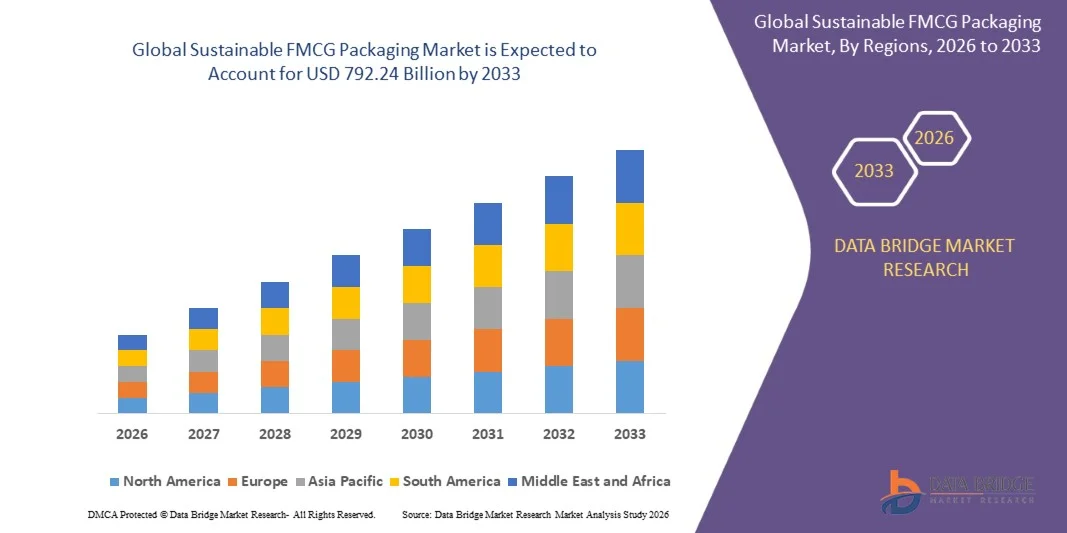
As per Data Bridge Market Research Analysis the Sustainable FMCG Packaging Market was valued at USD 412.5 Billion in 2025 and is projected to reach USD 792.24 Billion by 2033, growing at a CAGR of 8.50% from 2026 to 2033. The market is experiencing consistent growth driven by increasing consumer preference for environmentally responsible packaging, rising regulatory pressure to reduce packaging waste, and growing adoption of recyclable and bio-based materials across FMCG industries. Expanding investments in circular economy initiatives and continuous advancements in sustainable packaging technologies are further supporting market expansion across developed and emerging economies.
The increasing global emphasis on reducing carbon emissions and plastic pollution, combined with stringent regulations regarding single-use packaging materials, is compelling FMCG manufacturers to adopt sustainable packaging solutions. Recyclable plastics, paper-based packaging, compostable materials, and reusable formats are increasingly being incorporated across food, beverage, personal care, and household product categories to enhance sustainability performance. Rising consumer awareness regarding eco-friendly products and growing corporate commitments toward achieving net-zero and waste reduction targets are further accelerating the transition toward sustainable FMCG packaging worldwide.
Key Market Trends & Insights
- Asia-Pacific dominated the Sustainable FMCG Packaging Market with the largest revenue share of 45.71% in 2025, supported by the presence of large consumer goods industries, expanding urban populations, and increasing adoption of environmentally responsible packaging solutions across food, beverage, and personal care sectors
- The plastics segment led the market with a 62.48% share in 2025, driven by its widespread use across FMCG applications owing to its cost-effectiveness, lightweight properties, and versatility in packaging formats
- North America is expected to be the fastest-growing region at a CAGR of 7.3% from 2026 to 2033, fueled by rising consumer preference for environmentally friendly products and increasing regulatory focus on packaging sustainability
- Bio-based & compostable materials are the fastest-growing material type, projected to register a CAGR of 11.9% from 2026 to 2033, supported by increasing demand for environmentally friendly packaging with lower carbon footprints
- The flexible packaging segment dominated the packaging type category with a 54.62% revenue share in 2025, led by its lightweight structure, reduced material consumption, and lower transportation costs
- Food accounted for 50.62% of the market in 2025, preferred by the extensive consumption of packaged food products and growing emphasis on environmentally responsible packaging solutions
- The rigid packaging segment is the fastest-growing category, with a CAGR of 10.8% from 2026 to 2033, driven by increasing demand for durable, reusable, and high-barrier packaging solutions across food, beverage, personal care, and healthcare applications
Market Size & Forecast
- Global Market Value (2025): USD 412.5 Billion
- Expected Market Value (2033): USD 792.24 Billion
- Forecast CAGR (2026–2033): 8.50%
- Leading Region in 2025: Asia-Pacific
- Fastest Growing Region: North America
Report Scope and Sustainable FMCG Packaging Market Segmentation
|
Attributes |
Sustainable FMCG Packaging Key Market Insights |
|
Segments Covered |
|
|
Countries Covered |
North America · U.S. · Canada · Mexico Europe · Germany · France · U.K. · Netherlands · Switzerland · Belgium · Russia · Italy · Spain · Turkey · Rest of Europe Asia-Pacific · China · Japan · India · South Korea · Singapore · Malaysia · Australia · Thailand · Indonesia · Philippines · Rest of Asia-Pacific Middle East and Africa · Saudi Arabia · U.A.E. · South Africa · Egypt · Israel · Rest of Middle East and Africa South America · Brazil · Argentina · Rest of South America |
|
Key Market Players |
· Huhtamaki Oyj (Finland) · International Paper Company (U.S.) · Toyo Seikan Group Holdings, Ltd. (Japan) · Amcor plc (Switzerland) · Mpact Pty Ltd (South Africa) · Graphic Packaging International, LLC (U.S.) · Verallia SA (France) · Crown Holdings, Inc. (U.S.) · Stora Enso Oyj (Finland) · 3P Gulf Group (U.A.E.) · Ball Corporation (U.S.) · Albéa S.A. (France) · Sealed Air Corporation (U.S.) · Nampak Ltd (South Africa) · Tetra Pak International S.A. (Switzerland) · Smurfit Westrock Plc (Ireland) · Constantia Flexibles Group GmbH (Austria) · Napco National (Saudi Arabia) · Mondi Group (U.K.) · Owens-Illinois, Inc. (U.S.) · Coveris Holdings S.A. (Austria) · Sonoco Products Company (U.S.) |
|
Market Opportunities |
· Expansion of Compostable and Bio-Based Packaging Materials · Growing Demand for Refillable and Reusable Packaging Formats · Increasing Adoption of Sustainable Packaging in E-Commerce and Direct-to-Consumer Channels |
|
Value Added Data Infosets |
In addition to the insights on market scenarios such as market value, growth rate, segmentation, geographical coverage, and major players, the market reports curated by the Data Bridge Market Research also include in-depth expert analysis, pricing analysis, brand share analysis, consumer survey, demography analysis, supply chain analysis, value chain analysis, raw material/consumables overview, vendor selection criteria, PESTLE Analysis, Porter Analysis, and regulatory framework. |
What is the Key Trend in the Sustainable FMCG Packaging Market
Trend: Rising Adoption of Recyclable and Circular Packaging Solutions
FMCG manufacturers are increasingly adopting recyclable packaging formats and circular economy practices to reduce packaging waste and meet evolving sustainability targets. Growing consumer preference for environmentally responsible products and stricter regulations on single-use plastics are accelerating the shift toward paper-based, mono-material, and post-consumer recycled packaging solutions. Innovations in advanced recycling technologies and reusable packaging systems are further supporting the transition across food, beverage, and personal care industries.
Companies such as Unilever and Nestlé are expanding the use of recyclable and reusable packaging formats as part of their sustainability commitments. In 2024, Nestlé reported that 83.5% of its plastic packaging was designed for recycling and reusable purposes, highlighting the growing industry-wide emphasis on circular packaging solutions.
Sustainable FMCG Packaging Market Dynamics
Key Market Driver: Increasing Regulatory Pressure to Reduce Plastic Waste and Carbon Emissions
Growing global efforts to reduce plastic pollution and greenhouse gas emissions are significantly driving demand for sustainable FMCG packaging solutions. Governments across Europe, North America, and Asia-Pacific are implementing stricter regulations related to packaging waste, recycled content requirements, and extended producer responsibility programs. FMCG companies are increasingly replacing conventional packaging materials with recyclable, biodegradable, and renewable alternatives to comply with these regulations and achieve corporate sustainability goals.
Major companies such as Coca-Cola, PepsiCo, and Unilever are increasing investments in recycled-content packaging and circular packaging initiatives. In 2024, Coca-Cola announced plans to use 35% to 40% recycled material in its primary packaging by 2035, reflecting the strong influence of regulatory and environmental factors on packaging innovation.
Key Restraint/Challenge: High Costs Associated with Sustainable Material Sourcing and Processing
A major challenge in the Sustainable FMCG Packaging market is the relatively high cost associated with sourcing and processing sustainable materials compared with conventional packaging alternatives. Bio-based polymers, recycled resins, and compostable materials often involve higher manufacturing costs and limited supply availability. Additional investments in recycling infrastructure, material recovery systems, and packaging redesign further increase overall operational expenditure for manufacturers. Fluctuations in the availability of recycled feedstocks and quality consistency issues also create challenges for large-scale adoption.
The expansion of advanced recycling facilities by organizations such as Amcor plc and Berry Global Group highlights the substantial investments required to secure sustainable raw materials and develop circular packaging systems. These infrastructure requirements continue to represent a key barrier for wider industry adoption.
Key Market Opportunity: Expansion of Compostable and Bio-Based Packaging Materials
The increasing commercialization of compostable and bio-based materials is creating significant growth opportunities for the Sustainable FMCG Packaging market. Rising consumer awareness regarding plastic waste and growing demand for renewable packaging alternatives are encouraging manufacturers to develop plant-based and biodegradable solutions. Technological advancements in cellulose fibers, biopolymers, and molded pulp packaging are improving material performance and expanding their applications across food, beverage, and personal care products.
Companies such as TIPA Corp and Danone are actively investing in compostable packaging innovations to strengthen their sustainability strategies. In 2024, Danone expanded the use of bio-based packaging solutions across selected product categories, demonstrating the growing commercial potential of renewable materials in the global FMCG packaging industry.
How is the Sustainable FMCG Packaging Market Segmented?
The sustainable FMCG packaging market is segmented on the basis of material type, packaging type, and end-use industry.
- By Material Type
On the basis of material type, the Sustainable FMCG Packaging Market is segmented into paper and paperboard, plastics, metal, glass, and bio-based & compostable materials. The plastics segment dominated the market with the largest share of 62.48% in 2025, driven by its widespread use across FMCG applications owing to its cost-effectiveness, lightweight properties, and versatility in packaging formats. The segment benefits from strong demand for recyclable and recycled-content plastics that support sustainability goals while maintaining product protection and shelf life. Advancements in mono-material structures and improved recycling technologies are enabling greater circularity within the packaging value chain. FMCG manufacturers are increasingly incorporating post-consumer recycled content to comply with regulatory requirements and consumer expectations.
The Bio-Based & Compostable Materials segment is projected to register the fastest growth at a CAGR of 11.9% from 2026 to 2033, driven by increasing demand for environmentally friendly packaging with lower carbon footprints. Growing investments in biodegradable polymers and plant-based materials are expanding commercial applications across multiple FMCG categories. Consumers are showing higher preference for packaging that supports circular economy initiatives and compostability standards. Continuous innovations in material performance and shelf-life enhancement are improving product acceptance. Supportive government regulations promoting sustainable alternatives are further accelerating adoption across global markets.
- By Packaging Type
On the basis of packaging type, the Sustainable FMCG Packaging Market is segmented into flexible packaging and rigid packaging. The Flexible Packaging segment dominated the market with a share of 54.62% in 2025, supported by its lightweight structure, reduced material consumption, and lower transportation costs. Flexible packaging enables manufacturers to optimize resource efficiency while maintaining product protection and shelf appeal. Increasing use of recyclable films, pouches, and sachets across food and personal care applications is strengthening demand. The segment also offers advantages in storage efficiency and reduced greenhouse gas emissions during logistics operations. Continuous development of mono-material and recyclable flexible formats further reinforces its market leadership.
The rigid packaging segment is projected to register the fastest growth at a CAGR of 10.8% from 2026 to 2033, driven by increasing demand for durable, reusable, and high-barrier packaging solutions across food, beverage, personal care, and healthcare applications. The segment benefits from the growing adoption of recyclable materials such as glass, metal, and rigid plastics that support circular economy initiatives. Rising consumer preference for premium and sustainable packaging formats is encouraging manufacturers to invest in innovative rigid packaging designs. Advancements in lightweight containers and the incorporation of recycled content are improving environmental performance while maintaining product integrity.
- By End-Use Industry
On the basis of end-use industry, the Sustainable FMCG Packaging Market is segmented into food, beverages, personal care & cosmetics, household care, healthcare & pharmaceuticals, and others. The Food segment dominated the market with the largest share of 50.62% in 2025, driven by the extensive consumption of packaged food products and growing emphasis on environmentally responsible packaging solutions. Manufacturers are increasingly adopting recyclable, reusable, and compostable materials to align with changing consumer preferences and sustainability targets. Stringent regulations regarding packaging waste reduction are encouraging the use of sustainable alternatives across the food industry. Rising demand for convenience foods and ready-to-eat products is supporting packaging innovation. Continuous investments in high-performance and food-safe sustainable materials are further strengthening the segment's dominant position.
The Personal Care & Cosmetics segment is projected to register the fastest growth at a CAGR of 12.4% from 2026 to 2033, driven by increasing consumer awareness regarding eco-friendly beauty and hygiene products. Leading brands are focusing on recyclable packaging, refillable formats, and bio-based materials to enhance sustainability credentials. Growing preference for premium and clean-label products is encouraging manufacturers to invest in innovative packaging solutions. Expanding online retail channels and rising demand for aesthetically appealing sustainable packaging are supporting market growth. Increasing corporate commitments toward reducing plastic waste are further accelerating adoption across the segment.
Which Region Holds the Largest Share of the Sustainable FMCG Packaging Market?
Asia-Pacific dominated the sustainable FMCG packaging market and accounted for the largest revenue share of 45.71% in 2025, supported by the presence of large consumer goods industries, expanding urban populations, and increasing adoption of environmentally responsible packaging solutions across food, beverage, and personal care sectors. The region benefits from strong manufacturing capabilities, abundant raw material availability, and rising investments in recyclable and biodegradable packaging technologies. Growing regulatory initiatives aimed at reducing plastic waste and promoting circular economy practices are accelerating market expansion. Increasing demand for packaged consumer products and rising sustainability awareness among consumers are further supporting regional growth.
China Sustainable FMCG Packaging Market Insight
China held the largest share in the Asia-Pacific Sustainable FMCG Packaging market in 2025, supported by its extensive packaging manufacturing infrastructure and strong presence of FMCG production facilities. The country has witnessed increasing adoption of recyclable plastics, paper-based packaging, and bio-based materials in response to stringent environmental regulations. Rising demand from food, beverage, and household care industries is creating significant opportunities for sustainable packaging suppliers. In addition, continuous investments in advanced recycling technologies and government initiatives promoting green manufacturing are reinforcing China's leadership position in the regional market.
India Sustainable FMCG Packaging Market Insight
India is witnessing the fastest growth in the Asia-Pacific region, driven by increasing consumption of packaged goods, rising awareness regarding sustainable products, and expanding e-commerce activities. Growing regulatory measures aimed at minimizing single-use plastics are encouraging manufacturers to adopt recyclable and biodegradable packaging formats. Rising demand from food processing, personal care, and healthcare industries is significantly supporting market expansion. In addition, increasing investments in paper-based packaging and circular economy initiatives are accelerating long-term market growth across the country.
Europe Sustainable FMCG Packaging Market Insight
The Europe Sustainable FMCG Packaging market is expanding steadily, supported by stringent environmental regulations, strong consumer preference for eco-friendly products, and increasing adoption of recyclable packaging materials. Manufacturers across the region are focusing on reducing carbon emissions and incorporating recycled content into packaging formats. Strong demand from food, beverage, cosmetics, and pharmaceutical industries is further contributing to market expansion. In addition, increasing investments in bio-based materials and sustainable packaging innovations are supporting regional market development.
Germany Sustainable FMCG Packaging Market Insight
Germany accounted for the largest share in the Europe Sustainable FMCG Packaging market in 2025, driven by its advanced recycling infrastructure and strong emphasis on circular economy principles. The country has a well-established FMCG industry that is actively adopting paper-based and recyclable packaging solutions to comply with sustainability targets. Rising demand for environmentally responsible packaging across food, beverage, and personal care applications is further strengthening market growth. In addition, supportive government policies and increasing consumer preference for sustainable products are reinforcing Germany's leading market position.
U.K. Sustainable FMCG Packaging Market Insight
The U.K. market is supported by increasing demand for recyclable and compostable packaging solutions across consumer goods industries. Rising awareness regarding packaging waste reduction and growing adoption of sustainable retail practices are driving market growth. The country is also witnessing increasing utilization of recycled-content materials and refillable packaging formats in personal care and household products. In addition, expansion of e-commerce channels and corporate sustainability commitments are further supporting market development.
North America Sustainable FMCG Packaging Market Insight
North America is projected to grow at the fastest CAGR of 7.3% from 2026 to 2033, driven by rising consumer preference for environmentally friendly products and increasing regulatory focus on packaging sustainability. Growing adoption of recyclable materials, reusable packaging systems, and advanced waste management technologies is significantly supporting regional market expansion. Strong demand from food, beverage, healthcare, and cosmetics industries is further accelerating adoption. In addition, increasing investments in circular packaging solutions and corporate commitments toward carbon reduction are boosting regional demand for sustainable packaging products.
U.S. Sustainable FMCG Packaging Market Insight
The U.S. accounted for the largest share in the North America Sustainable FMCG Packaging market in 2025, supported by strong demand from food processing, beverage, healthcare, and personal care industries. The country benefits from increasing adoption of recyclable plastics, paper packaging, and post-consumer recycled materials across major FMCG brands. Growing consumer awareness regarding sustainable consumption and rising investments in packaging innovation are further strengthening market growth. In addition, the presence of leading packaging manufacturers and expansion of circular economy initiatives are reinforcing the U.S. leadership position in the regional market.
Which are the Top Companies in Sustainable FMCG Packaging Market?
The sustainable FMCG packaging industry is primarily led by well-established companies, including:
- Huhtamaki Oyj (Finland)
- International Paper Company (U.S.)
- Toyo Seikan Group Holdings, Ltd. (Japan)
- Amcor plc (Switzerland)
- Mpact Pty Ltd (South Africa)
- Graphic Packaging International, LLC (U.S.)
- Verallia SA (France)
- Crown Holdings, Inc. (U.S.)
- Stora Enso Oyj (Finland)
- 3P Gulf Group (U.A.E.)
- Ball Corporation (U.S.)
- Albéa S.A. (France)
- Sealed Air Corporation (U.S.)
- Nampak Ltd (South Africa)
- Tetra Pak International S.A. (Switzerland)
- Smurfit Westrock Plc (Ireland)
- Constantia Flexibles Group GmbH (Austria)
- Napco National (Saudi Arabia)
- Mondi Group (U.K.)
- Owens-Illinois, Inc. (U.S.)
- Coveris Holdings S.A. (Austria)
- Sonoco Products Company (U.S.)
What are Latest Developments in Sustainable FMCG Packaging Market?
- In June 2025, Green Bay Packaging announced an investment of more than USD 1 billion to expand its Arkansas kraft linerboard mill, including the installation of high-efficiency boilers and increased lightweight linerboard capacity. This development is strengthening the sustainable FMCG packaging market by enhancing the supply of recyclable paper-based packaging materials and supporting the transition toward lower-carbon packaging solutions. The investment is also improving production efficiency and enabling manufacturers to meet rising demand for sustainable packaging across food, beverage, and household product applications
- In June 2025, Tetra Pak and Cayuga Milk Ingredients completed a USD 270 million expansion project in New York to increase aseptic packaging capabilities and create 150 new jobs. This development is supporting the sustainable FMCG packaging market by expanding the availability of shelf-stable carton packaging that reduces food waste and improves product distribution efficiency. The enhanced production capacity is also enabling greater adoption of recyclable carton formats across dairy and beverage industries
- In June 2025, Ence launched a new range of cellulose-based renewable packaging supported by a EUR 12 million investment to replace conventional plastic packaging in food applications. This initiative is accelerating the sustainable FMCG packaging market by increasing the commercial availability of compostable and recyclable molded cellulose containers. The development is also encouraging the adoption of fiber-based alternatives and supporting circular economy objectives across the food packaging sector
- In May 2025, Hotpack Global confirmed plans to establish a USD 100 million manufacturing facility in New Jersey focused on producing sustainable disposable packaging products for North American food-service markets. This expansion is contributing to the growth of the sustainable FMCG packaging market by strengthening regional manufacturing capabilities and improving access to eco-friendly packaging solutions. The project is also supporting the increasing demand for recyclable and biodegradable packaging products among food and beverage companies
- In May 2025, Kimberly-Clark unveiled a USD 2 billion manufacturing expansion program in the U.S., including a new facility in Ohio and upgrades to its South Carolina operations, with plans to create around 900 skilled jobs. This investment is positively impacting the sustainable FMCG packaging market by enhancing domestic production capabilities and supporting the development of more resource-efficient consumer product packaging. The expansion is also enabling the company to accelerate sustainability initiatives and meet growing consumer demand for environmentally responsible packaged goods

- Interactive Data Analysis Dashboard
- Company Analysis Dashboard for high growth potential opportunities
- Research Analyst Access for customization & queries
- Competitor Analysis with Interactive dashboard
- Latest News, Updates & Trend analysis
- Harness the Power of Benchmark Analysis for Comprehensive Competitor Tracking
Data collection and base year analysis are done using data collection modules with large sample sizes. The stage includes obtaining market information or related data through various sources and strategies. It includes examining and planning all the data acquired from the past in advance. It likewise envelops the examination of information inconsistencies seen across different information sources. The market data is analysed and estimated using market statistical and coherent models. Also, market share analysis and key trend analysis are the major success factors in the market report. To know more, please request an analyst call or drop down your inquiry.
The key research methodology used by DBMR research team is data triangulation which involves data mining, analysis of the impact of data variables on the market and primary (industry expert) validation. Data models include Vendor Positioning Grid, Market Time Line Analysis, Market Overview and Guide, Company Positioning Grid, Patent Analysis, Pricing Analysis, Company Market Share Analysis, Standards of Measurement, Global versus Regional and Vendor Share Analysis. To know more about the research methodology, drop in an inquiry to speak to our industry experts.
Data Bridge Market Research is a leader in advanced formative research. We take pride in servicing our existing and new customers with data and analysis that match and suits their goal. The report can be customized to include price trend analysis of target brands understanding the market for additional countries (ask for the list of countries), clinical trial results data, literature review, refurbished market and product base analysis. Market analysis of target competitors can be analyzed from technology-based analysis to market portfolio strategies. We can add as many competitors that you require data about in the format and data style you are looking for. Our team of analysts can also provide you data in crude raw excel files pivot tables (Fact book) or can assist you in creating presentations from the data sets available in the report.













