


What is the Sustainable Plastic Market Size and Growth Rate?
-
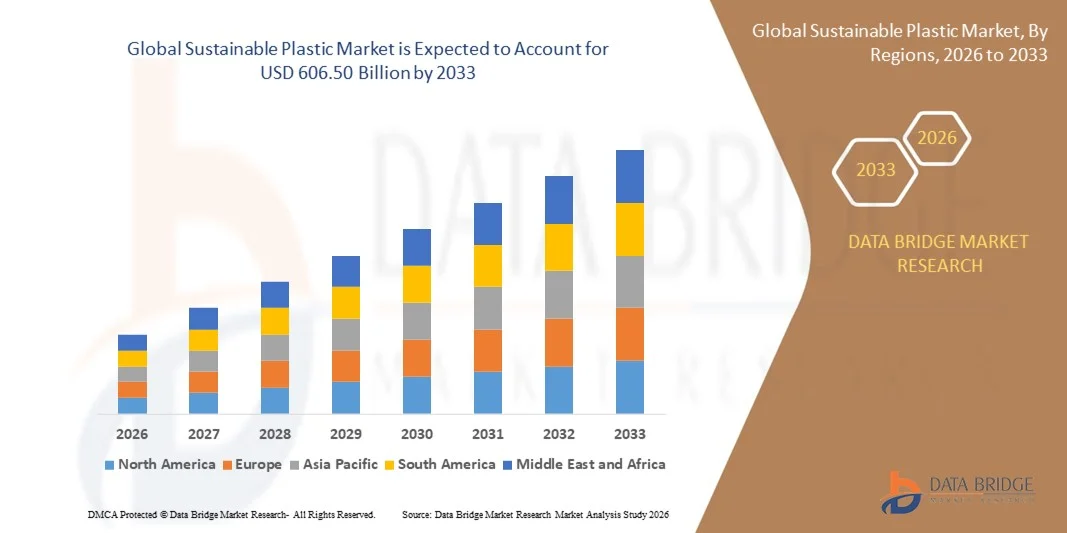
As per Data Bridge Market Research Analysis the global sustainable plastic market size was valued at USD 380.52 billion in 2025 and is expected to reach USD 606.50 billion by 2033, at a CAGR of 6.00% during the forecast period
- The market growth is largely fueled by the rising adoption of sustainable and eco-friendly packaging solutions across food, beverage, personal care, and industrial sectors, driven by growing environmental awareness and regulatory mandates on plastic reduction
- Furthermore, increasing consumer preference for biodegradable, recyclable, and reusable materials is establishing sustainable plastics as the preferred choice for packaging and industrial applications. These converging factors are accelerating the uptake of sustainable plastic solutions, thereby significantly boosting the industry's growth
Market Size & Forecast
Global Market Value (2025): USD 380.52 Billion
Expected Market Value (2033): USD 606.50 Billion
Forecast CAGR (2026–2033): 6.00%
Sustainable Plastic Market Analysis
- Sustainable plastics, including bio-based, recycled, and degradable materials, are becoming essential components in modern packaging and industrial applications due to their reduced environmental impact, functional performance, and compliance with circular economy initiatives
- The escalating demand for sustainable plastics is primarily fueled by stricter regulations on single-use plastics, growing corporate sustainability initiatives, and increasing consumer awareness of environmental impact, driving industries to adopt eco-friendly alternatives across product lines
- Asia-Pacific dominated the sustainable plastic market with a share of 44.17% in 2025, due to increasing demand for eco-friendly packaging solutions, expanding food and beverage manufacturing, and a strong presence of plastic production hubs
- North America is expected to be the fastest growing region in the sustainable plastic market during the forecast period due to rising demand for sustainable packaging in food, beverage, and personal care industries
- Recycled content segment dominated the market with a market share of 46.8% in 2025, due to initiatives to utilize post-consumer and post-industrial plastics to reduce environmental impact. Companies leveraging recycled content are able to meet regulatory sustainability targets while maintaining cost efficiency and high material performance. The widespread availability of recycled raw materials and established recycling infrastructure support the segment’s dominance across food, beverage, and packaging industries. In addition, recycled content plastics are increasingly incorporated into high-volume applications such as bottles, containers, and films, reinforcing their market leadership. For many manufacturers, the appeal lies in the balance between sustainability and functional performance
How is the Sustainable Plastic Market Segmented?
|
Attributes |
Sustainable Plastic Key Market Insights |
|
Segments Covered |
|
|
Countries Covered |
North America
Europe
Asia-Pacific
Middle East and Africa
South America
|
|
Key Market Players |
|
|
Market Opportunities |
|
|
Value Added Data Infosets |
In addition to the insights on market scenarios such as market value, growth rate, segmentation, geographical coverage, and major players, the market reports curated by the Data Bridge Market Research also include import export analysis, production capacity overview, production consumption analysis, price trend analysis, climate change scenario, supply chain analysis, value chain analysis, raw material/consumables overview, vendor selection criteria, PESTLE Analysis, Porter Analysis, and regulatory framework. |
Sustainable Plastic Market Trends
Growing Adoption of Bio-Based and Recyclable Plastics
- The global sustainable plastic market is experiencing a significant trend towards bio-based and recyclable materials, driven by increasing environmental awareness among consumers and stricter government regulations across industries such as food, beverage, personal care, and pharmaceuticals
- For instance, in 2025, Amcor plc launched a range of fully recyclable PET bottles and bio-based packaging solutions for leading beverage brands, enabling companies to reduce their carbon footprint while maintaining packaging durability and performance
- The adoption of sustainable plastics is further propelled by innovations in material science that enhance barrier properties, mechanical strength, and aesthetic appeal, making these solutions suitable for high-value and premium applications
- Increasing pressure from governments and international organizations to phase out single-use plastics is pushing manufacturers to integrate recycled and biodegradable plastics into their production lines to meet regulatory and sustainability goals
- Companies such as Mondi, Tetra Laval, and WestRock are actively investing in R&D to develop advanced recyclable films and compostable packaging materials, reflecting rising market demand for environmentally responsible packaging solutions
- These converging trends are driving a shift in industry standards, creating a sustainable packaging ecosystem where recyclable and bio-based plastics are increasingly replacing conventional plastics and redefining the competitive landscape
Sustainable Plastic Market Dynamics
Driver
Rising Demand for Eco-Friendly Packaging Solutions
- The growing environmental consciousness among consumers, coupled with a preference for sustainable alternatives, is significantly driving the adoption of sustainable plastics across multiple industries including food, beverage, personal care, and industrial sectors
- For instance, in 2025, WestRock Company partnered with several leading global food brands to supply recyclable paper-based and bio-based packaging, directly supporting their corporate sustainability targets and driving market expansion
- Regulatory mandates and policies promoting reduction of single-use plastics and encouraging circular economy practices are compelling manufacturers to adopt eco-friendly materials in their supply chains
- Increasing investments in research and development are enabling companies to introduce innovative sustainable plastics with improved durability, flexibility, and barrier properties to meet both functional and environmental requirements
- The rapid growth of e-commerce and logistics packaging is further propelling demand for sustainable plastics, as businesses seek to reduce environmental impact while ensuring product safety and quality
Restraint/Challenge
High Production Costs
- The relatively higher production costs associated with bio-based, recycled, and degradable plastics compared to conventional plastics remain a significant challenge for widespread adoption, particularly in price-sensitive markets
- For instance, manufacturers integrating advanced biodegradable polymers such as PLA and PHA into high-volume packaging have reported increased production expenses, which can limit large-scale adoption and reduce competitiveness
- Limited availability of raw materials and supply chain constraints for advanced sustainable polymers are also hindering rapid market growth, especially in developing regions
- The technical complexity involved in producing high-performance biodegradable and recyclable plastics can affect scalability and industrial adoption, creating barriers for smaller players entering the market
- Overcoming these cost and supply challenges while ensuring material performance will be critical for achieving sustained growth in the global sustainable plastics market and supporting the transition toward more environmentally responsible packaging solutions
Sustainable Plastic Market Scope
The market is segmented on the basis of function, process, layer, packaging, and end-user.
- By Function
On the basis of function, the sustainable plastic market is segmented into active, moulded pulp, and alternate fibre. The moulded pulp segment dominated the market with the largest revenue share in 2025, driven by its widespread use in packaging applications due to its biodegradability and ability to replace conventional plastics in protective packaging. Moulded pulp is favored for its cost-effectiveness, lightweight nature, and capability to be formed into diverse shapes for trays, cartons, and cushioning applications. Industries such as food and electronics increasingly rely on moulded pulp packaging to meet sustainability goals and reduce carbon footprint. The compatibility of moulded pulp with automated packaging lines and ease of recycling further strengthen its market position. Its growing adoption is also supported by regulatory mandates encouraging reduced plastic usage.
The alternate fibre segment is expected to witness the fastest CAGR from 2026 to 2033, fueled by rising demand for innovative, renewable materials in high-value packaging applications. For instance, companies such as TIPA Corp are introducing compostable fibre-based films that replace single-use plastics in flexible packaging. Alternate fibres offer superior mechanical strength, customizable barrier properties, and aesthetic flexibility, making them increasingly attractive for premium food and personal care packaging. Consumer preference for eco-conscious packaging also drives adoption in retail and e-commerce sectors. The versatility of alternate fibre solutions allows manufacturers to integrate them across multiple product formats, enhancing their growth potential.
- By Process
On the basis of process, the market is segmented into recycled content, reusable, and degradable. The recycled content segment dominated the market with the largest revenue share of 46.8% in 2025, driven by initiatives to utilize post-consumer and post-industrial plastics to reduce environmental impact. Companies leveraging recycled content are able to meet regulatory sustainability targets while maintaining cost efficiency and high material performance. The widespread availability of recycled raw materials and established recycling infrastructure support the segment’s dominance across food, beverage, and packaging industries. In addition, recycled content plastics are increasingly incorporated into high-volume applications such as bottles, containers, and films, reinforcing their market leadership. For many manufacturers, the appeal lies in the balance between sustainability and functional performance.
The degradable segment is anticipated to witness the fastest growth rate from 2026 to 2033 due to rising consumer awareness of plastic pollution and growing demand for compostable and biodegradable packaging. For instance, BASF has developed biodegradable polymer solutions that decompose naturally under industrial composting conditions. Degradable plastics are increasingly adopted in single-use packaging, agricultural films, and disposable items. Their ability to reduce landfill burden and meet circular economy objectives positions them for rapid market growth. Supportive government policies and incentives for eco-friendly packaging further enhance adoption prospects.
- By Layer
On the basis of layer, the sustainable plastic market is segmented into primary, secondary, and tertiary layers. The primary layer dominated the market with the largest revenue share in 2025, driven by its direct contact with products and critical role in protecting goods from contamination, moisture, and mechanical damage. Primary packaging made from sustainable plastics is widely used in food, beverage, and pharmaceutical industries, where safety and compliance with regulatory standards are essential. Innovations in barrier properties and material strength make sustainable plastics a viable alternative to conventional plastics. The rising adoption of visually appealing and functional packaging also supports the primary layer segment. Manufacturers are increasingly integrating sustainable solutions in primary packaging to enhance brand image and consumer trust.
The tertiary layer segment is expected to witness the fastest CAGR from 2026 to 2033, fueled by the growing need for bulk handling, storage, and transportation of goods in an environmentally responsible manner. For instance, Sealed Air and other packaging solution providers are offering sustainable pallets, drums, and IBCs made from recycled or degradable plastics. Tertiary packaging reduces waste and carbon footprint in logistics chains, appealing to large-scale distributors and manufacturers. Its role in improving supply chain efficiency while meeting sustainability goals contributes to its rapid growth potential. Increasing adoption in industrial, chemical, and e-commerce sectors further drives market expansion.
- By Packaging
On the basis of packaging type, the market is segmented into trays, bags, boxes, bottles and jars, films, pouches and sachets, drums, IBC, and others. The bottles and jars segment dominated the market with the largest revenue share in 2025, driven by the widespread use in beverages, personal care, and chemical industries. Bottles and jars made from sustainable plastics provide durability, barrier protection, and recyclability while allowing for innovative shapes and designs that appeal to consumers. Companies are increasingly replacing conventional PET and HDPE bottles with bio-based or recycled alternatives to meet regulatory and consumer sustainability demands. Their compatibility with automated filling and labeling systems also contributes to their market leadership. Bottles and jars are integral to brand differentiation and functional packaging requirements, reinforcing their dominance.
The pouches and sachets segment is expected to witness the fastest CAGR from 2026 to 2033 due to increasing adoption in flexible, lightweight, and single-use packaging applications. For instance, Mondi and other flexible packaging companies are developing compostable and recyclable pouches for food and personal care products. Pouches offer cost-effective transportation, space efficiency, and lower material usage, aligning with sustainability objectives. Rising e-commerce penetration and consumer demand for on-the-go convenience drive the growth of sustainable pouches and sachets. Innovations in multilayer sustainable films also enhance barrier properties, enabling wider application across sensitive products. Their versatility and reduced environmental impact position them for rapid market expansion.
- By End-User
On the basis of end-user, the sustainable plastic market is segmented into food, beverage, automobile & electronics, chemical, pharmaceutical, agriculture, and personal care. The food segment dominated the market with the largest revenue share in 2025, driven by stringent regulations, increasing consumer preference for eco-friendly packaging, and the need to maintain product freshness and safety. Sustainable plastics in food packaging reduce environmental impact while providing functional benefits such as barrier protection, durability, and lightweight handling. For instance, companies such as Amcor and Tetra Pak are increasingly supplying biodegradable and recycled packaging solutions to the food industry. The integration of sustainable packaging into the food supply chain enhances brand credibility and aligns with growing corporate sustainability initiatives. High-volume usage in processed and ready-to-eat foods further supports dominance.
The personal care segment is expected to witness the fastest CAGR from 2026 to 2033 due to increasing demand for premium and eco-conscious cosmetic and skincare packaging solutions. For instance, L'Oréal and Unilever are incorporating recycled and bio-based plastics into bottles, jars, and tubes to reduce their environmental footprint. Sustainable plastics provide aesthetic flexibility, safety, and functional performance required in personal care packaging. Consumer awareness of environmental impact and brand responsibility fuels adoption in this segment. Growth is further driven by innovations in refillable and reusable packaging formats, enhancing the segment’s appeal and market potential.
Sustainable Plastic Market Regional Analysis
- Asia-Pacific dominated the sustainable plastic market with the largest revenue share of 44.17% in 2025, driven by increasing demand for eco-friendly packaging solutions, expanding food and beverage manufacturing, and a strong presence of plastic production hubs
- The region’s cost-effective manufacturing landscape, rising investments in bio-based and recycled plastics, and growing exports of sustainable packaging solutions are accelerating market expansion
- The availability of skilled labor, favorable government policies promoting circular economy initiatives, and rapid industrialization across developing economies are contributing to increased consumption of sustainable plastics in both packaging and industrial applications
China Sustainable Plastic Market Insight
China held the largest share in the Asia-Pacific sustainable plastic market in 2025, owing to its position as a global leader in plastic manufacturing and advanced packaging solutions. The country’s strong industrial base, government incentives for sustainable materials, and extensive export capabilities for recycled and bio-based plastics are major growth drivers. Demand is further bolstered by increasing adoption of eco-friendly packaging in food, beverage, and personal care sectors, as well as ongoing investments in innovation for high-performance sustainable polymers.
India Sustainable Plastic Market Insight
India is witnessing the fastest growth in the Asia-Pacific region, fueled by rising food and beverage production, increasing adoption of biodegradable and recycled plastics, and government initiatives supporting sustainable manufacturing. For instance, the Swachh Bharat and Plastic Waste Management policies are driving adoption of sustainable plastics in packaging and industrial applications. In addition, expanding R&D capabilities, growing consumer awareness, and investments in renewable feedstock for bio-based plastics are contributing to robust market expansion.
Europe Sustainable Plastic Market Insight
The Europe sustainable plastic market is expanding steadily, supported by stringent regulations on plastic usage, growing consumer preference for eco-friendly packaging, and rising investments in recycled and bio-based materials. The region emphasizes sustainability, environmental compliance, and high-quality production standards, particularly in food, pharmaceutical, and personal care sectors. Increasing use of circular economy initiatives and innovative packaging solutions is further enhancing market growth.
Germany Sustainable Plastic Market Insight
Germany’s sustainable plastic market is driven by its leadership in advanced manufacturing, strong regulatory framework for sustainable materials, and a well-established recycling infrastructure. The country’s focus on R&D, industrial partnerships, and sustainable packaging solutions fosters continuous innovation. Demand is particularly strong for bio-based and recyclable plastics in food, chemical, and personal care industries.
U.K. Sustainable Plastic Market Insight
The U.K. market is supported by a mature consumer base demanding sustainable packaging, growing initiatives to localize circular economy solutions, and rising investments in recycled and degradable plastics. With increased focus on eco-friendly materials, R&D in high-performance sustainable polymers, and adoption of advanced manufacturing practices, the U.K. continues to play a significant role in Europe’s sustainable plastics market.
North America Sustainable Plastic Market Insight
North America is projected to grow at the fastest CAGR from 2026 to 2033, driven by rising demand for sustainable packaging in food, beverage, and personal care industries. For instance, regulatory policies encouraging recycled content usage, corporate sustainability initiatives, and growing e-commerce packaging needs are boosting market growth. In addition, increasing collaborations between material producers and end-users, along with innovation in biodegradable and compostable plastics, are supporting market expansion.
U.S. Sustainable Plastic Market Insight
The U.S. accounted for the largest share in the North America market in 2025, underpinned by its strong industrial base, expansive food and beverage industry, and investments in advanced recycling and bio-based plastics. The country’s focus on sustainability, innovation in packaging materials, and regulatory incentives for eco-friendly plastics encourage adoption. Presence of key players and a mature distribution network further solidify the U.S.'s leading position in the region.
Which are the Top Companies in Sustainable Plastic Market?
The sustainable plastic industry is primarily led by well-established companies, including:
- Amcor plc (Australia)
- Bemis Company Inc. (U.S.)
- Tetra Laval International SA (Switzerland)
- Mondi (U.K.)
- WestRock Company (U.S.)
- BASF SE (Germany)
- Sonoco Products Company (U.S.)
- Smurfit Kappa (Ireland)
- Sealed Air (U.S.)
- Huhtamaki (Finland)
- Gerresheimer AG (Germany)
- BALL CORPORATION (U.S.)
- Ardagh Group S.A. (Luxembourg)
- Crown Holdings (U.S.)
- DS Smith (U.K.)
- International Paper (U.S.)
- Berry Global Inc. (U.S.)
- Reynolds (U.S.)
- Genpack LLC (U.S.)
- DuPont (U.S.)
- Uflex Ltd. (India)
- Evergreen Packaging LLC (U.S.)
Latest Developments in Global Sustainable Plastic Market
- In October 2025, Braskem, a leading global provider of bio-based polymers, unveiled a new portfolio of sustainable plastic innovations at K 2025, including machine-direction-oriented (MDO) films derived from sugarcane-based PE and LDPE for healthcare applications under its Medcol brand. This launch highlights Braskem’s commitment to expanding the commercial adoption of renewable plastics and supporting circular economy initiatives. By offering versatile solutions for packaging, medical, and consumer applications, the company is reinforcing its position as a key driver of sustainability in the global plastics market
- In September 2025, Xampla, a U.K.-based green-tech firm, raised US$14 million to scale production of its plant-protein-based Morro™ materials, designed as a biodegradable alternative to single-use plastics. This funding emphasizes Xampla’s commitment to replacing conventional plastics with innovative, eco-friendly solutions. By enabling brands to adopt compostable packaging in food, personal care, and industrial applications, Xampla is positioning itself as a significant disruptor in the global sustainable plastics market
- In September 2025, Xampla entered a partnership with the National Physical Laboratory (NPL) to validate and verify its Morro materials through high-precision testing, confirming compliance with environmental and regulatory standards. This collaboration highlights the company’s dedication to providing verified, high-performance sustainable alternatives. By enhancing trust and adoption among multinational brands and regulators, Xampla is accelerating market penetration and reinforcing its leadership in biodegradable plastics
- In July 2025, Veolia announced the construction of its first “tray-to-tray” closed-loop PET recycling facility in the U.K., backed by a £70 million investment, designed to convert used PET trays into food-grade recycled PET. This initiative underscores Veolia’s focus on advancing circular economy practices and reducing reliance on virgin plastics. By enhancing the availability of sustainable packaging materials for the grocery and consumer goods sectors, Veolia is strengthening its influence in the rapidly growing sustainable plastics market
- In July 2025, ICAR-CCRI and Visvesvaraya National Institute of Technology (VNIT) signed an MoU to develop biodegradable packaging using orange peel waste, integrating citrus-derived bioactive compounds into chitosan-alginate biopolymers. This initiative demonstrates a commitment to upcycling agricultural residues into functional, sustainable packaging. By contributing to the circular bioeconomy and reducing plastic pollution, the collaboration is supporting the expansion of environmentally friendly packaging solutions in the sustainable plastics market

- Interactive Data Analysis Dashboard
- Company Analysis Dashboard for high growth potential opportunities
- Research Analyst Access for customization & queries
- Competitor Analysis with Interactive dashboard
- Latest News, Updates & Trend analysis
- Harness the Power of Benchmark Analysis for Comprehensive Competitor Tracking
Global Sustainable Plastic Market, Supply Chain Analysis and Ecosystem Framework
To support market growth and help clients navigate the impact of geopolitical shifts, DBMR has integrated in-depth supply chain analysis into its Global Sustainable Plastic Market research reports. This addition empowers clients to respond effectively to global changes affecting their industries. The supply chain analysis section includes detailed insights such as Global Sustainable Plastic Market consumption and production by country, price trend analysis, the impact of tariffs and geopolitical developments, and import and export trends by country and HSN code. It also highlights major suppliers with data on production capacity and company profiles, as well as key importers and exporters. In addition to research, DBMR offers specialized supply chain consulting services backed by over a decade of experience, providing solutions like supplier discovery, supplier risk assessment, price trend analysis, impact evaluation of inflation and trade route changes, and comprehensive market trend analysis.
Data collection and base year analysis are done using data collection modules with large sample sizes. The stage includes obtaining market information or related data through various sources and strategies. It includes examining and planning all the data acquired from the past in advance. It likewise envelops the examination of information inconsistencies seen across different information sources. The market data is analysed and estimated using market statistical and coherent models. Also, market share analysis and key trend analysis are the major success factors in the market report. To know more, please request an analyst call or drop down your inquiry.
The key research methodology used by DBMR research team is data triangulation which involves data mining, analysis of the impact of data variables on the market and primary (industry expert) validation. Data models include Vendor Positioning Grid, Market Time Line Analysis, Market Overview and Guide, Company Positioning Grid, Patent Analysis, Pricing Analysis, Company Market Share Analysis, Standards of Measurement, Global versus Regional and Vendor Share Analysis. To know more about the research methodology, drop in an inquiry to speak to our industry experts.
Data Bridge Market Research is a leader in advanced formative research. We take pride in servicing our existing and new customers with data and analysis that match and suits their goal. The report can be customized to include price trend analysis of target brands understanding the market for additional countries (ask for the list of countries), clinical trial results data, literature review, refurbished market and product base analysis. Market analysis of target competitors can be analyzed from technology-based analysis to market portfolio strategies. We can add as many competitors that you require data about in the format and data style you are looking for. Our team of analysts can also provide you data in crude raw excel files pivot tables (Fact book) or can assist you in creating presentations from the data sets available in the report.













