


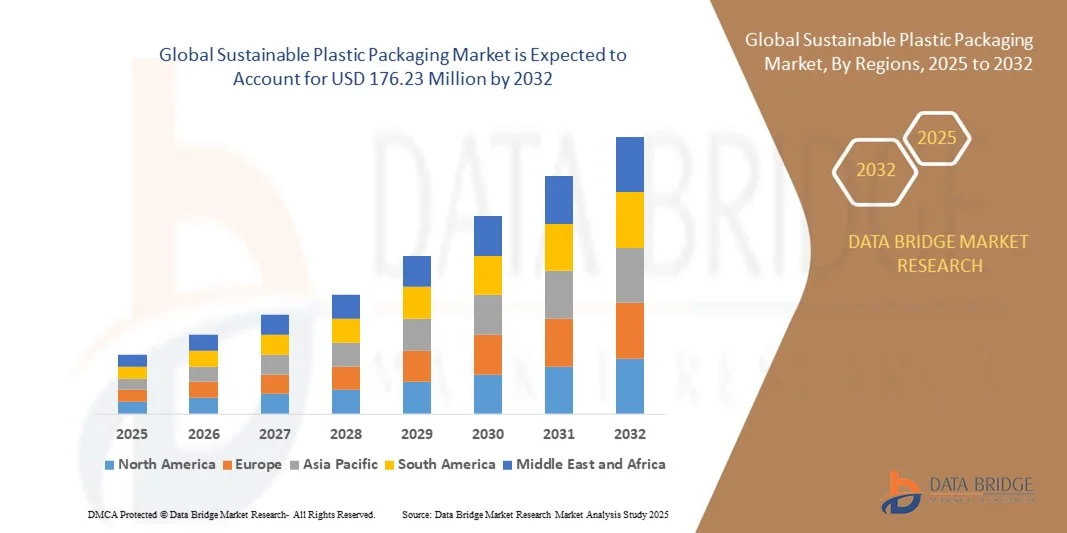
Sustainable Plastic Packaging Market Size
- The global sustainable plastic packaging market size was valued at USD 94.37 million in 2024 and is expected to reach USD 176.23 million by 2032, at a CAGR of 8.12% during the forecast period
- The market growth is largely fueled by increasing environmental awareness among consumers and stringent regulatory frameworks aimed at reducing plastic waste, driving the adoption of recyclable, biodegradable, and reusable packaging solutions across various industries
- Furthermore, rising demand from the food, beverage, and personal care sectors for sustainable and eco-friendly packaging materials is encouraging manufacturers to innovate and invest in advanced sustainable plastics. These converging factors are accelerating the adoption of sustainable packaging solutions, thereby significantly boosting the industry's growth
Sustainable Plastic Packaging Market Analysis
- Sustainable plastic packaging, including recycled-content, degradable, and mono-material solutions, is becoming increasingly vital in modern packaging due to its ability to reduce environmental impact, enhance recyclability, and meet consumer and regulatory expectations for eco-friendly products
- The escalating demand for sustainable plastic packaging is primarily fueled by growing consumer preference for environmentally responsible products, corporate sustainability initiatives, and government mandates on single-use plastics and packaging waste reduction
- Asia-Pacific dominated the sustainable plastic packaging market with a share of 44.17% in 2024, due to rapid industrialization, growing food and beverage production, and increasing adoption of eco-friendly packaging solutions across key economies
- North America is expected to be the fastest growing region in the sustainable plastic packaging market during the forecast period due to increasing demand for recycled and reusable packaging in food, beverage, and personal care sectors
- Recycled content segment dominated the market with a market share of 52.9% in 2024, due to strict government mandates and corporate sustainability commitments emphasizing circular economy principles. The use of post-consumer recycled (PCR) plastics reduces dependence on virgin materials and carbon footprint, promoting resource efficiency. Large packaging manufacturers are incorporating advanced mechanical and chemical recycling systems to enhance material quality and consistency in recycled-content packaging
Report Scope and Sustainable Plastic Packaging Market Segmentation
|
Attributes |
Sustainable Plastic Packaging Key Market Insights |
|
Segments Covered |
|
|
Countries Covered |
North America
Europe
Asia-Pacific
Middle East and Africa
South America
|
|
Key Market Players |
|
|
Market Opportunities |
|
|
Value Added Data Infosets |
In addition to the insights on market scenarios such as market value, growth rate, segmentation, geographical coverage, and major players, the market reports curated by the Data Bridge Market Research also include import export analysis, production capacity overview, production consumption analysis, price trend analysis, climate change scenario, supply chain analysis, value chain analysis, raw material/consumables overview, vendor selection criteria, PESTLE Analysis, Porter Analysis, and regulatory framework. |
Sustainable Plastic Packaging Market Trends
Increased Adoption of Mono-Material and Compostable Packaging
- The sustainable plastic packaging market is experiencing a significant shift toward mono-material and compostable solutions aimed at improving recyclability and reducing environmental impact. Packaging manufacturers are increasingly focusing on simplified material compositions to facilitate closed-loop recycling and to comply with stringent global sustainability mandates from regulators and brand owners
- For instance, Berry Global and Mondi Group have developed advanced mono-material polyethylene and polypropylene packaging structures designed for full recyclability without sacrificing strength or barrier properties. These solutions are being adopted across food, personal care, and pharmaceutical industries, helping brands achieve sustainability goals and minimize landfill waste
- Mono-material packaging offers improved compatibility with existing recycling systems while maintaining product protection and shelf stability. The recyclability of these formats helps companies lower extended producer responsibility fees and positions them favorably under upcoming plastic waste legislations
- In addition, compostable plastics derived from renewable resources such as polylactic acid (PLA) and polyhydroxyalkanoates (PHA) are gaining traction across single-use and flexible packaging segments. These materials degrade under controlled conditions, offering an alternative to conventional plastics while meeting consumer expectations for eco-friendly packaging options
- Technological advancements are enabling high-performance compostable films that provide moisture and oxygen barriers essential for sensitive products. Such innovations are expanding the applicable range of compostable packaging across mainstream sectors that previously relied on traditional multi-layer plastics
- This growing inclination toward mono-material and compostable solutions marks a transformational step toward achieving global circular economy targets. As brands and governments prioritize environmental accountability, sustainable plastic packaging is expected to become the foundation of future packaging design strategies across industries
Sustainable Plastic Packaging Market Dynamics
Driver
Rising Consumer Demand and Regulatory Pressure for Eco-Friendly Solutions
- Increasing consumer awareness regarding plastic pollution and growing regulatory actions against non-recyclable materials are key factors propelling the market for sustainable plastic packaging. Consumers are actively shifting their preferences toward products packaged in recyclable or biodegradable materials, compelling manufacturers to redesign packaging systems that minimize ecological impact
- For instance, in 2024, Amcor plc and Sealed Air Corporation announced expanded production capacities for sustainable polymer-based packaging that complies with circular economy frameworks in the European Union and North America. Such initiatives by major industry players highlight how consumer expectations and government policies are simultaneously pushing sustainability-focused innovation
- Global legislation such as the EU Packaging and Packaging Waste Regulation (PPWR) and extended producer responsibility (EPR) schemes are reinforcing the need for recyclable and renewable packaging solutions. Compliance with these frameworks encourages companies to invest in environmentally sound packaging formats to meet mandated recycling and content targets
- In addition, brand reputation and corporate ESG goals are motivating companies to adopt packaging made from post-consumer recycled or bio-based plastics. This strategic shift meets regulatory expectations and also enhances consumer trust and loyalty for eco-responsible brands
- The rising urgency to eliminate waste and support a circular materials economy has made eco-friendly solutions a central priority across packaging supply chains. This momentum is expected to sustain long-term market growth as global actions toward sustainability and carbon reduction continue to intensify
Restraint/Challenge
High Costs and Limited Availability of Sustainable Polymers
- The widespread adoption of sustainable plastic packaging is hindered by high material and production costs associated with bio-based and recycled polymers. Manufacturing sustainable alternatives requires advanced processing technology, specialized feedstocks, and quality control measures that elevate overall costs compared with conventional plastics
- For instance, BASF SE and NatureWorks LLC have both highlighted the supply limitations and higher expenses involved in producing biopolymers such as PLA and PHA, restricting their use in large-scale packaging operations. This supply-demand imbalance has slowed the adoption by cost-sensitive manufacturers, especially in emerging markets
- Limited recycling infrastructure and inconsistent waste collection systems further add complexity by reducing the efficiency of post-consumer recycled plastic production. This creates material shortages that impact both cost stability and product availability across supply chains
- In addition, many sustainable polymers face technical constraints such as limited heat resistance and reduced mechanical strength, which limit their application scope in high-performance packaging. Overcoming these limitations requires continued R&D investment, further adding to overall production expenditures
- Reducing these cost and supply challenges through technological innovation, expanded feedstock sourcing, and stronger public-private collaboration will be vital to accelerate the commercialization of affordable and scalable sustainable plastics, ensuring a broader transition toward environmentally responsible packaging practices
Sustainable Plastic Packaging Market Scope
The market is segmented on the basis of function, process, layer, packaging, and end-user.
- By Function
On the basis of function, the sustainable plastic packaging market is segmented into active, moulded pulp, and alternate fibre. The moulded pulp segment dominated the market with the largest revenue share in 2024, driven by its biodegradability, cost efficiency, and wide application in food service and electronics packaging. Moulded pulp packaging provides superior cushioning and protection while being lightweight and recyclable, aligning with global sustainability goals. Its production from recycled paper and agricultural waste materials further enhances its appeal among eco-conscious brands aiming to minimize environmental impact.
The alternate fibre segment is projected to witness the fastest growth rate from 2025 to 2032, fueled by technological advancements in plant-based and cellulose-based packaging materials. These materials offer similar functionality to conventional plastics while being compostable and renewable, attracting strong demand from food and beverage brands transitioning toward plastic-free alternatives. Growing research investments in fiber-reinforced composites and scalable manufacturing processes are also accelerating adoption across multiple end-use industries.
- By Process
On the basis of process, the sustainable plastic packaging market is segmented into recycled content, reusable, and degradable. The recycled content segment dominated the market with the largest share of 52.9% in 2024, supported by strict government mandates and corporate sustainability commitments emphasizing circular economy principles. The use of post-consumer recycled (PCR) plastics reduces dependence on virgin materials and carbon footprint, promoting resource efficiency. Large packaging manufacturers are incorporating advanced mechanical and chemical recycling systems to enhance material quality and consistency in recycled-content packaging.
The degradable segment is expected to grow at the fastest CAGR from 2025 to 2032, driven by innovations in biodegradable polymers such as PLA, PHA, and starch blends. These materials decompose under natural conditions, offering an eco-friendly alternative to traditional plastics in single-use packaging applications. Increasing consumer awareness about plastic pollution and regulatory bans on non-degradable packaging are further boosting adoption of degradable materials in both food and non-food packaging industries.
- By Layer
On the basis of layer, the sustainable plastic packaging market is segmented into primary, secondary, and tertiary. The primary layer segment dominated the market in 2024, as it directly encloses the product and demands high performance in barrier protection and sustainability. Manufacturers are focusing on developing recyclable mono-material structures and lightweight designs to reduce waste generation. The growing use of bio-based films and compostable laminates for direct product contact packaging is a key factor supporting its dominance.
The secondary layer segment is anticipated to register the fastest growth rate during the forecast period due to its rising adoption in logistics and distribution applications. This layer provides additional strength and product grouping benefits while enabling recyclability through paper-plastic hybrid solutions. Increasing focus on optimizing packaging efficiency and reducing transportation emissions is promoting the use of sustainable secondary packaging materials.
- By Packaging
On the basis of packaging, the sustainable plastic packaging market is segmented into trays, bags, boxes, bottles & jars, films, pouches & sachets, drums, IBC, and others. The bottles & jars segment held the largest revenue share in 2024, driven by their extensive use in the food, beverage, and personal care sectors. Growing adoption of recycled PET and bio-based resins has made bottles and jars a sustainable yet durable packaging choice. Companies are also integrating lightweight designs and refill models to reduce plastic usage and improve recyclability rates.
The pouches & sachets segment is projected to grow at the fastest pace from 2025 to 2032, owing to their convenience, portability, and material efficiency. The shift toward compostable and recyclable multilayer films has enhanced their environmental performance while retaining shelf-life protection. Rising demand for flexible packaging solutions in on-the-go food, pharmaceutical, and personal care products continues to drive this segment’s expansion.
- By End-User
On the basis of end-user, the sustainable plastic packaging market is segmented into food, beverage, automobile & electronics, chemical, pharmaceutical, agriculture, and personal care. The food segment dominated the market with the highest revenue share in 2024, driven by increasing demand for sustainable packaging that extends shelf life while maintaining safety and freshness. Food manufacturers are prioritizing recyclable, biodegradable, and lightweight packaging formats to meet consumer and regulatory expectations for environmental responsibility.
The personal care segment is expected to witness the fastest growth rate from 2025 to 2032, supported by the rapid shift of beauty and cosmetic brands toward eco-friendly and refillable packaging solutions. Growing awareness among consumers regarding the environmental impact of single-use plastic containers has prompted leading companies to adopt bio-based plastics and post-consumer recycled materials. The emphasis on brand sustainability and circular economy models continues to propel this segment forward.
Sustainable Plastic Packaging Market Regional Analysis
- Asia-Pacific dominated the sustainable plastic packaging market with the largest revenue share of 44.17% in 2024, driven by rapid industrialization, growing food and beverage production, and increasing adoption of eco-friendly packaging solutions across key economies
- The region’s cost-effective manufacturing, rising investments in recycling infrastructure, and expanding consumer awareness regarding sustainable products are accelerating market growth
- The availability of skilled labor, supportive government policies, and large-scale initiatives to reduce plastic waste are contributing to increased adoption of sustainable plastic packaging in both food and non-food sectors
China Sustainable Plastic Packaging Market Insight
China held the largest share in the Asia-Pacific market in 2024, owing to its strong manufacturing base and leadership in food, beverage, and personal care industries. Government initiatives promoting circular economy practices, along with widespread adoption of recycled and biodegradable packaging, are major growth drivers. Rising exports of packaged goods and investments in sustainable packaging technologies further support market expansion.
India Sustainable Plastic Packaging Market Insight
India is witnessing the fastest growth in the Asia-Pacific region, fueled by increasing demand from the food and personal care sectors, expansion of retail and e-commerce, and rising consumer awareness regarding environmental sustainability. Government policies such as plastic bans and incentives for biodegradable packaging manufacturing are strengthening the market. In addition, growing investments in compostable and recyclable packaging solutions are boosting adoption.
Europe Sustainable Plastic Packaging Market Insight
The Europe market is expanding steadily, supported by stringent environmental regulations, growing demand for recyclable and bio-based packaging, and rising consumer preference for eco-friendly products. The region emphasizes high-quality and sustainable packaging materials, particularly in food, beverage, and pharmaceutical industries. Investments in research and development for advanced sustainable polymers are further enhancing market growth.
Germany Sustainable Plastic Packaging Market Insight
Germany’s market is driven by strong regulatory compliance, advanced manufacturing capabilities, and high adoption of sustainable packaging in food and personal care sectors. Well-established R&D networks and partnerships between industry and academic institutions foster innovation in recyclable and biodegradable plastics. Demand is particularly strong for high-performance and premium sustainable packaging solutions.
U.K. Sustainable Plastic Packaging Market Insight
The U.K. market is supported by increasing government initiatives to reduce single-use plastics, growing investments in sustainable packaging manufacturing, and rising consumer preference for eco-friendly products. Collaborative efforts between industry and research institutions are driving innovation in compostable and recyclable packaging. Strong focus on sustainability across food, beverage, and personal care sectors continues to drive adoption.
North America Sustainable Plastic Packaging Market Insight
North America is projected to grow at the fastest CAGR from 2025 to 2032, driven by increasing demand for recycled and reusable packaging in food, beverage, and personal care sectors. Growing focus on circular economy initiatives, corporate sustainability commitments, and advanced recycling technologies are boosting adoption. In addition, rising regulatory pressures and consumer awareness regarding environmental impact are supporting market expansion.
U.S. Sustainable Plastic Packaging Market Insight
The U.S. accounted for the largest share in the North America market in 2024, underpinned by strong food and beverage manufacturing, personal care industry growth, and significant investment in sustainable packaging solutions. Regulatory frameworks promoting recycling, corporate sustainability strategies, and consumer preference for eco-friendly products are major growth drivers. Presence of key packaging manufacturers and extensive distribution networks further solidify the U.S.'s leading position in the region.
Sustainable Plastic Packaging Market Share
The sustainable plastic packaging industry is primarily led by well-established companies, including:
- Amcor plc (Australia)
- Bemis Company, Inc. (U.S.)
- Tetra Laval International S.A. (Switzerland)
- Mondi (Austria)
- WestRock Company (U.S.)
- BASF SE (Germany)
- Sonoco Products Company (U.S.)
- Smurfit Kappa (Ireland)
- Sealed Air (U.S.)
- Huhtamaki (Finland)
- Gerresheimer AG (Germany)
- BALL Corporation (U.S.)
- Ardagh Group S.A. (Luxembourg)
- Crown Holdings (U.S.)
- DS Smith (U.K.)
- International Paper (U.S.)
- Berry Global Inc. (U.S.)
- Reynolds (U.S.)
- Genpak LLC (U.S.)
- DuPont (U.S.)
- Uflex Ltd. (India)
- Evergreen Packaging LLC (U.S.)
Latest Developments in Global Sustainable Plastic Packaging Market
- In December 2024, ALPLA GmbH announced a new recyclable PET wine bottle designed to cut carbon emissions by up to 50% compared to traditional packaging. This innovation demonstrates a growing trend in premium beverage packaging toward sustainability, enabling brands to reduce environmental impact while appealing to eco-conscious consumers. The solution promotes wider adoption of recyclable PET in high-value segments, encouraging material circularity and inspiring competitors to develop similar sustainable packaging solutions
- In January 2024, Coop and Emmi launched a white PET bottle for dairy products that optimizes product protection while enhancing recyclability through the use of mono-material packaging. This development accelerates the shift away from multi-layer and mixed-material designs, simplifying recycling processes and reducing overall plastic waste. By demonstrating that functional and sustainable packaging can coexist, it sets a benchmark for dairy and liquid food manufacturers seeking environmentally responsible packaging alternatives
- In December 2023, Melodea Ltd. launched MelOx NGen, a sustainable barrier coating designed to improve the recyclability of plastic food packaging. Serving as a plant-sourced alternative to petroleum-based Ethyl Vinyl Alcohol copolymers, this FDA-approved coating can be applied to films, pouches, bags, lidding, and blister packs for snacks, confectionery, nutrition bars, dairy, meats, and pharmaceuticals. Its introduction promotes eco-friendly packaging options in multiple food and pharmaceutical segments, enhancing both recyclability and overall sustainability
- In October 2023, The Coca-Cola Company Philippines introduced bottles made from 100% rPET for its “Coca-Cola Original” and “Wilkins Pure” brands, excluding caps and labels. This development strengthens circular economy practices in the beverage sector, allowing manufacturers to reduce dependence on virgin plastics while maintaining brand quality and performance. It also sets a precedent for beverage producers in adopting rPET solutions, contributing to reduced plastic waste and increased recycling rates
- In September 2023, Sidel launched StarLITE R, a 100% rPET bottle specifically designed for carbonated soft drinks. The product supports material circularity and offers beverage manufacturers a sustainable packaging alternative, reducing plastic waste and promoting eco-conscious production practices. By integrating rPET in high-volume carbonated drink packaging, this solution encourages adoption of recycled plastics at scale and reinforces sustainability efforts across the beverage industry

- Interactive Data Analysis Dashboard
- Company Analysis Dashboard for high growth potential opportunities
- Research Analyst Access for customization & queries
- Competitor Analysis with Interactive dashboard
- Latest News, Updates & Trend analysis
- Harness the Power of Benchmark Analysis for Comprehensive Competitor Tracking
Global Sustainable Plastic Packaging Market, Supply Chain Analysis and Ecosystem Framework
To support market growth and help clients navigate the impact of geopolitical shifts, DBMR has integrated in-depth supply chain analysis into its Global Sustainable Plastic Packaging Market research reports. This addition empowers clients to respond effectively to global changes affecting their industries. The supply chain analysis section includes detailed insights such as Global Sustainable Plastic Packaging Market consumption and production by country, price trend analysis, the impact of tariffs and geopolitical developments, and import and export trends by country and HSN code. It also highlights major suppliers with data on production capacity and company profiles, as well as key importers and exporters. In addition to research, DBMR offers specialized supply chain consulting services backed by over a decade of experience, providing solutions like supplier discovery, supplier risk assessment, price trend analysis, impact evaluation of inflation and trade route changes, and comprehensive market trend analysis.
Data collection and base year analysis are done using data collection modules with large sample sizes. The stage includes obtaining market information or related data through various sources and strategies. It includes examining and planning all the data acquired from the past in advance. It likewise envelops the examination of information inconsistencies seen across different information sources. The market data is analysed and estimated using market statistical and coherent models. Also, market share analysis and key trend analysis are the major success factors in the market report. To know more, please request an analyst call or drop down your inquiry.
The key research methodology used by DBMR research team is data triangulation which involves data mining, analysis of the impact of data variables on the market and primary (industry expert) validation. Data models include Vendor Positioning Grid, Market Time Line Analysis, Market Overview and Guide, Company Positioning Grid, Patent Analysis, Pricing Analysis, Company Market Share Analysis, Standards of Measurement, Global versus Regional and Vendor Share Analysis. To know more about the research methodology, drop in an inquiry to speak to our industry experts.
Data Bridge Market Research is a leader in advanced formative research. We take pride in servicing our existing and new customers with data and analysis that match and suits their goal. The report can be customized to include price trend analysis of target brands understanding the market for additional countries (ask for the list of countries), clinical trial results data, literature review, refurbished market and product base analysis. Market analysis of target competitors can be analyzed from technology-based analysis to market portfolio strategies. We can add as many competitors that you require data about in the format and data style you are looking for. Our team of analysts can also provide you data in crude raw excel files pivot tables (Fact book) or can assist you in creating presentations from the data sets available in the report.













